

A busy PI firm can look successful and still be trapped. The intake team is fielding strong matters, paralegals are buried in medical records, attorneys are chasing signatures and status updates, and the best cases are waiting too long for strategy, negotiation, and settlement pressure. In that setup, the problem is not demand. It is resource allocation optimization, the discipline of putting the right people on the right work at the right time so the firm can move cases faster without starving billable time or burning out staff.
That shift is significant because this discipline is not new theory dressed up in software language. The modern roots go back to linear programming and George Dantzig's simplex method, introduced in 1947, which made it practical to solve complex optimization problems at scale and move resource decisions from intuition to quantitative planning. For PI firms, the point is direct. The firm that treats time, skill, and capacity as a managed portfolio will usually outpace the firm that treats every matter as an emergency.
Why PI Firms Must Rethink Resource Allocation
A PI practice can grow into a bottleneck without ever looking inefficient on paper. New consultations keep coming in, signed matters keep stacking up, and the team absorbs the strain through longer nights, slower follow-up, and more handoffs. The firm still looks busy, but the work that drives case value gets pushed behind tasks that should never sit on an attorney's desk in the first place.
The problem is allocation. Attorneys should spend their time on liability analysis, demand strategy, negotiation, and settlement decisions, while paralegals and support staff handle the repeatable work that moves files forward without requiring senior judgment every time.
Practical rule: if a task does not require legal judgment, client reassurance, or negotiation power, it probably does not belong with your highest-cost people.
That is why resource allocation optimization matters in a PI setting. It is not a corporate management phrase. It is a way to protect billable hours, keep case pacing steady, and avoid the hidden tax of rework that comes from putting scarce attention on the wrong task. The discipline has long shaped how firms turn time, skill, and capacity into a managed operating model, rather than relying on guesswork and constant reaction.
Specific PI Pressure Points
Most firms feel the strain in the same places. Intake gets overloaded, records arrive late, settlement packages stall, and attorneys get pulled into operational cleanup. Every one of those drag points lowers the speed at which a file becomes a stronger demand package or a better negotiation position.
PI firms also face a different capacity problem than a generic service business. Case load is not interchangeable. A simple rear-end matter, a disputed liability case, and a high-damages file with layered treatment records all pull on the firm in different ways. That is why the right comparison is not just headcount, it is whether the firm has the right mix of judgment, workflow support, and review capacity.
Firms that want to modernize should start by looking at how staffing interacts with case complexity, not just volume. If you are rethinking hiring for support roles, articles on legal hiring can help frame the staffing side of the equation without turning the discussion into a generic ops exercise.
That same operational discipline is why better case-management design matters too. A well-run matter pipeline and a better allocation model reinforce each other, especially when paired with cleaner file movement through case management for law firms.
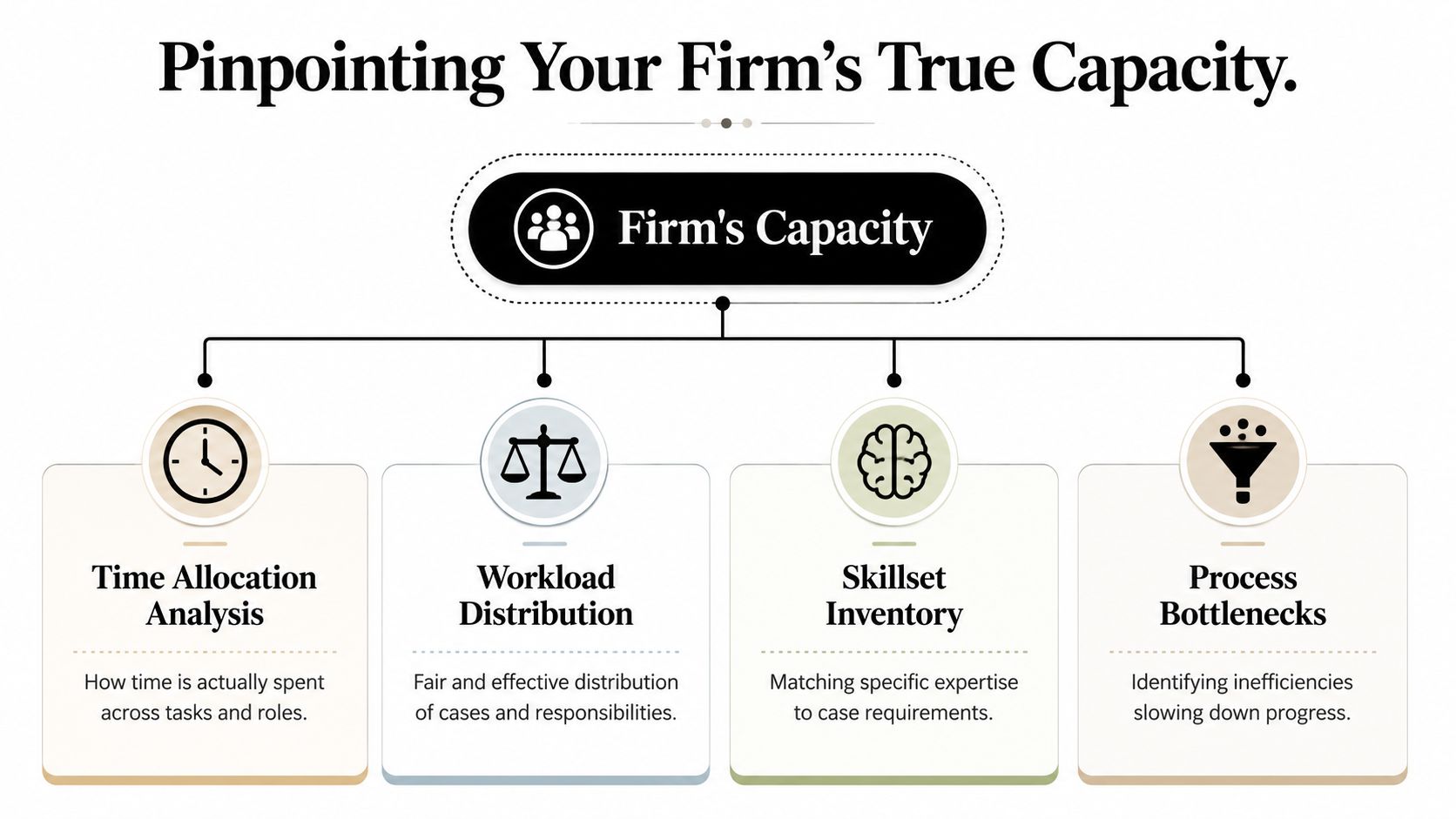
Pinpointing Your Firm's True Capacity
You cannot optimize what you have not mapped. In PI firms, the problem is often not that the team lacks effort, it is that nobody can see which tasks are consuming the day and which files are creating the most drag. Start with a capacity audit that tracks where time is spent, not where job descriptions say it should go.
Build a capacity inventory, not a headcount list
A real capacity inventory should show who can do what, how much of their day is already spoken for, and where the work gets stuck. Separate attorneys, paralegals, case managers, intake staff, and admin support by actual function, then map which tasks only a lawyer can handle and which can be delegated without losing quality. If your team is already using case management for law firms, that workflow data should feed the capacity review instead of sitting in a separate system.
The goal is to find the mismatch between available capacity and critical work. If your best settlement negotiator is still spending time formatting records, the firm is not just inefficient. It is giving away time that should be used to move stronger files toward demand, negotiation, and resolution.
A useful benchmark is the 75%–85% utilization range, which leaves a 15%–25% buffer for interruptions, rework, and urgent tasks utilization benchmark for productive teams. Push much higher than that, and flexibility disappears. In PI, that usually shows up as slower callbacks, delayed demand prep, and file stagnation that hurts settlement posture.
Audit the work by category
Break the week into distinct work buckets. One bucket is attorney strategy, another is records review, another is client contact, and another is internal cleanup. Then compare the time each bucket consumes against the value it creates for the matter.
If senior staff are carrying a lot of low-value administrative work, the firm may look productive while undermining settlement speed.
A basic workflow review can expose what your calendar will not. One firm may have enough people, but the wrong people are doing the wrong work. Another may have the right people, but the process keeps forcing duplicate review, duplicate follow-up, and duplicate file searches. That is the point where capacity problems become case-value problems.
The resource planning discipline described in effective resource decision making gives PI firms a way to make allocation choices around constraints, not wishes. If the file pipeline keeps slipping, the issue is often decision quality, not raw effort. That same review should also account for staffing assumptions discussed in articles on legal hiring, because hiring and allocation have to work together if the firm wants more billable hours in the right places.
Use the benchmark to spot overload and slack
The 75%–85% range is useful because it gives you a realistic target. A firm below that range may have idle talent or poor case routing. A firm above it usually has no room for the unexpected, which is where PI work lives.
You do not need a complex dashboard to begin. Track who is overloaded, who is underused, and which tasks are the most frequent source of delay. Once that picture is visible, allocation decisions get much easier because you are no longer guessing at where the pressure sits.
Setting Goals and Rules for Case Prioritization
A PI firm that prioritizes by arrival order is usually rewarding the wrong cases with the best resources. First-in, first-out feels fair, but fairness isn't the same as profitability. A firm that wants stronger settlement results needs a scoring model that sends attention to the files with the best combination of value, readiness, and strategic upside.
Define KPIs that match firm economics
Case count alone won't tell you whether the firm is healthy. You need measures that reflect how quickly matters move, how efficiently the team works, and how much value the attorney's time produces. That means focusing on case velocity, settlement quality, and the effort required to move a file toward resolution.
The practical question is simple. Which files deserve senior attention now, and which files can wait without hurting value? If every matter is treated as equally urgent, then no matter gets the right level of urgency.
A better rule is to score cases using the factors that matter in PI work, including potential value, complexity, liability clarity, client responsiveness, treatment progression, and the amount of attorney time required to keep momentum. That gives the firm a way to prioritize by impact, not by noise.
Create a prioritization matrix that reflects settlement leverage
The matrix doesn't need to be complicated to work. It just needs to be consistent. A good matter gets more weight if it has strong damages, clean liability, a responsive client, and a path to meaningful negotiating power. A weak file gets less senior time until it reaches a point where that attention can change the outcome.
Rule of thumb: reserve your most experienced people for the files where their judgment can change the settlement trajectory, not for the files that only need more checking.
That approach is especially important when settlement value is tied to timing. Some files benefit from fast, organized demand prep. Others need more patience and documentation before they're ready for serious negotiation. The point is to put the right resource mix behind the right file at the right stage.
Stop treating urgency as importance
Urgent work and important work are not the same thing. A client can be anxious, a provider can be slow, and a claims rep can be difficult, but none of that automatically means the file deserves top-tier attorney attention. Firms that confuse urgency with value end up over-serving low-return tasks while stronger cases wait.
The more disciplined model is to create rules for triage. Intake should route, staff should screen, and attorneys should intervene where legal judgment offers the greatest strategic benefit. That's how the firm protects both case capacity and the value of each hour spent.
Redesigning Workflows with Strategic Automation
The biggest waste in many PI firms isn't lack of talent. It's the amount of skilled attention spent on repetitive work that doesn't need human judgment. Medical record review is the clearest example. Someone on the team spends hours opening records, sorting provider notes, locating chronology, identifying treatment gaps, and trying to reconstruct the story before a demand can even be drafted.
That process eats billable time and slows settlement movement. It also creates variance, because different people review files differently and at different speeds.

Automate the repeatable, protect the strategic
The point of automation in a PI firm isn't to replace lawyers. It's to move the repetitive first pass out of the way so attorneys and paralegals can spend their time on analysis, negotiation, client communication, and demand strategy. Ares is one option in this category, because it automates medical record review and demand letter drafting by turning raw records into organized, case-ready summaries.
That matters because the firm's most expensive people should not be manually reconstructing treatment chronology if a system can do the first pass quickly. The human job is then to review the structure, apply judgment, and apply those facts to optimize outcomes.
For firms evaluating automation more broadly, legal workflow automation is the right frame. The goal isn't novelty. It's to remove the work that keeps senior staff from doing the work that moves a case toward settlement.
Tie automation to utilization, effort, and cost
A good workflow redesign should improve more than speed. It should show up in the metrics that matter. Teamwork's framework is useful here, because it recommends forecasting demand, mapping capacity, and then tracking utilization rate, task effort variance, and resource cost efficiency together, since utilization by itself can hide imbalance resource optimization workflow and metrics.
That's especially relevant in PI. If medical review takes too long, the downstream demand package gets delayed. If attorney review is tied up in manual cleanup, negotiation slows. If paralegals are overloaded with mechanical work, the whole case pipeline becomes less predictable.
A better allocation pattern looks like this. The system handles extraction and organization. The staff reviews, corrects, and applies strategy. The attorney focuses on case value, not file mechanics.
Use workflow redesign to shorten the path to value
The primary payoff from automation is not just labor savings. It's faster movement from intake to meaningful demand posture. When records are ready sooner, the attorney can assess case strength earlier, spot treatment issues sooner, and frame negotiation around cleaner facts.
That means fewer files sitting in limbo and more files reaching settlement-ready status with less friction. In a PI practice, that's not just an efficiency gain. It's a direct path to better use of attorney time and more consistent case momentum.
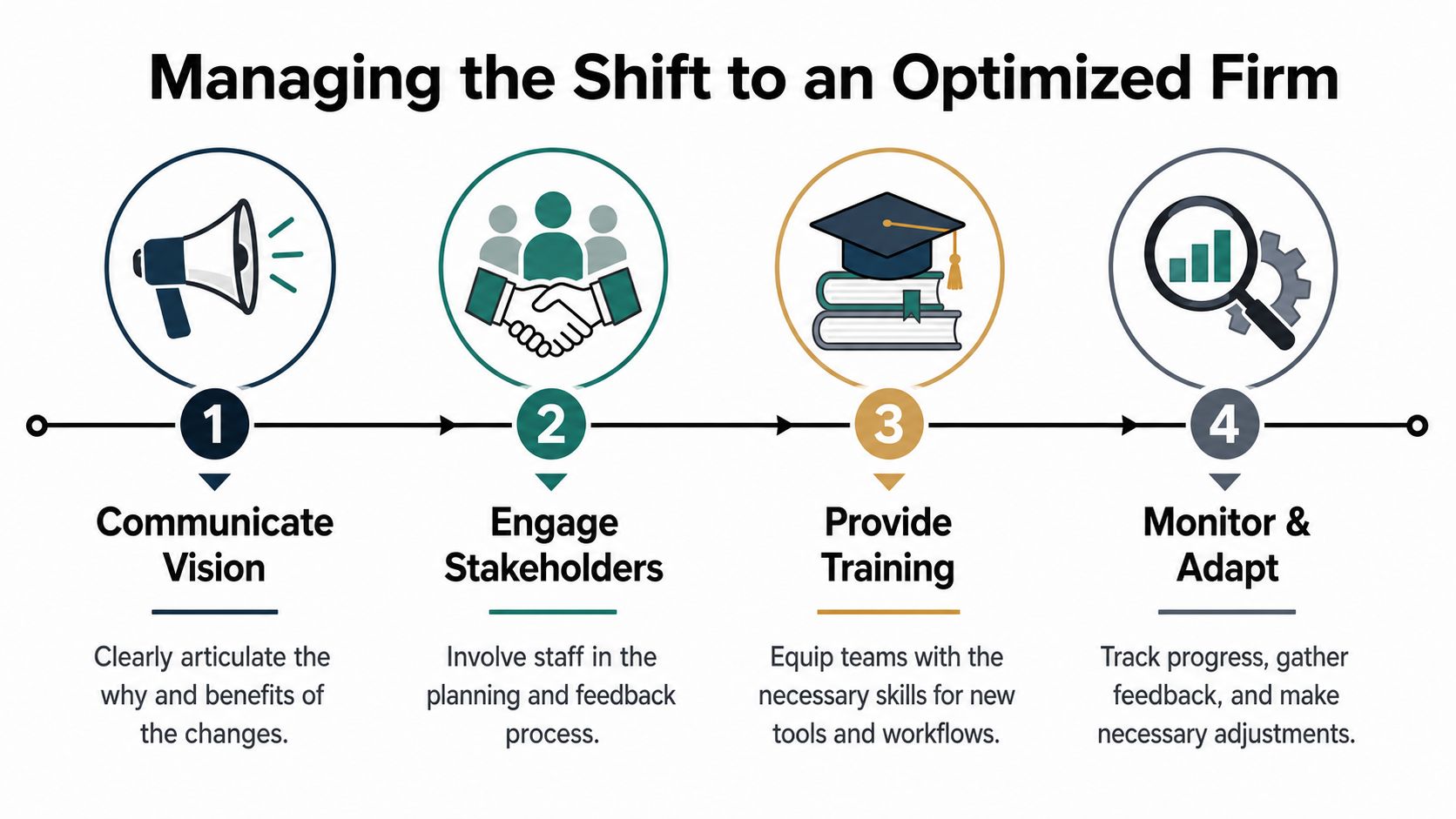
Managing the Shift to an Optimized Firm
Even a strong system fails if the team sees it as extra work instead of better work. Lawyers and staff don't resist change because they like inefficiency. They resist it because new workflows often look like added friction before they look like relief. The firm has to make the payoff visible early and keep the rollout controlled.
Start with the why, then show the relief
People buy in when they understand what changes in their day. Less manual cleanup. Fewer repeated requests. Cleaner file status. More time for work that uses their legal training. That message has to be consistent from leadership down to the people who touch the files every day.
A phased rollout works better than a big-bang launch because it lets the team see proof before the whole firm changes at once. Pick one workflow, one practice group, or one category of matter, then show the difference in speed and workload before expanding.
Make the team part of the design
The people doing the work know where the process breaks. Their input is essential. If the team helps identify the pain points, they're more likely to trust the fix. If the change is handed down without field input, it usually gets treated as a management project instead of a firm improvement.
Training should focus on practical use, not feature tours. Staff need to know how the workflow changes, what to do when a file is ready for review, and how the new process affects handoffs. The objective is consistent behavior, not abstract familiarity.
For leaders who want a broader framework for allocation choices, resource allocation decisions is a helpful reference point because the challenge is choosing what gets attention first and what gets deferred.
Monitor adoption and adjust fast
Change management doesn't end when the new system goes live. That's when the true test starts. Leaders should watch for friction points, missed steps, and workarounds that signal the process is too clunky or not clear enough.
The best adopters inside the firm can become internal champions. They help normalize the new workflow, answer informal questions, and show the rest of the team what good use looks like. That peer effect matters more than another memo from management.
Ares also fits naturally into this kind of transition because it gives firms a concrete workflow to standardize around, especially where medical summaries and demand preparation are frequent bottlenecks. The technology only matters, though, if the team uses it in a repeatable way.
Measuring Your ROI and Planning for the Future
If the firm can't show a before-and-after change, it hasn't really optimized anything. A good allocation model should make the work easier to see, easier to prioritize, and easier to complete with less waste. The question is whether the firm can prove that the new process creates more capacity and better file movement.
The cleanest way to measure return is to compare the same operating signals before and after the change. Look at how quickly cases move, how much time the team spends on low-value cleanup, and whether senior staff are getting pulled into tasks that should be handled elsewhere. If those patterns improve, the firm is getting closer to a sustainable operating model.
Use a simple review cycle
Quarterly workflow reviews work well because they force the firm to notice new bottlenecks before they harden into habits. The review should ask what slowed files down, where the team spent too much time, and whether any role is again drifting into work that doesn't belong there.
That kind of review also keeps resource planning honest. If intake is suddenly overloaded or record review is backing up again, the fix may be staffing, process, or technology, but you won't know unless someone is looking at the full picture regularly.
The right reporting layer makes those decisions easier. A dashboard that combines utilization, file movement, and work queue visibility gives leadership a clearer basis for action, which is why dashboard analytics matters as a management habit, not just a software feature.
Measure the value of better allocation, not just the time saved
Time saved is important, but it's not the whole story. The deeper benefit is that better allocation gives attorneys more room to focus on work that can influence settlement value. That means stronger demands, cleaner negotiations, and less delay between case progress and case action.
For planning talent over the long term, strategic workforce planning is a useful complement because the firm has to keep matching capacity to workload as the caseload changes.
The best firms treat optimization as a habit. They review, adjust, and keep tightening the connection between work type and worker type. That's what keeps case flow steady and protects the quality of the attorney's time.
If your PI firm is hitting the point where good cases are slowing down because the team is buried in manual work, it's time to modernize the allocation model. Start by mapping where time goes, then decide which tasks should stay human and which ones should be automated. If you want a practical way to reduce records-review drag and give attorneys more time for strategy and settlement work, explore Ares and see how it fits into your case workflow.