

The demand is due Thursday. On Monday morning, a paralegal is sorting imaging discs beside a stack of records, an associate is still concerned about a treatment gap, and the client wants to know what happens next. Nobody needs another dashboard that counts uploaded pages. The firm needs a reliable way to turn scattered medical evidence into work an attorney can verify, explain, and use.
That's the job of personal injury litigation support. It isn't a department name or a promise to move faster. It's the repeatable set of decisions that connects intake, records, legal judgment, and case strategy without losing the source evidence along the way.
The Monday Morning That Defines PI Litigation Support
By the time the team opens the file, the records may have come from several providers in different formats. A specialist's report is buried in a large PDF. Imaging is on a disc. Billing records don't line up neatly with treatment notes. The client remembers a stretch when care stopped, but the file doesn't yet explain why.
The associate doesn't need a summary that sounds polished. They need to know which records support the injury narrative, where the chronology is uncertain, what's missing, and whether the demand can be defended against the predictable questions from an adjuster. If someone has to reconstruct all of that under deadline pressure, the firm is depending on individual heroics rather than a sound process.

Start with a better question than “How quickly can we review this file?” Ask what a defensible support operation should produce at each stage of a PI case. Intake should capture the facts needed to open and evaluate the matter. Record collection should preserve where evidence came from. Review should organize the evidence while flagging gaps and uncertainty. Attorney-facing work should make it easy to trace each important assertion back to the underlying record.
Operating principle: Automate the organization, not the lawyer's judgment. Every useful summary should make the source easier to inspect, not harder to find.
The case lifecycle matters because a demand, mediation brief, deposition exhibit, and trial notebook all depend on the same underlying facts, but serve different purposes. If the firm builds its process around that lifecycle, it can reuse verified work instead of asking each person to start again from a pile of documents.
That's what strong personal injury litigation support looks like in practice: consistent preparation, visible evidence gaps, and attorney control at every decision point. The goal isn't to eliminate human review. It's to reserve human attention for questions that require legal judgment.
What Litigation Support Actually Means in a PI Practice
In a PI firm, litigation support is the preparation work that turns client and case materials into organized, usable evidence. It includes intake summaries, record requests, provider lists, medical chronologies, demand packets, deposition exhibits, and trial materials. Those aren't interchangeable documents. Each is an artifact built for a particular decision or phase of the case.
Think of it as a surgical team's pre-op workflow. The team doesn't wait until the procedure starts to identify the patient, check the relevant records, and prepare the equipment. Likewise, a firm shouldn't wait until a demand deadline to figure out whether a record set is complete or whether a chronology has a gap.
Define the work by responsibility
A paralegal or case manager can gather records, track requests, organize incoming files, and flag missing information. A litigation-support specialist or operations lead can maintain templates, naming rules, quality checks, and handoff standards. The attorney decides what the evidence means, evaluates legal relevance and credibility, approves legal arguments, and takes responsibility for work sent outside the firm.
Those boundaries matter. A service or tool can make a chronology easier to review, but it shouldn't decide whether a treatment interval is legally significant or whether a medical opinion supports causation. For a practical overview of how a litigation paralegal's responsibilities fit into casework, see what a litigation paralegal does.
Don't mistake PI support for generic e-discovery
General e-discovery often focuses on collecting, processing, searching, reviewing, and producing documents. PI support shares some of that discipline, especially around preservation and traceability, but its day-to-day value lies in organizing medical evidence around treatment, injury, causation, damages, and the client's case story. A document-review workflow designed for corporate email won't automatically give a PI team a useful treatment timeline.
Document handling still matters. A resource such as PDFWix for law firm needs can help teams think about practical PDF work, but conversion and annotation alone don't establish what a record means or whether the file is complete.
Choose staffing and tools based on the artifacts your firm must produce, the decisions those artifacts support, and the controls needed to verify them. A workflow built around those requirements is more useful than a tool list built around features.
Why Medical Records Run the Whole Case
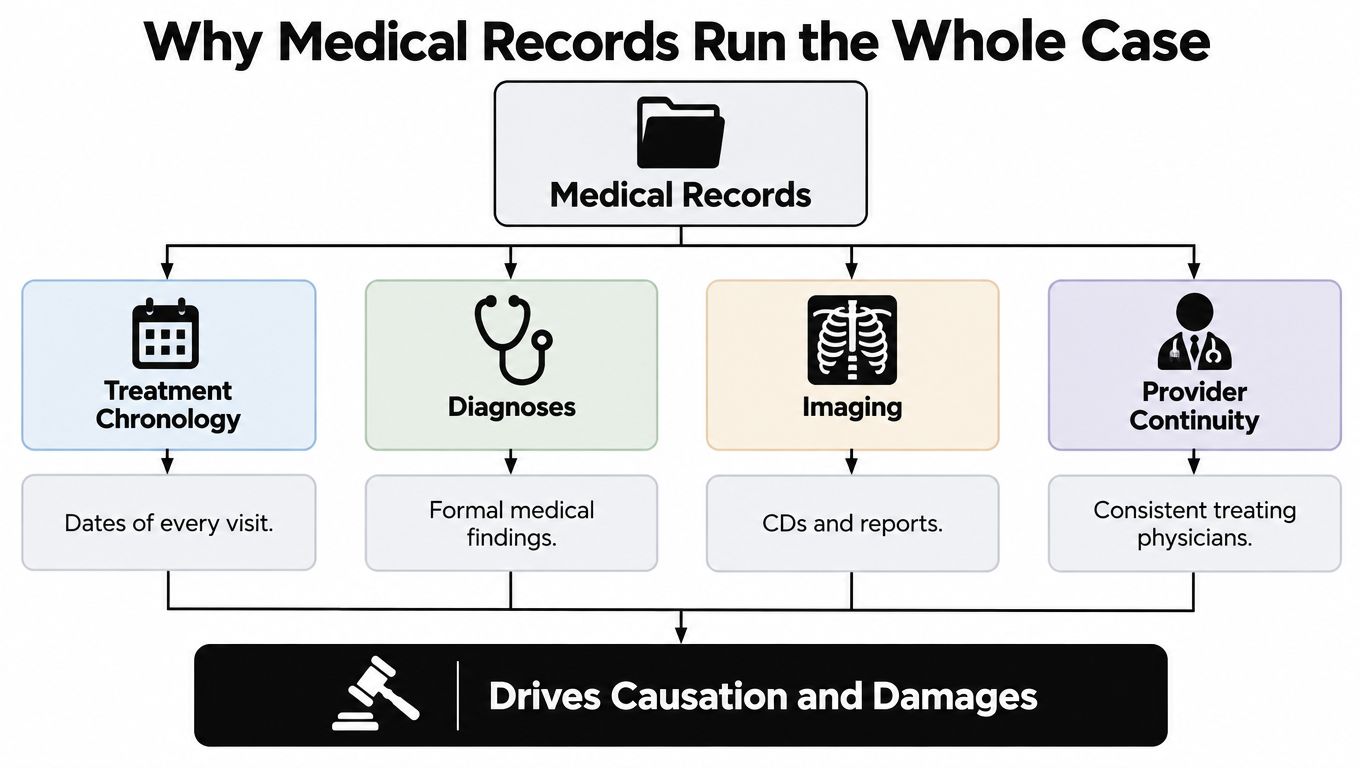
Medical records aren't just attachments to the claim. They show what the client reported, what clinicians observed, what care followed, and where the evidence leaves room for questions about causation or damages. If the chronology is incomplete, even a straightforward liability theory can arrive at negotiation with avoidable weaknesses.
Imagine a client who first treated after an accident, later saw a specialist, and then has a long interval without documented care. A thin summary might label that interval “gap in treatment” and move on. A useful chronology marks the dates and source pages, distinguishes what the records say from what the client reports, and flags the unanswered question for the attorney to investigate. Without that discipline, the demand may overstate what the records establish or fail to explain a fact the insurer will notice.
Make the record trail defensible
Treat records management as a proportionality and defensibility task, not a contest to collect everything. Federal discovery guidance considers the burden and expense of preservation, collection, search, review, and production in relation to case-specific factors, including the importance and likely value of information. For a PI firm, a sensible protocol should identify relevant sources, record collection dates, distinguish complete records from partial productions, and preserve the ability to trace extracted facts to their source.
That means a chronology should show both evidence and uncertainty. Note an unexplained provider transition, inconsistent references to an injured body part, or a date where the file lacks a supporting note. Keep each extracted fact connected to the original document and page, along with a clear indication of review status. For practical record-organization methods, see how to organize medical records.
Focus effort where review consumes it
The economics of review reinforce the point. RAND's study of large document productions found that review accounted for about 73% of total e-discovery costs, compared with 19% for processing and about 4% for internal counsel, IT, and other employee costs, as summarized in its empirical study of e-discovery costs. Those findings aren't a universal budget forecast for every PI firm, but they support a practical conclusion: organizing files is not enough if people still spend most of their time locating and interpreting relevant facts.
Structured extraction can surface service dates, providers, diagnoses, procedures, medications, imaging references, and symptom progression. It only helps if the attorney or trained reviewer can verify each item against the record. The purpose is to reduce repetitive sorting while making it easier to examine causation, damages, and evidentiary gaps, not to disguise uncertainty as a finished narrative.
For a visual overview of how medical evidence can connect to case analysis, see the medical-record impact flowchart.
The Standard PI Litigation Support Workflow
A mature workflow makes ownership visible. Every stage should have a responsible person, a defined check, and an artifact that the next person can use. The sequence below isn't a rigid software prescription. It's a way to find where a file is getting stuck or where the firm is relying on memory instead of a repeatable handoff.
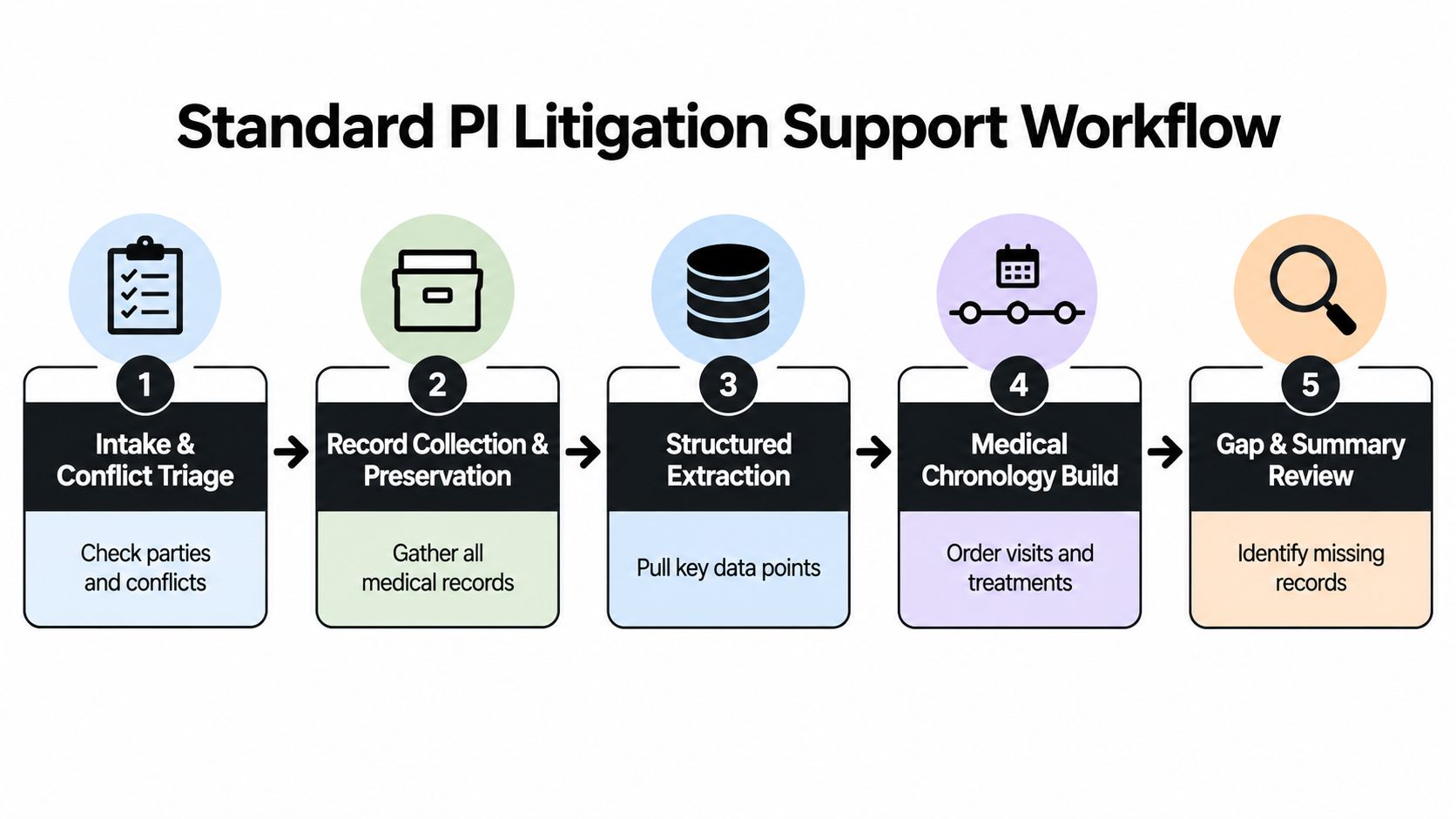
Intake and conflict triage. The intake professional captures parties, incident details, known injuries, and initial provider information. The attorney or designated conflict reviewer clears the matter before substantive work proceeds. The output is a usable intake summary, not an unstructured call note.
Record collection and preservation. The case manager tracks requests, incoming records, imaging, bills, and authorizations. They log sources and dates, label partial productions, and flag outstanding requests. The output is a collection record the team can audit.
Structured extraction. A trained reviewer, sometimes assisted by software, organizes dates of service, provider names, symptoms, diagnoses, procedures, and imaging references. AI can help locate those fields across varied documents, but an extracted fact isn't verified merely because a system found it.
Chronology and issue spotting. The paralegal or case manager builds the treatment sequence and flags gaps, inconsistent references, and unsupported intervals. The output should distinguish record evidence from questions that need follow-up.
Attorney review and case work. The attorney evaluates causation, damages, liability, and case strategy. They approve the chronology and decide what belongs in demand language, negotiation materials, disclosures, or trial preparation.
Preserve the handoff into negotiation
Demand drafting should start from verified facts, with supporting source references available for disputed assertions. Before the demand leaves the firm, the attorney checks that the narrative doesn't turn a reported symptom into a formal diagnosis, omit a material gap, or overstate what an imaging report says. After resolution, a file audit can record what was produced and approved, helping the team close the matter with an orderly record.
Document workflows often break at the handoff between receiving, organizing, reviewing, and preparing materials. A practical resource on document workflow automation can help teams assess where routine transfer and handling tasks create avoidable friction.
Map these stages against a recent file. If no one owns a handoff, the artifact is missing, or attorney review happens only after drafting, the workflow has a control problem, not merely a staffing problem.
Hours Saved Is Not the Same as Value Created
A shorter review time can be useful. It doesn't prove the firm has a stronger case, a more accurate demand, or a safer process. Keep two scorecards: one for operational performance and another for the quality of the evidence and legal work.
The distinction matters because adoption can favor visible drafting tasks over the less glamorous work of checking whether underlying data is reliable. In an ABA survey of more than 2,800 legal professionals, 54% reported using AI for drafting, while 14% used it to analyze firm data and matters, according to the ABA's 2025 legal industry report. Drafting is easy to notice. Whether a chronology missed a treatment gap is harder to measure, but far more important to trust.
| Metric Type | Examples | What It Tells You | Limit |
|---|---|---|---|
| Operational | Minutes per page, review cost, turnaround time, caseload capacity | Whether the process uses staff time and resources efficiently | Faster throughput can still produce weak or inaccurate work |
| Case quality | Missed treatment gaps, chronology accuracy, corrections after review, completeness of causation and damages support | Whether the organized evidence is dependable and useful to legal judgment | Outcomes depend on factors outside the review workflow |
Score the process, not the sales pitch
Before adopting a tool, establish a manual-review baseline on a representative set of records. Then compare the system's output with attorney-reviewed ground truth. Track whether dates, providers, diagnoses, procedures, and symptom references are correct, and whether material events or uncertainties were missed. Include corrections in the evaluation rather than treating edits as an inconvenience.
Ask whether the tool makes source verification easier. Can a reviewer jump from a summary item to the exact page? Can the firm identify which fields are commonly corrected? Does the chronology distinguish a patient-reported symptom from a clinician's finding? Those checks tell you more about case quality than a demo showing a polished draft.
If the only metric the vendor can improve is time to first draft, you haven't yet established value. Measure whether the draft is accurate, traceable, and useful to the attorney.
Use both scorecards before expanding use. Operational results show whether a workflow is workable; quality checks show whether its output is safe to rely on.
Governance Before Automation
PI firms should adopt controlled automation, not maximum automation. Medical records can contain protected health information, while the firm's annotations and strategy may constitute sensitive work product. A tool that saves time but obscures where a fact came from, who reviewed it, or how client data is handled creates a new risk instead of solving the old one.
The ABA's Formal Opinion 512 identifies duties relevant to lawyers using generative AI, including competence, confidentiality, supervision, and client consent and disclosure where applicable. Treat those obligations as operating requirements, not a policy document to file away. The attorney remains responsible for reviewing and approving the legal work product, whether a person or a model prepared the first draft.
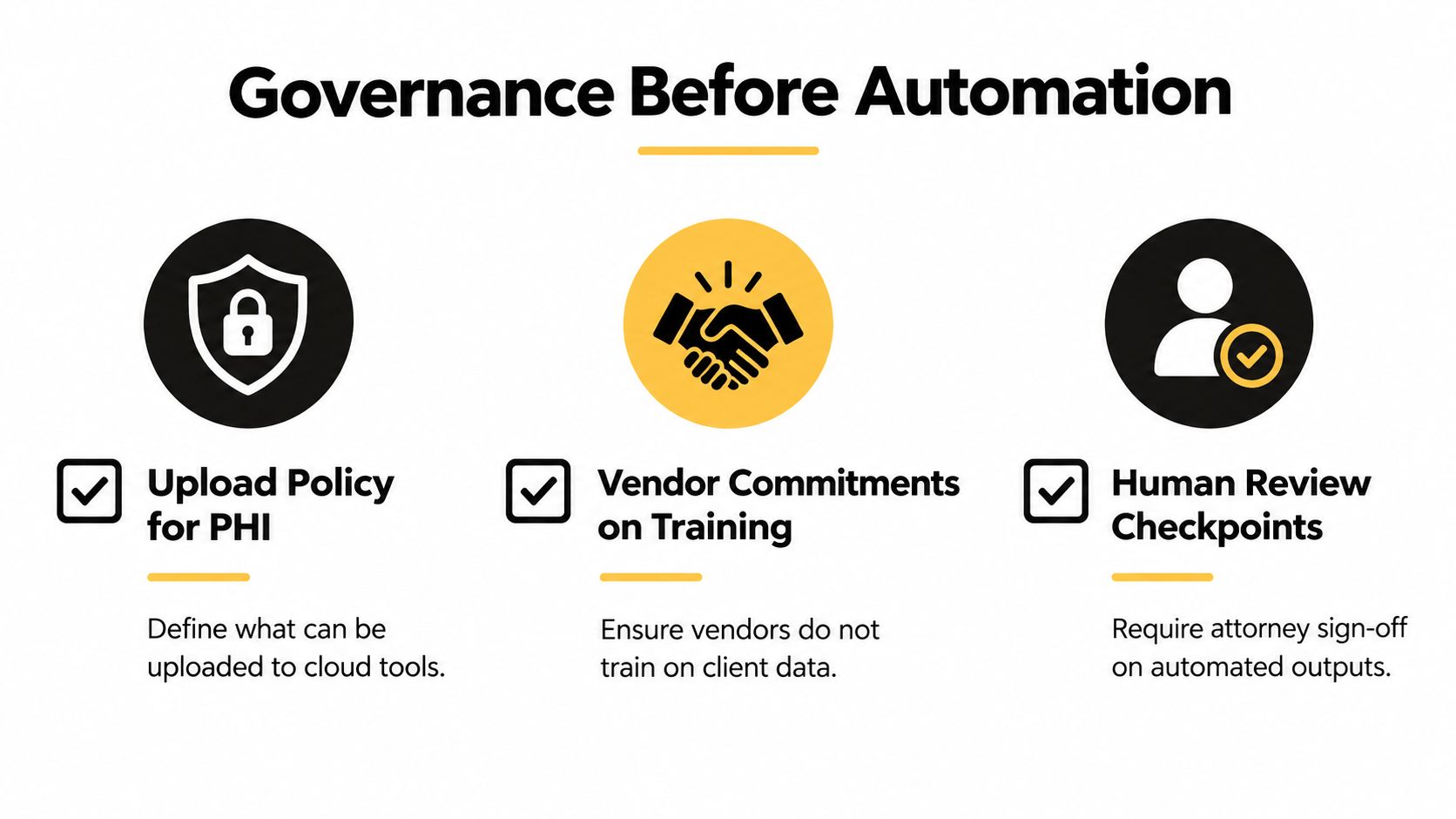
Put the rules in writing before uploading records
Before signing with a vendor, require clear answers to these questions:
- PHI upload policy: Which files may staff upload, to which environment, and under what access controls?
- Training and data use: Will the vendor use client information to train models? Require a clear contractual commitment about isolation and permitted use.
- Source traceability: Can every extracted fact link to the original document and page?
- Review status: Can the firm see which outputs are uncertain, unreviewed, or corrected?
- Auditability: Does the system log uploads, transformations, edits, exports, and approvals?
- Access and retention: Can the firm assign role-based permissions and apply retention and deletion rules?
- Attorney approval: Can a demand or other external document remain subject to attorney sign-off before it leaves the firm?
Ask the vendor to demonstrate the workflow using a controlled test file, not just a polished interface. Review the security terms, data-handling commitments, access model, export behavior, and deletion process with the person responsible for the firm's IT or security program. A vendor security assessment checklist can help structure that conversation.
Firm size doesn't remove the need for governance. Reuters, reporting on the ABA's 2025 survey, noted generative AI adoption of about 39% at firms with more than 50 lawyers and about 20% at firms with 50 or fewer; see its coverage of legal AI data strategy and adoption. Smaller practices may have fewer dedicated technology staff, which makes a simple, usable playbook more important, not less.
Staffing, Vendors, and Rollout That Actually Fit
Start with the work, not a fashionable staffing ratio. A solo attorney may need a consistent intake checklist, dependable record-tracking support, and a carefully limited toolset. A mid-sized firm may need a designated operations owner to maintain templates, quality checks, and vendor accountability. A high-volume practice may need specialized roles for retrieval, review, chronology quality control, and attorney escalation.
Contingency fees shape the economics. Legal-economic research describes contingent fees as the dominant payment method for U.S. plaintiff personal-injury attorneys, with the model associated with PI and medical-malpractice matters for at least a century. Firms advance time and case expenses without knowing whether a matter will produce a recovery, a point discussed in the legal-economic research on contingent fees. That makes efficiency important, but it doesn't justify cutting verification from work that affects case value.
Buy evidence control, not a convincing demo
Ask vendors to show how a reviewer traces a summary statement to its record page, how corrections are captured, how data is handled, and how files can be exported or deleted. Test the product against records your team has already reviewed. Reject a workflow that can't expose uncertainty or preserve attorney approval.
For staffing, write down the handoff before adding headcount. If case managers repeatedly chase the same missing records, fix collection tracking. If paralegals spend their time sorting duplicate pages, improve intake organization and review. If attorneys are rewriting unsupported summaries, strengthen quality control before increasing volume. Firms exploring distributed support can review information about remote legal assistant jobs as they assess how to structure administrative roles.
Run a contained pilot
Select a limited set of matters that reflects the kinds of records the firm handles. Define the manual baseline, the fields to verify, the reviewer responsible, and the conditions that stop the pilot. Compare output quality and review effort, record corrections, and have the attorney decide whether the results are dependable enough for broader use. Don't move live demand drafting into an automated workflow until that review is complete.
Ares is one option for PI teams evaluating medical-record review and demand drafting: its platform organizes record details into summaries and draft materials for attorney review. Assess it by the same standards as any other tool, including source traceability, data handling, correction visibility, and attorney control.
A Practical Operating Philosophy and Quick Checklist
Treat PI litigation support as the discipline of turning medical records and case facts into reviewable, defensible, attorney-verified material. A good process doesn't hide gaps. It makes them easier to identify, investigate, and address before they weaken a negotiation or filing.
On Monday morning, make five decisions:
- Map the lifecycle from intake through file audit.
- Standardize collection and record provenance.
- Choose for defensibility, not demo speed.
- Run a measured pilot before expanding use.
- Track efficiency and quality side by side.
Measured AI use, stronger audit trails, and repeatable handoffs can replace last-minute paralegal heroics with firm operations the team can trust. Keep the attorney in control of every conclusion.
Ares helps personal injury firms organize medical records, build case-ready summaries, and draft demand materials for attorney review. If your team is ready to test a more traceable workflow, visit Ares and evaluate it against your firm's verification and governance requirements.