A busy PI desk falls behind in a familiar sequence. A new client signs while records are still outstanding on older files, the attorney asks for a demand update before specials are verified, and a treatment gap surfaces after liability work is already underway. By that point, the problem is no longer one missing item. The file has started to move in the wrong order.
That is why a personal injury checklist for paralegals needs to function as a stage-gated workflow. Each phase should have a clear completion standard before the next one begins. Intake should produce a usable file. Records collection should produce a complete medical story. Liability review should produce a supportable theory of fault. Demand prep should rest on documented damages, not assumptions.
I have found that strong PI teams do not get faster by working harder across the whole file at once. They get faster by controlling handoffs. Every stage answers a specific question before the case advances. Is the case viable? Are treatment records complete? Is liability documented? Are damages calculated and supported? That structure cuts rework, exposes risk earlier, and makes it much easier to see which files are ready for settlement work and which ones still need development.
AI automation matters most at those handoff points. Used well, it can speed up intake review, records sorting, chronology building, medical summarization, and first-pass demand drafting. Ares is relevant here for that reason. The value is not abstract. It reduces manual review on repetitive tasks so paralegals can spend more time fixing gaps that affect case value.
What follows is a proven eight-stage framework for moving PI files from intake to settlement or trial with fewer misses, cleaner documentation, and better visibility into what is ready now versus what still needs work.
1. Initial Client Intake and Case Assessment Checklist
Bad intake infects the rest of the case. If the first file setup is sloppy, every later stage gets slower because your team is fixing missing facts, wrong contacts, incomplete insurance details, and bad calendar entries.
At intake, the job isn't just collecting information. It's deciding whether the file is viable, urgent, and clean enough to move into records and liability work without immediate rework. I want one intake packet, one source of truth, and one person accountable for completeness before the file is opened fully.
What gets locked down on day one
Start with the basics, but don't stop there. Good intake captures the facts that shape strategy later, especially causation problems, preexisting conditions, liability disputes, and insurance issues.
- Client identity and contact data: Confirm legal name, date of birth, current address, best phone, email, emergency contact, and preferred communication method.
- Incident facts: Record date, location, mechanism of injury, parties involved, responding agencies, and whether photos, video, or witness information already exists.
- Insurance stack: Gather every policy tied to the claim, including auto, health, MedPay, UM/UIM, workers' compensation, and any known liability coverage.
- Immediate viability flags: Note prior injuries, delayed treatment, comparative fault issues, intoxication concerns, low-impact facts, and whether there's already representation history.
- Deadline control: Calendar the statute, notice deadlines, claim reporting deadlines, and any known preservation issues the same day.
A mid-sized firm usually doesn't fall apart because nobody knows PI law. It falls apart because the intake team captures facts in one format, the litigation team needs another, and nobody trusts the initial record.
Practical rule: If a field matters later for a demand letter, discovery response, lien resolution, or settlement statement, collect it at intake.
What works and what doesn't
What works is a digital intake form with conditional logic. Auto-route motor vehicle cases differently from premises, dog bite, or negligent security matters. Push the intake data directly into your CMS so staff aren't typing the same details twice.
What doesn't work is a freeform narrative entered by whoever answered the phone. That may feel faster, but it creates downstream guesswork. Intake should also trigger recurring reminders for unresolved items, especially missing reports, unsigned authorizations, and medical provider lists. If a client says, "I'll send that later," assume you'll need a follow-up task before the call ends.
2. Medical Records Collection and Organization Checklist
Records collection is where many files stall. The issue usually isn't effort. It's that requests go out without a tracking system, provider responses arrive incomplete, and nobody notices missing date ranges until demand prep.
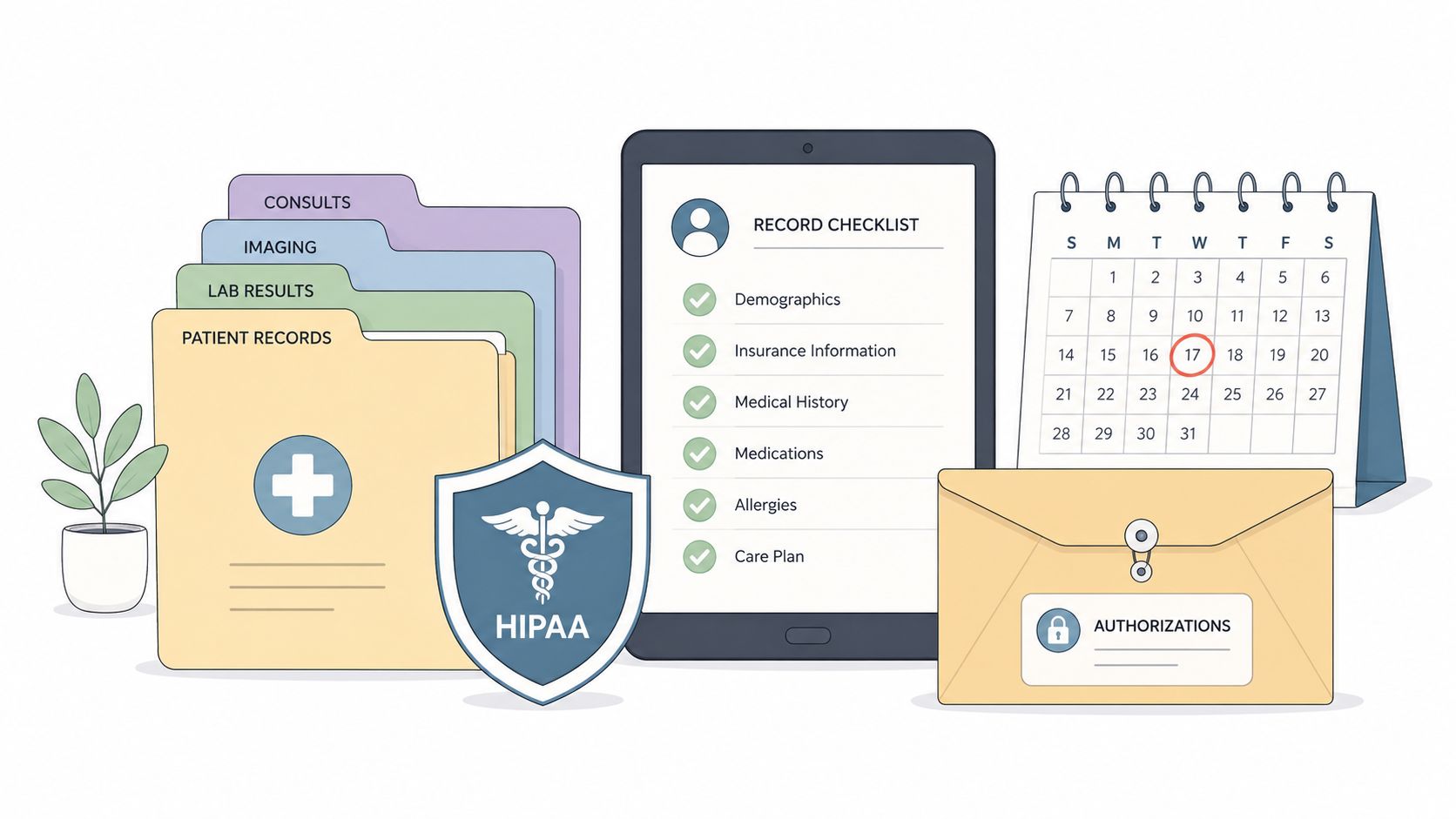
Use one master tracker for every provider. Hospitals, EMS, imaging centers, primary care, specialists, PT, chiropractic, urgent care, behavioral health, and pharmacies all belong on it if they're relevant. That tracker should show request date, authorization status, follow-up dates, receipt status, bill status, and whether the records are complete.
A practical system for medical records retrieval for lawyers should separate "requested" from "complete." Those are not the same thing.
Build the file before the records arrive
Most delays happen because staff wait for records before organizing the file. Reverse that. Create the provider list, treatment timeline shell, and request log first.
- Provider roster: Enter every known provider and every possible provider the client mentions, even if treatment was only one visit.
- Authorization control: Verify signatures, date formats, and provider-specific release requirements before sending anything.
- Follow-up cadence: Put unresolved requests on a recurring follow-up cycle so slow providers don't disappear off the radar.
- Completeness review: Compare received records against the requested date range, billing pages, imaging reports, and referral references inside the chart.
The hardest cases aren't the ones with the most pages. They're the ones with fragmented treatment across many providers, because each missing packet creates an artificial treatment gap until proven otherwise.
Strategic triage beats chronological reading
One major gap in a typical personal injury checklist for paralegals is triage. The ABA-related data in the verified brief states that 78% of PI firms have adopted digital case management, yet paralegals still spend an average of 6.5 hours per case manually sorting and triaging unstructured medical PDFs before analysis begins. That's where files bog down.
Don't review everything in strict date order if the record volume is heavy. Review by legal impact first. Start with emergency care, imaging, surgical consults, treating physician causation language, documented gaps in care, discharge notes, and any provider comments that suggest prior complaints or inconsistent reporting. That gives the attorney usable strategy early, even before the full chronology is polished.
Triage the records that can hurt or help valuation first. The rest can follow.
3. Liability Investigation and Evidence Documentation Checklist
Some evidence has a short shelf life. Surveillance gets overwritten. Vehicles get repaired. Conditions at a property change. Witnesses forget details or stop answering calls. If your liability checklist isn't activated early, you're not collecting evidence. You're chasing what used to exist.
The first pass should answer three questions. What proves fault, what undermines fault, and what needs immediate preservation. Everything else is secondary.

Early investigation tasks that actually matter
Liability work should be concrete, not generic. "Investigate accident" is useless as a checklist item. Break it into actions that leave a documented trail.
- Scene preservation: Order photographs, mapping references, weather context, lighting conditions, and any available video sources.
- Witness capture: Get full names, phone numbers, addresses, relationship to the incident, and a same-day or early statement summary where possible.
- Official records: Request crash reports, incident reports, 911 logs, dispatch material, body cam, business records, or maintenance records as the theory of liability requires.
- Preservation letters: Send targeted notices to property owners, vehicle owners, carriers, businesses, or manufacturers when evidence could be altered or destroyed.
- Chain of custody: Track where photos, downloaded video, damaged property, and other evidence came from and who handled it.
A strong investigation file often changes settlement posture before damages are even fully developed. In one common scenario, early scene photos can contradict the defense's later claim about visibility, lane position, warnings, or condition notice.
Fraud, inconsistency, and verification
Most paralegals focus on proving liability. Good ones also pressure-test it. Compare the client account to the report, photos, EMS note, and any witness account. If something doesn't line up, flag it early for the attorney.
Outside specialists can help in the right file, especially where surveillance, staged events, or inconsistent loss narratives are concerns. For a practical example of how investigators approach claim scrutiny, see Sentry Private Investigators Ltd's fraud expertise.
A file gets stronger when you document the bad facts early, not when you hide them in a note nobody reads.
4. Medical Records Review and Summary Creation Checklist
Considerable paralegal time often disappears. Manual review sounds manageable until a file has years of treatment, duplicate scans, scattered imaging, and specialists who document the same complaints differently. The verified brief notes that paralegals and case managers report eliminating over 10 hours of manual review and drafting time per personal injury case by using structured checklists and automated workflows.
The mistake I see most often is treating summary creation as one long reading exercise. It works better as extraction, validation, and synthesis.
Read for issues, not just chronology
Your medical summary should answer legal questions, not just retell treatment dates. Did the client report the same mechanism of injury consistently. Is there objective support for the complaints. Did any provider note prior symptoms, noncompliance, symptom magnification, or a break in causation.
Split the review into lanes:
- Objective findings: Imaging, exam findings, surgical observations, diagnoses, restrictions, and referral patterns.
- Subjective complaints: Pain reports, symptom progression, functional limitations, sleep disruption, headaches, anxiety, and daily impact.
- Causation and defense points: Prior history, delayed onset, treatment gaps, inconsistent histories, intervening incidents, and discharge language.
- Valuation drivers: Surgery recommendations, injections, permanency language, work restrictions, scar documentation, and future treatment recommendations.
A clean chronology isn't enough if it hides the defense arguments in the middle of the summary.
Use AI carefully and validate every output
The under-discussed issue isn't whether AI can accelerate summaries. It can. The central question is how to integrate AI-generated summaries into a demand package without creating trust, admissibility, or compliance problems. The verified brief states that in a 2025 Legal Technology Institute study, 62% of paralegals reported uncertainty about the legal standing of AI-generated medical chronologies.
That concern is valid. The safer workflow is to treat AI output as a first draft and validation layer, not as self-authenticating evidence.
Validation checkpoint: Cross-reference every AI-generated date, diagnosis, provider, and treatment milestone against the source record before it reaches the attorney or leaves the firm.
I also document who reviewed the output, what source set was used, and whether the summary was checked for omitted records or duplicate pages. The time savings are real, but only when the validation step is mandatory.
5. Damages Calculation and Documentation Checklist
A damages file should let the attorney answer valuation questions without rebuilding the case from scratch. If medical bills are scattered, wage loss is based on verbal estimates, and future care isn't separated from completed treatment, the demand will either go out weak or go out late.
This phase is about disciplined documentation. Every claimed category needs support, and every support document needs a home in the file. I prefer one damages workbook with separate tabs or sections for medical expenses, lost earnings, out-of-pocket costs, liens, future care, and non-economic support.
Build damages from documents, not assumptions
Clients often understate or overstate losses on the first call. That's normal. The paralegal's job is to replace early estimates with records.
- Medical specials: Tie each bill to a provider, date range, and status. Separate billed amounts, payments, balances, and lien-related obligations where relevant.
- Wage loss: Get written employer verification, payroll records, disability slips, and any work restrictions that support time off or modified duty.
- Future damages: Flag recommendations for future imaging, injections, surgery, therapy, medication management, or specialist follow-up.
- Human damages support: Pull notes showing pain, sleep disruption, missed activities, driving limits, household limits, and changes in function.
The strongest damages presentations are boring in the best way. They're organized, traceable, and hard to attack.
Common misses that weaken value
Three misses show up all the time. First, wage loss isn't verified until the demand is due. Second, lien exposure isn't checked until settlement is close. Third, records mention future treatment, but nobody includes it in the damages summary.
When you need a medical-legal framework for evaluating records in support of damages, this piece on expert guidance on medical records for attorneys is worth reviewing. Use it as a practical lens, not as a substitute for your own file-specific analysis.
6. Demand Letter Drafting and Substantiation Checklist
A demand letter should feel inevitable, not inflated. The best ones don't bury the adjuster in paper and hope volume does the work. They present a liability story, a causation story, and a damages story that all point in the same direction.
When demand drafting goes badly, it's usually for one of two reasons. The file is still incomplete, or the draft reads like a template that never absorbed the specific records.
Structure the demand for persuasion
I build demands in a fixed order because it keeps the narrative tight. Liability first. Then injury mechanism and treatment course. Then objective findings, functional impact, specials, future implications, and the settlement position.
A practical workflow for writing a demand letter should also force a pre-send review for contradictions. If the demand says treatment was continuous but the chronology shows a gap, the defense will spot it immediately. If the claim of severe limitation isn't reflected anywhere in the records or client statement, it weakens the entire package.
- Lead with your strongest fact pattern: Clear fault should appear early, not buried after medical detail.
- Use record-supported causation language: Pull directly from treatment notes and imaging where the records help you.
- Address weak points directly: Explain treatment gaps, prior injuries, or delayed specialty care instead of pretending they don't exist.
- Match exhibits to claims: Every major factual statement in the demand should connect to a medical record, bill, photo, report, or wage document.
Drafting trade-offs that matter
Longer isn't always stronger. A short, disciplined demand with sharp exhibits often performs better than a sprawling packet full of duplicate records and generic suffering language.
I've also found that attorney review works best when the paralegal submits not just a draft, but a short issue memo with unresolved questions. That may be a causation conflict, a prior injury overlap, an uncertain lien issue, or a missing wage record. The cleaner that handoff, the faster the demand gets out.
Good demands don't hide file problems. They frame them before the adjuster does.
7. Settlement Negotiation Preparation and Execution Checklist
Negotiation prep starts before the first call. If the attorney doesn't have a clean case summary, confirmed specials, updated treatment status, known liens, and client authority parameters, every negotiation becomes slower and less precise.
A stage-gated personal injury checklist for paralegals proves beneficial. A file that's ready for negotiation should already have the medical summary, damages support, policy information, and open issues list in one place. If not, you're still in demand prep, whether the carrier has responded or not.
Prepare the negotiation file like a working brief
I like a concise settlement packet for internal use. Not a duplicate demand, but a negotiation sheet that shows liability strengths, defense risks, treatment highlights, specials status, lien status, current client condition, and talking points for expected pushback.
- Authority control: Confirm the client's current settlement position and document how authority should be handled if offers move.
- Response strategy: List likely adjuster themes, such as minimal impact, gap in care, preexisting issues, or excessive treatment.
- Coverage check: Make sure policy details and any available excess or umbrella issues have been reviewed before final numbers are discussed.
- Documentation trail: Memorialize every offer, counter, condition, and follow-up in writing.
Many firms lose an advantage by negotiating from memory. That's avoidable.
Execution matters as much as valuation
The paralegal often becomes the continuity point during negotiation. Attorneys may handle the call, but the paralegal keeps the number history straight, updates the file, circulates revised authority requests, and catches loose ends like missing lien payoff language or release issues.
This is also the stage where discipline matters most. Don't let a favorable number distract the team from unresolved Medicare, hospital, health insurance, child support, workers' compensation, or provider lien issues. A good settlement can still become a bad closing if those items weren't surfaced early.
8. Case File Organization and Trial Preparation Checklist
Some files settle late. Some don't settle at all. Either way, poor organization gets exposed the moment discovery intensifies, depositions begin, or trial prep starts.
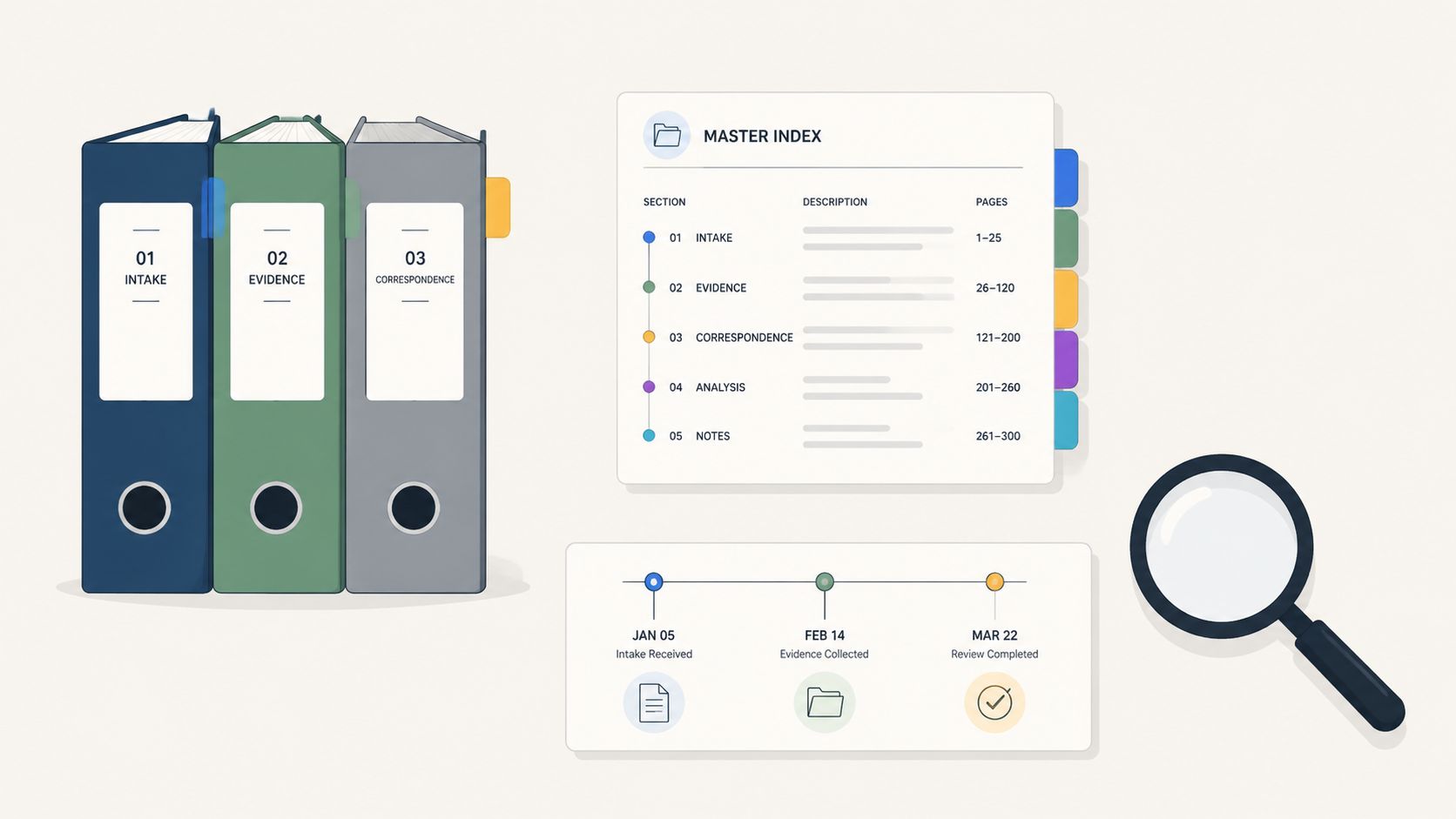
A trial-ready file isn't a separate project you begin at the end. It's the result of disciplined organization from intake forward. That means naming conventions, indexed folders, exhibit control, privilege separation, and a reliable chronology that everyone on the team can access quickly.
Organize for retrieval under pressure
Trial prep exposes every weak naming choice and every lazy folder dump. Build the file so someone can find a key page in minutes, not after a team-wide search.
A strong trial preparation checklist should include indexed medical records, deposition summaries, exhibit lists, witness files, expert materials, motions, rulings, demonstratives, and a current issues log. I also keep draft materials separate from finalized productions and maintain a record of what was produced, when, and in what form.
- Master index: Track major documents, Bates ranges, exhibit status, and where the final version lives.
- Transcript handling: Highlight liability admissions, impeachment points, and testimony that conflicts with records or prior statements.
- Expert coordination: Store CVs, reports, reliance materials, fee schedules, and scheduling notes together.
- Work product separation: Keep privileged strategy notes and internal summaries out of production-ready folders.
AI can help, but trust still has to be built
By this stage, AI-assisted chronologies and summaries can save major time if the source records were organized correctly at the start. But the same validation rule still applies. If a chronology is going into mediation prep, expert review, or trial prep, someone on the legal team has to verify the output against the underlying file.
That concern isn't theoretical. As noted in the verified brief, many paralegals remain unsure about how AI-generated chronologies will be treated if challenged. The answer isn't to avoid automation. It's to document your verification process so the team can explain exactly how the summary was built and checked.
8-Point Paralegal Personal Injury Checklist Comparison
| Checklist | Implementation complexity | Resource requirements | Expected outcomes | Ideal use cases | Key advantages |
|---|---|---|---|---|---|
| Initial Client Intake and Case Assessment Checklist | Low–Moderate | Paralegal time, intake forms, CMS integration | Complete baseline case data; deadlines calendared | New client onboarding; case triage | Prevents missed deadlines; uniform documentation |
| Medical Records Collection and Organization Checklist | Moderate | HIPAA authorizations, provider follow-ups, tracking tools | Complete, organized medical file; HIPAA compliance | Cases needing full treatment history | Prevents missing docs; organized chronology |
| Liability Investigation and Evidence Documentation Checklist | Moderate–High | Field investigation, photo/video, preservation letters, possible PI/expert | Preserved perishable evidence; documented liability facts | Scene accidents, premises, product defect cases | Early witness ID; strengthens negligence proof |
| Medical Records Review and Summary Creation Checklist | High | Medical expertise, extensive review time, templates or AI assistance | Concise medical summaries; identified gaps & causation support | Demand drafting; causation and damages analysis | Clear medical narrative; evidentiary backbone |
| Damages Calculation and Documentation Checklist | Moderate–High | Financial records, employer verification, experts, spreadsheets | Itemized damages; past/future loss estimates; ranges | Valuation for demand/negotiation | Defensible calculations; uncovers full loss |
| Demand Letter Drafting and Substantiation Checklist | High | Legal drafting skill, integrated medical & damages evidence | Persuasive demand letter; substantiated settlement ask | Initial settlement demand; insurer engagement | Increases credibility; higher opening offers |
| Settlement Negotiation Preparation and Execution Checklist | Moderate–High | Client authority documents, case summary, negotiator time | Clear negotiation parameters; documented authority | Settlement rounds; strategy-driven negotiations | Prevents unauthorized deals; improves outcomes |
| Case File Organization and Trial Preparation Checklist | High | Document management system, Bates numbering, ongoing maintenance | Trial‑ready, easily searchable case files | Litigation readiness; trial preparation | Rapid document retrieval; reduces prep time |
Build Your Bulletproof PI Workflow
At 4:45 p.m., an attorney asks for a settlement range on a case that should have been ready last week. The intake notes are incomplete, the records are still mislabeled, wage loss support is sitting in email, and nobody can tell whether the last treatment date is confirmed. That file does not have a legal problem first. It has a workflow problem.
A strong personal injury checklist for paralegals works as a stage-gated system. Each phase has a clear output, a defined owner, and a stop point before the file moves forward. Intake produces a usable case foundation. Records collection produces a complete and organized medical file. Liability work produces documented proof, not assumptions. Damages, demand drafting, negotiation, and trial prep each build on what the prior stage finished.
That structure changes daily operations. Attorneys get cleaner handoffs and fewer last-minute questions. New staff learn the firm's standard faster because "complete" is visible on the file, not stored in one senior paralegal's head. Clients get better updates because the team can answer from the record instead of rebuilding the case every time someone calls.
In a busy PI practice, file discipline affects value.
Small misses create expensive rework. An unsigned authorization delays records. Disorganized treatment notes slow summaries. Missing billing support weakens damages. A demand sent before liability proof and causation support are lined up gives the carrier room to discount the case. By the time that shows up as a lower offer or a longer negotiation cycle, the administrative mistake has already become a case outcome problem.
The fix is usually simple, but it has to be enforced. Start with the phase that causes the most delay in your office. For many firms, that is intake or medical records. Define the required inputs, set the completion standard, assign ownership, and block the next phase until those items are done. Then repeat the process across the remaining stages. That is how a checklist becomes an operating system instead of a reference document.
AI can help, but only inside that structure. Ares is one option for PI firms using automation for medical record review and demand drafting. It can save time on chronology building, record sorting, and first-pass narrative work. The primary gain comes from using it after records are collected and organized, and before attorney review, with validation built in. AI speeds up a clean process. It does not fix a broken one.
The firms that move cases well usually follow the same sequence every time, with fewer gaps, fewer handoff failures, and less duplicated work. That is what makes a PI workflow bulletproof. The file stays usable from intake through settlement, and it stays trial-ready if negotiations fail.
If your team is buried in records review or losing time on first-draft demand work, Ares is worth a look. It's built for personal injury practices and focuses on medical chronology extraction, record review, and demand drafting so paralegals and attorneys can spend more time on case strategy and less time rebuilding the file by hand.