

A medical file rarely arrives in the order a case needs. You may receive an emergency department export, a specialist's notes, therapy records, imaging reports, billing pages, and portal downloads from several providers, all merged into one PDF. The file looks complete until you try to answer the questions that matter: What happened first? When did the symptoms become documented? Which findings support causation? Where did treatment stop, and why?
The practical answer is to stop treating the chart as one document. The parts of medical records serve different purposes, and each module carries a different kind of evidentiary weight. A clinical note may establish the patient's account, an imaging report may narrow the medical explanation, and a billing ledger may show whether the treatment described in the narrative took place. Good review connects those pieces without overstating what any one of them proves.
Navigating the Complexity of Medical Files
A new file often lands with the familiar appearance of completeness. The PDF has hundreds of pages, the provider names are present, and the medical records department has marked the request fulfilled. Then the first review shows that the emergency visit is separated from the imaging report, the therapy notes are arranged by upload date rather than service date, and the billing pages contain codes without enough clinical context to explain the treatment.
That is where inexperienced review goes wrong. Reading from page one to the last page feels thorough, but it encourages the reviewer to follow the provider's export order instead of the patient's medical chronology. A better approach is to identify the record modules first, then rebuild the sequence of care from the dates, encounter types, diagnoses, tests, procedures, and follow-up instructions.
Start with the record architecture
Traditional records were organized around documents such as admission notes, progress notes, operative reports, postoperative notes, delivery notes, and discharge notes. Those documents captured the patient's history, clinical signs, diagnostic work, treatment, medication decisions, and follow-up continuity as a connected body of evidence, rather than as one standalone narrative. The history of early electronic systems, including Harvard Medical School's COASTER and Duke University's The Medical Record, shows why modern files still behave like collections of standardized modules rather than one continuous story. The historical overview of medical records provides useful context for that structure.
In a personal injury file, the structure helps you separate three questions:
- What did the patient report? Look first at the history of present illness, symptom descriptions, mechanism of injury, and functional complaints.
- What did the provider observe or measure? Review physical findings, diagnostic impressions, test results, and procedure documentation.
- What care followed? Track medications, referrals, therapy, restrictions, specialist recommendations, and discharge instructions.
The same event can appear differently in each module. An emergency note may describe immediate pain and limited movement. A radiology report may identify a finding without deciding whether the collision caused it. A therapy note may show that the limitation persisted during ordinary activities. None should be treated as a substitute for the others.
Build the chronology before valuing the claim
Create a working timeline with the date of service, provider, body part, complaint, objective finding, treatment, and next step. Include gaps as entries, not empty space. An unexplained interval may reflect recovery, an outside provider, a missed appointment, insurance friction, or a missing production. Those possibilities have different implications, so the gap needs investigation before it becomes an argument.
A structured review process, such as the workflow described in this guide to organizing medical records, prevents the file from dictating the order of analysis. The goal isn't to make the record look cleaner than it is. The goal is to expose the actual sequence, including contradictions, incomplete exports, changes in diagnosis, and treatment that appears in one module but not another.
Practical rule: A large PDF is not evidence of a complete record. Completeness is demonstrated when the modules connect into a consistent, traceable chronology.
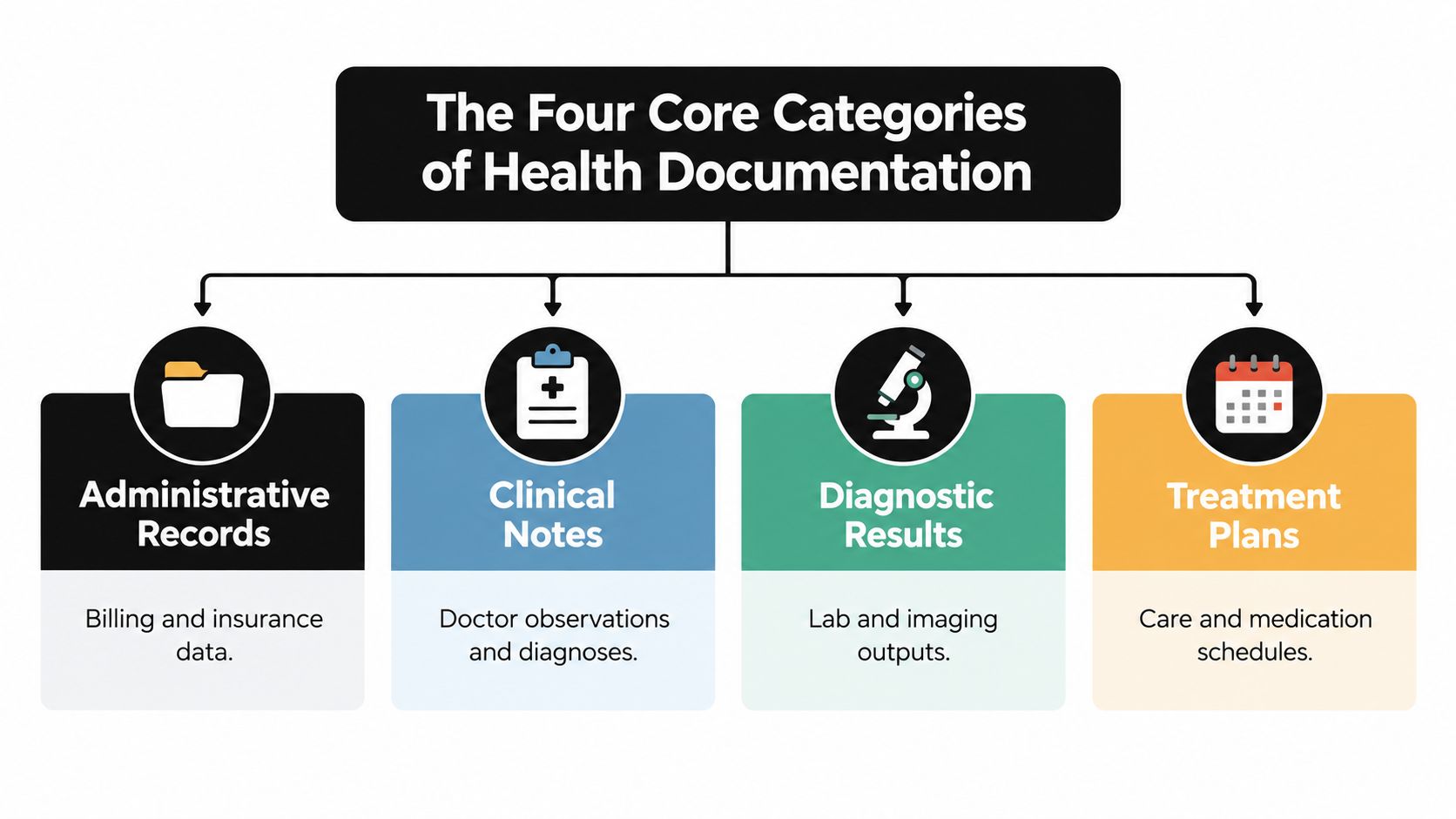
The Four Core Categories of Health Documentation
Medical documentation has several overlapping classifications, but a useful PI review begins with four working categories: clinical, diagnostic, administrative, and financial. They aren't four isolated folders. They are four ways of asking what the file can establish.
Clinical documentation
Clinical material includes the patient's history, physical examination, diagnoses, progress notes, consultation notes, treatment decisions, and discharge summaries. It usually supplies the narrative foundation for causation and damages. The emergency history may connect symptoms to the reported incident, while later progress notes can show whether those symptoms improved, persisted, or changed.
Clinical notes also contain limitations. They may copy forward earlier language, use broad diagnoses, or record the patient's account without resolving causation. A reviewer should distinguish a reported symptom from a documented examination finding and from a provider's medical assessment.
Diagnostic documentation
Diagnostic records include laboratory data, radiology reports, imaging summaries, and other test outputs. They can support or challenge the clinical narrative, but an image alone doesn't explain every symptom. The written impression, comparison studies, clinical context, and later treatment recommendations must be reviewed together.
A diagnostic result may show an abnormality without establishing when it developed. That is why the report should be matched to the history, prior records, and physical findings rather than quoted as an automatic causation conclusion.
Administrative documentation
Administrative records identify the patient, date the encounter, document consent and releases, and may include enrollment or case-management material. They help establish whose record you're reviewing, which provider created it, and whether the production includes the relevant episode of care.
They can also reveal that a record request was narrower than intended. A portal export, for example, may contain selected visit notes but not the provider's full chart, billing records, or raw images.
Financial documentation
Financial records include charges, payment information, claims records, and itemized billing. They support the economic component of a claim and help confirm that a service occurred. They can also expose discrepancies, such as a procedure described in a note but absent from the ledger, or a charge that doesn't align with the treatment chronology.
The clinical and financial categories answer different questions. Clinical notes explain why care was provided. Financial records show what was billed or claimed. A persuasive demand uses both without treating a charge as proof of medical necessity.
A complete record commonly includes administrative, legal, financial, and clinical portions, with the clinical portion covering identification, history, physical findings, diagnostics, treatment, and follow-up. The North Carolina Medical Board's discussion of medical-record documentation is a useful reference for understanding that broader structure.
Clinical Notes and the Patient Narrative
Clinical notes carry the patient's story, but they don't all carry the same evidentiary value. Review them in layers. Start with what the patient said, separate that from what the provider found, and then identify the decision the provider made based on those facts.
Read the history of present illness for the first account
The history of present illness, or HPI, is often the earliest detailed account of the event and symptoms. Extract the reported mechanism, onset, body parts, symptom quality, functional effect, prior symptoms mentioned, and reason for seeking care. Pay attention to whether the note records immediate symptoms, delayed onset, worsening complaints, or a specific change after the incident.
Don't reduce the HPI to a single sentence such as “patient had neck pain.” Record the details that may matter later, including whether the patient reported difficulty turning the head, lifting, sleeping, walking, working, or performing ordinary activities. Those functional descriptions can connect a diagnosis to lived impairment.
The HPI is still subjective evidence. It becomes more useful when later examinations, treatment decisions, and follow-up notes remain consistent with it. If later records describe a different onset or body part, flag the difference and determine whether it reflects correction, shorthand, a new complaint, or a genuine inconsistency.
Separate symptoms from examination findings
The review of systems can help show what the patient reported across body systems, but it often provides less detail than the HPI. The physical examination supplies the provider's observations. Look for range-of-motion limitations, tenderness, swelling, weakness, sensory changes, gait findings, reflex findings, and other documented abnormalities relevant to the alleged injury.
Record the exact body region and side when the note provides them. “Back pain” is less useful than a documented finding tied to a specific area and movement. Also capture negative findings when they affect interpretation. A normal neurological examination may matter even when the patient reports pain, particularly if later arguments depend on neurological impairment.
Track progress notes as a sequence
Progress notes show what happened after the initial encounter. Compare the symptom description, examination, diagnosis, treatment, and plan at each visit. A patient who reports persistent pain but demonstrates improving range of motion presents a different medical narrative from a patient whose symptoms and functional restrictions remain materially unchanged.
Use a comparison grid rather than relying on memory:
| Review point | Questions to answer |
|---|---|
| Symptoms | Is the same complaint repeated, resolved, or replaced by another complaint? |
| Findings | Do examinations confirm improvement, persistence, or deterioration? |
| Treatment | Was medication changed, therapy continued, or a referral made? |
| Function | Are work, sleep, mobility, or daily activities discussed? |
| Plan | What did the provider direct the patient to do next? |
Review discipline: Never call a treatment gap unexplained until you've checked referrals, outside-provider references, scheduling notes, and the completeness of the production.
Copied-forward language deserves careful attention. A templated statement may appear in several visits even when the examination changed. Compare the substantive portions of the note, not just the diagnosis code or repeated assessment. The strongest chronology identifies both continuity and change, because either can affect the causation and damages analysis.
Diagnostics, Imaging, and Procedural Evidence
A complaint of pain and an objective finding serve different functions. The complaint establishes what the patient experienced and reported. Diagnostic and procedural records may corroborate the condition, narrow competing explanations, or show why a provider selected a particular treatment. Neither category should be treated as conclusive in isolation.

Read the report, not just the image label
For radiology, begin with the Findings section. It describes what the radiologist observed. Then read the Impression, which generally distills the clinically relevant interpretation. Capture the exact anatomy, side, level, acute findings, comparison studies, and any language suggesting chronicity or degeneration.
A report can identify a condition without determining legal causation. Terms that indicate an acute process may support the timing of an injury, while degenerative language may raise a prior-condition issue. The answer depends on the complete record, including the patient's baseline, prior imaging, mechanism, examination, and provider's clinical assessment.
Don't cite an imaging label without reviewing the underlying report. A billing entry for an MRI confirms that a service was charged, but it doesn't tell you what the MRI showed. Likewise, a report may identify a finding that isn't addressed in the treatment plan, which can affect how much weight the finding deserves in the demand.
Match procedures to medical necessity
Operative notes and procedure reports are especially important because they describe what was performed, why it was performed, and what the provider observed. Review the preoperative diagnosis, postoperative diagnosis, indication, procedure, findings, complications, and follow-up instructions. Then compare those details with the later recovery notes.
Physical therapy records supply another cross-check. The evaluation should identify the functional problem and baseline limitations. Subsequent notes can show the exercises, tolerance, progress, persistent restrictions, and response to care. If a procedure is followed by therapy, match the procedure date, prescribed restrictions, therapy goals, and progress. That sequence is more persuasive than presenting isolated invoices.
A secure imaging workflow may require more than a PDF report. When the case turns on the actual study, a resource describing a DICOM viewer built by devPulse can help a litigation team understand why image files and their viewing environment are distinct from the written radiology interpretation.
Reconcile the clinical and billing trail
Use billing records as a verification layer:
- Date alignment: Does the billed service correspond to a documented encounter?
- Provider alignment: Does the rendering provider appear in the clinical record?
- Procedure alignment: Does the code correspond to the procedure described?
- Treatment continuity: Do later notes discuss the service or its expected result?
- Missing material: Is there a billed service with no report, or a report with no apparent billing entry?
Codes are useful indexing tools, not medical conclusions. They can point you toward missing records and help organize expenses, but they shouldn't replace the narrative and objective documentation needed to explain reasonableness, necessity, and causation.
Administrative and Legal Record Components
A record can contain clinically persuasive information and still be difficult to authenticate or interpret if the administrative foundation is weak. Before relying on a note, confirm that it belongs to the correct patient, provider, and encounter. A mismatched demographic page or unclear date can create avoidable questions about identity and chronology.
Confirm identity and service dates
Review the patient's name, date of birth, medical record identifier, facility, provider, and date of service. Check whether the pages carry consistent headers or encounter identifiers. If the production combines records from affiliated facilities, determine whether the same identifier follows the patient or changes between systems.
Dates require the same care. A note may contain a service date, signature date, entry date, and billing date. Those dates aren't interchangeable. Use the date of service for the medical chronology when it is available, and preserve the other dates when they help explain when a record was created or finalized.
Examine consent and authorization material
Consent forms, releases of information, treatment authorizations, and related legal documents can show that the provider was permitted to disclose the record and that the patient agreed to a procedure or treatment. They may also define the scope of what was requested or released.
An authorization isn't proof that the treatment was medically necessary. It supports the administrative chain around the record. Keep that distinction clear. The clinical note addresses the medical decision, while the authorization helps establish the circumstances under which the care or disclosure occurred.
Advance directives and other legal forms may not be central to every PI claim, but they belong in the administrative review when they affect decision-making, surrogate authority, or the interpretation of a hospitalization. Don't discard them just because they aren't part of the narrative note.
Look for case-management and enrollment material
Case-management records may contain referrals, outreach, care coordination, scheduling, and barriers to treatment. Enrollment records can identify coverage periods or the responsible health plan. These materials may explain why a referral was delayed, why care moved to another provider, or why the first production doesn't contain the next stage of treatment.
Use a chain-of-custody worksheet for each provider:
| Item | Verification question |
|---|---|
| Patient identity | Do the identifiers match the client? |
| Facility | Is the creating or holding entity clear? |
| Encounter | Is the date of service identifiable? |
| Production | Is the file complete, redacted, or partial? |
| Authorization | Does the release cover the requested material? |
| Exceptions | Are missing pages, excluded notes, or unavailable images explained? |
The point isn't to turn every record request into an evidentiary dispute. It is to identify problems early, while the provider, client, and records custodian can still clarify them.
Requesting the Complete Designated Record Set
Many intake teams request “the medical chart” and assume the provider will send everything relevant. That assumption is unsafe. A provider's ordinary chart export may omit billing, claims, enrollment, case-management, correspondence, or specific notes used in care decisions.
Understand what the designated record set can contain
Under HIPAA, the designated record set can include more than traditional medical notes. The U.S. Department of Health and Human Services explanation of medical-record access identifies categories that may include medical records, billing and payment records, claims information, enrollment records, case-management records, laboratory reports, X-rays, consent forms, and certain clinician notes used to make decisions about care.
That scope changes the request strategy. Ask for the chart, but also identify the specific modules that could fill chronology or damages gaps. A request that names only office notes may produce exactly that, while leaving the financial and diagnostic evidence in another system.
Draft the request by module
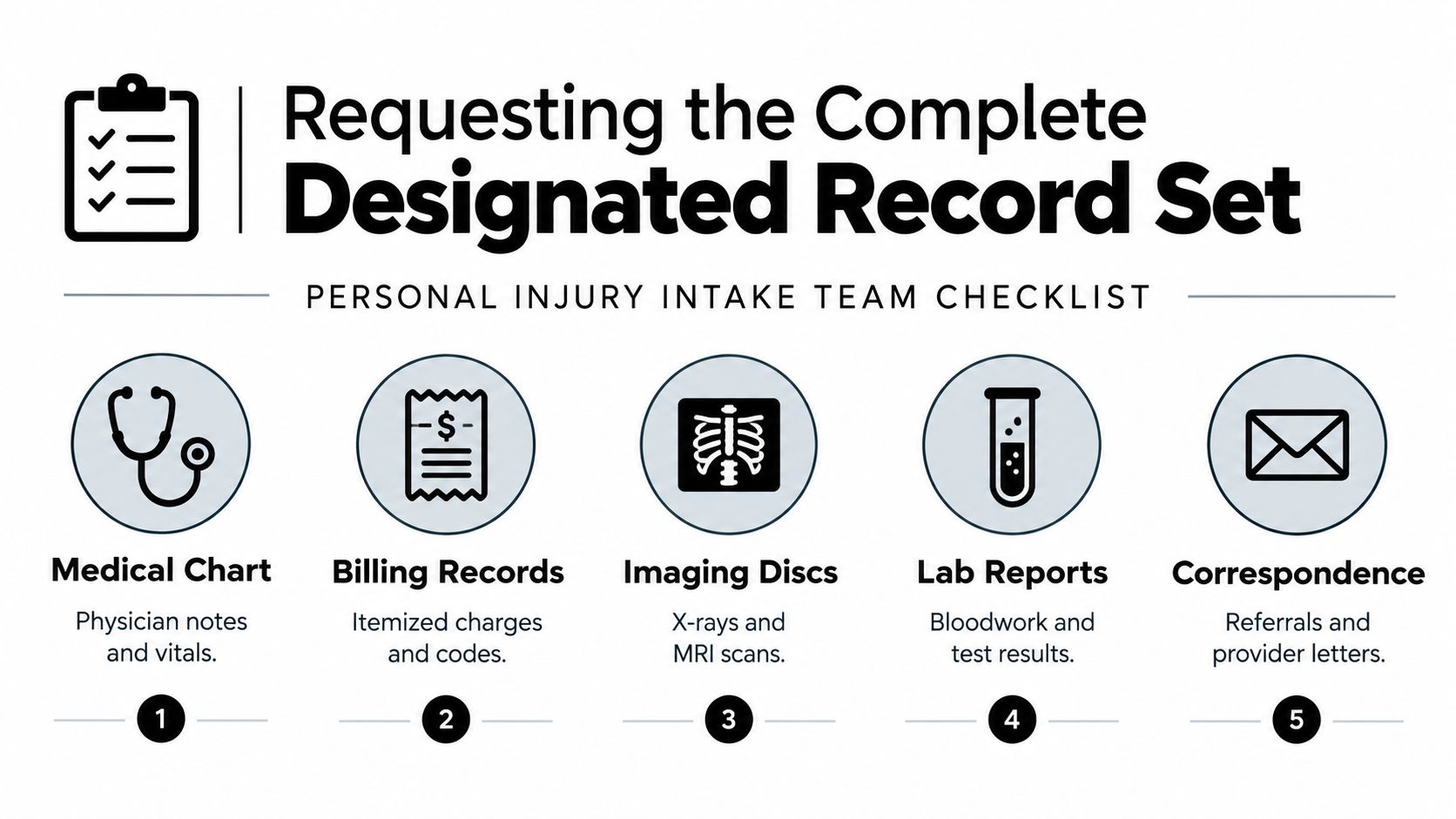
A practical request should identify:
- Medical chart: Admission, emergency, progress, consultation, operative, postoperative, and discharge notes.
- Diagnostics: Radiology reports, laboratory reports, imaging studies, image discs, and related interpretations.
- Treatment: Medication administration, prescriptions, therapy records, referrals, restrictions, and follow-up instructions.
- Financial material: Itemized bills, ledgers, payment records, claims, and account histories.
- Administrative material: Registration, demographic records, consent forms, authorizations, enrollment information, and case-management notes.
- Communications: Referrals, provider correspondence, scheduling records, and messages that document care coordination.
If the client needs help preparing a request, a practical guide on how to request your health records can help organize the basic information before the firm sends its formal authorization and production instructions.
Ask whether the production is partial
Do not ask only, “Did you send the complete chart?” Ask the custodian to identify what systems and date ranges were searched, what categories were excluded, whether imaging was provided in original format, and whether any records were withheld or unavailable. Request an explanation for every stated limitation.
A portal download may be useful for immediate triage, but it shouldn't be labeled complete without confirmation. The same applies to a provider's “continuity of care document.” It may contain clinically important elements while omitting the full narrative, billing detail, or raw diagnostic files.
The guide to obtaining medical records for legal review reinforces the practical value of requesting by provider, date range, and record type. That level of specificity makes follow-up easier because the firm can identify precisely what remains outstanding instead of sending repeated general requests.
Navigating Digital Portals and Partial Records
Digital access has made initial intake faster, but faster access isn't the same as complete access. The record may now arrive as a portal download, a patient-generated PDF, a continuity document, a secure message export, or a link to images. Each format can contain useful evidence while omitting other modules.
The shift is measurable. ONC data reported that 77% of individuals were offered online access to health information in 2024, compared with 73% in 2022, and that 65% accessed it online at least once in the past year, compared with 57% in 2022. Those figures describe access and use, not completeness, which is the distinction PI teams need to preserve.
Know what a portal export may leave out
A patient portal commonly makes selected allergies, medications, immunizations, provider notes from a visit, and test results available as partial records. That can be enough to confirm a diagnosis date or identify a facility, but it may not include the full provider narrative, signed orders, complete billing ledger, raw imaging, therapy flowsheets, or internal care-coordination material.
Review the export for signs of incompleteness:
- Single-visit boundaries: The file covers one encounter but refers to earlier or later care.
- Summary language: A result is displayed without the full report or source attachment.
- Missing signatures: Notes appear without finalization or authentication information.
- No financial module: Charges, payments, claims, and account history are absent.
- No image files: The report is present, but the actual study is not.
- Broken chronology: A referral or follow-up is mentioned without the receiving provider's record.
Use the portal as an index
A portal can help identify provider names, service dates, test types, and likely missing documents. Treat those details as search terms for a formal request. Preserve the original download and its metadata when possible, then compare it with the provider's medical-records production.
When the portal shows “MRI completed,” request the radiology report and the original study. When it shows a follow-up appointment, request the note, examination, plan, and any therapy or referral documentation connected to that visit. When it shows a bill, request the itemization and claims detail rather than assuming the displayed balance is the complete financial record.
Follow up with targeted questions
A concise follow-up can ask the records department to confirm whether the production includes all encounter notes, diagnostic reports, images, therapy records, billing and claims records, correspondence, and case-management material for the requested period. It should also ask whether another facility, legacy system, or affiliated provider holds related records.
Digitization has made modular review normal. The modern reviewer must be comfortable working from fragments while actively testing whether those fragments can support the conclusion being drafted. A partial record can start the chronology. It shouldn't silently become the entire evidentiary foundation.
Structuring Data for Demand Letter Drafting
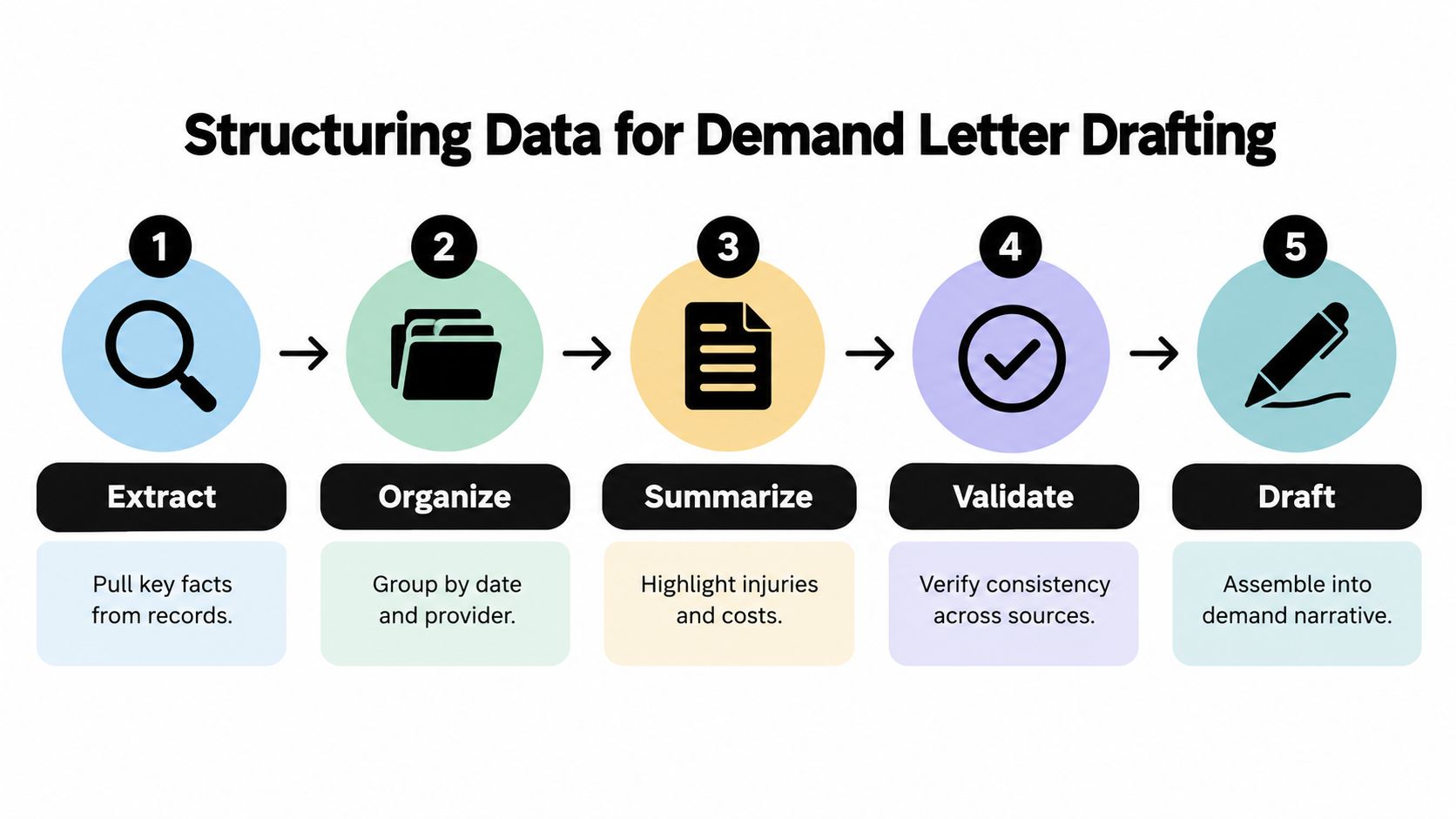
A demand letter becomes difficult to defend when the writer has to search the PDF for every date, diagnosis, treatment, and charge while drafting. The solution is to extract the evidence into a working chronology before writing the narrative. The chronology should preserve source location, not just summarize the medical story from memory.
Extract the facts that change the case
Start with one row per meaningful event. Include the service date, facility, provider, encounter type, body part, reported symptom, objective finding, diagnosis, treatment, functional impact, follow-up plan, and source page or file name.
Don't extract every sentence. Extract the facts that answer the legal and medical questions. An emergency note describing onset, a radiology impression describing an acute finding, a therapy note documenting limited function, and a final bill may each deserve a row because each contributes a different part of the claim.
Organize by chronology and body part
Chronology should be the primary view, but a body-part index catches problems chronology alone may hide. Separate cervical, thoracic, lumbar, shoulder, knee, head, and other claimed areas when the file contains multiple complaints. Identify whether each body part appears in the initial account, examination, diagnostic workup, treatment plan, and later follow-up.
A useful working table looks like this:
| Date | Provider and setting | Record module | Key evidence | Case use |
|---|---|---|---|---|
| Service date | Facility or clinician | HPI or examination | Symptom, finding, or limitation | Onset and severity |
| Service date | Radiology or laboratory provider | Diagnostic report | Finding and impression | Corroboration or differential |
| Service date | Specialist or therapist | Progress or treatment note | Response, restriction, or function | Persistence and reasonableness |
| Service date | Billing department | Ledger or claim | Charge and service detail | Special damages |
Summarize without overstating
The summary should distinguish documented fact from interpretation. “The patient reported difficulty sleeping” is different from “the injury caused sleep impairment.” “The MRI report described a finding at the lumbar level” is different from “the collision caused the finding.” The demand can argue causation, but the record citation should accurately state what the source says.
Use the medical record summary workflow to keep the chronology tied to source documents. Page references, file names, and encounter dates let another reviewer verify the statement quickly and let the attorney revise the demand without reopening the entire PDF.
Validate before drafting
Run a consistency check across the modules:
- Date check: Does each treatment event have a service date?
- Provider check: Does the named provider match the bill and report?
- Diagnosis check: Does the diagnosis appear consistently, or does it change?
- Causation check: Does the timing support the argument, or does the record identify another explanation?
- Gap check: Are missing periods explained by a record, referral, or client interview?
- Expense check: Does each claimed charge correspond to documented care?
The final draft should place the strongest evidence where it answers the likely defense. If the defense questions onset, lead with the earliest consistent account. If it questions treatment necessity, connect the examination, diagnosis, treatment plan, and response to care. If it questions damages, tie the billing ledger to the actual services described in the record.
Quick Reference Checklist for Record Completeness
Before a demand goes out, perform a completeness audit separate from the merits review. A case can have strong facts and still lose credibility because the file lacks the discharge summary, the imaging study, the itemized ledger, or an explanation for a long treatment interval.
Confirm the clinical sequence
Check that the file includes the initial encounter, history of present illness, review of systems where relevant, physical examination, diagnoses, medications, referrals, restrictions, progress notes, specialist consultations, therapy records, operative or procedure notes, and discharge or follow-up documentation.
Then compare the first account with later entries. Confirm that the claimed body parts, symptom onset, functional limitations, and treatment response are either consistent or explained. A discrepancy isn't automatically fatal, but an undiscovered discrepancy can become a damaging surprise.
Confirm objective and procedural support
Verify that each referenced test has a report and, where material, that the actual image or study is available. Review the findings and impression, comparison language, acute or chronic descriptors, and the provider's response to the result.
For procedures, match the indication, operative or procedure note, postoperative instructions, therapy plan, and later progress. Make sure the demand doesn't rely on a procedure code when the supporting clinical documentation is missing.
Confirm administrative and financial support
Use this final list:
- Identity: Patient identifiers match across providers and facilities.
- Dates: Service dates are distinguished from signature, entry, and billing dates.
- Authorizations: Releases, consents, and relevant treatment authorizations are present.
- Provider coverage: Every provider named by the client or in the chart has been requested.
- Designated record set: Billing, claims, enrollment, case-management, and decision-related records were considered.
- Charges: Itemized bills and ledgers correspond to documented services.
- Images: Raw studies are requested when the written report is not enough.
- Correspondence: Referrals, provider letters, scheduling material, and care-coordination records are reviewed.
- Gaps: Every material treatment gap has an explanation or remains clearly identified as unresolved.
Decide what still needs follow-up
If the file is missing a module, don't bury that fact in a general note. Create a short outstanding-records list with the provider, requested category, date range, reason it matters, and follow-up status. That list gives the attorney a defensible basis for deciding whether to delay the demand, proceed with a qualification, or obtain clarification from the client or provider.
A complete file isn't one with the most pages. It's one in which the relevant parts can be traced from event, to symptom, to finding, to treatment, to expense, with known limitations stated plainly.
Ares helps personal injury teams turn uploaded hospital, clinic, therapy, operative, nursing, and discharge records into organized medical chronologies and summaries with source-linked references. Visit Ares to review how the platform can support record completeness checks and demand-letter preparation.