

Most advice about paralegal case management starts in the wrong place. It recommends better templates, longer checklists, and faster document review, as if the central problem were typing speed or file storage. Those tools matter, but a personal injury firm usually falls behind because paralegals must decide which parts of a growing record set deserve attention, which require escalation, and which add no meaningful value to the claim.
A litigation-support survey found that 93% of respondents said the data volume managed for an average dispute is increasing, while half said the number of documents, records, or exhibits used at trial remains the same according to the National Association of Legal Assistants. That gap changes the job. The operational bottleneck isn't only document review. It's triage, prioritization, and judgment.
This guide presents a practical model for PI firms. It covers the end-to-end workflow, evidence architecture, integrity controls, realistic AI use, and a 30-day adoption plan built around measurable operating habits rather than a new headcount request.
Why Most Paralegal Case Management Advice Misses the Real Problem
A firm can have polished intake forms and still lose days on a medical-record dump. It can have a case management platform and still leave a critical imaging report buried under duplicate productions, billing pages, and administrative correspondence. Templates organize intended work. Triage determines what work deserves to happen first.
The same survey reported that 47% of respondents rated their case management adoption and consistency below average, and 30% said they used a case management solution that was at least 10 years old in the NALA litigation-support trends report. Those findings point to an operating problem, not just a software problem. A system can store every file and still fail if nobody has defined priority, ownership, or the next decision.
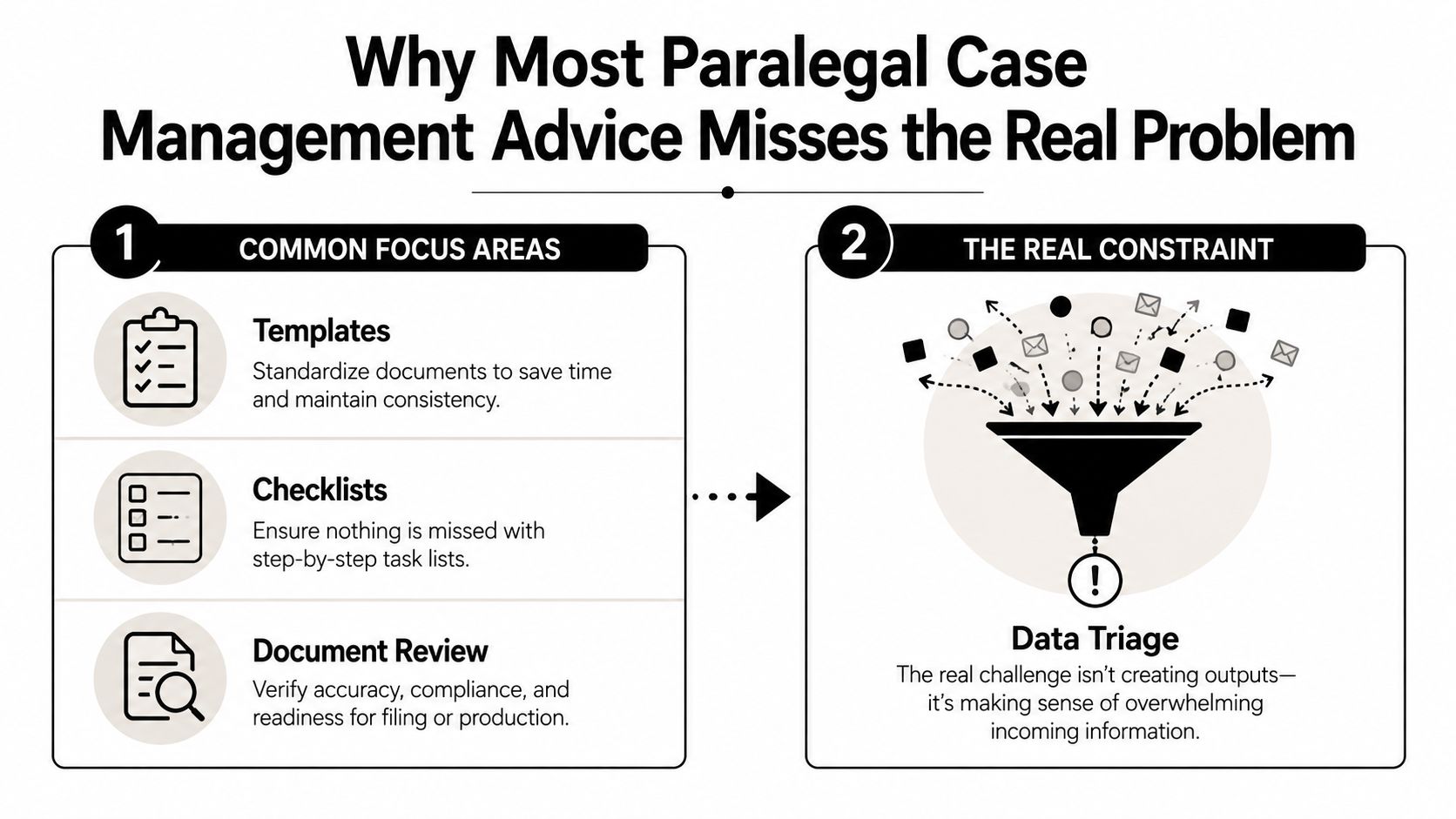
Speed alone doesn't clear the queue
Faster review helps only when the reviewer knows what to extract. In a PI matter, the useful output isn't a folder containing every received record. It's a reliable chronology, a provider map, a liability timeline, and a short list of contradictions or missing proof that an attorney can act on.
That distinction explains why a workflow built around “process everything” keeps failing after the next production arrives. The firm needs a repeatable way to rank records by legal relevance, urgency, and evidentiary reliability.
Practical rule: If a document doesn't change liability, causation, damages, coverage, a deadline, or the credibility of a witness, it shouldn't receive the same review priority as one that does.
A triage-first workflow still uses checklists and templates. It puts them in their proper place. The checklist confirms that the team completed the right action. It doesn't decide which medical inconsistency threatens the claim or whether a missing witness statement creates a liability gap. Those decisions remain with trained legal professionals.
What Paralegal Case Management Actually Means in a PI Firm
In a personal injury firm, paralegal case management is the structured coordination of the matter from intake through demand, litigation, negotiation, and resolution. The work connects records, deadlines, clients, providers, insurers, experts, opposing counsel, and attorney decisions in one operating picture.
That's different from general legal administration. Administrative support may schedule a meeting or save an attachment. A PI paralegal must understand why a policy provision matters, whether the treatment record supports the claimed injury, and which missing item could weaken a demand. The paralegal doesn't replace attorney judgment, but the paralegal makes that judgment possible by presenting the facts in a usable form.
The work has both control and judgment layers
A strong file includes control work:
- Intake verification: Confirm the parties, incident details, potential coverage, conflicts, and applicable limitation dates.
- Records coordination: Request police, EMS, medical, wage, and insurance materials, then track status and follow-up.
- Treatment monitoring: Map providers and treatment to claimed injuries while flagging unexplained gaps or changes.
- Demand preparation: Assemble the chronology, supporting records, damages summary, and liability materials for attorney review.
- Resolution support: Coordinate negotiations, mediation logistics, releases, lien information, and closing requirements.
The judgment layer sits inside those tasks. A paralegal may recognize that a later diagnosis needs an explanation, that a provider's note conflicts with an earlier history, or that a surveillance video should be preserved before it disappears. Those observations drive the attorney's next question.
The profession's shift toward specialized case work has historical roots. The National Federation of Paralegal Associations was founded in 1974 by eight associations, reached 15 member organizations by 1978, and expanded to 27 associations with more than 6,000 individuals by 1983. In 1987, it formally agreed on a definition of “paralegal” while treating “paralegal” and “legal assistant” as interchangeable terms as summarized by The Legal Assistant. The modern PI paralegal operates in that professionalized tradition, with responsibility for structured substantive work rather than simple file handling.
The End-to-End Workflow From Intake to Demand Letter
A PI workflow should make the next action obvious. Each stage needs an owner, deadline, visible status, and quality check. Without those controls, document volume grows faster than trial-usable material, and the file starts depending on memory instead of judgment.
Eight stages that keep a matter moving
Intake: Verify coverage, conflicts, incident facts, and the statute of limitations within the firm's intake window. Escalate uncertainty rather than marking the matter complete.
Records: Request police reports, EMS run sheets, medical records, bills, imaging, wage documentation, and insurance materials. Log the recipient, request date, expected response, and next follow-up.
Treatment tracking: Tie each provider and treatment date to the claimed injuries. An unexplained gap requires review before it shapes the demand narrative.
Liability development: Collect statements, photographs, video, incident reports, vehicle information, and other proof while preservation remains possible. Record who supplied each item and what it may establish.
Damages assembly: Organize medical specials, wage-loss support, out-of-pocket expenses, liens, and other claimed losses. Separate verified amounts from items still needing documentation.
Demand preparation: Build a chronology with page references, liability narrative, injury analysis, and damages summary. The attorney should receive a structured package, not unsorted PDFs.
Negotiation support: Track carrier requests, responses, authority questions, mediation scheduling, expert needs, and outstanding proof. Each communication should create a recorded next step.
Resolution: Confirm settlement terms, releases, lien handling, client instructions, distribution requirements, and closing documents before the matter leaves the active pipeline.
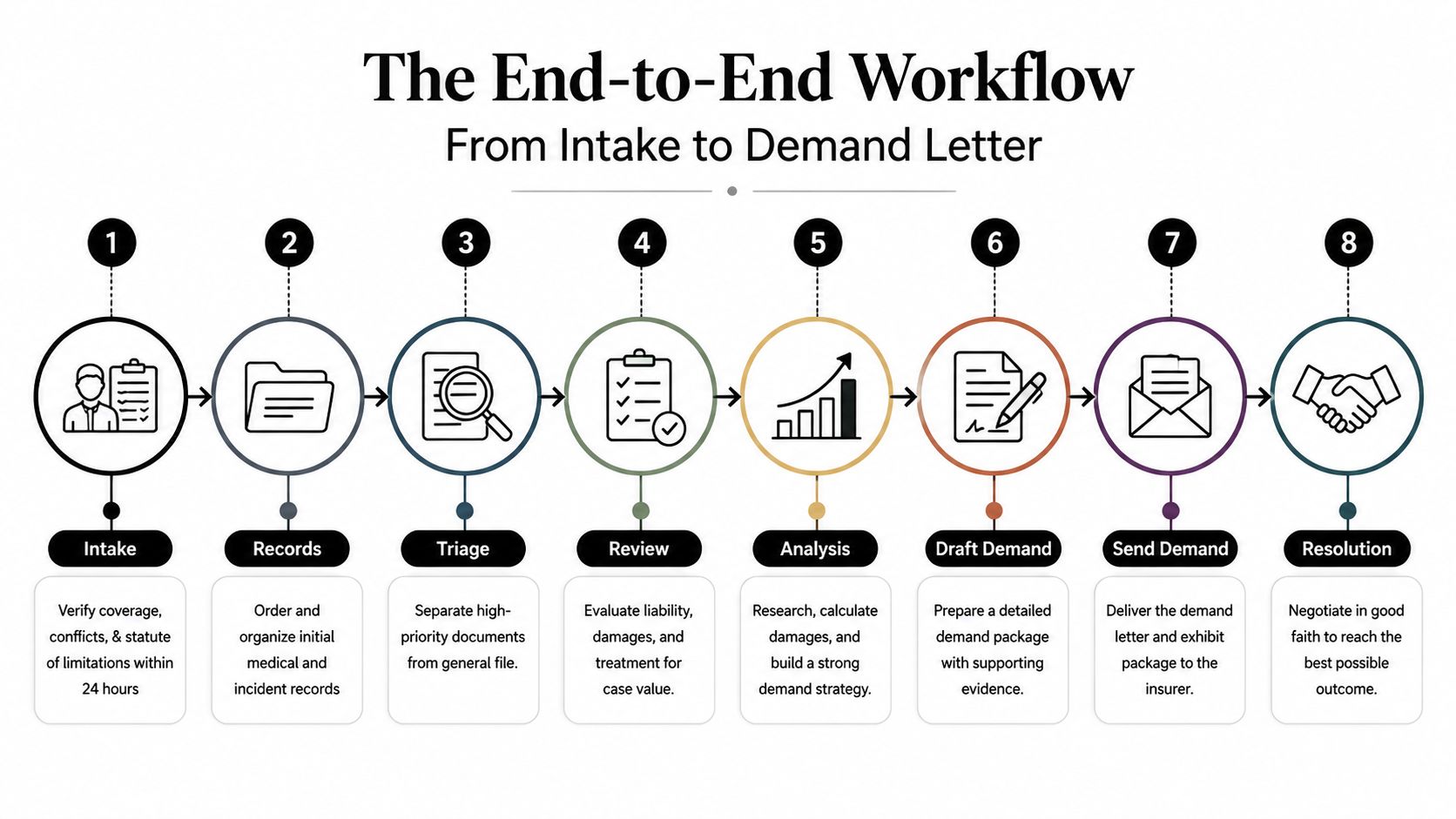
Use four status labels: active, waiting, blocked, and ready for review. For example, after a client finishes treatment, a matter is waiting if the final provider records were requested, blocked if a key authorization or missing record prevents damages review, active when the paralegal is reconciling bills and treatment dates, and ready for review when the chronology, citations, gaps, and contradictions meet the attorney's acceptance standard. “Records requested” is not “records received,” and “demand drafted” is not “demand ready for attorney review.”
A practical handoff names the owner, deliverable, due date, and acceptance standard. “Medical chronology complete” should mean providers are identified, treatment dates are ordered, key diagnoses are cited, missing records are listed, and contradictions are flagged. AI can reduce sorting and review time, but the bottleneck shifts to deciding what matters, what remains unproven, and what the attorney must address.
Core Responsibilities and Where Paralegals Add the Most Value
Paralegal value is not measured by how many documents a file contains. It is measured by how quickly the team can identify what affects liability, causation, damages, and the next legal decision. A 1993 Department of Justice survey found that lawyers reported spending an average of 40 hours per week on tasks included in the study and estimated that paralegals could perform about 25% of that work in the Department of Justice survey. The figures are historical, but the allocation question still holds: which work requires legal judgment, and which work can be standardized without weakening the file?
The answer depends on the matter stage. Pre-suit work centers on records, chronology, liability framing, and damages assembly. Litigation adds discovery control, deposition preparation, exhibit coordination, expert materials, and deadline management. Paralegals add the most value where document volume must be converted into a reliable decision structure.
The survey also found strong demand for support with case-file management. 56.8% of respondents said paralegals could take on up to five additional hours of case-file management work, while 40.6% reported zero additional demand for that task. The contrast supports a practical staffing rule: firms should assess workflow demand before adding capacity. Some need structured delegation. Others need triage, clearer priorities, and fewer unresolved records competing for attention.
| Task Category | 1993 DOJ Share | Modern PI Firm Share | Value Tier |
|---|---|---|---|
| Case-file management | Included in study, exact category share not specified | High, across every matter stage | Judgment and control |
| Records organization | Included in study, exact category share not specified | High during intake, treatment, and demand | Judgment-bearing |
| Chronology and issue spotting | Included in study, exact category share not specified | High when causation or credibility is disputed | High-value analysis |
| Filing, stamping, and routine formatting | Included in study, exact category share not specified | Variable, often standardized | Delegable throughput |
| Attorney handoff and deadline control | Included in study, exact category share not specified | High throughout litigation | Control function |
Allocate work by risk, not convenience
Keep liability theory selection, settlement valuation, client communication about adverse developments, and credibility conclusions with the attorney or an experienced paralegal working under defined supervision. Standardize Bates stamping, routine naming, filing confirmations, calendar entries, and follow-up reminders when the quality check is clear.
Contract paralegals can increase throughput for defined production work, provided the firm supplies issue definitions, naming rules, escalation triggers, and review standards. AI can assist with first-pass extraction and sorting, but it cannot decide what a record proves, which gap threatens the claim, or whether a contradiction changes case value. As document volume rises, review becomes faster while judgment carries more of the workload. The paralegal's strongest contribution is making that judgment easier to perform and easier to audit.
Turning Raw Records Into Trial-Ready Evidence
A provider folder can hold every record and still hide the case. Trial-ready organization starts when the paralegal turns incoming material into answers to legal questions, not merely a larger document collection.
Legal education materials emphasize charts, checklists, and sequencing that bring critical facts into view. The order and placement of records affect how quickly attorneys can locate admissible proof and develop a trial narrative as discussed in these legal education materials.
Build the timeline before the argument
Create an indexed timeline that brings together EMS, police, emergency, primary-care, specialist, therapy, imaging, and billing records. Each entry should state the date, provider, event, diagnosis or complaint, treatment, page reference, and connection to liability, causation, or damages.
Then organize the material by issue:
- Liability: Statements, photographs, reports, video, roadway or premises evidence, and preservation correspondence.
- Causation: Initial complaints, mechanism of injury, diagnostic findings, prior conditions, intervening events, and treatment progression.
- Damages: Bills, wage records, restrictions, future care materials, liens, and out-of-pocket losses.
- Coverage and procedure: Policies, declarations, correspondence, notices, releases, and deadline records.
This architecture follows the questions raised by an attorney, mediator, expert, or judge. Keep provider folders as source archives, but give the team issue-based paths to the same proof.
Link Bates ranges, exhibit numbers, deposition references, and motion citations. An exhibit supporting a demand statement, discovery response, and deposition question should be retrievable from each path. Firms assessing ways to reduce manual friction in medical files can review medical record review for attorneys.
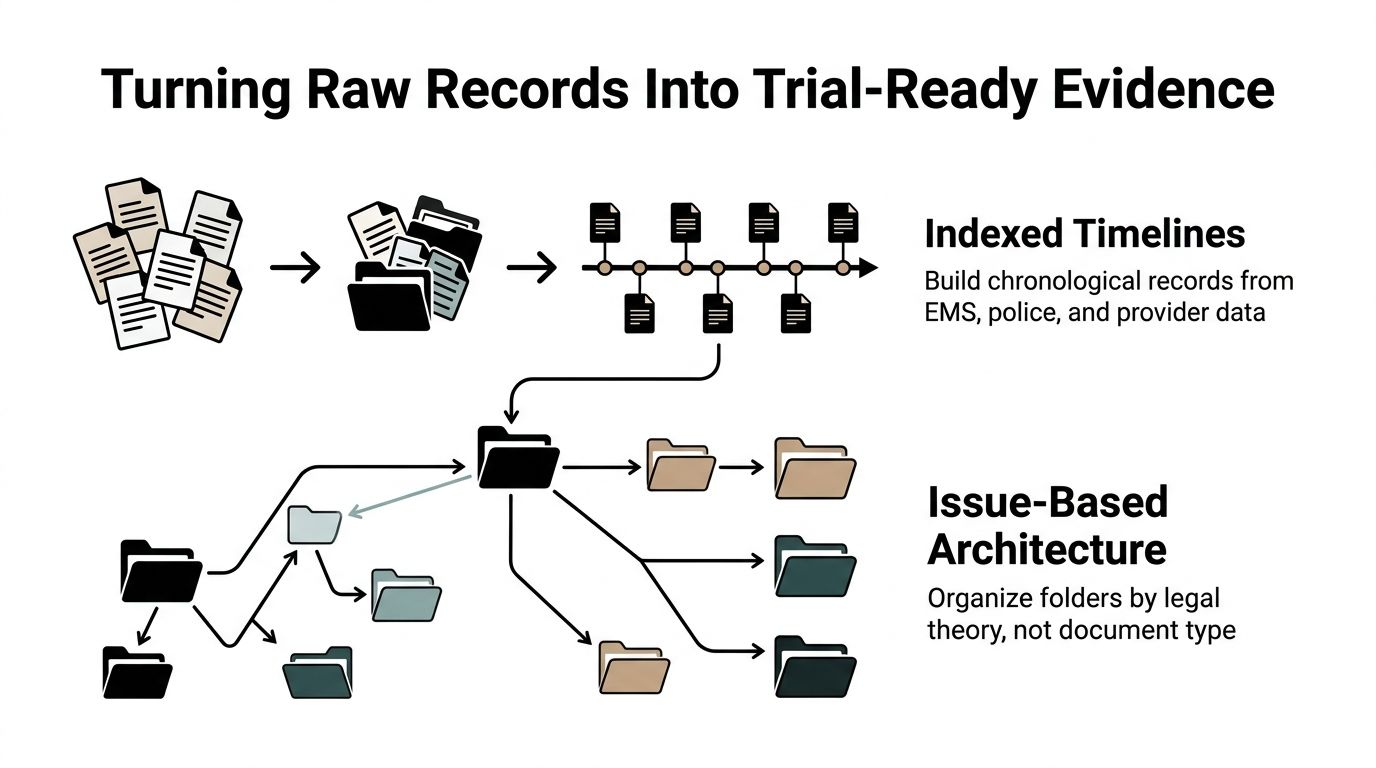
Deduplicate before substantive review. Tag information by provider and issue, not only by filename. Maintain an impeachment log tied to deposition transcripts, prior statements, dates, and the exact record creating the inconsistency.
The useful unit of work is the answer a document helps the team prove.
This approach shifts the output from “records received” to “evidence ready for a decision.” It also exposes missing records and contradictions beside the supporting material, so attorney review focuses on judgment rather than searching. As document volume grows, faster extraction does not remove the bottleneck. It moves the bottleneck to deciding which facts matter, which gaps threaten the claim, and which contradictions require escalation.
Chain of Custody and Document Integrity: Practices That Survive Scrutiny
Document integrity usually fails through routine handling, not dramatic misconduct. An attachment stays in one person's inbox, a revised production replaces an earlier copy, or a cloud folder preserves the file but not a clear history. Months later, the team cannot identify which version supported the demand or who handled the original.
A defensible process records how evidence entered the file, where it stayed, and who changed or transferred it. The log should capture acquisition date, location, matter number, storage method, and ownership. These controls apply to physical, documentary, and digital evidence, and they reduce disputes over authenticity and potential spoliation risk. Practical guidance is available in this evidence-handling resource.
Build the controls into intake
Preserve the received file before review, then create a working copy. For digital evidence, a hash records a file fingerprint, while write-blocking methods can reduce the risk of alteration during acquisition. Use a naming standard that identifies the matter, source, date, document type, and version. A naming rule should not depend on one paralegal remembering how the firm stores files.
Keep one authoritative repository. Email is a delivery channel, not the evidence database. If a carrier sends an EUO packet, opposing counsel produces discovery, or a provider issues a corrected record, log the sender, recipient, date, purpose, file identity, and storage location. Preserve the earlier version and identify the correction rather than allowing the new file to erase the record's history.
Physical storage needs equivalent controls. Limit access, document removal and return, and separate active working materials from originals. Firms reviewing secure storage layouts can use evidence storage room design to assess organization, access, and controlled handling.
Put recurring failure points on the checklist
- Email drift: Save the attachment to the matter record and record its source. Do not leave the only copy in an individual inbox.
- Phantom duplicates: Mark superseded files clearly and preserve the original. Sync tools should not create competing versions with unclear authority.
- Unsigned records: Flag records missing expected certifications, declarations, or custodian information for attorney review.
- Unlogged transfers: Record each physical or digital movement when it occurs. Reconstructing the chain after a dispute creates avoidable uncertainty.
A clean chain supports demand drafting, discovery responses, expert review, and motion practice. It lets the attorney answer a practical question with documents, not memory: how did this item move from its source into the exhibit set? Firms formalizing these controls can review audit trail requirements and adapt the principles to their systems and jurisdictional obligations.
Where AI Helps and Where It Does Not
AI's practical role in PI case management is pre-screening. Document volume keeps rising, while the material usable at trial does not necessarily increase at the same pace. Firms need to reduce first-pass review without handing legal judgment to a software tool.
AI can sort records, identify dates, group likely duplicates, extract providers and diagnoses, draft a chronology, apply Bates numbers, and flag language that appears inconsistent with earlier statements. The result is a prioritized review queue. A paralegal still must decide whether an inconsistency matters, whether a prior condition affects causation, and what information the attorney needs before setting a settlement position.
| Task Category | AI Helps With | Keep with Attorney or Paralegal Judgment |
|---|---|---|
| Medical records | Sort records, extract dates, providers, diagnoses, and treatment events | Decide clinical significance and causation |
| Document control | Detect likely duplicates, apply naming rules, and assist with indexing | Confirm the authoritative record and integrity history |
| Chronology | Build a draft sequence with source references | Resolve conflicting dates and select the narrative |
| Demand support | Create an initial factual scaffold from approved information | Set valuation, tone, legal theory, and requested resolution |
| Contradiction review | Flag apparent conflicts across records and statements | Decide whether a conflict affects credibility or proof |
Pilot one bounded use case
A PI firm could begin with medical-record intake for one matter type. The tool receives only approved records, extracts dates, providers, diagnoses, and treatment events, then places each item beside its source citation. The paralegal compares the draft against the records, marks omissions or incorrect extractions, and sends unresolved medical or causation issues to the attorney.
That pilot has a clear boundary. It tests whether AI reduces sorting and extraction time while preserving source review. It does not permit the tool to diagnose, select a liability theory, value the claim, communicate adverse conclusions to a client, or decide which injury defines the case.
Teams assessing broader applications can review AI for lawyers, then set matter-specific privacy, access, retention, and quality controls before connecting a system to live files. Define “correct” in advance. For a chronology pilot, that may mean every extracted event has a source, missing records are visible, and interpretations are labeled for human review.
AI output requires a documented check. The paralegal should confirm citations, compare extraction with the source, separate facts from interpretation, record omissions, and escalate disputed points. A confident summary without support can make an error harder to detect.
A broken workflow remains broken after automation. If naming rules, source records, and review ownership are unclear, AI will produce polished output faster without improving the evidence file. Its value appears when the firm uses it to prepare better review queues, leaving judgment with the people accountable for the matter.
KPIs, Templates, and a 30-Day Adoption Plan
A useful KPI shows where a matter is slowing or where evidence quality is weakening. It should not reward activity that produces more clutter. A rising document count means little if the attorney still lacks a usable chronology, a complete liability file, or a clear list of missing proof. The operating question is whether each matter is becoming easier to evaluate and act on.
Track movement and decision readiness
Use a small scorecard tied to handoffs and judgment:
- Intake to records request: Measure how quickly the first necessary requests leave the firm.
- Records received and triaged: Track incoming records, review status, categorization, and unresolved gaps.
- Chronology build time: Record the time from a sufficiently complete production to an attorney-ready chronology.
- Demand turnaround: Measure the interval from demand assignment to an attorney-ready draft.
- Client touchpoints: Confirm that planned updates and requests occur consistently.
- Settlement pipeline coverage: Check whether active matters have records, damages support, and defined next actions.
Baseline the workflow before changing it. The purpose is diagnosis, not an arbitrary target. Compare delays across records retrieval, review, attorney handoff, missing information, and revisions. A short cycle time can still conceal weak triage if attorneys must repeatedly rebuild the file.
Use templates as guardrails
Create four working templates:
- Records request tracker: Include source, request date, follow-up date, received status, missing items, and escalation owner.
- Issue-based folder structure: Use consistent folders for liability, causation, damages, coverage, discovery, experts, and resolution.
- Demand outline: Tie every factual assertion to chronology entries and source pages.
- Weekly audit sheet: Review deadlines, blocked tasks, missing records, client contact, integrity exceptions, and attorney decisions.
Templates should reduce variation at predictable failure points. They should also leave room to record exceptions, because unusual injuries, fragmented treatment, and disputed causation rarely fit a clean sequence.
Roll out the change in four weeks
Week one maps the current workflow and captures baseline cycle times. Interview the people doing the work. Their workarounds often show where the formal process fails.
Week two standardizes folder structure, naming conventions, the request tracker, and handoff definitions. Train with examples from closed matters, handling sensitive information appropriately.
Week three introduces one AI-assisted triage use case. Require source-level checks, define escalation rules, and sample outputs before expanding the tool's role.
Week four compares the baseline with the new process, records the gains and failures, and revises the SOP. Templates should support consistent decisions, not turn experienced paralegals into checkbox operators. Their judgment remains the firm's primary control.
Ares helps personal injury firms organize medical records, extract dates, diagnoses, providers, treatments, and symptom chronology, and create structured summaries and demand drafts for review. Visit Ares to see how paralegals can turn document volume into case-ready judgment with an AI-assisted triage workflow.