

Two weeks after a rear-end collision, your client sees a primary-care doctor for neck pain. The progress note is three lines. A chiropractor ordered an MRI, but no referral appears in the file. The billing extract shows a Level 4 evaluation and management code, while the narrative reads more like a routine Level 2 visit. The insurer calls the treatment delayed, the imaging unexplained, and the bill inflated.
That file isn't unusual. Outpatient medical records often contain the evidence needed to prove causation, treatment continuity, and damages, but the evidence is distributed across offices, specialties, imaging systems, pharmacies, and billing platforms. A summary packet rarely tells the whole story.
The practical task isn't about obtaining more pages. It's determining what each record proves, identifying what it fails to prove, and reconstructing a chronology that survives an adjuster's attack. The method below is the one PI teams can apply before drafting a demand, preparing a deposition, or sending records to an expert.
Why Outpatient Charts Decide More PI Cases Than You Think
The three-line primary-care note may establish that the client reported neck pain after the collision. It may not establish precisely when symptoms began, whether the physician reviewed the chiropractor's MRI order, or why the visit received a higher-level evaluation code. Each apparent detail creates a follow-up question.
A missing referral doesn't automatically defeat causation. A coding inconsistency doesn't automatically prove fraud. But both problems tell opposing counsel where to press. The chronology must show what happened before the visit, what prompted the next treatment, and whether the clinical narrative matches the administrative record.
Practical rule: Treat every outpatient entry as one piece of a chain, not as a self-contained conclusion.
The reason these charts matter is structural. Outpatient care develops over repeated visits, often across different providers and systems. The World Health Organization's guidance describes outpatient records as longitudinal documentation that should capture identification, history, observations, tests, procedures, and separate first visits from revisits by relevant patient and disease characteristics. That design supports analysis over time, rather than proof of only one acute episode. WHO guidance on outpatient records
The historical infrastructure also explains why records can feel fragmented. The National Library of Medicine identifies the National Ambulatory Medical Care Survey, begun in 1973, as an ongoing source of outpatient utilization data, while reporting that in 2006 only 29.2% of office-based physicians and 29.4% of hospital outpatient departments reported using EMR systems. NAMCS history and outpatient data infrastructure Digital adoption has expanded since then, but expansion hasn't made every referral, image, claim, and outside note reconcile automatically.
A usable PI playbook therefore starts with three questions:
- What happened clinically? Identify symptoms, findings, treatment decisions, and changes.
- What happened administratively? Reconcile dates, codes, bills, authorizations, and provider identities.
- What matters legally? Connect the verified sequence to mechanism, causation, restrictions, prognosis, and claimed damages.
The adjuster sees a gap and argues abandonment. The litigator asks whether the gap reflects recovery, access, insurance, a provider change, or a missing production. That distinction can change the demand.
What Outpatient Medical Records Actually Are
An outpatient medical record is the documentation created when a patient receives care without being admitted to a hospital. It can include a primary-care visit, urgent care encounter, telehealth appointment, physical therapy session, specialist consultation, imaging appointment, pharmacy transaction, or ambulatory surgery episode.
The record isn't a single document. It is a stitched-together record set created by different people for different purposes. A physician may write a SOAP note, a therapist may use a DAP format, an imaging center may produce a radiology report, and the billing office may transmit claims data separately. Those pieces may describe the same episode with different dates, terminology, and levels of detail.
Separate the record types before reviewing them
PI teams should distinguish at least four sources:
- Clinical documentation: Progress notes, examination findings, assessments, plans, consultation reports, and discharge instructions.
- Diagnostic material: Radiology reports, laboratory results, procedure reports, and, where available, the underlying images.
- Administrative material: Itemized bills, claim forms, CPT and ICD-10 codes, modifiers, payment histories, and prior authorizations.
- Access and exchange material: Patient-portal downloads, health information exchange summaries, audit information, and records imported from another system.
A portal summary may be useful for locating a visit, but it isn't necessarily the provider's complete legal medical record. A billing extract may identify a service and code, but it won't necessarily show what the clinician documented. An image report may state the radiologist's impression without providing the original study or showing whether the treating provider discussed it with the patient.
Read the chart as a longitudinal file
The outpatient setting produces repeated encounters over time. That makes the chart valuable for showing symptom progression, conservative treatment, referrals, medication changes, work restrictions, and the point at which a provider recommended advanced care. It also creates more opportunities for omissions and inconsistencies.
The National Academies describes outpatient records as scattered across physician offices and subject to variation in quality, poor organization, missing documentation, inaccessible information, and inaccurate diagnostic coding. Its framework identifies lack of standardization, inaccessibility, incompleteness, and inaccuracies as recurring problems in retrospective use. National Academies discussion of outpatient record limitations
That reality changes the review standard. Don't ask only whether the chart looks complete. Ask whether the available entries account for the patient's reported symptoms, objective findings, treatment decisions, and transitions between providers. A record can be orderly on the page and still incomplete as evidence.
Core Contents of an Outpatient Record and What Each Element Proves
A progress note often provides the chart's clinical narrative: chief complaint, history of present illness, review of systems, examination, assessment, and plan. For a PI review, the symptom history can support notice, timing, and consistency when it identifies the body region, triggering event, functional effect, and relevant prior condition. It still does not establish that the incident caused every later diagnosis.
The 2024 primary-care note-quality study shows why a clean-looking narrative requires verification. Most patient-initiated issues raised during visits were omitted from notes, and nearly half of notes contained information or observations that could not be verified. 2024 study of outpatient primary-care note quality Compare the note with orders, results, referrals, medication changes, portal messages, and earlier encounters before relying on it in a chronology or demand letter.
Match each component to its evidentiary job
Imaging reports establish that a study was performed, identify its date and indication, and record the radiologist's interpretation. They do not, standing alone, prove that an accident caused an abnormality, and the report is not the underlying image set. Obtain the images when causation or progression matters. Also look for comparison studies, the ordering provider's acknowledgment, and later treatment decisions.
Billing and coding can confirm that a service was submitted, identify the diagnosis attached to it, and reveal treatment patterns. CPT and ICD-10 codes are not independent medical opinions. Compare each code with the note, date of service, modifiers, and documented decision-making. A Level 4 E/M code (99214) attached to a three-line note with no documented review of systems or decision-making is a follow-up request, not a conclusion about the visit.
Prescriptions and pharmacy records distinguish an order from dispensing and refill activity. A prescription proves that medication was ordered. A pharmacy claim provides stronger evidence that it was dispensed, but neither proves ingestion, therapeutic effect, or compliance. Refill gaps may support a damages argument or raise a causation question, but they require context.
Referrals and prior authorizations show that a provider sought another service or took an administrative step. The referral does not prove that the consultation occurred. Find the receiving provider's report, appointment record, authorization decision, denial, or patient communication.
Laboratory results, ambulatory operative notes, and discharge instructions may supply objective findings, procedure details, restrictions, and follow-up directions. They also expose missing links when the chart moves from a recommendation to a later intervention without documenting the intervening decision.
| Record Element | What It Typically Proves | Common PI Failure Point |
|---|---|---|
| Progress note | Reported symptoms, examination, assessment, and plan | Treating subjective history as conclusive causation evidence |
| Imaging report | Study date, indication, and radiologist's interpretation | Failing to obtain images, comparisons, or provider acknowledgment |
| Billing and coding | Submitted service, diagnosis codes, and billed level | Assuming a code proves the service's clinical necessity |
| Prescription and pharmacy record | Medication order, dispensing, and refill activity | Treating an order as proof of use or benefit |
| Referral and authorization | Intended care pathway and administrative action | Assuming the referral proves completed treatment |
| Laboratory and procedure records | Results, procedural details, restrictions, and instructions | Missing the follow-up note that explains clinical significance |
Outpatient vs Inpatient Records at a Glance
An inpatient chart usually concentrates documentation around an admission, acute condition, and discharge. Outpatient medical records distribute the story across recurring encounters, independent facilities, and providers who may not share the same EHR.
That difference affects evidentiary weight. An inpatient record may be the clearest source for the immediate event, examination, intervention, and discharge condition. An outpatient record often supplies the longer arc, including baseline function, symptom persistence, conservative care, escalation, and the prognosis that shapes damages.
| Dimension | Outpatient Records | Inpatient Records |
|---|---|---|
| Documentation cadence | Repeated visits, calls, orders, referrals, and therapy entries | Dense entries concentrated during one admission |
| Provider authorship | PCPs, specialists, NPs, PAs, therapists, radiologists, and facility staff | Hospital physicians, consultants, nurses, therapists, and ancillary departments |
| Care setting | Offices, urgent care, telehealth, therapy, imaging, and ambulatory surgery | Hospital units, emergency services, operating rooms, and inpatient departments |
| Coding structure | E/M levels, procedure codes, diagnosis codes, and modifiers | Diagnosis-related group structure alongside procedure and diagnosis coding |
| Clinical scope | Longitudinal and often fragmented | Focused on an acute episode |
| Ownership and systems | Frequently divided among practices, vendors, and image archives | More often centralized within the hospital stay, though outside records remain separate |
| PI relevance | Baseline, continuity, progression, restrictions, and future care | Acute mechanism, severity, intervention, and discharge status |
The trade-off is straightforward. Outpatient records can reveal the causal progression a PI case needs, but they require reconciliation. Inpatient records can be easier to follow, but they may not show pre-existing degeneration or whether the patient followed through after discharge.
For teams working with office systems, an overview of clinic electronic medical records explained can help clarify why clinical notes, practice-management data, and imaging repositories may not form one unified export. That technical distinction matters when a provider produces a summary but omits the underlying documents.
Don't assign weight based on page count. A short outpatient note may contain the only contemporaneous statement about onset. A lengthy inpatient chart may document the acute event thoroughly while saying little about the patient's later functional limitations.
How to Obtain and Authenticate Outpatient Records
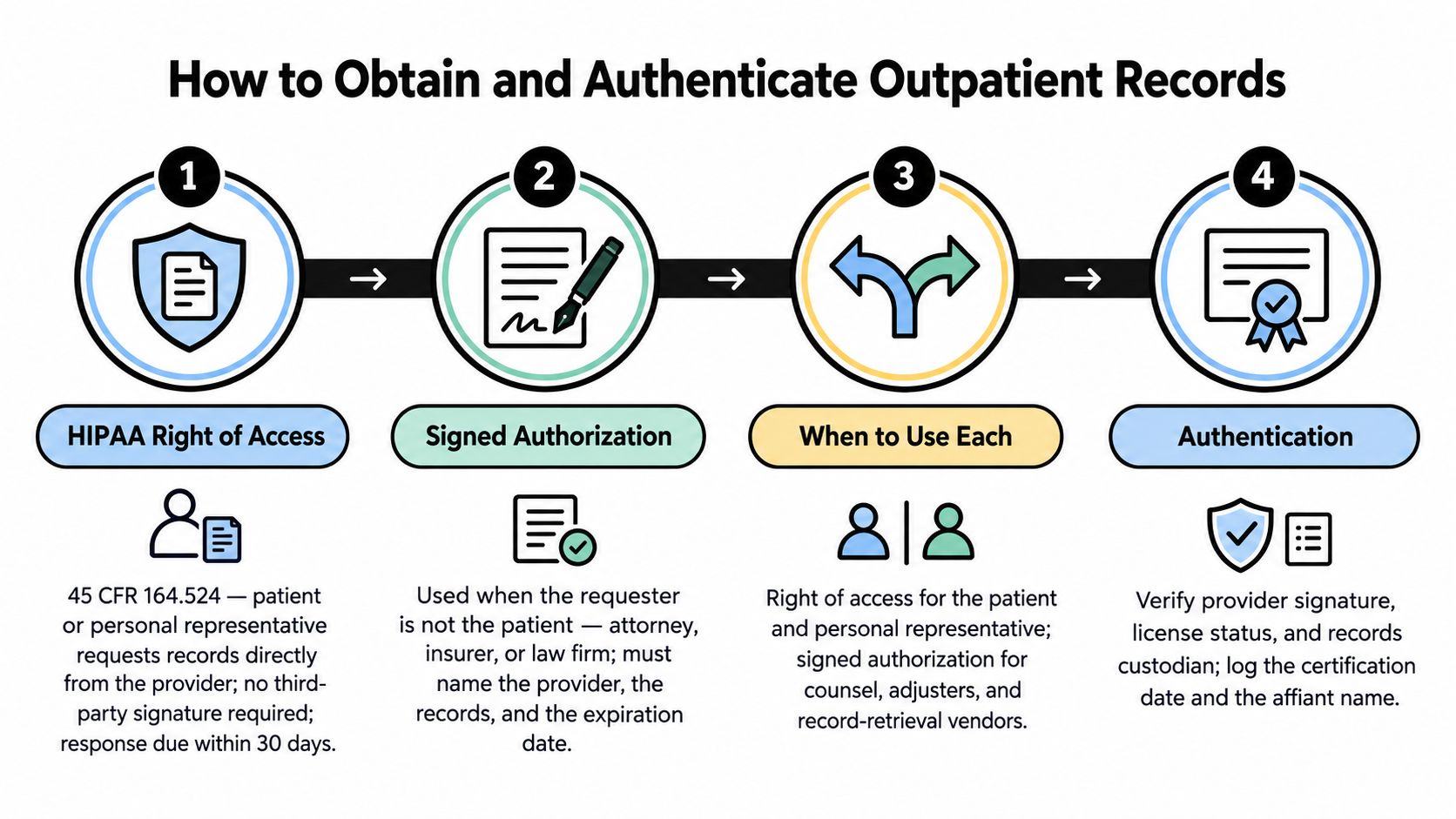
Start with the correct access pathway. Under 45 CFR 164.524, a patient or personal representative may request access to protected health information from a covered provider. That right of access is different from a signed authorization used by counsel, an insurer, or a retrieval vendor to receive records on someone else's behalf.
The request must identify the patient and provider clearly and describe the material sought. A PI authorization should identify the treating entity, include relevant clinical and billing materials, state its expiration terms, and account for state-law requirements. Where applicable, include language addressing redisclosure limits. A release that names only “medical records” may generate a summary packet when the case requires notes, images, labs, audit information, and billing detail.
Build the request around the provider network
Use the client's intake interview, bills, pharmacy history, portal entries, referral names, and prior authorizations to identify every treating location. Reconcile practice names, addresses, former business names, hospital affiliations, and separate imaging or therapy entities.
Request the complete chart components separately:
- Clinical notes and telephone encounters.
- Referral, authorization, and consultation records.
- Imaging reports and available image files.
- Laboratory and procedure records.
- Medication lists, prescriptions, and relevant dispensing information.
- Itemized bills, claims, payment ledgers, CPT, ICD-10, and modifier data.
Track what arrived, what was withheld, and what the provider says doesn't exist. A partial production should never be filed as a complete chart.
Authenticate the version you intend to use
Identify whether the production is the provider's legal medical record, a billing extract, a portal download, or a health information exchange summary. Preserve the original files, transmission details, file names, and production correspondence. Review the date of export and look for duplicated visits, missing page ranges, late entries, altered metadata, or codes that don't match the note.
For admissibility, prepare the foundation before the record becomes a trial exhibit. Depending on the jurisdiction and record, that may include business-records testimony, a custodian declaration, or a certification under applicable evidence rules. Federal Rules of Evidence 901 and 902 provide authentication routes, while the business-records exception may require a qualified custodian or other foundation. The internal link on medical record request letters provides a useful drafting reference, but the request still needs to fit the case, provider, and applicable state law.
Review Checklist and Chronology Building for PI Cases
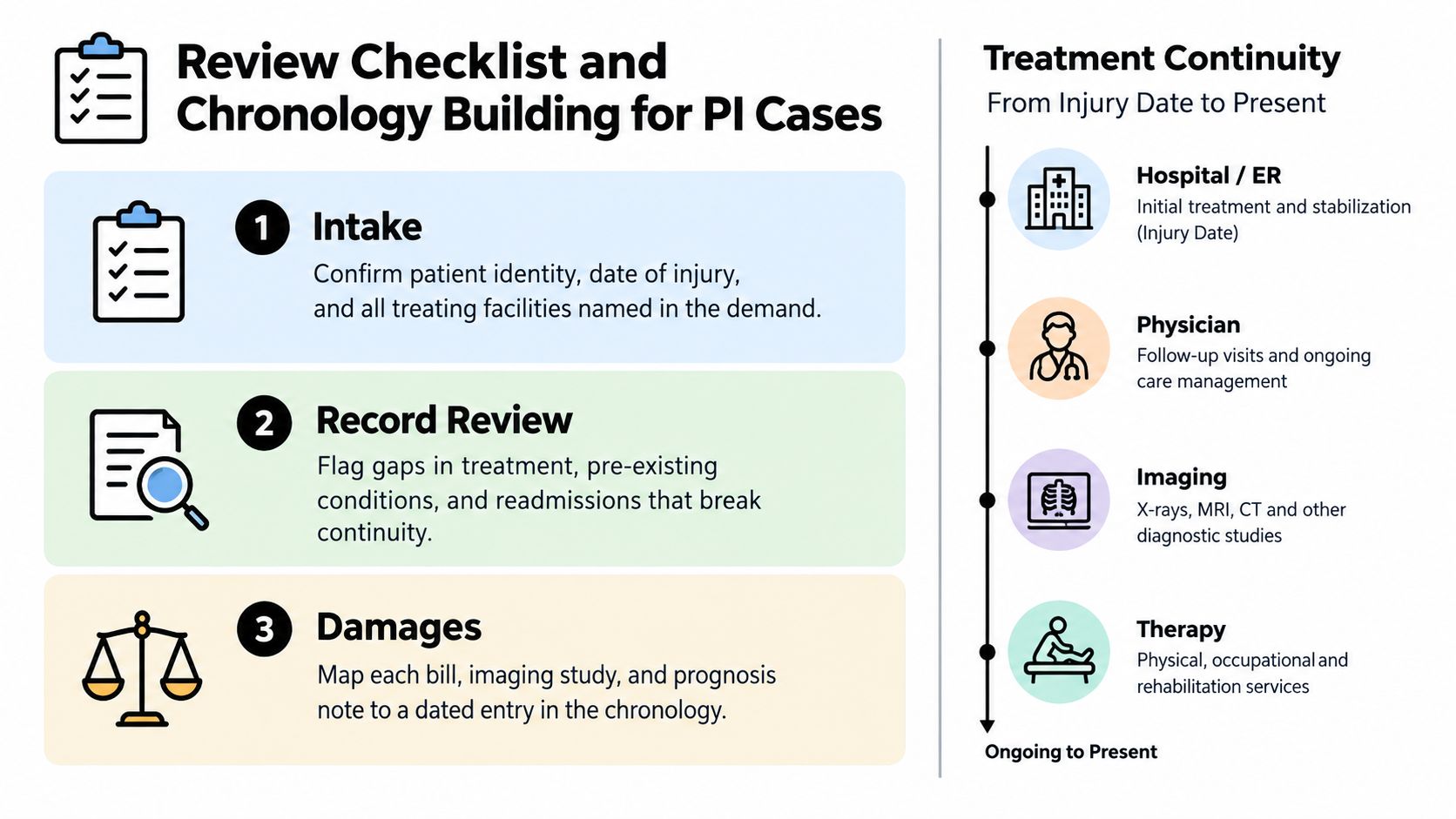
A chronology can look orderly and still fail at the point of demand drafting. A missing visit may appear as a treatment gap, while a billing mismatch may sit unnoticed until the adjuster challenges the claim. Start by separating intake verification from substantive review, then connect each reliable entry to causation, treatment continuity, damages, or a follow-up task.
Start with intake integrity
Confirm the patient's identity, date of injury, providers, facilities, and known record systems. Test the production before relying on its narrative:
- Date integrity: Compare the date of service, note creation, signature, order, result, and billing dates.
- Provider integrity: Match the author, rendering provider, ordering provider, and billing entity.
- Record completeness: Check for corresponding orders, results, referrals, bills, and follow-up entries.
- Coding sanity: Compare CPT, ICD-10, E/M level, modifiers, units, and billed service with the narrative.
- Duplicate control: Separate repeated services from duplicate pages, corrected claims, and imported entries.
A late signature does not automatically show misconduct. A corrected note does not automatically make the record unreliable. Record the discrepancy, identify the explanation, and preserve the source version used in the chronology.
Review for causation and continuity
Begin with the first post-incident complaint. Capture the patient's words about onset, mechanism, body region, functional loss, and prior symptoms. Compare those statements with earlier records and later entries. A pre-existing diagnosis may support aggravation, weaken a new-injury theory, or show that the chart never distinguishes between the two.
Track the points that change the case:
- Mechanism consistency: Does the reported event correspond with the later complaints?
- Symptom progression: Do later notes document persistence, worsening, new distribution, or a different complaint?
- Objective correlation: Do examination findings, imaging, and laboratory results support the assessment?
- Treatment escalation: Did care progress from medication or therapy to injections, specialist evaluation, or surgery?
- Functional proof: Do restrictions, work notes, activity limits, and patient statements align?
The note-quality problems summarized in the record-contents section are exactly why these intake checks matter. Treat note text as partial evidence, then reconcile it against orders, results, referrals, and billing before it enters the chronology.
Build the chronology for action
Use one row for each clinically meaningful event. Include enough detail for another lawyer, an expert, or an adjuster to understand both what happened and why it matters.
| Date | Provider and setting | Key finding | Treatment or decision | Code or bill | PI relevance |
|---|---|---|---|---|---|
| Date of service | Rendering provider and facility | Symptom, examination, result, or diagnosis | Order, medication, referral, restriction, or procedure | CPT, ICD-10, or billing entry | Causation, continuity, damages, or follow-up needed |
| 2025-03-14 | Dr. Reyes, chiropractic | Cervical ROM limited, no neuro deficit | Continued manipulation, MRI ordered | 98941, M54.2 | Establishes conservative care and the imaging order the adjuster says is unexplained |
The final column converts chart review into litigation work. Mark whether an entry supports onset, explains a gap, identifies a prior condition, documents a restriction, supports future care, or requires another records request. Keep unresolved conflicts visible rather than smoothing them into a clean but unsupported story.
A well-built chronology becomes the working spine of the demand letter, deposition outline, expert packet, and settlement evaluation. A practical medical record chronology method can standardize the format, but the lawyer must decide which entries matter and what each one proves.
HIPAA, Discovery, Admissibility, and AI in Review
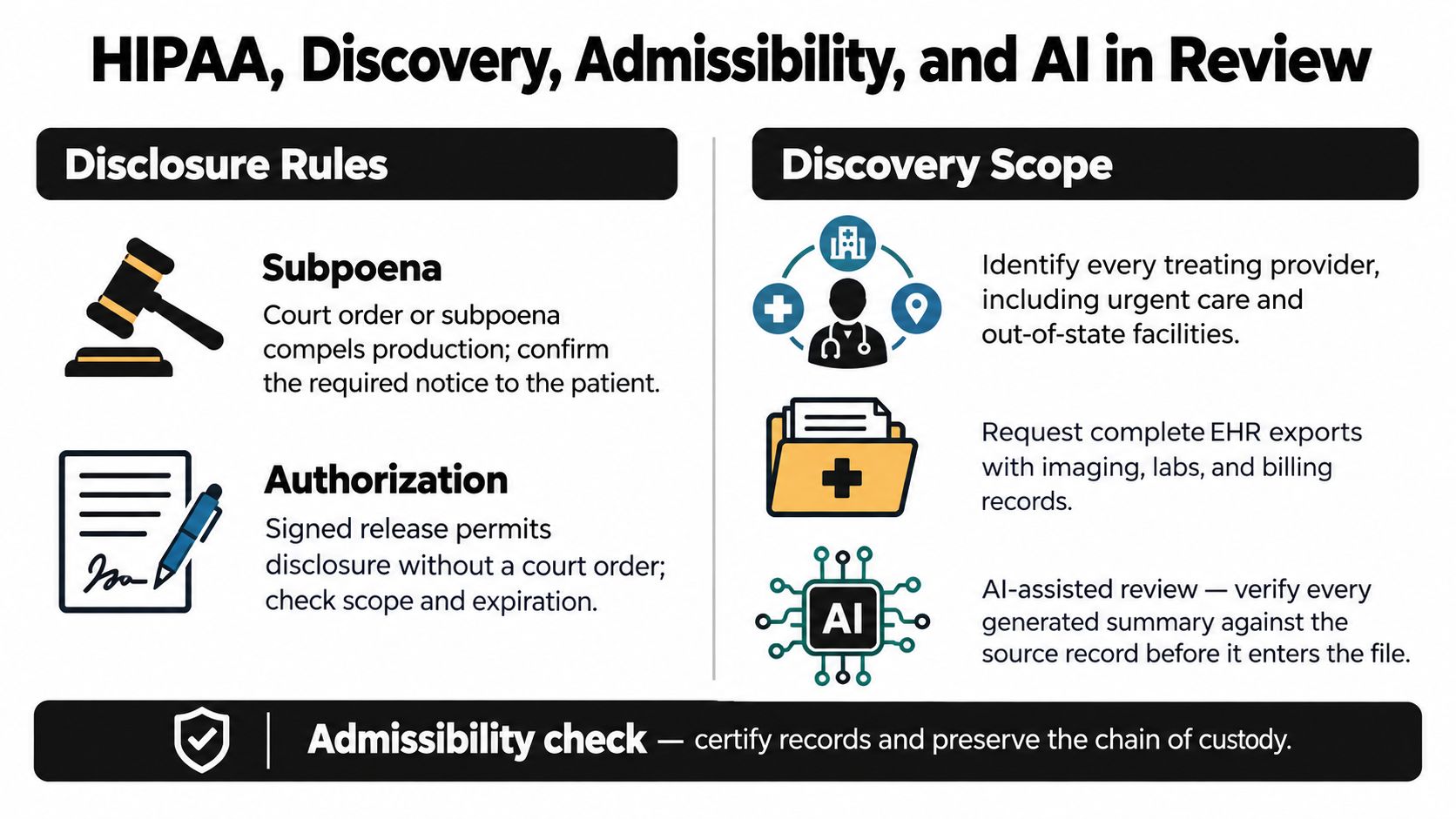
HIPAA governs permitted disclosure. It doesn't determine the entire discovery strategy or make every produced document admissible. A patient authorization may permit disclosure within its scope, while a subpoena or court order may trigger additional notice and procedural requirements. The request must still identify the right providers and seek records relevant to the claims and defenses.
Discovery should target complete charts, not only summary packets. Identify urgent-care visits, outside specialists, therapy providers, imaging centers, pharmacies, and out-of-state facilities. If the production omits a visit the client remembers, use interrogatories, requests for production, deposition questions, and targeted follow-up requests to establish what happened and why the record is absent. Firms building internal policies may find this overview of practical HIPAA compliance for SMBs useful for separating privacy controls from litigation-specific collection decisions.
Preserve the foundation with the file
For admissibility, consider the business-records exception under Federal Rule of Evidence 803(6) where applicable. The foundation should address how the provider created, maintained, and retrieved the record, whether entries were made near the time of the event, and whether the production is complete or certified. Custodian declarations, audit trails, export information, and EHR metadata may help establish authenticity and integrity.
Narrative summaries present a separate problem. A summary prepared for litigation may require additional foundation or expert explanation, while a contemporaneous treatment note may be admissible for a different purpose. Don't let a convenient summary replace the source entries.
Use automation as review support
AI-assisted tools can index records, sort events chronologically, identify possible gaps, surface diagnosis changes, and compare treatment entries with billing data. Those functions are useful when a file contains multiple providers and inconsistent document formats. They don't replace source verification, relevance judgments, privilege review, medical interpretation, or custodian testimony.
A defensible workflow keeps the source page attached to every extracted fact. The reviewer should verify dates, negations, body parts, prior conditions, provider identity, and causal language before the information enters a demand or expert disclosure. HIPAA and subpoena considerations for PI teams offers a focused reference for that legal intersection.
Putting It All Together on Your Next Case File
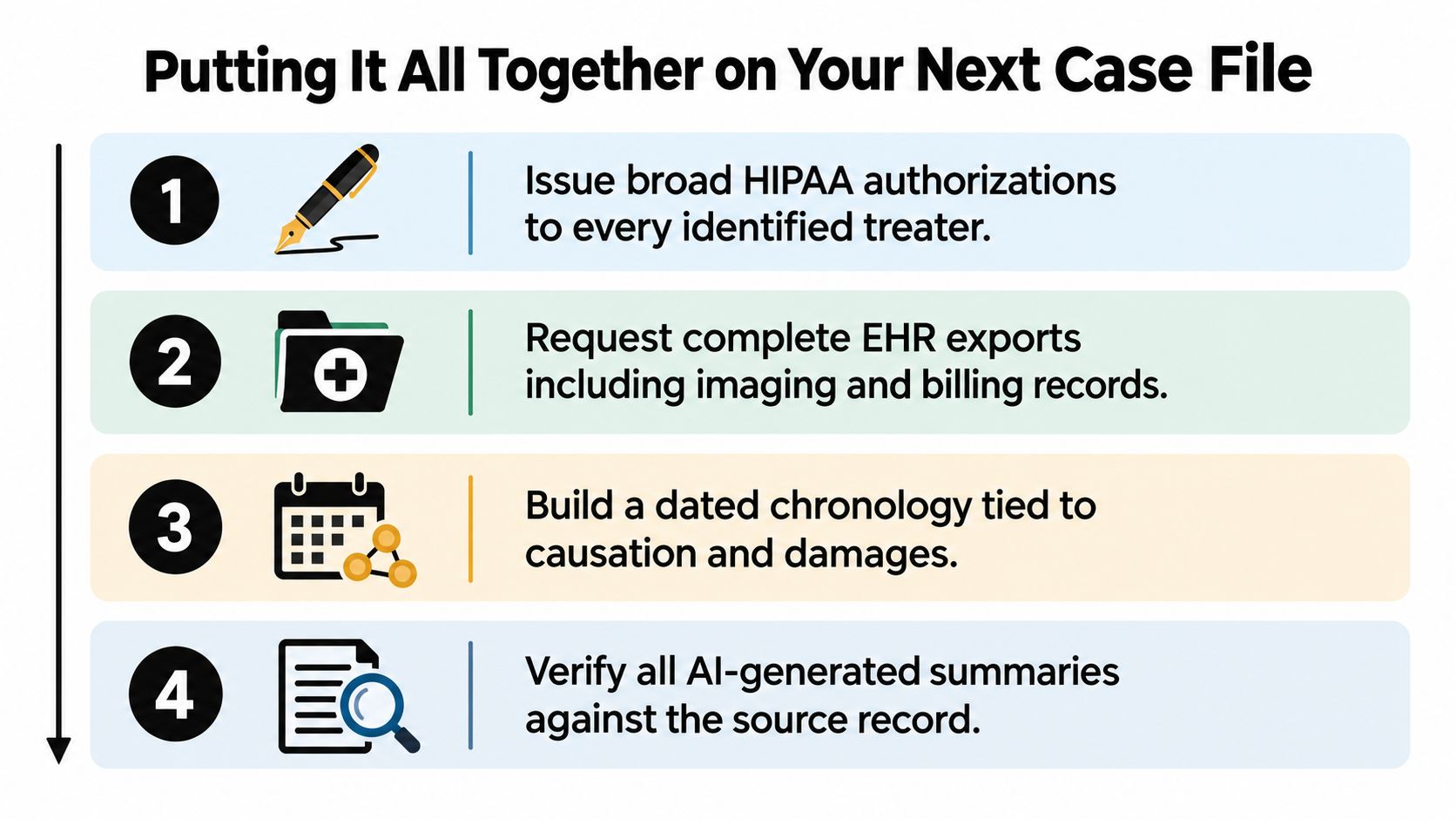
Apply the process in this order:
- Issue broad, properly scoped authorizations to every identified treater and request records directly where the patient or representative can exercise access rights.
- Request complete exports, including clinical notes, imaging, labs, referrals, prescriptions, itemized bills, and coding detail.
- Create the master chronology before depositions, with separate fields for clinical facts, administrative facts, and PI relevance.
- Investigate every unexplained gap, including missing referrals, late entries, duplicate visits, treatment pauses, and codes that don't match the documentation.
- Cross-reference the treatment sequence with the incident timeline before drafting the demand package.
Outpatient charts reward patience and pattern recognition. They can reveal a clean causation link, a pre-existing condition that must be addressed directly, or damages documentation buried in a referral, restriction note, pharmacy entry, or later specialist report.
Administrative support can help with provider follow-up, file organization, and routine record handling. A Medical virtual assistant may assist with those operational tasks, but legal judgment remains necessary when the chronology affects causation, admissibility, or settlement position.
Ares helps PI firms organize outpatient medical records into structured dates, diagnoses, treatments, providers, and symptom chronologies, then use those verified insights to support medical overviews and demand-letter drafts. Upload your case file to Ares and use the resulting chronology as a review aid, while confirming every material point against the source record before sending it out.