You're three weeks out from a mediation, and the chart looks clean at first glance. Then someone spots a missing antihypertensive, a questionable dose on a pain medication, and a recent switch that never made it into the intake note. That's the kind of gap opposing counsel loves, because once it's in the record, they'll argue the story is incomplete, the symptoms are less reliable, and the damages are easier to discount.
For personal injury teams, medication history review is not clerical cleanup. It's the difference between a record that supports causation and one that leaves room for attack. If you want a practical primer on the clinical side, understanding medication reconciliation steps is a useful companion, and the way to keep the file organized usually starts with disciplined record handling, the same kind of structure discussed in organizing medical records for case review.
Why Medication History Review Can Make or Break Your Case
A clean-looking chart can be the most dangerous kind of messy. In personal injury work, the problem usually shows up late, after the demand is drafted, after the client has testified, sometimes even after defense counsel has already framed the case around “inconsistent medical history.” Then someone notices that the intake note omitted a long-standing medication, or that the emergency record lists a drug the client says they never took.
That gap matters because incomplete medication histories are a documented source of admission errors. A systematic review found that up to 67% of prescription medication histories contained at least one error, 60%–67% had at least one omission or commission error, and when nonprescription drugs were included the error rate rose to 27%–83%. The same evidence base estimated that over a quarter of hospital prescribing errors could be traced to incomplete admission histories, which is a useful reminder for litigators, because weak intake documentation doesn't stay local, it spreads into treatment notes, medication lists, and discharge summaries. For the underlying review, see the classic evidence summary on medication history errors and admission discrepancies.
Practical rule: if the chart can't show what the client was actually taking before the event, defense counsel will argue that later symptoms, side effects, or treatment choices can't be cleanly tied to the incident.
A defense lawyer doesn't need a perfect contradiction. They need a plausible one. A missing blood thinner, a forgotten sleep aid, or an undocumented OTC anti-inflammatory can be enough to muddy causation, complicate damages, or suggest the symptoms predated the injury.
This is why medication review belongs in the same bucket as liability analysis and damages workup. It changes how a case reads, how a settlement demand lands, and how ready you are if the file goes to deposition or trial. If you wait until the final round of record review, you're already answering the weakest version of the case instead of building the strongest one.
What Medication History Review Actually Means in Clinical Practice
A proper medication history is not just a current med list pasted into a chart. It's a structured inventory of all prescribed and non-prescribed medicines, and the minimum fields are medication name, formulation, dose, route, and frequency. Best-practice guidance also adds duration, time of last dose, indication, and recent changes, because those details distinguish what was intended from what the patient used, and that distinction is often where litigation value hides.
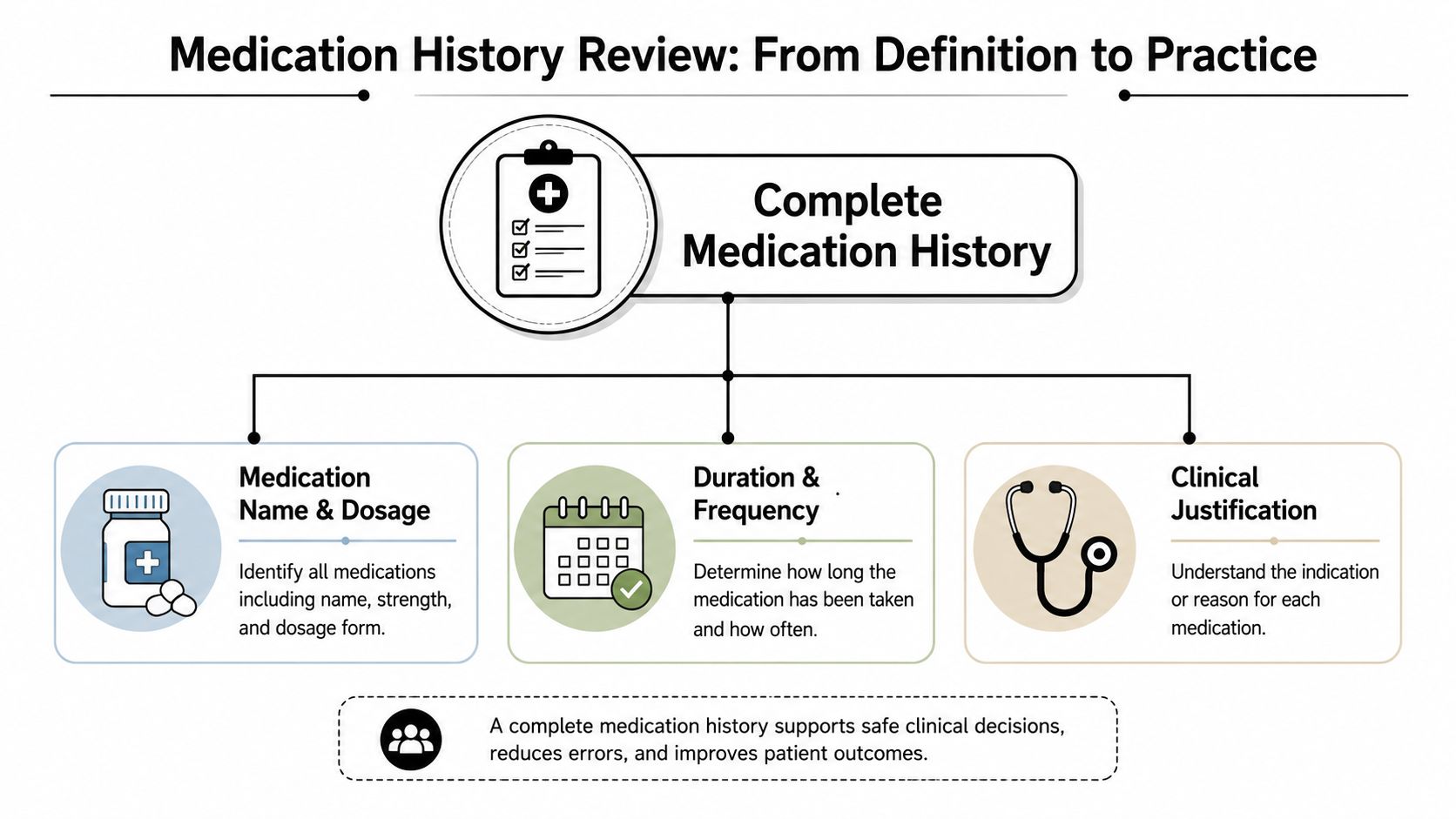
A list that says “metoprolol” is not the same as a list that says metoprolol succinate extended-release, 50 mg, by mouth, once daily, for hypertension. Formulation and route matter because the same active ingredient can behave differently depending on dosage form, and guidance specifically calls out extended-release products, inhaled drugs, topical agents, injections, and variable-dose drugs like warfarin or levodopa as cases where separate documentation is needed to avoid misclassification. That's not academic detail. In a personal injury file, the wrong formulation can make a client look noncompliant, overmedicated, undertreated, or unreliable when none of those conclusions are true. The best-practice summary from the Society of Hospital Medicine is a helpful clinical reference on what complete medication reconciliation should capture.
What belongs in a usable record
A litigation-ready medication history usually answers a few simple questions clearly:
- What is the drug? Capture the exact name, not a shorthand or class label.
- How is it taken? Route and formulation matter, especially when multiple forms exist.
- How much and how often? Dose and frequency help distinguish routine use from rescue use.
- Why is it taken? Indication can support or undermine the causation story.
- What changed recently? Stopping, starting, or changing a drug can affect symptom timing.
A chart that leaves those fields blank is a chart that invites speculation. A complete one gives you a chronology you can use in a demand letter, an expert discussion, or a deposition outline.
Red Flags and Discrepancies That Undermine Medical Records
The mistake many legal teams make is treating discrepancies as exceptions. They are routine, and they matter because opposing counsel will use them to question the whole timeline. In a 2023 study of 50 patients and 421 medicines, researchers found 59 discrepancies in total, and 24 patients (48%) had at least one discrepancy in their medication history. The most common error was omission of a current medication (49%), followed by incorrect dose (19%) and recording a drug not taken before admission (15%). A separate cross-sectional study of 168 patients in Norway found 83% had at least one discrepancy at admission, and 9% of all discrepancies had the potential to cause severe harm or discomfort. In a personal injury file, that kind of slippage gives defense counsel room to argue that the chart is incomplete even when it looks orderly. The study details are summarized in the 2023 medication discrepancy paper.
When you test a record for weaknesses, start with the errors that can be turned into a theme. An omitted current medication can suggest the patient was less careful, less forthcoming, or less symptomatic than claimed. An incorrect dose can make side effects or effectiveness hard to interpret. A drug that appears in the chart but was never part of the client's use can create the appearance of inconsistency across providers.
| Error Type | Frequency | Case Impact |
|---|---|---|
| Omitted current medication | 49% of discrepancies in the 2023 study | Can weaken causation, adherence, and symptom timing |
| Incorrect dose | 19% of discrepancies in the 2023 study | Can distort severity, side effects, and response to treatment |
| Medication recorded but not taken | 15% of discrepancies in the 2023 study | Can support credibility attacks and chart inconsistency arguments |
| Discrepancy with potential severe harm or discomfort | 9% of all discrepancies in the Norway study | Can materially affect treatment interpretation and risk analysis |
A record also needs to hold up under the same scrutiny used in master document fraud detection workflows. That does not mean accusing anyone of fraud. It means checking whether the chart stays coherent when compared with the client interview, pharmacy history, and prior records.
The core question is not whether the chart is neat. The question is whether every entry can survive comparison against what the client, the pharmacy, and prior records show.
Clinically important errors matter because they are not just clerical noise. The older evidence base found 11%–59% of medication history errors were clinically important in studies that assessed severity. In practice, that means some discrepancies are large enough to change prescribing decisions, affect symptom interpretation, and shape the way a jury reads the timeline.
A Practical Checklist for Attorneys and Paralegals
The most reliable medication review process is boring in the best way. It starts with source triangulation, because a single source is rarely complete or reliable. Reconciliation guidance says to verify history with at least two up-to-date sources, usually the patient or caregiver plus records like outpatient medication lists, pharmacy profiles, discharge orders, or prior case notes. That same approach is what makes a record useful in litigation, because a lone intake sheet is easy to attack, while converging sources create pressure on the other side to concede chronology and consistency. A concise overview of legal record organization appears in medical record review for attorneys.
Use a repeatable checklist, not an improvised conversation:
- Verify sources first. Compare the client interview against pharmacy records, prior notes, and any available discharge paperwork.
- Ask about recent changes. Don't stop at current meds. Ask what was started, stopped, or changed in the last stretch before treatment.
- Capture OTC and supplements. Vitamins, herbals, NSAIDs, inhalers, injections, and PRN medications are common omission points.
- Document the actual pattern. Variable-dose medicines and extended-release products need the specific schedule, not just the label.
- Check for the last dose. Timing can matter when the question is sedation, anticoagulation, pain control, or symptom onset.
- Look for adverse effects or nonadherence. These details can explain gaps without destroying credibility.
Best practice: if a medication matters to causation, pain, bleeding risk, sedation, or symptom interpretation, it belongs in the chronology, not just in a background note.
The legal value gets created when a client's chart shows a recent NSAID start, an anticoagulant, or a medication change before the crash, providing a defensible timeline. That timeline often turns a vague medical narrative into a coherent damages story, unlike a client who “takes something for pain.”
The highest-value questions are usually the simplest ones. What was taken, when was it taken, and who verified it? If you can't answer those cleanly, the record probably isn't ready for demand, mediation, or expert review.
How AI Tools Accelerate Review While Maintaining Security
Manual medication review is slow because the useful information is scattered. A person has to read intake notes, consult pages from different providers, compare med lists, and reconstruct a chronology that the chart never offered in one place. AI-assisted review changes that workflow by extracting key dates, diagnoses, treatments, providers, and symptom chronology from raw records, then organizing the results into a structure a legal team can use.
A practical option in this category is an AI record platform such as Ares, which is designed to extract treatment history and medications across providers from medical records and turn them into organized case summaries. That kind of workflow is valuable because it doesn't replace legal judgment, it shortens the time between raw chart and usable chronology. If you prefer a broader overview of AI-assisted review, the product discussion in AI medical record review for attorneys covers the same workflow from a legal operations angle.
The trade-off is straightforward. Manual review gives you maximum control but burns attorney and paralegal time. AI tools can accelerate extraction and gap spotting, but only if the team still verifies the output against the source pages before relying on it in a demand or mediation package.
The security issue matters just as much as speed. Any platform handling PHI needs enterprise-grade privacy controls, clear access management, and a workflow that keeps humans in the loop. That's the standard legal teams should expect before uploading a single chart.
Later in the process, a structured summary can save hours during drafting. It can also help a team spot the one medication change that explains why a symptom started before the collision, why pain management escalated, or why a side-effect argument needs to be framed more carefully. For teams that handle a steady volume of files, that kind of pre-sort can change how quickly a case moves from intake to resolution.
If you want a practical companion for AI-assisted summarization, Family Folder's record summarization approach is a useful reference point for how organized output can reduce review friction without replacing source verification.
Real Case Examples Showing the Impact of Thorough Review
A strong medication review often changes a case in quiet ways that matter a lot. One common scenario is the client whose treatment notes say they were “not on medication,” while pharmacy records and prior visits show a chronic prescription that never made it into the intake form. That discrepancy doesn't just create embarrassment. It gives the defense a way to argue that the medical history was incomplete, which can weaken settlement power if the issue is not fixed before mediation.
Another pattern shows up when the dose is wrong. A pain medication recorded as a routine dose might have been used intermittently, or a medication note might reflect an old regimen instead of the current one. That distinction can matter when the defense is trying to argue that the reported symptoms are out of proportion, that side effects were overstated, or that the timeline of worsening pain doesn't line up with the event.
A more subtle example is the recent medication change that never gets discussed in the chart. If the client stopped one drug, started another, or changed frequency shortly before the incident, that fact can explain symptoms, help frame causation, or clarify why the treating provider made a particular decision. Without that detail, the record can look as if the injury caused everything, or nothing, and both extremes are easy for opposing counsel to challenge.
What wins cases is not a dramatic fact. It's a record that can explain itself under pressure.
I've seen cases where the entire tone of negotiation changed after a team cleaned up the medication chronology. The demand letter read more credibly because the treatment story matched the prescription story. The adjuster had less room to say the file was sloppy, and the defense had less room to claim the symptoms were detached from the medical timeline.
That's the point. Thorough medication review turns uncertainty into a defined record. Defined records are harder to attack, easier to value, and much more useful when the case needs to survive scrutiny from someone who has every incentive to find a gap.
Building a Repeatable Process for Stronger Case Outcomes
The firms that get better results from medication history review do three things consistently. They demand clinical rigor, they verify against multiple sources, and they treat discrepancies as workflow issues instead of afterthoughts. That combination gives you cleaner chronologies, stronger demands, and fewer surprises during mediation or deposition.
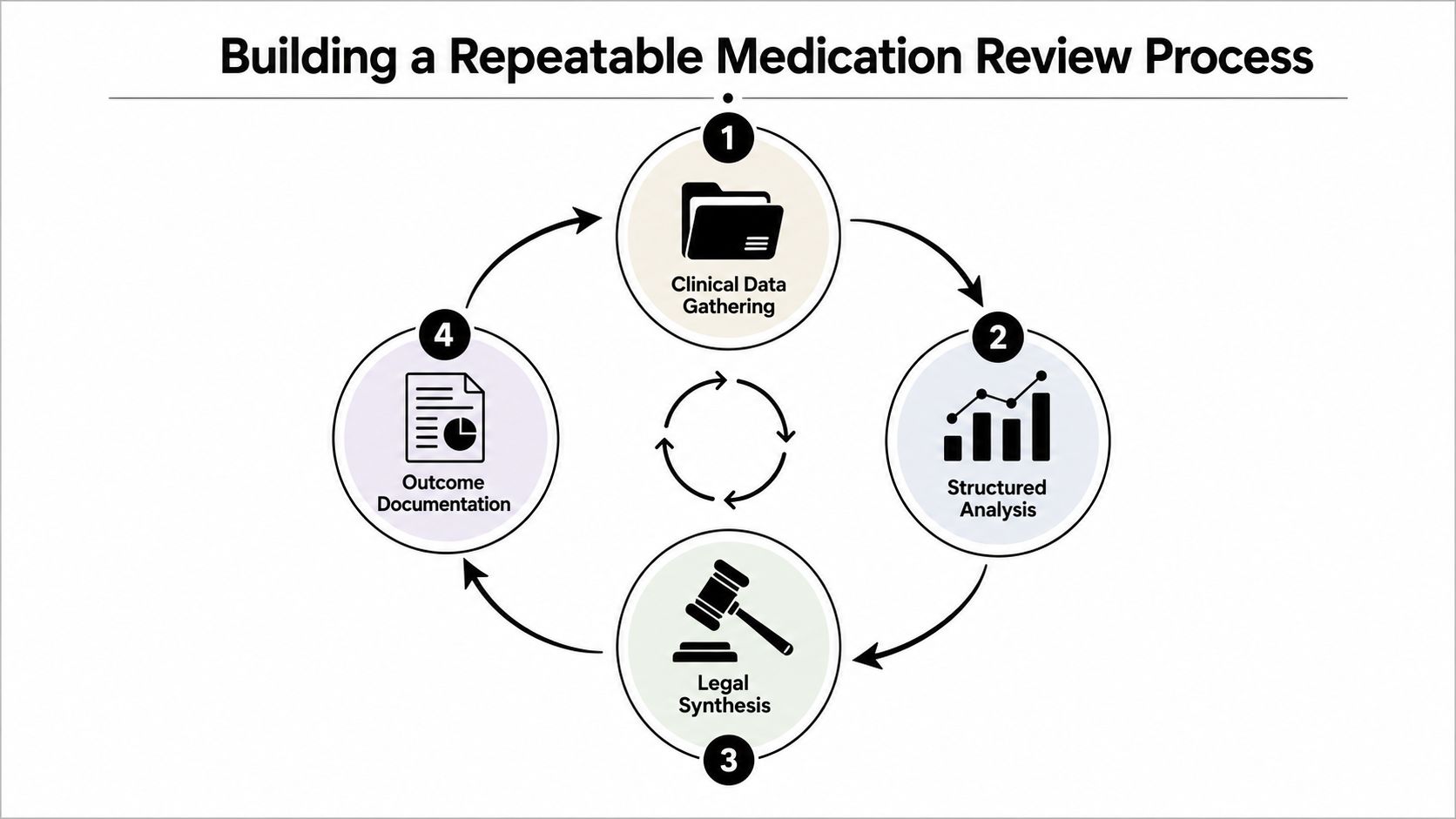
A repeatable process usually looks like this in practice:
- Clinical Data Gathering. Pull the interview, records, pharmacy history, and prior notes into one working file.
- Structured Analysis. Compare names, doses, routes, and recent changes across sources.
- Legal Synthesis. Translate the medical chronology into causation, damages, and credibility points.
- Outcome Documentation. Save the cleaned timeline in a form the whole team can reuse.
Training matters because a good system still depends on people asking the right questions. Paralegals and case managers need a standard intake script for OTCs, supplements, recent changes, and last-dose timing. Attorneys need a habit of checking whether the chronology supports the theory they plan to present, not just whether the chart looks complete.
The broader trend is clear, more firms are moving toward structured, data-driven review because the old “skim and summarize” method leaves too much value on the table. Medication history review is one of the places where that shift shows up fastest, because the same missing detail can affect credibility, causation, and settlement strength all at once.
If your team wants cleaner medical chronologies, faster record review, and a more defensible medication story in every file, Ares can help organize the chart into a case-ready timeline. Visit Ares to see how its medical record review workflow supports personal injury teams that need to spot gaps, reconcile medications, and build stronger settlement positions.