
Yes, medical records are legal documents that courts can admit when they're authenticated and fit a hearsay exception; federal privacy law also makes maintained patient records legally retrievable, subject to limited exceptions. But the familiar advice to “get the complete chart and certify it” misses a critical question: complete according to whose definition?
A provider's production may contain readable clinical notes while leaving out billing detail, referral documentation, or information about when an entry was changed. For PI attorneys and paralegals, a defensible file starts with the collection scope, not the first page of the chronology.
Yes, Medical Records Are Evidence, but Their Weight Varies
Calling a chart a legal document doesn't make every entry accurate, persuasive, or sufficient to prove causation. Admissibility and evidentiary weight are different questions. A record may clear the foundation requirements and still contain contradictions that opposing counsel can use effectively.
The Indian Health Service risk-management manual identifies completeness, objectivity, consistency, and accuracy as core documentation characteristics. Those qualities matter because attorneys need to distinguish what a clinician observed, what a patient reported, and what someone later summarized.
Medical record types and their legal role
| Record type | What it proves | Typical legal use | Main risk |
|---|---|---|---|
| Clinical notes | Assessment, treatment and follow-up | Care timeline and causation | Late entries or copied-forward text |
| Imaging and lab results | Objective findings and their dates | Injury confirmation and damages | Missing reports or unlabeled images |
| Consent forms | What the patient agreed to | Informed-consent and liability questions | Unsigned or undated forms |
| Billing and claims data | Services billed, amounts and dates | Special damages and charge reasonableness | Codes that do not match clinical notes |
| Case-management records | Referrals and care coordination | Context for delays and gaps in treatment | Outside the requested record set |
| EHR audit logs and metadata | Who accessed or changed an entry, and when | Testing alteration or late entry | Never requested unless specified |
Read “what it proves” as the proposition the document can support, not a guarantee that the proposition is established. An imaging report may document a finding without resolving whether the collision caused it. A bill may establish the charge submitted without independently establishing its reasonableness.
Practical rule: Identify the proposition you need to prove before deciding which document supports it.
Say a treatment note describes persistent neck pain, but the assessment repeats language from an earlier encounter. The useful question isn't merely whether the note exists. Counsel needs to know whether the clinician reassessed the condition, whether the symptoms changed, and whether other records support the claimed progression.
Likewise, a signed consent form can help establish the documented authorization, but counsel shouldn't treat the signature alone as a complete account of the discussion. Review the accompanying note, procedure identification, date, and any documented limitations.
The table is a collection map. Use it to assign follow-up work by evidence category rather than treating every missing item as another request for “the chart.”
Why Federal Privacy Law Makes Records Reachable and How to Request Them
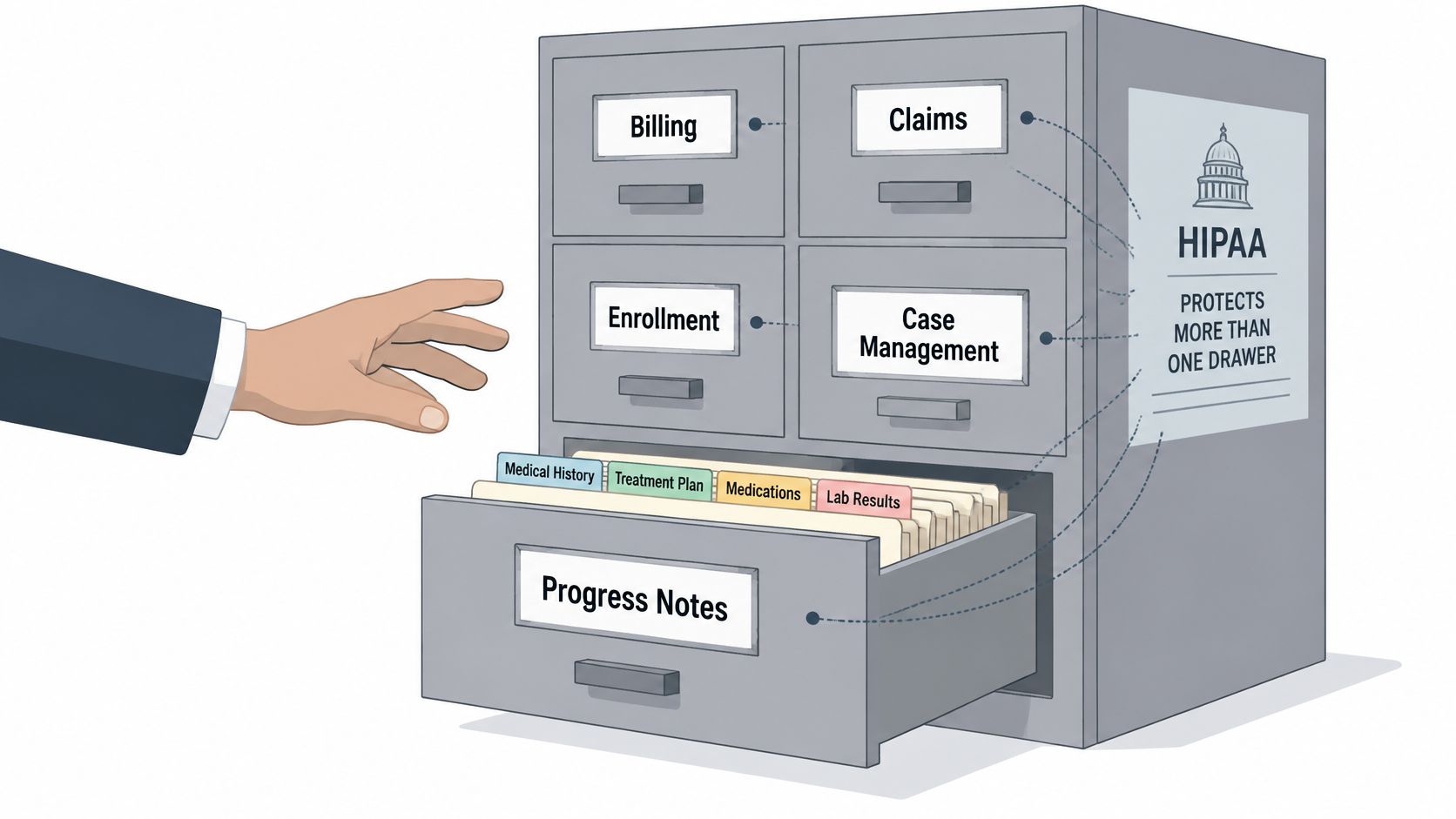
Think of a filing cabinet with progress notes in one drawer and billing, claims, enrollment, case-management, and decision-making information in others. Requesting the clinical drawer alone may leave out material that explains a treatment interruption, a disputed charge, or an unsuccessful referral.
The HHS medical-records access guidance describes patients' legally enforceable right to inspect and obtain copies of information in the designated record set, with limited exceptions. That right applies to maintained information whether it's on paper, electronic, remote, or archived, and patients can direct transmission to a chosen recipient, including counsel, subject to the applicable requirements.
The collection problem begins when the request names only one part of that cabinet.
Choose the route before sending the request
Say your client treated at a hospital, an orthopedic practice, and a therapy clinic. The hospital sends discharge paperwork, the orthopedist sends office notes, and the clinic sends attendance records. You still don't have the underlying imaging, itemized billing, or documentation explaining why therapy stopped.
Before chasing those gaps, identify the legal route used for each production. A patient access request, authorization-based disclosure, subpoena, and court order aren't interchangeable. Their requirements, objections, and enforcement mechanisms differ.
Routes to obtain medical records
| Route | Who grants it | What it requires | Main limit |
|---|---|---|---|
| Patient authorization | The patient authorizes disclosure | A valid signed authorization identifying the information and recipient, with required authorization elements | Limited to what the form names |
| Patient access request | The patient exercises access rights and may direct copies to counsel | A request satisfying the provider's lawful access procedures and applicable third-party direction requirements | Access exceptions, route-specific deadlines, and applicable fee rules |
| Subpoena with satisfactory assurance | Counsel or an authorized issuing authority under governing procedure | Valid process and documented assurances of patient notice or efforts to secure an appropriate qualified protective order, where required | A subpoena alone doesn't resolve every privacy restriction |
| Court order | The court | An order that specifies the records | Only the information the order covers |
For an authorization, check the named entities, recipient, categories, and relevant treatment period before sending it. A broad cover letter won't necessarily cure a narrow authorization.
For patient access, make clear that the patient is exercising an access right rather than merely giving permission for a discretionary disclosure. Counsel should verify the requirements governing any direction to transmit copies to the firm.
For a subpoena, preserve the service materials and privacy assurances alongside the request. The attorney must determine whether notice, a protective order, additional consent, or another procedural step is necessary. Our explanation of HIPAA and subpoenas addresses that distinction.
For an order, match the request to the order's actual language. Don't assume an order covering treatment notes also authorizes every other category of protected information.
Define completeness rather than declaring it
A provider's legal medical record may be narrower than the designated record set. The New York Office of Mental Health policy distinguishes the record released for legal proceedings or authorized requests from the broader collection available through patient access.
That distinction changes how a paralegal should write a follow-up. “Your production is incomplete” invites a general response. “The production contains office notes but no itemized billing, referral correspondence, or referenced imaging report” gives the recipient something concrete to locate or explain.
Use a collection worksheet with these fields:
- Entity and custodian: Identify the treating location, health system, billing office, and any separate imaging custodian.
- Requested categories: Name clinical notes, reports, images, consent forms, billing, claims, and relevant coordination records.
- Production scope: Record what arrived and any stated exclusions or unavailable categories.
- Format: Specify readable copies and identify any separately requested native material or indexes.
- Follow-up owner: Assign a person to resolve each outstanding category.
A patient can also seek amendment of inaccurate or incomplete information. That process isn't a way to erase an unfavorable history. If the provider denies amendment, the patient's disagreement may become linked documentation, leaving counsel to evaluate both the original entry and the documented dispute.
Control deadlines, fees, and sensitive categories
Name the request route in the cover letter and calendar the deadline that governs it. Don't apply a patient-access deadline automatically to a subpoena or assume all routes carry the same fee limits.
Record requested charges and the basis stated for them. Have counsel check additional restrictions affecting mental health, substance-use treatment, HIV-related information, and minors' records before staff sends a routine form.
Retention needs separate attention. HHS explains that HIPAA doesn't establish a universal medical-record retention period; state law generally controls retention, while HIPAA requires safeguards for information that remains maintained.
If the response is overdue or categories remain missing, send a written gap notice identifying the request, receipt history, missing material, and requested response. Counsel can then choose the appropriate escalation rather than filing a motion built on an undocumented collection history.
How Courts Decide Whether a Record Gets In
Counsel should separate the foundation analysis into distinct questions: Is this the record it claims to be? Is it being offered for the truth of its contents? If so, what exception permits that use?
Authentication addresses identity. Hearsay analysis addresses the use of statements. Neither automatically resolves relevance, trustworthiness, expert-opinion issues, or statements embedded within the record.
Foundation rules for admitting medical records
| Rule or route | What it covers | What counsel must establish |
|---|---|---|
| FRE 901 authentication | Evidence that the item is what its proponent claims | A sufficient identifying foundation through testimony or another permitted method |
| FRE 803(6) business records | Records of regularly conducted activity | Timely creation by, or from information transmitted by, someone with knowledge; ordinary-course maintenance; regular practice; required foundation; no disqualifying lack of trustworthiness |
| FRE 902(11) certified domestic records | Self-authentication through a custodian certification | A qualifying certification, reasonable written notice, and an opportunity for the opposing party to inspect the record and certification |
| FRE 803(4) diagnosis or treatment statements | Qualifying statements made for medical diagnosis or treatment | The statement's treatment-related purpose and pertinence to diagnosis or treatment |
| State evidence code equivalents | Comparable authentication and hearsay routes, with differences in detail | The current text of the state rule that governs the case |
These federal rule references are a working framework, not a substitute for the governing evidence code or the court's scheduling requirements. The responsible lawyer must confirm the applicable language and how local courts apply it.
Test the foundation against the actual exhibit
Say counsel offers a chiropractic note to support a cervical-injury claim. The foundation should establish that the entry was made at or near the visit by someone with knowledge, maintained in the practice's regular course, and created as a regular practice. Counsel also needs a basis for identifying the offered copy as the practice's record.
That still doesn't turn every sentence into conclusive medical proof. A patient's symptom description, a clinician's finding, and a third party's account require different analysis. A certification supporting business-record status doesn't necessarily cure every embedded statement.
An authentic record can contain a disputed conclusion. Don't confuse proving the document's identity with proving the injury theory.
Common failures are avoidable. A production may arrive without a qualifying custodian certification, a chronology may be offered where the source record is needed, or an entry may lack a clear author and date. Resolve those issues while the custodian is reachable, not when counsel is assembling exhibits.
Before deciding whether live custodian testimony is necessary, gather:
- The exhibit version: Preserve the exact record counsel intends to offer.
- The foundation material: Obtain the certification, declaration, or proposed testimony required for that route.
- The notice history: Save notices, delivery confirmation, and inspection correspondence.
- The identity details: Confirm the patient, provider, encounter, author, and production source.
- The objections analysis: Identify embedded hearsay and anticipated trustworthiness challenges.
Use the firm's trial objections and responses preparation to connect each anticipated objection to a foundation document or witness. A generic “business record” label isn't an exhibit-specific answer.
Metadata and Audit Trails That Change the Picture
Say a surgical note displays an encounter date before the procedure, but another field suggests it was created after the patient complained. That mismatch calls for investigation, not an accusation. An audit trail may establish whether the displayed date reflects an encounter, an imported document, a draft, or a later amendment.
The visible chart and its handling history answer different questions.
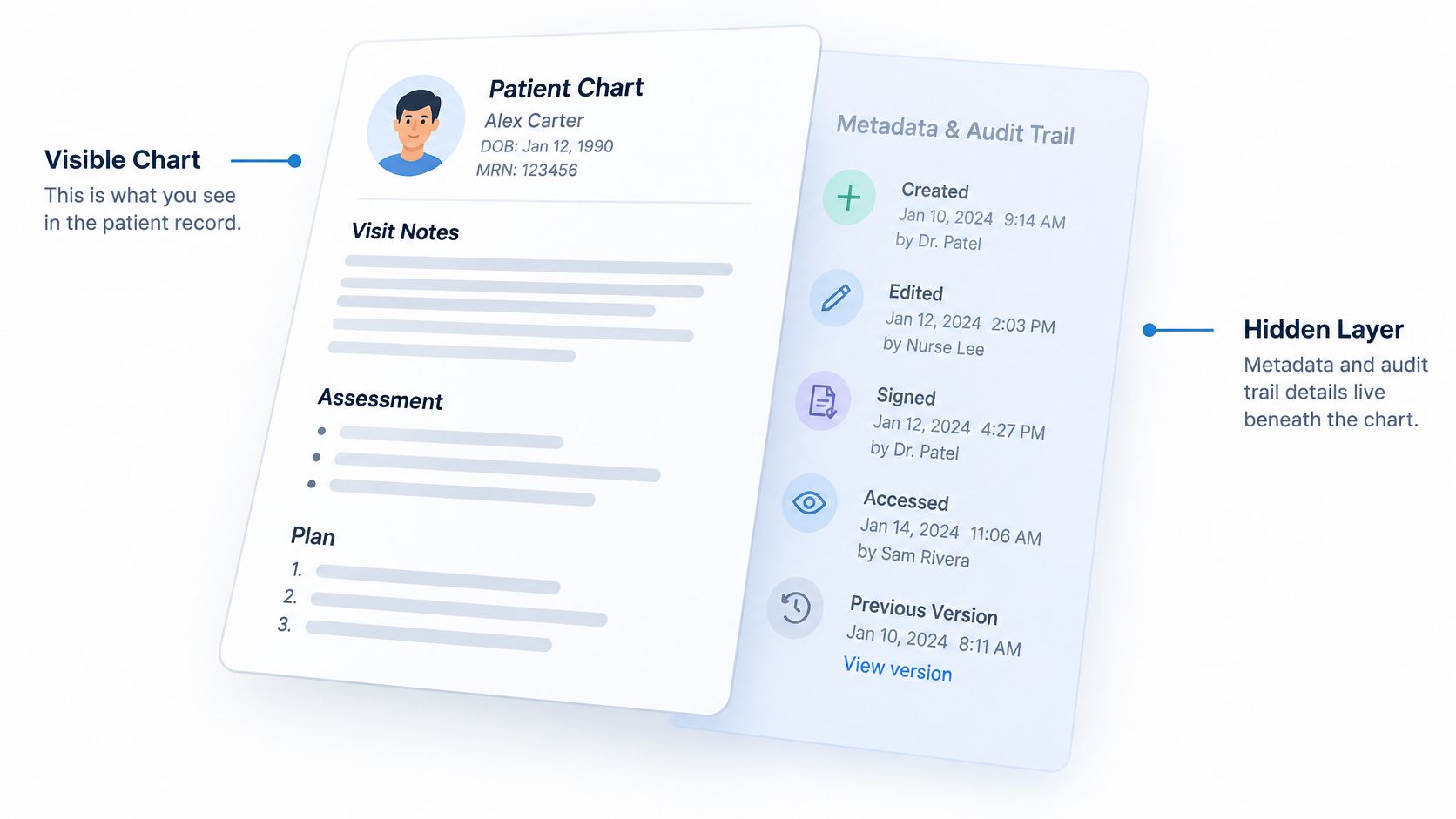
A peer-reviewed review of electronic records and litigation describes courts compelling production of metadata and audit logs, including where a plaintiff sought to determine whether a record was altered, when, and by whom. It also identifies review problems involving records gathered across institutions and health-information exchanges, along with difficult-to-read scans.
Ask a defined question of the system history
Metadata is evidence about creation and handling. Available fields may distinguish creation, modification, signing, access, and export events, but counsel must establish what the particular system records.
Target the request to the uncertainty:
- A questionable entry date: Seek creation, modification, and signature timestamps for the identified note.
- Repeated clinical language: Compare relevant versions and encounters before concluding text was copied forward.
- A changed diagnosis: Request the available amendment history and the meaning of status fields.
- A disputed access event: Identify the relevant users, event types, and treatment episode rather than requesting an unexplained access dump.
An access log may show that a user opened a chart without establishing that the user changed its contents. Likewise, a later signature doesn't by itself prove that the clinician fabricated an earlier assessment.
The accompanying video provides another way to consider the relationship between a chart and its electronic history.
Keep the request proportional
Requesting every system log can create a costly production without answering the disputed question. A narrower request identifying the patient, entry, relevant period, event fields, and available version history gives counsel a more useful basis for negotiation.
Our guide to audit trail requirements can help teams organize that inquiry. Include a request for field definitions when abbreviations or event codes could change the interpretation.
Treat a timestamp discrepancy as a question to resolve, not a finding of misconduct.
If the requested history isn't available, document the explanation and its source. Counsel decides whether that absence affects authentication, discovery strategy, preservation arguments, or the need for technical testimony.
How to Preserve Chain of Custody from Request to Trial
A defensible handling process lets counsel explain where a record came from and what the firm did to it. It doesn't require treating every routine PDF as a forensic device, but it does require preserving a reliable reference copy.
The North Carolina Medical Board's record guidance emphasizes documentation integrity, confidentiality, lawful release, and retention responsibilities. For litigation support, the practical response is to separate received evidence from the material staff creates while reviewing it.
The collection trail should remain understandable without relying on the memory of the person who handled the file.
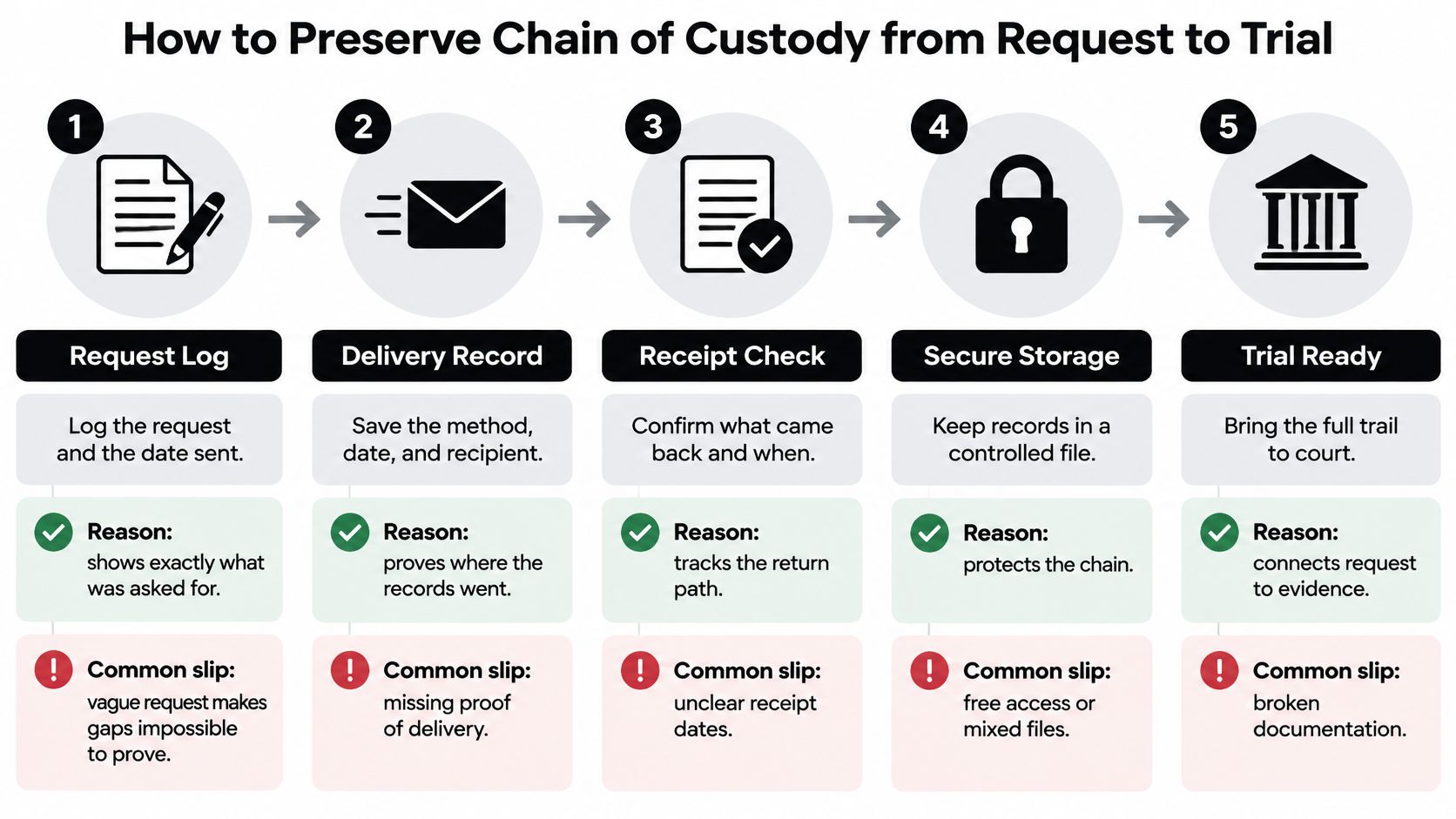
Build a handling log staff can actually maintain
Log the request and date sent. Save the authorization or process, cover letter, requested categories, delivery method, and recipient. A vague request makes later claims about missing categories difficult to substantiate.
Preserve the production as received. Save native files or certified copies when supplied, along with delivery correspondence and attachments, in a controlled originals location. Don't overwrite that copy with a searchable, compressed, or annotated version.
Record the receipt boundaries. Log the receipt date, filenames, page count or Bates range, and any index, then compare the return against the request. A continuous page range doesn't establish that every requested category was produced.
Create separate working copies. Label chronologies, extracts, and summaries as derivative review materials, with a version date and responsible reviewer. Calling a document work product doesn't itself establish privilege or protection, so counsel should direct those designations.
Cite each material chronology entry. Include the source page, author, encounter date, and relevant disposition or follow-up. If the source distinguishes a patient report from a clinician finding, preserve that distinction rather than flattening both into a diagnosis.
Document transformations. Record who performed a scan, OCR pass, conversion, or extraction, when it occurred, and which tool was used. Check that pagination, orientation, handwriting, and image quality survived the process.
Flag differences without deleting evidence. Identify duplicates, amendments, late entries, and conflicting versions in the review log. Retain the received originals and state what remains uncertain instead of selecting the version that best supports the claim.
Control access and preservation. Restrict permissions by role, maintain handling history, and suspend routine deletion under counsel's preservation instructions. Release a hold only when counsel confirms the applicable preservation obligations have ended, not merely when staff marks the matter closed.
Make the final index match the evidence
A clean chain consists of an index that matches the received production and a log that accounts for subsequent handling. Keep the provider's identifiers separate from internal Bates numbers so a witness can reconcile both.
Before export, open the proposed exhibit and verify its source, boundaries, and legibility. That final check catches practical failures such as an omitted reverse side, a broken attachment, or a chronology citation pointing to the wrong working version.
Decide Whether Your Records Can Carry the Case
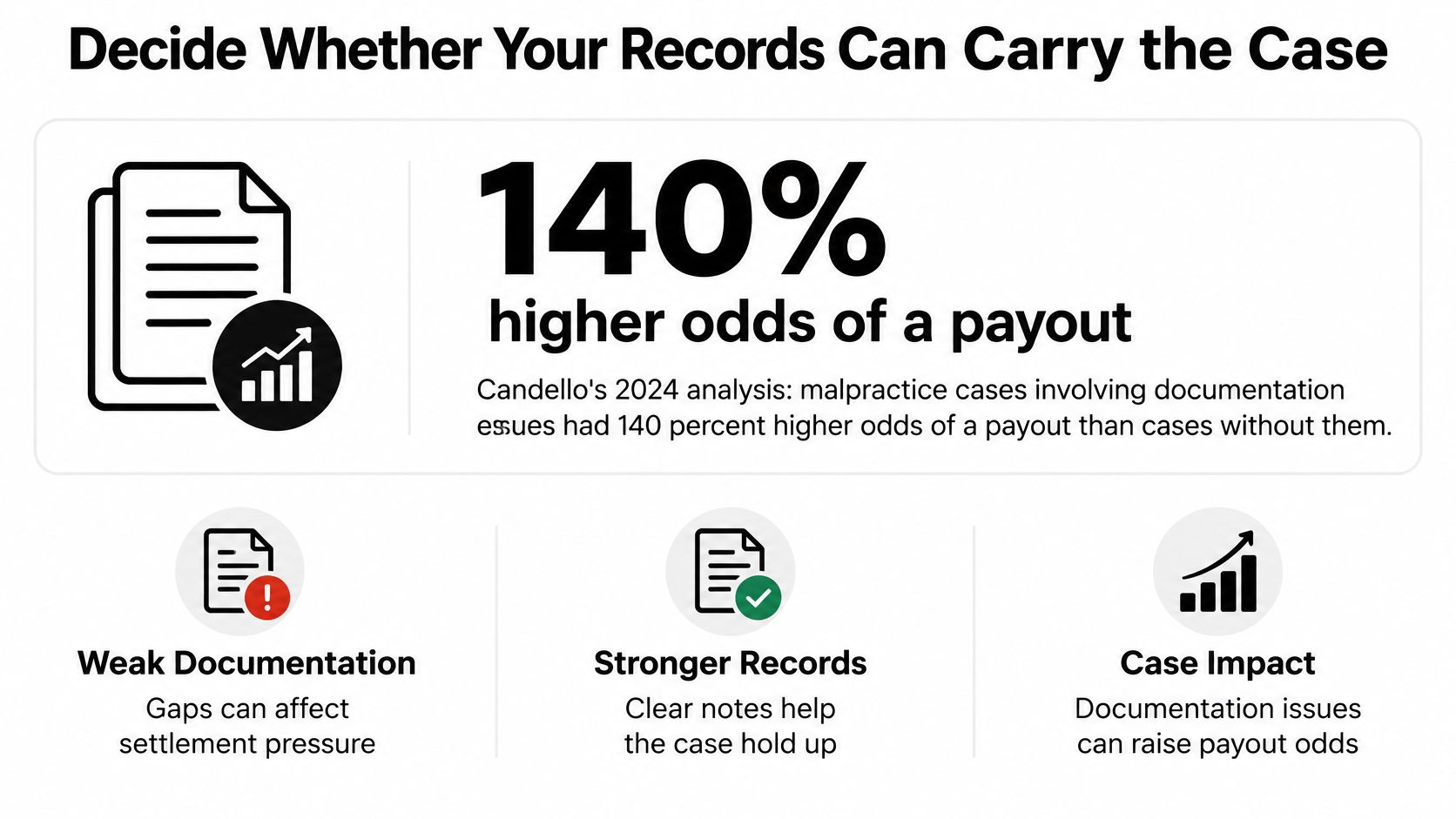
In Candello's analysis reported in 2024, medical malpractice cases involving documentation issues had 140% higher odds of a payout than cases without documentation issues. That finding concerns malpractice cases, not a valuation formula for a collision claim, but it underscores why lawyers shouldn't treat documentation defects as clerical cleanup.
The practical decision is whether the file supports the assertions counsel intends to make.
Apply a release gate before using the file
- Traceability: Can the reviewer locate a source page for every material date, provider, diagnosis, and treatment assertion?
- Collection gaps: Has the team named missing categories and requested them in writing?
- Timeline integrity: Does the available electronic history support the disputed sequence, without unexplained discrepancies that could change the argument?
If a check fails, pause the affected demand narrative or valuation assumption and assign corrective work. That doesn't mean suspending the entire case or overlooking a filing deadline. It means refusing to present an unresolved inference as an established fact.
Keep attorney verification in the workflow
At volume, the workable process combines a cited chronology, a gap audit against the request, and final verification by the responsible attorney. At Ares, our Medical Summaries product organizes records into chronologies, billing ledgers, treatment timelines, and red flags to support that review.
The lawyer still owns the judgment. Customers are responsible for reviewing and verifying every output before using it in proceedings or client communications. Our HIPAA-compliant platform restricts PHI access through role-based access controls with detailed audit logging, but platform controls don't replace exhibit foundation or attorney analysis.
Run these checks on a current file this week and record the result before the next demand or deposition. If material remains missing after a written follow-up, escalate the issue before assuming it's harmless.
Ares helps PI teams turn medical records into organized chronologies, billing analysis, and source-cited demand drafts. Visit Ares to explore a review workflow that keeps supporting evidence accessible while your attorneys verify the facts and make the legal decisions.