For any personal injury firm, a client's medical history is the single most important piece of the puzzle. It's the official narrative that connects an incident to an injury, spells out the severity, and ultimately justifies the compensation you're fighting for.
The problem is, that narrative is almost never in one place. It's scattered across a dozen different providers—hospitals, specialists, physical therapists, imaging centers.
The Mountain of Manual Work
Pulling all those records together manually is a huge administrative drain. Your team has to track down every provider, send out flawless HIPAA-compliant requests, and then hound them with follow-up calls and emails. It’s a slow, frustrating process filled with opportunities for error. A single missing record or an incomplete file can stall a case or weaken your negotiating position.
This is exactly the problem medical record retrieval services were created to solve. Think of them as a dedicated logistics partner whose only job is to gather your client's most sensitive evidence. They handle the entire complex process from start to finish, delivering a single, organized file.
How Retrieval Services Create Order from Chaos
At the heart of this process is a sophisticated information retrieval system designed to manage a high volume of requests with precision. By taking this work off your plate, these services:
- Manage all provider outreach. They deal with the endless phone calls and follow-ups with every medical facility.
- Guarantee HIPAA compliance. Their entire workflow is built around federal privacy and security rules, removing that risk from your firm.
- Are relentless with follow-ups. Their teams are dedicated to chasing down outstanding requests so nothing gets lost.
- Deliver an organized file. Records arrive digitally, sorted, and ready for your review—not in a jumble of faxes and mail.
By handing off this function, law firms free up their paralegals from hours of administrative headaches. That's time they can now spend on high-impact work like legal research, drafting motions, and preparing for depositions.
In the end, these services do far more than just collect paper. They lay the factual groundwork for a successful claim. Without a complete, accurate medical history, proving the full extent of your client's suffering is a losing battle. A professional retrieval service ensures you have every piece of evidence you need to secure the best possible outcome.
In-House vs. Outsourced Retrieval: Which Workflow is Right for You?
One of the most critical operational decisions a personal injury firm has to make is how to handle medical record retrieval. Should you keep it in-house, or is it better to partner with a specialized service? There’s no single right answer; each path comes with its own set of trade-offs in cost, efficiency, and control. The choice really comes down to your firm's case volume, staff resources, and what you’re building for the future.
Managing retrieval internally gives your team total command of the process. You set the timeline, you speak directly with providers, and you keep all sensitive client data securely within your own systems. But that control comes with a steep, often hidden, price tag.
The Real Cost of Doing It Yourself
The in-house approach means dedicating your paralegals or administrative staff to a repetitive, time-consuming, and entirely non-billable task. This isn't a simple matter of sending out a request form. It's a relentless cycle of follow-up calls, faxes, and emails to chase down records from dozens of different healthcare providers, each with its own bizarre process and inevitable delays.
This is the chaos that a dedicated retrieval service is built to solve. They step in to transform scattered client files into a single, cohesive medical history you can actually use.
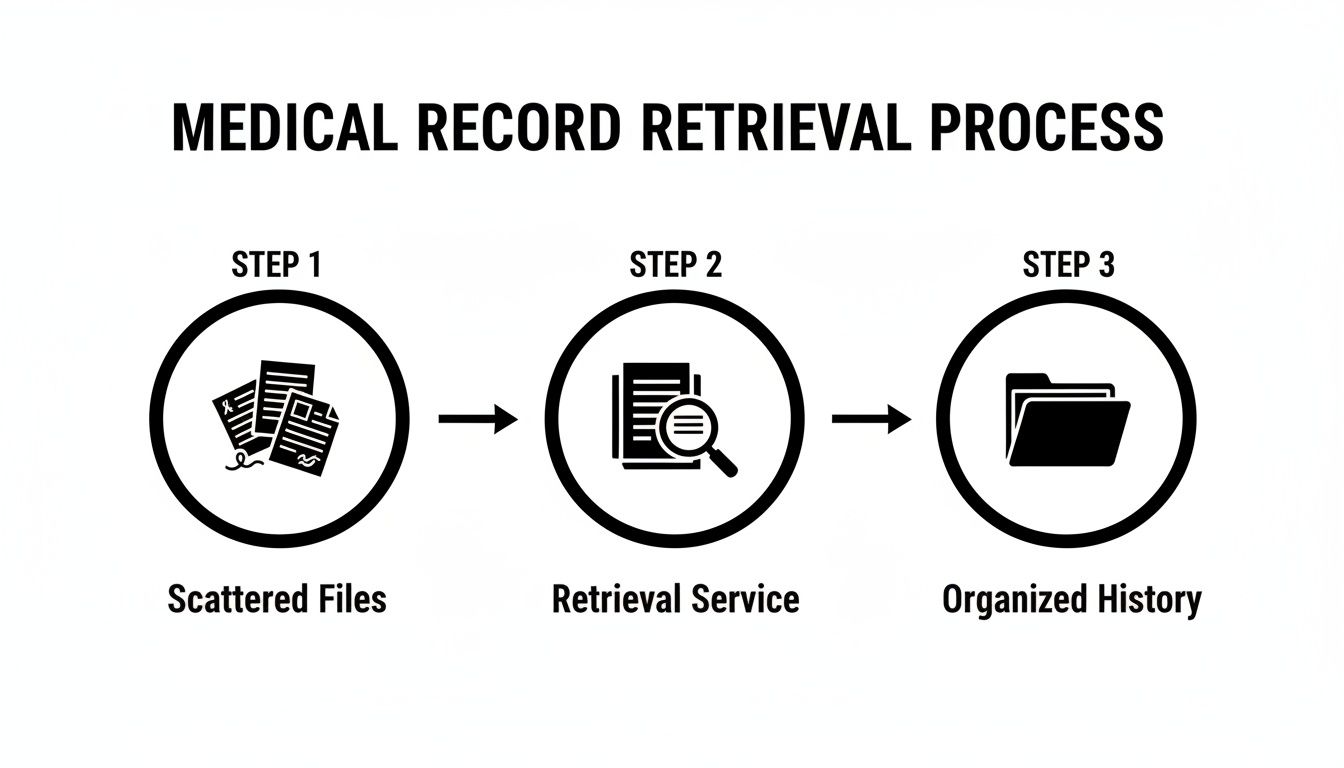
As the diagram shows, a retrieval partner acts as the essential hub, creating order out of a messy and fragmented system. For a law firm, this isn't just an administrative hand-off; it’s about turning a major headache into a strategic advantage.
Every hour your team spends on these administrative tasks is an hour they aren't spending on high-value work like drafting motions, preparing for depositions, or giving clients the attention they deserve. As your case volume grows, the in-house model simply can't keep up, leading to bottlenecks, staff burnout, and a much higher risk of making a costly mistake or missing a crucial record.
One study on law firm operations found that paralegals can spend up to 30% of their time on administrative duties just like record retrieval. Outsourcing this frees them up to focus on the substantive legal work that actually wins cases.
The Power of Outsourced Expertise
When you outsource to a dedicated medical record retrieval service, you shift this entire burden to a team of experts. These companies have established relationships with healthcare providers all over the country. They use fine-tuned workflows and smart technology to get records much faster and more reliably than any law firm could on its own.
This specialization brings some serious benefits to the table:
- Speed: They get records in a fraction of the time. Some services can deliver complete files in an average of 15 days, a huge improvement over the 4-6 weeks it often takes to do it manually.
- Predictable Costs: Most vendors offer flat-fee or per-request pricing. This turns a fluctuating internal cost into a predictable expense you can easily budget for.
- Guaranteed Compliance: A reputable vendor's entire business is built around HIPAA. They shoulder the compliance burden, which significantly reduces your firm's exposure to regulatory risk.
But traditional outsourcing isn’t a silver bullet. While vendors handle the chase, your team is still left with the massive task of manually reviewing, organizing, and summarizing all those records to build a winning case. This is where modern, AI-assisted platforms are completely changing the equation. To see how technology is reshaping these workflows, check out our guide to legal workflow automation software.
Choosing the Right Workflow For Your Firm
So, how do you decide? The best way to weigh the trade-offs is to compare the different approaches side-by-side. The table below breaks down the key factors for each method, including the emerging AI-assisted model that combines the best of both worlds.
Comparison of Medical Record Retrieval Methods
| Factor | In-House Process | Traditional Vendor | AI-Assisted Platform |
|---|---|---|---|
| Cost Structure | High hidden labor costs (staff salary, benefits, overhead). | Predictable per-request or subscription fees. | Often subscription-based, offering better ROI on high volume. |
| Turnaround Time | Slow and unpredictable. Totally dependent on staff workload and provider responsiveness. | Fast and reliable. Established processes get records in weeks, not months. | The fastest option. Automation can reduce retrieval times even further. |
| Scalability | Very difficult to scale. More cases mean hiring more staff. | Easily scales to handle any case volume without hiring. | Highly scalable. Technology handles increased load effortlessly. |
| Staff Focus | Pulls paralegals away from legal work into administrative tasks. | Frees up your entire team to focus on high-value, billable work. | Maximizes staff efficiency by automating retrieval and analysis. |
| Data Organization | Manual. Staff must sort and organize every document received. | Delivers digital records, but organization is still on your team. | Records arrive pre-organized, summarized, and ready for review. |
| Compliance Risk | The firm bears 100% of the HIPAA compliance responsibility and risk. | The vendor manages compliance, significantly reducing the firm's risk. | Built-in compliance and security protocols managed by the platform. |
Ultimately, the best approach truly depends on where your firm is today and where you want it to be tomorrow. A small firm with just a few cases a year might get by with an in-house process. But for any practice looking to grow, improve efficiency, and become more profitable, moving to a specialized service is a strategic investment that pays for itself over and over again.
Navigating HIPAA Compliance in Record Retrieval
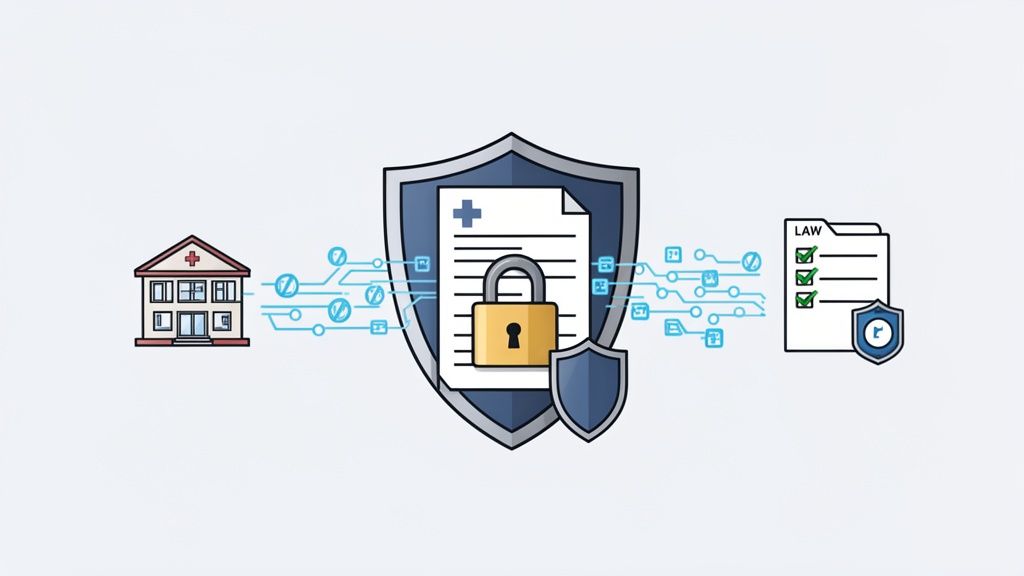
If you work with Protected Health Information (PHI), you know that HIPAA isn't just a suggestion—it's the law. For personal injury firms, every single step of the medical record retrieval process, from the first request to how you store the final document, is under a microscope. One slip-up doesn’t just risk a client's case; it can bring on severe financial penalties.
Think of HIPAA as the strict rulebook for handling someone's most private information. It dictates exactly how that data can be requested, shared, and kept safe. Breaking these rules isn't a minor foul. Fines can run into the thousands of dollars per violation and can do permanent damage to your firm's reputation.
The Authorization Form: Your Compliance Keystone
The whole retrieval process stands on one foundational document: the HIPAA-compliant authorization form. This is much more than a signature. It’s a legally binding permission slip from your client, giving a specific entity the green light to access their PHI for a very specific reason.
To be valid, that authorization absolutely must include a few key elements:
- Specific Identification: It needs to name the patient and the exact law firm or retrieval service getting the information. No ambiguity allowed.
- Defined Scope: The form must spell out precisely what records are being requested, like "all records related to the July 15, 2023 accident."
- Expiration Date: Every authorization must have a clear expiration date or an event that voids it.
- Right to Revoke: It has to tell the patient they can revoke the authorization in writing at any time.
If any of these pieces are missing, a hospital can—and often will—reject the request, causing frustrating delays. Even worse, using an improper form could be seen as an unauthorized disclosure of PHI. For a closer look at what this means for your document workflows, our guide on https://areslegal.ai/blog/hipaa-compliant-document-management is a great resource.
Security During Transfer and Storage
Once you have a valid authorization, the game shifts to handling the data securely. This is where modern retrieval services have a massive edge over old-school, in-house methods that still lean on fax machines or unencrypted emails.
A professional retrieval partner builds their entire operation around enterprise-grade security. This means end-to-end encryption, secure portals for downloading documents, and audit trails that log every person who ever touches a file.
This level of security is non-negotiable. Understanding the technical side, like the specifics of cloud hosting in healthcare, is crucial for anyone handling PHI. This isn't your standard cloud storage; it's a specialized infrastructure built from the ground up to protect against breaches.
The market growth reflects how critical this has become. The global medical records retrieval market was valued at a huge $1.1 billion and is projected to hit $2.8 billion by 2034, growing at a rapid 10.1% annually. North America is at the forefront of this trend, driven by strict HIPAA enforcement and the widespread use of electronic health records.
Working with a compliant retrieval service lifts that immense technical and regulatory weight off your shoulders. It frees up your team to focus on what you do best: building the strongest possible case for your client.
How AI Is Transforming Medical Record Analysis
Traditional medical record retrieval services solved the first big headache for personal injury firms: just getting the documents. But as soon as those records landed on your desk, a second, even bigger challenge began—a mountain of unstructured data that paralegals had to sift through, page by painful page. Now, artificial intelligence is tackling this more complex part of the job, moving way beyond simple retrieval and into intelligent analysis.
AI doesn’t just fetch the records; it actually reads, understands, and organizes them. Think of an AI platform as a brilliant paralegal who works at lightning speed, capable of scanning thousands of pages in seconds to pull out the exact information you need to build a compelling case. It’s a genuine shift from collecting documents to extracting real insights.
Uncovering the Story Hidden in the Data
The real magic of AI is its ability to connect the dots across a client's entire medical journey. A manual review might eventually piece together the timeline, but an AI-powered system does it in minutes. In the process, it can identify crucial relationships that a human reviewer, no matter how diligent, might easily miss.
This technology automatically flags and extracts key data points, turning them into a structured, usable summary. What you get back usually includes:
- Diagnoses and ICD Codes: Instantly pinpoints all official diagnoses.
- Treatment Timelines: Builds a clean, chronological history of every appointment and procedure.
- Provider Information: Maps out every single doctor, specialist, and facility involved in your client's care.
- Symptom Chronology: Tracks how symptoms progressed over time, as recorded in clinical notes.
This automated process takes a chaotic stack of papers and transforms it into an actionable case overview. For a closer look at how this all works, check out our guide on AI-powered medical record review.
A Practical Example of AI in Action
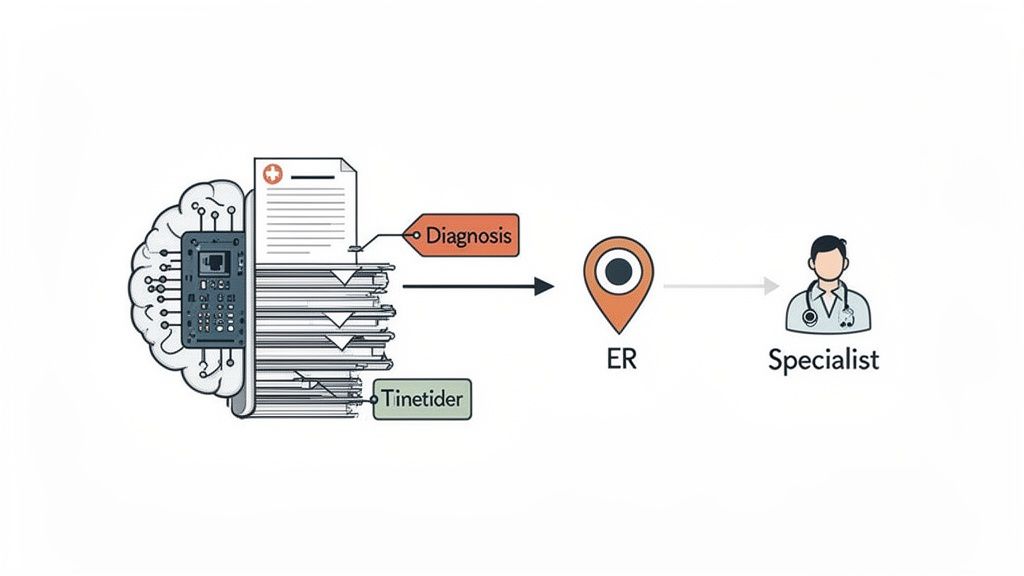
Let’s walk through a common PI scenario. Your client is in a car accident and goes to the ER complaining of back pain. Two weeks later, they see an orthopedic specialist who diagnoses a herniated disc. To build a strong demand letter, you have to manually connect those two events to establish a clear line of causation.
An AI platform processes these records and immediately makes the connection. It flags the initial ER visit, notes the complaint of "lumbar pain," and then links it directly to the follow-up specialist appointment and the official herniated disc diagnosis. It essentially builds the narrative for you, delivering a clear, evidence-backed timeline that anchors your claim.
This isn't just about speed; it's about precision. By structuring the data, AI helps attorneys spot gaps, identify pre-existing conditions, and build a more persuasive argument based on a complete and accurate medical history.
Bridging Gaps in a Fragmented System
The need for this kind of technology is driven by the reality of modern healthcare data. While Electronic Medical Records (EMRs) are now the standard, the system is still incredibly fragmented. In the U.S., where 96% of non-federal hospitals use certified EHRs, retrieval delays still hold up 40% of cases. AI helps bridge these gaps, with firms reporting they can assemble records up to 80% faster.
For managing partners, this means HIPAA-secure tools can seriously improve outcomes. Some firms have found they can spot trial gaps 5x quicker, which has led to 20-30% higher settlements in complex cases. You can find more data in the medical records retrieval market analysis.
At the end of the day, AI turns medical records from a static administrative hurdle into a dynamic strategic asset. It gives PI firms the power to move faster, craft stronger arguments, and focus their valuable human expertise on winning the case—not just on taming the paperwork.
Calculating the ROI of Modern Retrieval Services
For any law firm partner or operations manager, every new tool has to pass the ultimate test: what's the return on our investment? Bringing a modern medical record retrieval platform into your firm isn't just an operational tweak; it's a serious financial decision. To really understand the ROI, you have to look past the price tag and see how it actually impacts your firm's efficiency, bottom line, and ability to grow.
The real value is found in the hours you get back. When your paralegals aren't stuck chasing down providers and sorting through faxes, they can pour that time into high-value legal work—the kind that wins cases. That shift, from administrative busywork to strategic action, is where the real return lies.
Quantifying the Time Savings
Let's run some conservative numbers. A paralegal handling retrieval in-house can easily spend 10-15 hours on a single case just getting records. This includes everything: identifying every provider, drafting and sending requests, making endless follow-up calls, and then trying to make sense of the documents that trickle in. All of that is non-billable time.
If you figure a paralegal's blended rate—salary plus benefits and overhead—is around $50 per hour, you're looking at $500 to $750 in labor costs sunk into a single case before you’ve even started the real legal work. Now, multiply that by your firm's total caseload. It adds up, and fast.
An automated platform essentially erases this manual effort. By handing off the entire retrieval and organization workflow, you reclaim those hours almost overnight.
A firm handling 100 cases a year could save between 1,000 and 1,500 paralegal hours annually. That’s a direct operational savings of $50,000 to $75,000 that can be put right back into growing the business.
Boosting Caseload Capacity and Settlement Value
But the ROI goes way beyond just cutting costs. When you free up your best people, you fundamentally increase your firm's capacity to handle more cases without having to hire more staff. This isn't just about saving money; it's about making more.
This efficiency is becoming critical. We're seeing a surge in legal claims, with auto torts up 12% year-over-year and pharmaceutical mass torts jumping 25% since 2020. With over 400,000 auto accident lawsuits filed in the U.S. each year, slow, manual processes are a serious handicap. In contrast, firms that have switched to automated systems are reporting as much as a 50% increase in their caseload capacity, giving them a massive leg up on the competition. You can dive deeper into these market trends on Market Publishers.
On top of that, speed and organization have a direct impact on how much you can win for your clients. When your team gets organized, summarized medical records weeks earlier than the old way, they have a huge head start in building a powerful case narrative. AI-driven platforms are a game-changer here, capable of flagging critical details—like an untreated comorbidity—that a busy paralegal might miss. Insights like that can boost settlement leverage by as much as 25%.
A Hypothetical Case Study
Picture a mid-sized PI firm managing about 200 active cases. Right now, their paralegals spend an average of 12 hours per case on medical record retrieval.
Before Automation:
- Total annual hours on retrieval: 2,400 hours
- Annual labor cost (@ $50/hr): $120,000
- Caseload is limited by how much administrative work the team can handle.
After Adopting an AI Platform like Ares:
- Retrieval time per case: Drops to ~1 hour (mostly for final review).
- Total annual hours on retrieval: 200 hours
- Annual labor cost: $10,000
- Annual Savings: $110,000
And that $110,000 is just the start. The 2,200 hours you've just given back to your team can be spent on client strategy, case development, and ultimately, taking on more clients. This isn't an expense; it's an investment that directly fuels your firm’s profitability and sharpens your competitive edge.
How to Choose the Right Retrieval Partner
Picking a medical record retrieval partner is a whole lot more than just farming out an admin task. It's a strategic move that hits your firm’s efficiency, bottom line, and even your case outcomes. The right service slides right into your existing workflow, but the wrong one just creates new headaches and bottlenecks. To make the right call, you have to look past the shiny sales pitches and really dig into a few core areas.
Think of it like hiring a key paralegal. You wouldn't just glance at a resume and say, "You're hired." You'd interview them, maybe give them a small test project, and see if they genuinely fit with your team's rhythm. You need to apply that same level of scrutiny here.
Technology and Integration Capabilities
The first thing to kick the tires on is their technology. A modern retrieval platform should do a lot more than just play nice with a fax machine. It needs to plug directly into the tools your team already lives in every single day.
When you're in a demo, don't be shy. Ask the tough questions:
- Case Management Integration: Does it actually connect with your case management software, like Filevine or whatever you’re using? A true integration means no more mind-numbing double data entry.
- Secure Portal: Is there a secure, 24/7 online portal where you can fire off requests and grab records anytime? This is table stakes—an absolute must-have for both convenience and security.
- Real-Time Tracking: Can you see the live status of every single request? Knowing exactly where a request stands is critical for managing client expectations and your own deadlines.
If a platform makes your team jump between different windows and logins all day, it’s not solving a problem. It’s just creating a new one.
Security Standards and HIPAA Compliance
You're dealing with Protected Health Information (PHI), and that's a massive responsibility. A data breach doesn't just tarnish your firm's name; it can bring on staggering legal and financial penalties. You have to be absolutely certain that a potential partner’s security is locked down tight.
Any company worth its salt in medical record retrieval will be verifiably HIPAA compliant. But you should push for more. Look for credentials like SOC 2 certification. That tells you they've gone through rigorous third-party audits and are committed to enterprise-level security.
Don't hesitate to ask for their compliance documentation and security protocols. A partner you can trust will have this information ready to go and won't get squirrely when you ask how they guard your client's most sensitive data.
Pricing Models and Customer Support
Pricing in this space is all over the map, so you need to know exactly what you're paying for. The two most common models you'll see are per-request fees and subscription plans.
- Per-Request Pricing: This model is simple and can be a good fit if your case volume goes up and down. Just be sure to ask about all the little "gotcha" fees—provider costs, postage, and extra charges for massive files can add up fast.
- Subscription Pricing: For firms with a steady, high volume of cases, a subscription plan often makes more sense. It gives you a predictable monthly cost and the ROI gets better as your caseload grows.
Just as critical is the quality of their customer support. What happens when a hospital is dragging its feet or a provider rejects an authorization? A great partner has a support team that jumps on these problems and gets them solved, not one that just logs a ticket and makes you wait. Test them out. If they're slow to respond before you've signed on the dotted line, imagine how slow they'll be once they have your business. You're looking for a service that feels like a genuine extension of your own team.
Frequently Asked Questions
It’s only natural to have a few questions before bringing a new service or technology into your firm. When it comes to medical record retrieval, most personal injury attorneys want to know about three things: cost, speed, and security. Let's break down what you can realistically expect.
We've gathered the most common questions we hear from legal professionals to give you clear, straightforward answers. The goal is to help you see exactly how these services can slide into your current workflow, save your team a ton of time, and ultimately, build stronger cases.
How Much Do Medical Record Retrieval Services Cost?
You'll typically run into two main pricing models. The first is a simple per-request fee, where you pay a flat rate for each set of records you need. This can work well if your case volume goes up and down, but be sure to ask about the fine print—things like provider fees, postage, or extra charges for massive files can sneak up on you.
The second option is a subscription plan. This is a recurring fee, which often makes more financial sense for firms that handle a consistently high volume of cases. For a busy practice, a subscription turns a variable cost into a predictable operational expense, and the return on investment gets better with every case you handle.
The most important thing is finding a transparent pricing model that fits your firm's caseload and budget. Always ask for a complete breakdown of all potential costs so there are no surprises down the line.
How Long Does It Take to Get Records?
This is where a dedicated service really shines. If your paralegals are chasing down records themselves, you know it can easily take four to six weeks, and sometimes much longer. It's a frustrating waiting game.
Specialized vendors have built-in advantages—they have established relationships with healthcare providers and a system for persistent follow-up that cuts through the delays. Most top-tier services can get a complete set of records back to you in an average of 15 days. That's not just a small improvement; it means you can start building your case strategy weeks ahead of schedule.
Is My Client’s Data Secure?
It has to be. Any legitimate medical record retrieval service operates under strict HIPAA compliance. This isn't just a feature; it's a legal requirement for handling protected health information (PHI). It’s the absolute baseline.
But the best services go even further. Here’s what you should look for as proof of their commitment to security:
- End-to-end encryption to protect data while it's in transit.
- A secure online portal for making requests and downloading the files.
- Detailed audit trails that track every single action taken with a client's file.
Many leading platforms also hold advanced security certifications like SOC 2, which is a rigorous, third-party audit of their security controls. This gives you peace of mind that your client's most sensitive information is protected and your firm stays compliant.
Ready to eliminate the administrative grind and get back to winning cases? Ares is an AI-powered platform that automates medical record review and demand letter drafting, turning thousands of pages into case-winning insights in minutes. Discover how firms are saving 10+ hours per case and heading into negotiations with more leverage. Learn more and see a demo of Ares in action.