You've received a box of medical records from several providers, but the pages don't tell one story. The emergency department uses one description of the injury, the orthopedist uses another, and the physical therapist's notes arrive without the imaging report that supposedly started treatment. Somewhere in that stack is the fact that will support causation, weaken the defense, or explain why the claim is worth more than the first offer.
A disciplined medical history review turns that scattered material into a traceable account of what happened before the incident, what changed afterward, how treatment progressed, and what limitations remain. In personal injury work, the reviewer isn't just sorting documents. The reviewer is building the factual foundation for liability strategy, damages, expert analysis, and negotiation.
Why Medical History Review Makes or Breaks a PI Case
A rear-end collision file can look straightforward until the chronology is examined closely. The client reports new leg pain after the crash. The emergency record mentions back discomfort, but the later orthopedic note focuses on radicular symptoms. A symptom diary in the primary care file shows that similar complaints appeared shortly before the collision, while another entry records a marked change in severity afterward.
If the paralegal misses that diary, the demand may overstate the case and leave the attorney unprepared for a predictable defense argument. If the paralegal finds it but fails to connect it to the crash date and subsequent treatment, the defense can characterize the entire claim as pre-existing. In either situation, the firm loses control of the causation narrative.
Chronology is evidence, not clerical formatting
A medical history can carry substantial diagnostic value. The National Center for Biotechnology Information's clinical overview states that a complete medical history can yield an accurate diagnosis in up to 74% of cases. In PI practice, the lesson is broader than diagnosis. A well-built history may reveal the baseline condition, the first report of symptoms, the mechanism of injury, the escalation of care, and the functional consequences that followed.
That sequence affects every major case question:
- Causation: Did the claimed symptoms begin after the incident, or did the incident aggravate an existing condition?
- Damages: Did treatment remain conservative, or did it progress to injections, surgery, or specialist care?
- Defense rebuttal: Do later records contradict the defense's description of the injury or recovery?
- Subrogation: Do other payers or prior claims relate to the same body part and treatment period?
The independent autopsy findings in Texas offer a useful reminder that medical conclusions depend on careful reconstruction of the available history, not on isolated facts removed from context.
Practical rule: A demand letter should never rely on a medical fact that the reviewer can't locate again in the source records.
A chronology without page references is only a persuasive summary. A chronology with dates, provider names, clinical language, and Bates citations becomes a working litigation tool. Teams can use a structured medical record organization process to preserve that connection from the first production through settlement or trial.
What to Extract From Every Medical Chart
Start with the assumption that every record set is incomplete until the chart proves otherwise. A provider's production may contain office notes but omit imaging, billing records, referral notes, or the discharge summary that explains why care changed. Your first task is to identify what exists, then determine what should exist based on the treatment pattern.
Build the factual spine first
Record the date of service, facility, provider, specialty, encounter type, and source page or Bates range for every clinically relevant event. Don't summarize a visit as “follow-up care.” Identify whether it was an orthopedic evaluation, a primary care visit, a physical therapy session, an emergency encounter, or a consultation with a pain specialist.
Extract diagnoses at each stage, including the provider's wording and ICD code when available. Distinguish a suspected or working diagnosis from a final diagnosis. An emergency department may document “possible cervical strain” while a later specialist identifies a disc disorder supported by imaging. Those entries aren't interchangeable, and the difference can matter when the defense argues that the claimed injury was never objectively established.
Treatment needs the same precision. Capture medications, dosage changes when documented, injections, surgery, physical therapy, home exercises, referrals, restrictions, and conservative-care recommendations. An imaging report should be summarized for its impression and relevant findings, while an operative report requires attention to the preoperative diagnosis, procedure performed, intraoperative findings, complications, and postoperative plan.
The medical record chart review template can help standardize the fields reviewers capture across providers and cases.
Read for chronology and admissions
A symptom timeline should answer four questions:
- What was the client experiencing before the incident?
- What did the client report immediately afterward?
- How did the symptoms develop or change during treatment?
- What limitations, diagnoses, and future recommendations appear later?
Look closely at the history of present illness, review of systems, physical examination, and functional statements. A note may say the client denies prior symptoms, then list a prior diagnosis involving the same body region. That contradiction deserves a flag, not a silent choice between competing versions.
Provider language can also contain admissions that aren't obvious in a damages summary. Statements such as “pain began after lifting at work,” “history of intermittent symptoms,” or “patient stopped therapy because symptoms improved” may affect causation, mitigation, or treatment-gap analysis. Record the exact clinical language where it matters, but don't convert a medical note into a legal conclusion.
Treat each document type differently
- Emergency records often establish the first complaint, mechanism, initial examination, precautions, and discharge instructions.
- Primary care notes may supply baseline health, prior conditions, medication history, and symptom changes that specialist records don't repeat.
- Imaging reports provide the radiologist's findings and impression. They don't, by themselves, establish when a condition began.
- Specialist consultations may connect symptoms to examination findings, recommend escalation, or identify competing explanations.
- Operative reports show what the surgeon found and performed, rather than what a referral note anticipated.
- Therapy records can document functional limits, compliance, progress, and the practical effect of pain on daily activities.
Always preserve the source location. “MRI confirmed injury” is weak. “MRI impression describes the relevant finding, Bates pages 184 to 186” gives the attorney a verifiable fact to use, challenge, or send to an expert.
Red Flags and Documentation Gaps to Catch Early
Missing information usually causes more trouble than obviously incorrect information. In a comparison of 105 encounters, 90% had at least one documentation error, and 71.5% of detected errors were omissions, according to the published evidence summary on documentation errors. For PI reviewers, that means an empty space in the chart deserves as much attention as a contradictory statement.
An omitted intake form can conceal baseline complaints. An unsigned history of present illness may leave the origin of a symptom unclear. A missing medication list can make it difficult to determine whether a drug was new after the incident or part of long-term care. Copy-forward examinations can create the appearance of unchanged findings even when the patient's condition evolved.
Separate absent facts from inaccurate facts
An omission is information the record doesn't contain. A commission is information that appears but may be inaccurate, inconsistent, or unsupported. The distinction guides the next action. An omission may justify a follow-up request, subpoena, client interview, or provider clarification. A commission may require comparison against other records, deposition preparation, or attorney review.
Watch for treatment gaps that have no explanation. A long pause may reflect improvement, insurance problems, relocation, a referral delay, or a missing production. Don't label it abandonment or recovery until the surrounding records support that conclusion. Cross-reference the last visit, the next visit, pharmacy activity, work records, and the client's account.
Other warning signs deserve early escalation:
- Copy-forward findings: Identical examination language appears across visits despite changing complaints or treatment.
- Late addendums: An addendum appears after a demand, claim dispute, or litigation event and changes the apparent history.
- Unreconciled prior injuries: The chart names an earlier injury to the same body region but never explains how it differs from the current complaint.
- Scope concerns: A provider offers conclusions outside the provider's documented specialty or examination.
- Medication without function: Opioid or other pain medication appears without notes describing functional progress, side effects, or treatment goals.
- Abrupt endings: Records stop before the chart explains maximum medical improvement, ongoing restrictions, or the reason care ended.
- IME irregularities: The examination date, referral path, materials reviewed, or conclusions don't align with the disclosed file.
| Red Flag | Omission vs Commission | Case Value Risk |
|---|---|---|
| Missing intake or baseline history | Omission | The defense may argue that the firm cannot establish the client's pre-incident condition. |
| Copy-forward examination findings | Commission | Repeated language may undermine the reliability of the treatment narrative. |
| Unexplained treatment gap | Omission | The gap can be portrayed as recovery, noncompliance, or lack of causation. |
| Prior injury with no reconciliation | Omission | A competing cause remains unresolved in the chronology. |
| Late-dated addendum | Commission | The timing may raise credibility and authentication questions. |
| Records ending before outcome documentation | Omission | The file may not support a complete damages or future-care position. |
A useful process for handling incomplete medical records should log each gap, identify the record expected, assign follow-up responsibility, and preserve the correspondence. Never bury an unresolved gap inside a polished summary.
A Repeatable Medical History Review Workflow
A defensible workflow should be simple enough for a new paralegal to follow and detailed enough that senior staff don't need to reconstruct the reviewer's assumptions. The following six stages work well for a PI intake or an active file.
1. Send the intake questionnaire promptly
Send the client questionnaire within 24 hours of intake as a firm operating standard. Ask for the pre-incident medical baseline, prior injuries, providers, surgeries, medications, body regions previously treated, employment limitations, and the client's description of symptom onset. Request names even when the client believes an old provider is irrelevant.
2. Customize each records request
Use a master request, but tailor it to the facility. Name the expected categories, including emergency notes, imaging, operative reports, discharge summaries, physical therapy notes, specialist consultations, pharmacy records, and billing materials. A request for “complete records” often produces a narrow subset of what the provider stores.
3. Log every production
The receipt tracker should identify the provider, date received, record period, page count, file format, apparent gaps, and the person who handled the file. Where firm protocol requires it, preserve a chain-of-custody hash or equivalent file-integrity record. A production log prevents duplicate review and gives the attorney a clean answer when opposing counsel questions completeness.
4. Assemble the chronology
Apply Bates numbers and combine the production into an indexed PDF with usable bookmarks or hyperlinks. Keep the provider identity visible in the index. A chronological file makes it easier to compare the date of imaging with the reported onset of pain and to identify whether a later treatment decision was based on a result that is missing from the production.
5. Complete the extraction pass
Populate a structured summary with diagnosis dates, providers, treatment milestones, medications, work status, restrictions, functional limitations, symptom descriptions, and source citations. Keep the client's reported symptoms separate from the provider's objective findings. That separation prevents an advocate's summary from accidentally presenting a patient statement as a clinical conclusion.
6. Run the gap analysis
Compare the expected care sequence with the documents received. If an inpatient stay appears in an emergency note, look for the discharge summary. If a specialist refers to imaging, locate the actual report and images when available. If therapy starts after a referral, check whether the referral, authorization, and initial evaluation are present.
Use the video below as a visual supplement to the workflow, not as a substitute for source verification.
CMS describes medical record review as requesting, receiving, and reviewing claim-related documentation, then synthesizing notes, diagnostic findings, medications, and nursing documentation into a longitudinal clinical picture. Its review procedures also establish time-bound determination and notice requirements, which reinforces the value of a workflow based on intake, receipt tracking, chronology, and documented follow-up rather than informal folder management. CMS medical record review guidance provides the operational model.
Using AI Tools Without Sacrificing Defensibility
AI-assisted review is useful when it reduces omission risk, not merely when it produces a faster summary. A system can compare overlapping productions to identify duplicate pages, flag inconsistent pain descriptions across providers, and surface expected records that aren't present in the file. Those functions create a better first pass, but they don't decide whether a condition was caused by an accident.
Use a clear division of responsibility:
| Review Task | AI Handles | Human Owns |
|---|---|---|
| Document organization | Sorts pages by provider, date, and document type | Confirms the order and resolves ambiguous dates |
| Initial extraction | Identifies diagnoses, medications, procedures, and symptoms | Verifies each fact against the source page |
| Pattern detection | Flags duplicates, contradictions, and possible gaps | Determines whether the issue is clinically and legally significant |
| Chronology drafting | Builds a date-based event sequence | Adds context, qualifications, and attorney-directed analysis |
| Causation assessment | Surfaces relevant pre- and post-incident language | Interprets causation and reserves legal conclusions for counsel |
| Final work product | Exports structured review data | Approves the summary, citations, and disclosure decisions |
Privacy controls come before convenience
A vendor handling protected health information should operate under an appropriate business associate agreement, limit processing to the minimum necessary information, and provide meaningful audit logs. The firm should know where records are processed, whether customer data is isolated from model training, how files are encrypted, who can access them, and whether prompts and generated outputs can be exported for an ethics or internal compliance review.
The need for governance is not theoretical. Coverage of a 2026 CMS pilot testing AI for medical record review describes the tension between workflow efficiency and the privacy risks of sending sensitive records to third-party systems, particularly under HIPAA. The For The Record discussion of AI-assisted review is useful background for firms evaluating those controls.
AI should produce a reviewable starting point. It shouldn't become an unexamined witness in your case file.
A senior paralegal or nurse consultant should verify every material extraction before it reaches a demand, discovery response, expert packet, or deposition outline. Firms comparing platforms can also review AY Automate legal automation resources as part of a broader vendor assessment. The relevant question isn't whether a tool sounds intelligent. It's whether the firm can reproduce how the tool reached a conclusion and show who verified it.
Turning Your Review Into a Winning Demand
The medical summary becomes valuable when every extracted fact has a destination in the demand. Put the diagnosis timeline into the causation narrative. Use treatment escalation to support the specials discussion and medical-necessity explanation. Match work status and restrictions to lost-wage documentation. Use documented pain and functional limitations to support non-economic damages without inflating the record.
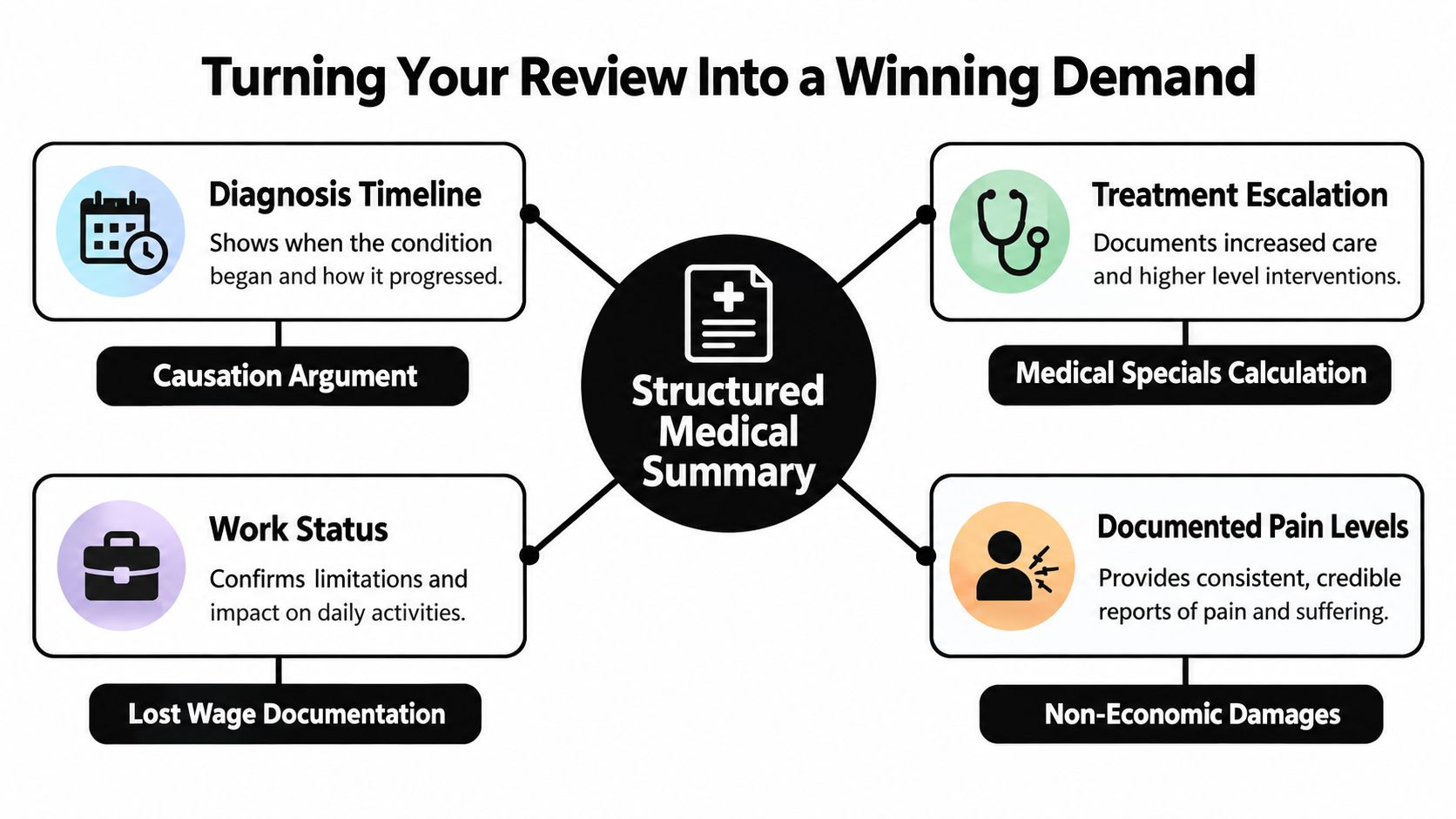
A vague demand says the client “sustained serious injuries and underwent extensive treatment.” A stronger demand identifies the first post-incident complaint, cites the examination, identifies the imaging impression, explains why treatment escalated, and attaches each major expense to the relevant Bates-stamped record. It also acknowledges a prior condition when one exists, then explains the documented change rather than pretending the earlier history is absent.
Build the demand outline while reviewing the chart. That approach exposes missing support before drafting begins and avoids rewriting the narrative after a late record arrives. Assign one primary reviewer to preserve consistency in terminology and chronology, while routing medical causation and final framing to the supervising attorney.
CMS's longitudinal approach is particularly useful here. A demand isn't a collection of favorable snippets. It's a coherent clinical account that allows the insurer to follow the sequence from baseline through injury, treatment, limitation, and outcome. The cleaner that sequence is, the harder it becomes to dismiss the claim with a generic pre-existing-condition response.
Ares offers personal injury teams an AI-powered workflow that organizes uploaded medical records into page-cited chronologies, treatment summaries, billing information, and red flags, then supports demand letter drafting from those structured findings. If fragmented charts are slowing your next review, visit Ares to see how the platform can fit into a HIPAA-conscious, human-verified medical history review process.