

A catastrophic injury file lands on a paralegal's desk, followed by thousands of pages of hospital records, imaging reports, billing statements, and provider correspondence. The team needs a reliable medical chronology, a defensible damages narrative, and a demand letter, yet critical facts remain buried in scanned documents while staff copy information between disconnected systems. That situation is common in personal injury practice, and adding another isolated application rarely fixes it.
A legal technology platform should connect the firm's information, people, and decisions across the matter lifecycle. The practical question isn't whether a vendor has artificial intelligence. It's whether the system can handle sensitive medical information, fit existing case workflows, preserve attorney judgment, and produce work product that staff can verify. The market's expansion supports that shift. One industry estimate valued global legal technology revenue at USD 26.7 billion in 2024 and projected USD 46.8 billion by 2030, while another outlook estimated USD 28.7 billion in 2025 and projected USD 69.7 billion by 2033. These are projections from separate market models, but both point to sustained double-digit growth and a move toward platforms as operational infrastructure (Grand View Research's legal technology market analysis, Fortune Business Insights' legal technology market outlook).
Why Personal Injury Firms Need a Legal Technology Platform
A mid-sized personal injury firm may have a catastrophic injury matter with 4,000 pages of medical records. Paralegals sort hospital charts, redact protected health information, reconcile treatment dates, and search narratives for diagnoses or billing details. Meanwhile, the attorney is trying to determine whether a treatment gap is real, whether a procedure supports the damages theory, and whether the demand letter reflects the complete record.
That work becomes fragile when each task lives in a separate folder, spreadsheet, email chain, or case management screen. A missed provider, duplicated invoice, or misunderstood clinical note can affect valuation and negotiations. A legal technology platform gives the firm a shared operational layer for intake, records, chronology, case analysis, drafting, and communication. The purpose isn't to remove lawyers from decision-making. It's to give them a more complete and reviewable set of facts before they make decisions.

The operational pressure is specific to PI work
Personal injury firms handle a difficult combination of high-volume intake, medical-record analysis, insurer deadlines, lien resolution, and client communication. The information arrives in inconsistent formats, including searchable PDFs, scanned records, handwritten notes, imaging references, police reports, bills, and correspondence. A generic practice management tool may track a matter and a deadline, but it often doesn't interpret the clinical story inside the file.
A platform designed around PI workflows can connect:
- Intake and triage, so facts collected at the first call aren't re-entered later.
- Medical record processing, including extraction of dates, providers, diagnoses, procedures, and treatment events.
- Case valuation support, using organized evidence rather than scattered notes.
- Demand generation, with drafts grounded in reviewed records and attorney-selected arguments.
- Lien and billing workflows, where staff can compare charges, treatment, and supporting documentation.
- Client updates, using consistent templates and matter information.
A recent overview of document extraction architecture describes platforms that combine OCR with artificial intelligence or large language models to convert unstructured files into fields such as document type, key dates, parties, and clauses. It also emphasizes mandatory human review for low-confidence outputs, an important safeguard for legal work (document data extraction and automation architecture).
Practical rule: If the platform creates another place for staff to upload, review, and retype the same information, it isn't an operational backbone. It's another silo.
The legal technology market now reflects demand from daily law firm operations, not only storage or billing. Software generated USD 21.4 billion in 2024 in one market breakdown, and law firms represented 60% of end-user revenue in 2025 in another forecast (Grand View Research's software and regional market data, Fortune Business Insights' end-user analysis). For PI leaders, the buying decision starts with understanding what a platform does under the hood.
Core Capabilities and Architecture Explained
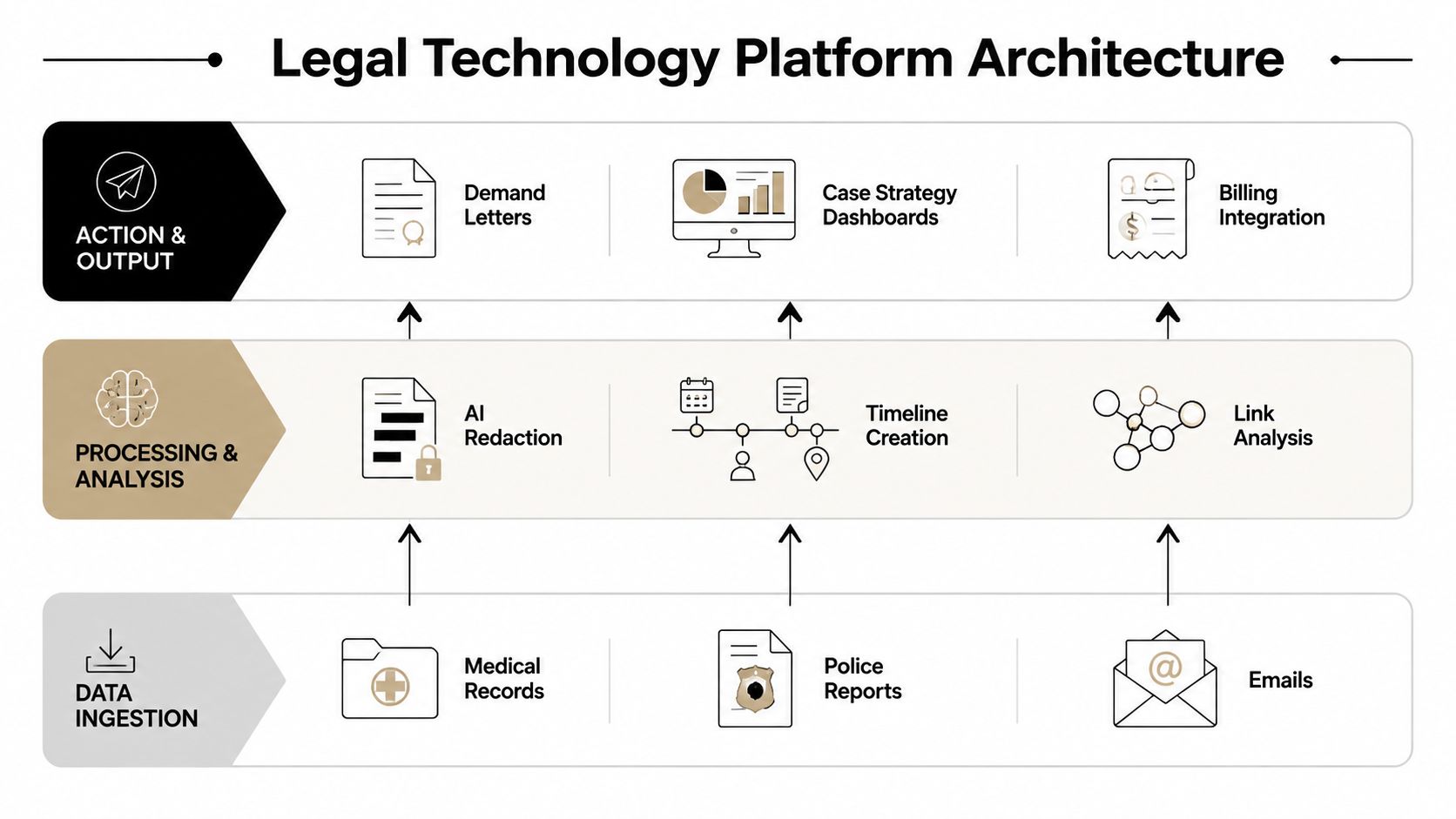
A useful way to assess a legal technology platform is to trace one document through four layers. The platform receives information, interprets it, applies intelligence, and returns an action that a legal professional can review or use.
Data ingestion comes first
The ingestion layer accepts medical records, police reports, correspondence, bills, imaging references, and intake materials. Strong systems support secure uploads, OCR for scanned pages, structured imports, and connectors to the firm's existing applications. The source file should remain available, with its origin and page location preserved, so a reviewer can move from an extracted fact back to the evidence.
OCR quality matters because PI files rarely arrive in one clean format. Printed hospital records are easier to process than handwritten clinical notes, fax artifacts, or poorly scanned exhibits. A vendor demonstration that works only on clean PDFs doesn't establish that the platform can handle the firm's actual inventory.
Processing turns pages into a case record
The processing layer classifies documents and extracts entities. Depending on the system, those entities may include providers, dates, diagnoses, procedures, symptoms, medications, billing references, and treatment events. The platform can then organize those details into a chronology, identify duplicate material, and surface areas that require confirmation.
Confidence scoring and review queues separate usable automation from risky automation. The system should identify uncertain fields and route them to a person instead of automatically accepting an unreliable extraction. Human review remains essential for ambiguous medical language, causation questions, pre-existing conditions, and gaps that require context across multiple providers.
Intelligence should support judgment
The intelligence layer can compare treatment events, flag missing records, identify apparent gaps, and organize facts relevant to a demand narrative. It may also help a team find inconsistencies between a chronology and billing material. Those functions are valuable because they direct attention. They don't decide whether a fact proves causation or justifies a particular settlement position.
The output layer converts reviewed information into work product. Examples include medical overviews, demand-letter drafts, case dashboards, document requests, client communication templates, and exports into a practice management system. The platform's usefulness depends on whether these outputs arrive in the attorney's existing workflow.
For firms considering an AI assistant for legal work, the Ares legal AI assistant illustrates the kind of workflow-specific product that should be evaluated alongside broader case management and document platforms. The comparison should focus on evidence traceability, review controls, export options, and integration behavior, not on the number of AI features listed on a sales page.
Middleware determines whether the system fits
Integration middleware connects the platform to systems such as Filevine, Litify, or Needles, as well as medical-record retrieval services, document storage, email, and electronic signatures. A technically available connector isn't enough. The firm needs to know which fields sync, which system remains authoritative, how updates are handled, and what happens when a transfer fails.
The architecture succeeds when staff can follow one matter through intake, records review, drafting, approval, and filing without duplicate entry. It fails when the AI output is useful but trapped in a separate portal.
Benefits and Risks for Personal Injury Practices
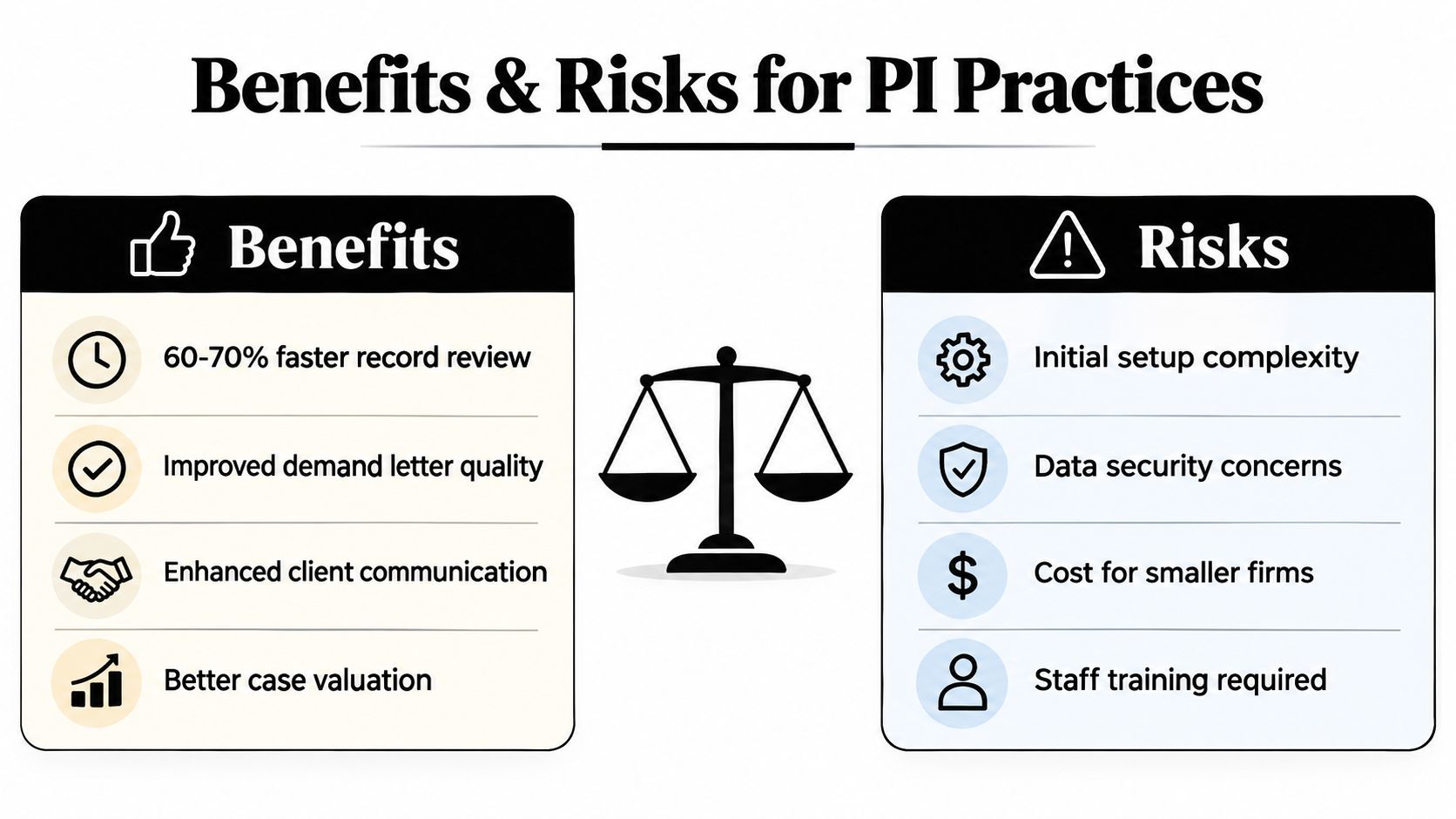
Automation can change the economics of document-heavy PI work, but the result depends on workflow design and review discipline. In one reported firm example, a routine document-review task fell from 30 minutes to 5 minutes, an 83% reduction, according to the vendor case material (reported legal document review case study). That result applies to the reported task, not every PI matter, but it shows why firms test repeatable extraction and drafting workflows.
The operational benefits are straightforward. A chronology produced from organized records can help an attorney evaluate a file earlier. A demand draft assembled from reviewed facts can reduce repetitive formatting and copying. Better visibility into treatment gaps and missing documentation can improve preparation for negotiation. Consistent client updates can also reduce avoidable status calls, provided staff keep the underlying matter data current.
What firms can gain
A platform may help a firm:
- Recover review capacity: Repetitive extraction and classification can give paralegals more time for provider follow-up, lien work, and attorney support.
- Improve narrative consistency: A demand draft built from a reviewed chronology is less likely to omit a provider or treatment event than one assembled from scattered notes.
- Find issues sooner: A structured timeline can make unexplained gaps, duplicate records, and conflicting dates easier to investigate.
- Scale without adding identical manual steps: A repeatable workflow can support more active matters while preserving defined review checkpoints.
The risks are equally practical. An AI system may summarize a record incorrectly, miss a nuanced finding, or treat a copied-forward note as a new clinical event. Integration failures can force staff to maintain two systems. Veterans may reject a platform if training is generic or if it changes their established sequence without solving a visible problem.
Governance is part of the product
PHI requires more than a security logo. The firm should confirm contractual coverage, access controls, retention behavior, audit logs, data-use restrictions, and the process for handling deletion or correction requests. Thomson Reuters reported that only 41% of law firms had established policies governing generative AI use, 40% provided gen AI training, and 20% measured ROI in 2025 (Thomson Reuters survey coverage).
Speed is useful only when the firm can explain where the output came from, who reviewed it, and what happened when the system was uncertain.
Leaders should treat automation as controlled delegation. Define what the system may prepare, what a paralegal must verify, and what only an attorney may approve. That approach captures efficiency without turning a generated summary into an unexamined fact.
How to Evaluate a Legal Technology Platform
Feature checklists produce weak buying decisions. A PI firm should evaluate a legal technology platform against the work it must perform, the data it will touch, and the systems it must update.
Start with security and privacy. Ask whether the vendor offers a business associate agreement where required, how it separates customer data, who can access production environments, how it records user activity, and how it handles model training. “Encrypted” is not a complete answer. The firm needs evidence about permissions, auditability, retention, incident response, and administrator controls.
Next, test medical-record performance with representative files. Use a mixture of clean PDFs, scanned pages, duplicate records, billing statements, and difficult clinical notes. Ask the vendor to show extracted dates, diagnoses, providers, procedures, and source references. Don't accept a polished demonstration based only on files the vendor selected.
Compare operational fit, not feature volume
Integration deserves its own evaluation. A platform should connect with the firm's case management system, document repository, email, retrieval providers, and e-signature workflow where those connections are necessary. Confirm whether the integration is real-time, scheduled, one-way, or two-way. Also ask how the system handles failed syncs, duplicate matters, changed field values, and user permissions.
The firm should define success before signing. Useful measures include review time per file, time from records receipt to attorney-ready chronology, demand-draft rework, unresolved data-quality exceptions, and staff adoption. Don't promise a savings figure before measuring the current process. Establish a baseline, run a controlled pilot, and compare like-for-like work.
A practical matrix can expose weak answers quickly:
| Evaluation Criteria | Key Requirements | Red Flags |
|---|---|---|
| Security and privacy | Clear access controls, audit logs, retention rules, incident response, and appropriate contractual protections | Vague security language, unclear data ownership, or no usable audit history |
| Medical ingestion | OCR, document classification, source-linked extraction, and review queues for uncertain results | Demonstrations limited to clean files or summaries without citations to source pages |
| PI workflow fit | Chronology, treatment-gap review, demand drafting, billing support, and configurable approvals | Generic templates that require extensive manual reconstruction |
| Integrations | Documented connections with case management and related systems, with defined sync behavior | Export-only workflows that create duplicate entry |
| ROI and adoption | Baseline measures, usage reporting, exception tracking, and training support | No adoption reporting or claims that cannot be tested |
| Scalability and control | Role-based permissions, configurable workflows, and portable data | Proprietary lock-in, weak exports, or expensive customization for basic needs |
For additional context on distinguishing a product vendor from a broader technology provider, firms can review this guide to evaluating a legal technology company. The final choice should reflect matter volume, injury complexity, staffing, and the firm's tolerance for process change.
Implementation Checklist for PI Firms
Most failed deployments don't fail because the software has no useful capability. They fail because the firm never decides how the platform fits the work. Implementation should therefore begin with process ownership, not a mass upload.
Phase one establishes the foundation
Map the current path from intake through resolution. Identify where medical records arrive, who names and stores them, who reviews them, where chronologies live, how demand letters are approved, and which system holds the authoritative matter data. Document exceptions, such as cases with multiple defendants, disputed causation, or extensive pre-existing treatment.
Then complete the privacy and access plan. Identify the PHI flows, confirm contractual requirements, define retention rules, and assign role-based permissions for attorneys, paralegals, intake staff, vendors, and administrators. Decide who owns data quality and who approves changes to extraction rules or templates.
Phase two uses a controlled pilot
Choose a limited batch of representative matters. Include different injury types, record formats, and levels of complexity. Don't select only easy files, because a pilot that avoids the firm's hardest inputs gives false confidence.
Train users by role:
- Intake staff: Teach matter creation, source capture, consent handling, and escalation.
- Paralegals: Focus on uploads, review queues, chronology validation, exception handling, and exports.
- Attorneys: Practice source verification, narrative editing, approval, and final responsibility for generated work product.
- Administrators: Cover permissions, integration monitoring, reporting, and incident procedures.
Measure the pilot against the existing process. Track missing fields, corrections, duplicate records, failed transfers, review time, and the amount of attorney rework. A system that produces a fast but unreliable chronology hasn't delivered value.
Phase three connects the workflow
Integrate the platform with the firm's case management system, medical-record retrieval services, document storage, and e-signature tools where appropriate. Assign one owner to each connection and define what staff should do when a sync fails. Make the exception path visible. Silent failures are more dangerous than visible delays.
Phase four scales with oversight
Roll out gradually, starting with a workflow that has clear inputs and outputs, such as medical-record organization or chronology preparation. Schedule governance reviews after launch. Examine access logs, correction patterns, user feedback, and generated-document approvals. When the system flags an unusual billing entry or treatment timeline, the escalation path should identify the responsible reviewer and the deadline for resolution.
Real-World Use Cases in Personal Injury Law
A useful first deployment often starts with medical chronology. A mid-sized firm receives records from several providers and uses the platform to classify documents, extract treatment events, and assemble a timeline for attorney review. The attorney isn't handed an unquestioned summary. The team checks source pages, corrects uncertain entries, and uses the validated chronology to prepare the demand narrative.
The operational change is simple but meaningful. Instead of asking one paralegal to read every page linearly before anyone can assess the file, the firm creates a structured review queue. Missing records and unexplained intervals become follow-up tasks rather than discoveries made late in negotiations. The lesson is that chronology automation works best when it creates accountable review work, not when it pretends review is unnecessary.
High-volume review requires standardization
A busy practice may use assisted document review across many active matters to find treatment gaps, duplicate records, and references to providers whose records haven't arrived. The firm can apply a consistent checklist while preserving attorney control over causation, damages, and settlement strategy.
The friction usually appears in naming conventions and matter setup. If intake staff create inconsistent provider names or attach records to the wrong matter, downstream extraction can be accurate and still produce a messy result. Firms should standardize matter identifiers and document categories before expanding the workflow.
Intake can become a disciplined triage point
A boutique practice may use structured intake information to decide which files require immediate attorney review, which records are missing, and which questions need follow-up. The platform doesn't replace legal judgment about viability. It helps the firm assemble the relevant facts before committing extensive resources.
Across these examples, the pattern is consistent. The platform creates value when it turns unstructured information into a reviewable sequence of tasks. It doesn't create value when the firm purchases predictive features but leaves intake, permissions, and source data disorganized.
Adoption Best Practices and Next Steps
Successful adoption rests on three operating commitments: an executive sponsor who removes obstacles, a phased rollout that limits risk, and continuous refinement based on how staff work. A managing partner may approve the purchase, but a paralegal who handles records every day will identify whether the workflow saves time or moves effort to another screen.
Begin with the most repeatable bottleneck. For many PI firms, that means intake consistency, document organization, or medical-record review. Once staff trust that workflow, expand into demand-letter drafting and approval. More advanced valuation support should follow only after the firm has reliable data and clear review standards.
Build ownership into the rollout
Appoint a legal technology champion with authority to collect feedback and coordinate changes. Create a short feedback loop between attorneys, paralegals, intake staff, and operations. Review failed extractions, duplicate documents, rejected drafts, and integration errors as process signals, not just user mistakes.
A practical adoption model includes:
- Start narrow: Select one workflow with a visible pain point and defined completion criteria.
- Document exceptions: Record what happens with handwritten notes, duplicate records, missing bills, and unusual treatment histories.
- Train in context: Use the firm's own matter types and approval steps instead of generic vendor examples.
- Review performance regularly: Compare current work against the baseline and examine both time savings and correction burden.
- Avoid premature customization: Configure essential PI workflows first, then refine templates after users have real experience.
- Plan for portability: Confirm that the firm can export matter data and work product in usable formats.
Teams that want a focused reference for improving the front end of this process can review guidance on how to optimize data extraction processes. The principle applies directly to PI operations: better inputs create more dependable downstream review and drafting.
Governance reviews should remain part of ordinary management. Legal-specific AI adoption was reported at 40% of legal professionals in 2025, down from 58% in 2024, while 38.8% of survey respondents said their AI tools weren't integrated with any other applications they used daily and 31.8% reported limited integration (2025 legal industry technology and AI adoption report). Those figures reinforce the implementation gap. Product availability doesn't guarantee workflow readiness.
Generative AI, automated medical-record summarization, and deeper interoperability may expand what platforms can do. Firms that benefit will be the ones that pair those capabilities with source verification, permission controls, training, and measurable operating standards. The competitive advantage won't come from buying the most features. It will come from building a dependable system that helps attorneys act on trustworthy information sooner.
Ares provides an AI-powered platform for personal injury firms that organizes medical records, extracts key case facts, and supports medical overviews and demand-letter drafting with human review. Visit Ares to see how a workflow-focused legal technology platform can fit your firm's approach to sensitive records, case preparation, and settlement work.