Which version of the medical file proves the injury: the thickest PDF, the neatest chronology, or the entry traced to the clinician who wrote it? A legal medical record is the health documentation a personal injury team gathers, reviews and relies on to show injury, treatment and cost. Its strength has little to do with page count. Records may move between systems and still arrive incomplete, duplicated, or separated from the visit that explains them.
Provenance matters more than bulk. Ask who created each entry, when it was signed, what source fed it, and whether later corrections changed the story. Treat the file like a chain of custody: every entry needs an author, a time, a source and a history. A chronology can look finished and still omit the encounter that reframes causation.
What a Legal Medical Record Includes
The phrase covers more ground than many expect. There's no single standardized document called the legal medical record. What exists is a set of provider-held files that, taken together, describe an injury from the first emergency department encounter through the last therapy discharge.
U.S. health-privacy law draws the outer boundary. Under 45 CFR § 164.501, a covered entity's designated record set includes the medical and billing records maintained by or for a health care provider, and the regulation separately defines a record as any item, collection or grouping of information containing protected health information that the entity maintains, collects, uses or disseminates.
Two details in that language matter in a claim. Billing records sit inside the same boundary as clinical notes, so procedure codes and charges belong in the production rather than a separate accounting folder. And the definition is technology neutral: it reaches paper charts, electronic health record entries and information spread across connected systems without distinguishing between them. The designated-record-set concept came out of HIPAA's 1996 statutory framework and now anchors both patients' access rights and disclosure practice.
The bundle usually contains the following, and each piece plays a specific role in a claim.
| Component | What It Shows | How Counsel Uses It |
|---|---|---|
| Clinical and physician notes | Symptoms, exam findings and assessments | Establish the condition and when it began |
| Diagnostic reports | Imaging, lab and test results | Provide objective evidence of injury |
| Medication history | Prescribed drugs and dates | Show treatment and continuity of care |
| Treatment plans | Recommended care and referrals | Compare planned care with care actually received |
| Billing records | Charges, payments and procedure codes | Support the special damages total |
| Encounter and discharge records | Visit dates, providers and admissions | Build the injury timeline |
A summary that extracts only diagnoses and procedures will miss the billing, encounter and longitudinal material that fixes chronology, causation, damages and treatment gaps. That's the practical reason to map providers before drafting anything: the file gets assembled against a list, not against whatever arrives first.
Once you know what belongs in the bundle, the work becomes ordering it properly, and requesting medical records after a crash covers the authorizations, provider letters and follow-up that keep the file moving.
Quick check on any file: can you build a treatment timeline, a causation argument and a damages total from what's in front of you? If any of those three stalls, a component is missing.
Why Courts Weigh Some Medical Records More Heavily
Two charts can describe the same injury and carry very different weight. What separates them is rarely the medical content. It's how each one was made.
Federal Rule of Evidence 803(6), the business-records exception, admits a record of an act, event, condition, opinion or diagnosis when five conditions hold: it was made at or near the time of the event by someone with knowledge, or from information that person transmitted; it was kept in the course of a regularly conducted business or activity; making it was a regular practice; a custodian, qualified witness or compliant certification establishes those conditions; and the opponent doesn't show the source or method of preparation indicates a lack of trustworthiness.
That's a wide door with a strict frame around it. Timing and knowledgeable authorship are written into the rule itself, which is why a contemporaneous emergency department note, imaging report or therapy record generally helps more than an undated retrospective summary assembled for the lawsuit.
A contemporaneous note written by the treating clinician beats a polished summary written for the file, every time.
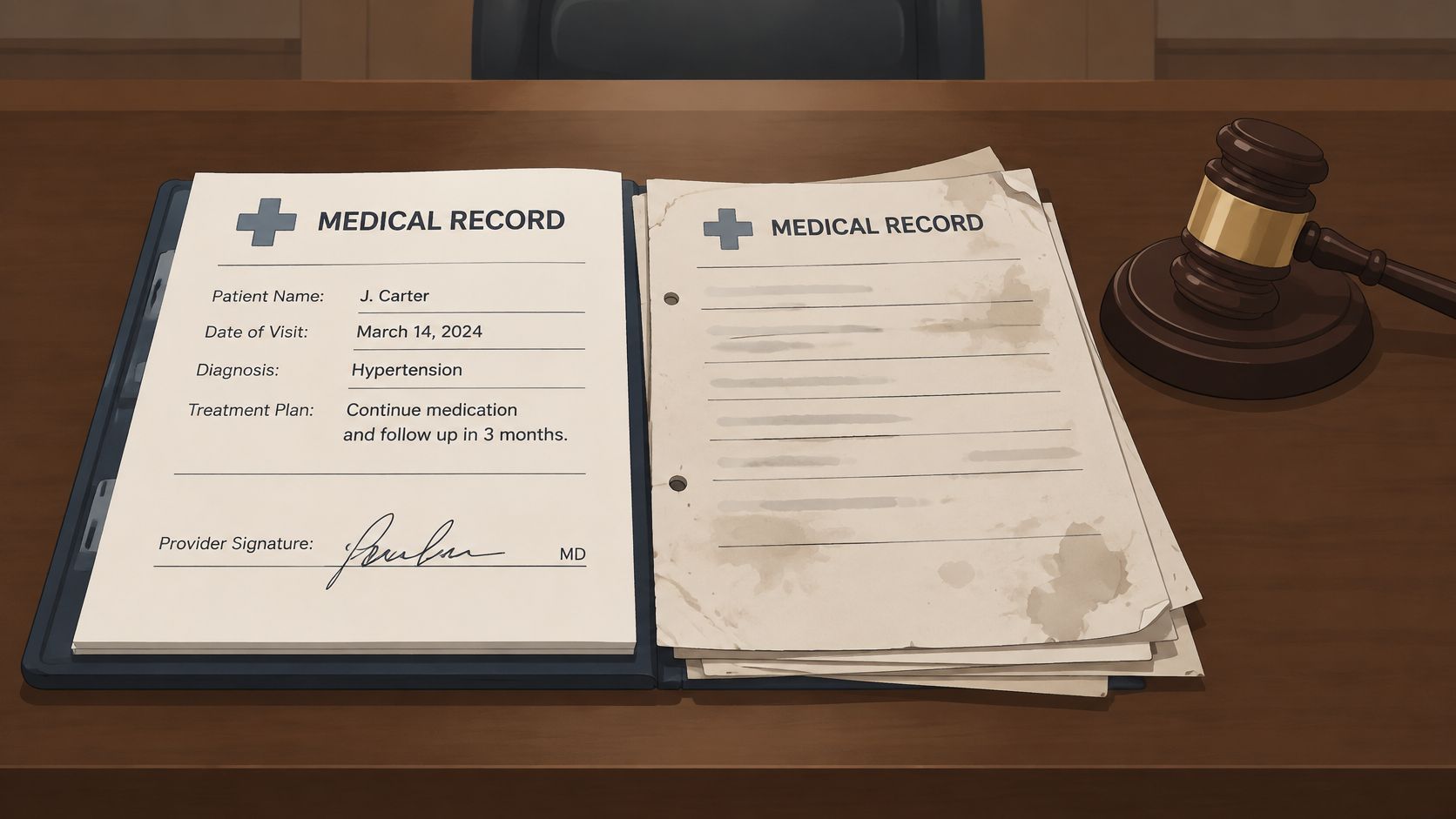
Admissibility isn't automatic, whatever the file looks like. Irregular entries, unexplained alterations, hearsay statements tucked inside the record and preparation circumstances that suggest unreliability all create openings for objection. A chart that reads cleanly from start to finish can still be excluded if nobody can explain how a page got into it.
Apply three checks to any page before you rely on it. The date: when was the entry made relative to the event it describes? The author: did the writer have knowledge of the encounter, and did that person treat the patient? The habit: was an entry of this kind the practice's regular practice, or a one-off created later for a purpose? Fail any of the three and the page still has value, but it needs corroboration from something the rule does cover.
How Legal Teams Build the Record Step by Step
Collection is a sequence, not a single request. Firms that send one letter and wait tend to end up with a chronology built on whatever came back first, which is usually the hospital and rarely the imaging center.
The workflow below is the order that holds up when a defense lawyer asks how the file was assembled.
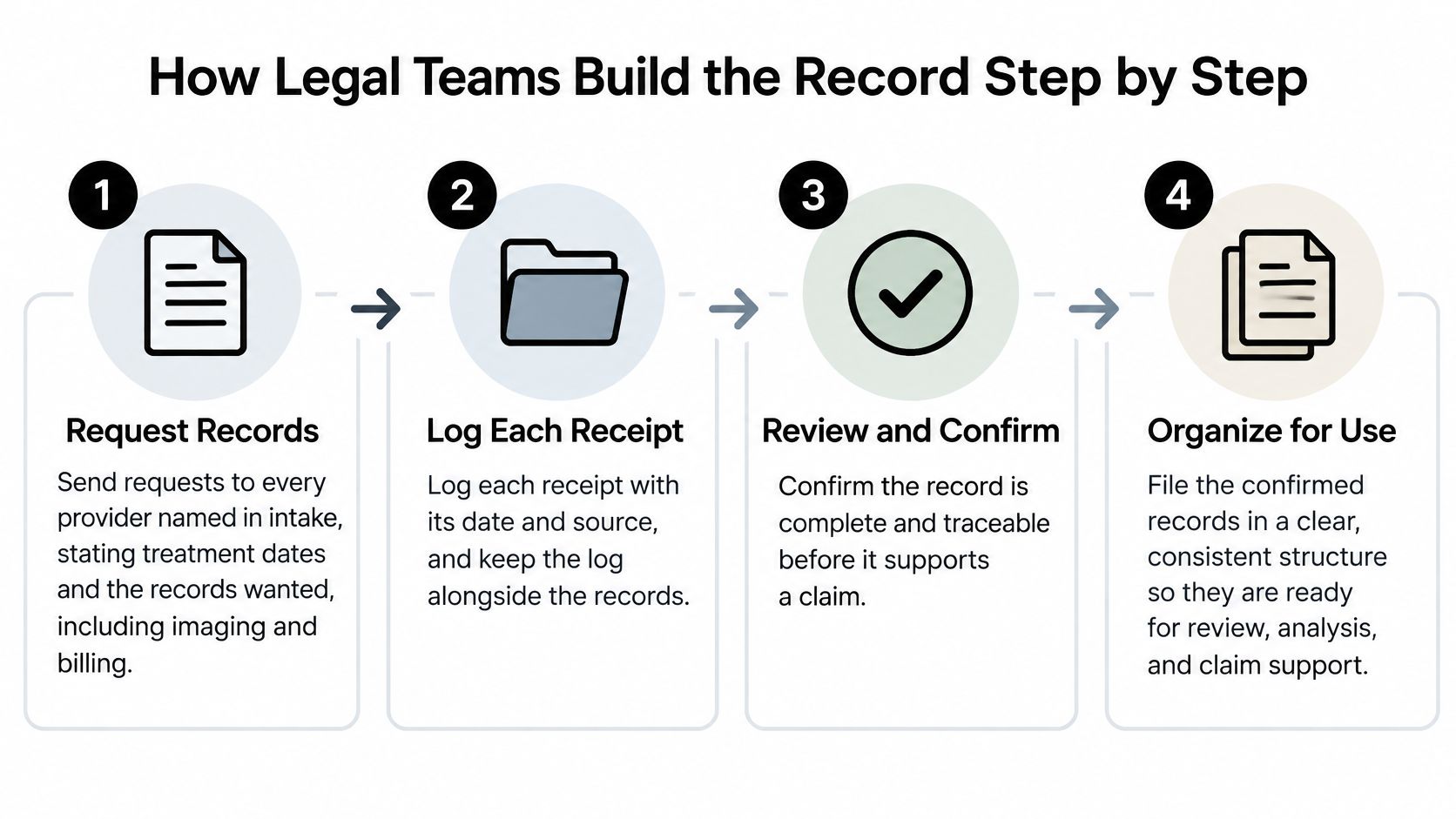
- Request from every provider named at intake. State the treatment dates and the categories wanted: office notes, imaging, billing. A request that names dates and record types gets a faster, more complete response than an open-ended one.
- Log each receipt with its date and source. The log is evidence in its own right. When a gap surfaces at deposition, the log shows when you asked, what arrived and what you did about the silence.
- Keep the original file exactly as received. Don't re-save, merge or tidy it. The version you received is the version you may have to authenticate.
- Preserve native metadata and hash exported files. Chain-of-custody controls are what let you show integrity later, as People v. Deroo illustrates in its treatment of record reliability and review process.
- Record every transformation. If you ran OCR, converted a file format or split a PDF, note it and note who did it. Access auditing matters here too: the HIPAA Security Rule expects mechanisms that record and examine activity in systems holding electronic PHI.
- Build a chronology where every line links to a page. Each date, diagnosis, treatment and limitation traces back to the artifact it came from. That's what makes the summary verifiable instead of merely persuasive.
- Verify against source pages before relying on it. An attorney or paralegal reads the summary next to the records. The common slip is summarizing before the originals are all in, which produces a chronology that looks complete and misses the later visits that change the damages picture.
At Philbrook Law, paralegals upload case files to Ares, which organizes and analyzes the records automatically, and Medical Summaries turns thousands of pages of records into organized chronologies, billing ledgers, treatment timelines and red flags. The reviewer still checks each extracted fact against its source page, because an automated reading of a chart is a draft, not a finding.
Release rules shape what you can even ask for and when. HIPAA medical records release laws sets out the disclosure side of that. On the damages side, how medical records shape injury claims explains how treatment documentation converts into a special damages figure a carrier will negotiate against.
Spotting Gaps and Corrections That Change a Timeline
The failure that costs cases isn't a missing document. It's a chronology that looks finished. Dates jump, imaging is referenced but never produced, the same visit appears twice under two spellings of the patient's name, and nothing in the file records that anyone followed up.
| Gap | Warning Sign | Action |
|---|---|---|
| Missing encounters | Dates jump across weeks with no visit | Request records from every provider named at intake |
| Unavailable imaging | A report refers to films that were never produced | Request the images and the radiologist report separately |
| Medication gaps | Prescriptions appear, then stop | Check pharmacy records and prescribing notes |
| Duplicate or unmatched records | The same visit appears twice, or under a different name | Match on date, provider and patient identifiers |
| Unanswered requests | A provider never responded | Log the request and every follow-up in the file |
Why exchange volume isn't completeness
Interoperability metrics get quoted as though they answer the completeness question. They don't. HHS reported that nearly 500 million records had been exchanged through TEFCA by February 2026, up from roughly 10 million in January 2025, according to the agency's interoperability announcement. In a 2025 survey of more than 8,100 family physicians, only 8% to 19% said outside data were routinely available, easy to find and easy to use inside their EHRs, depending on the information type.
Exchange volume measures movement of data. It says nothing about whether every causally relevant encounter was found, received, indexed and read. A record can be legally authentic and still clinically incomplete, or technically exchanged and practically undiscoverable. Fragmentation across hospitals, specialists, imaging systems, pharmacies, emergency departments, portals and personal health apps is the ordinary condition of a claim file, not an anomaly.
Corrections that should stay visible
Medical-record guidance is consistent on how errors get handled: the original entry stays readable, the correction is dated and signed, and electronic amendments remain identifiable through an audit trail, as the Medical Protection Society's records guidance sets out.
A medication dose corrected in a later note, with the original still visible, is easier to defend than a silent change that leaves the chart tidier. A cleaner record is not always a stronger one. Visible corrections preserve evidentiary history. Silent normalization destroys it and invites questions nobody in the room can answer.
Provenance rule: if you can't say who wrote a line, when they wrote it, and what it said before the correction, you don't yet know what the record proves.
Three ways a record can look contemporaneous when it isn't
- Copied-forward text: a new note imports last month's exam findings wholesale, so the assessment reads as a fresh observation when it's really a carry-over.
- Retrospective histories: a patient's account of the accident, recorded months later at a specialist's office, is dated to the specialist visit but describes an event long past.
- Imported documents: outside records scanned into the chart inherit the upload date, not the date of the encounter they describe.
When timing or authenticity is contested, ask for native electronic records, audit trails, amendment logs, metadata and version history. A printed chart can't show you what changed between versions. The system that generated it can.
The patient access file is not the designated record set
Patient portals are now a mainstream channel: in 2024, 65% of U.S. individuals were offered and accessed their online medical records or patient portal, according to ONC's data brief. That matters because the provider's designated record set and the broader patient-access file aren't the same thing. The access file can hold information the provider doesn't maintain in its formal record, and the client may already have it. Ask what's sitting in their portal before you send the fourth follow-up letter.
Automated red-flag review shortens this search: Ares flags missing records, treatment gaps and inconsistencies in a case. Each flagged item still needs a person to open the source page and confirm it. Incomplete medical records covers what to do when the file arrives with holes you can't fill. And when a case runs through a qualified medical evaluation, next steps after your QME exam explains how that report enters the file and what it changes about the timeline you've already built.
How Long Records Are Kept and Who Must Preserve Them
HIPAA's Privacy Rule doesn't set a fixed retention period for medical records, and intake teams often assume a federal floor exists. It doesn't. The HHS guidance on record retention confirms that retention is governed by state law, payer rules, professional requirements and litigation-preservation duties, while HIPAA separately requires administrative, technical and physical safeguards for protected health information across its lifecycle, disposal included. Firms mapping state schedules against provider practice will find the retention side worked through in how long medical records must be kept.
| Holder | Retention Rule | Note |
|---|---|---|
| Medicare fee-for-service providers | At least six years from creation or from the date last in effect, whichever is later | CMS requirement for required records |
| Other health-care providers | Set by state law, payer rules and professional standards | HIPAA sets no fixed period |
| Personal injury litigation file | Preserve once a claim or lawsuit is reasonably anticipated | Governed by a legal hold, not a fixed period |
Two obligations run in parallel and shouldn't be confused. The provider decides how long to keep treating records under its own rule set. Your firm decides what it preserves once a claim, demand or lawsuit is reasonably anticipated, and that duty covers more than the records themselves: metadata, correspondence, production history and the request log all fall inside the hold.
Preservation rule: once a claim is reasonably anticipated, the question stops being what the provider must keep and becomes what your firm must be able to show.
Say a firm clears its intake folder after a settlement offer goes out. Six months later the defense asks which imaging was requested, when it arrived and what was produced in response. The answer lived in a folder nobody kept. That's a preservation failure even if every page was disclosed on time. Retention schedules are the provider's problem. Reconstructing your own file is yours.
Confirm the Record Before You Use It in a Claim
Before the record goes into a demand letter, a mediation brief or a deposition outline, answer one question: would you defend every line of the summary if opposing counsel asked where it came from?
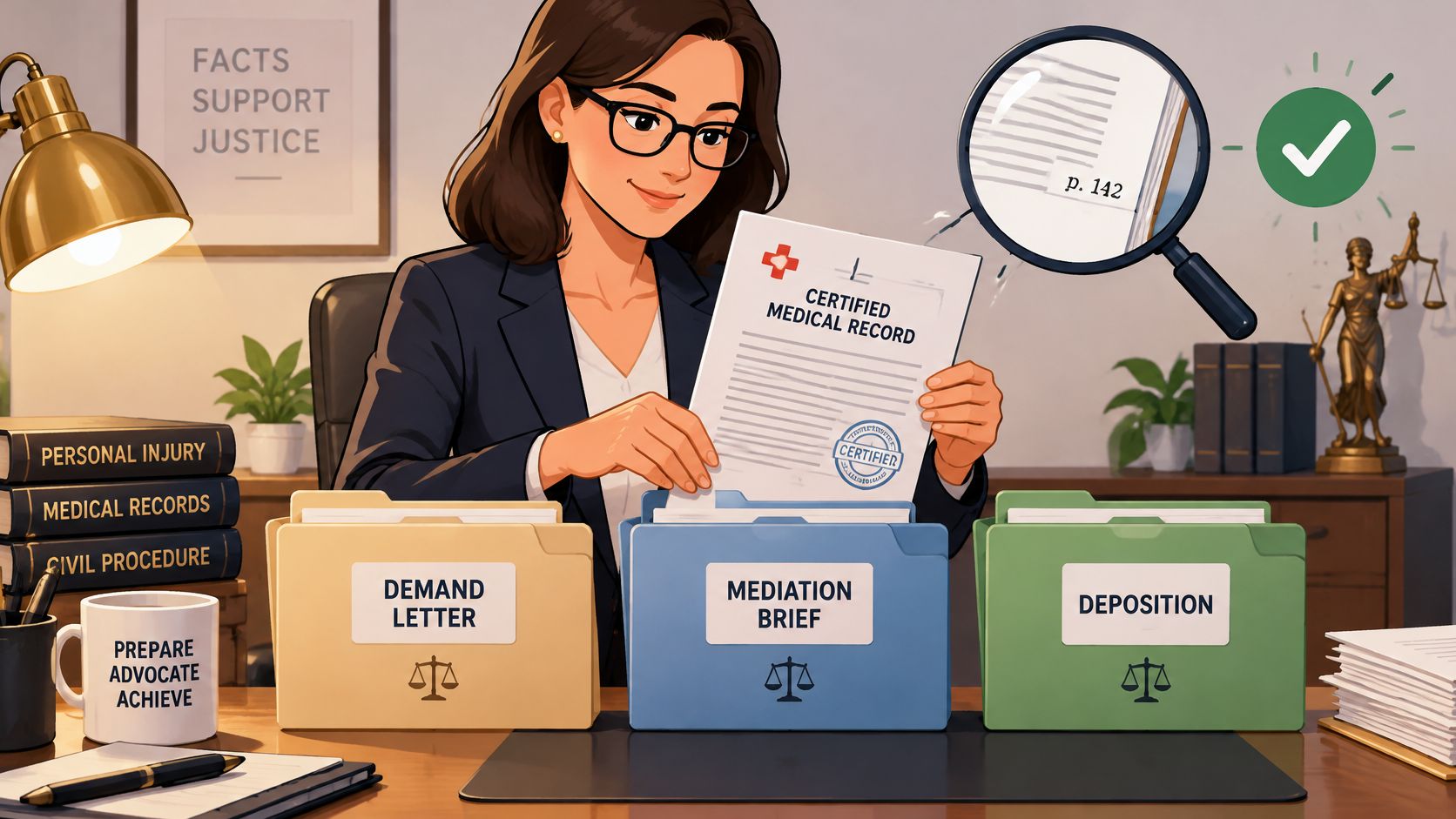
Three uses test the file in different ways. A demand letter needs a causation narrative and a special damages figure, each cited to the page that supports it, because the adjuster will read the citations before the prose. A mediation brief pulls timelines, total treatment costs and major procedures into a template; Goody Law Group takes those three elements from Ares straight into its standard mediation template rather than rebuilding them by hand. Deposition preparation is the live test, where an attorney pulls up a summary in real time to locate a specific visit, imaging result or provider and has seconds, not hours, to get it right.
Here's the checklist to run before relying on the record anywhere.
- Every provider requested: compare the intake list against the log, not against the folder.
- Completeness check logged: gaps, duplicates and unanswered requests documented with dates.
- Key dates traced to a page: each diagnosis, procedure and limitation has a source citation.
- Corrections identified: later amendments and audit-trail entries distinguished from the original entries.
- Outputs verified by a person: someone read the summary against the source pages and signed off.
Each item maps to a step above, so when one fails you can go back to the step rather than re-reading the whole file. Automated output changes nothing about that duty: anyone using a summary, ours included, remains responsible for reviewing and verifying every output before it goes into a legal proceeding or a client communication.
The practical move is unglamorous. Run the completeness check on the file you have now, before the demand goes out, and find out what's missing while there's still time to request it.
Ares builds Medical Summaries that turn thousands of pages of records into page-cited chronologies, billing ledgers, treatment timelines and red-flag reports, so the provenance questions above have an answer you can point to. If your current file has gaps you can feel but can't name, upload it and let the platform surface the missing encounters, treatment breaks and inconsistencies before you draft. Start at Ares and run the completeness check on a live case this week.