

Most law firm keyword research fails because it treats search volume like the goal. For legal SEO, that's the wrong starting point. A keyword can look attractive in a spreadsheet and still bring the wrong people, the wrong intent, or no click at all.
For law firms, the key question isn't, “What gets searched the most?” It's, “Which searches still lead to a consultation after Google has crowded the page with AI answers, snippets, and local results?” That's the difference between vanity traffic and work that truly helps the intake team.
If you want a practical baseline before building a keyword map, the framework in SEO for law firms is a useful companion to this process, especially if you're trying to connect content planning with practice-area growth. For a broader planning lens, the marketing plan for lawyers approach also helps keep keyword work tied to business goals instead of isolated rankings.
Why Most Law Firm Keyword Research Fails
The usual advice says to chase the biggest keywords in your practice area and work outward from there. That sounds efficient, but it misses how legal search really works. Legal queries are heavily commercial, and one industry roundup says 64% of legal keywords have commercial or transactional intent, which means the searcher is often close to hiring, not just reading source.
That matters because a broad keyword list can create a false sense of coverage. The same source says the average law firm website ranks for 216 keywords source, which sounds impressive until you realize most of those terms may never produce a call. A firm can “rank for a lot” and still miss the few queries that drive intake.
Volume without click potential is a trap
Most guides stop at search volume and ignore whether Google will send traffic to a site. Informational legal queries are increasingly answered on the results page itself, while transactional searches still have more value because the user is looking for a firm, not a definition.
Practical rule: If a keyword doesn't have a plausible click path, it's not a priority, even if the volume looks strong.
The safest mindset is to treat volume as a starting signal, not a decision rule. For legal marketing, the only keywords worth serious investment are the ones that combine intent, local relevance, and a reasonable chance of earning a click. That's why a firm doing structured legal SEO planning should evaluate terms by business value first, then by scale.
The result is a better shortlist. Instead of “personal injury lawyer” as a catch-all ambition, the better approach is to identify the service pages, city modifiers, and client questions that map to actual intake opportunities. That's where keyword research starts paying for itself.
Building Your Seed Keyword List From Practice Areas and Client Language
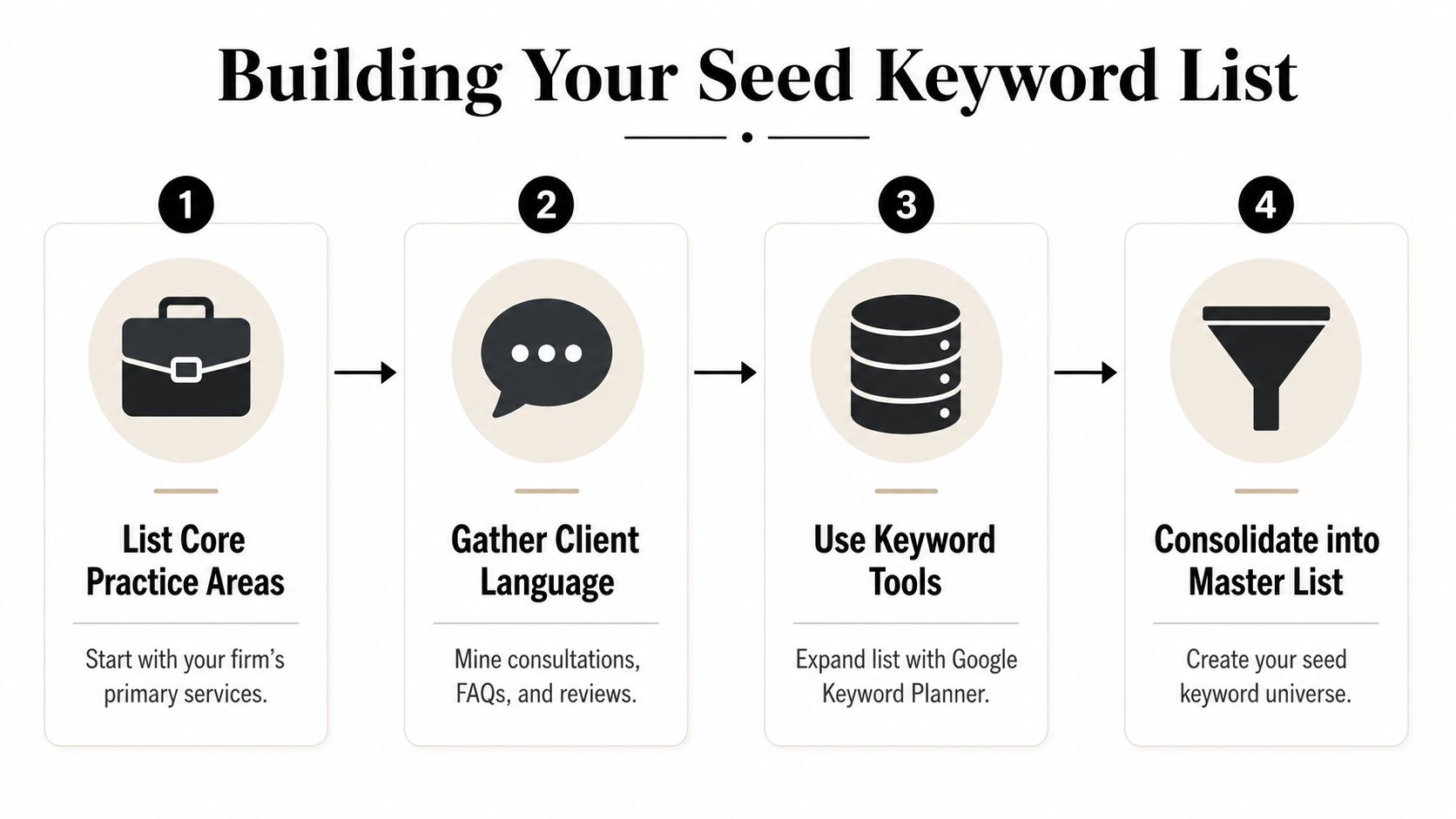
Start with what the firm sells. List each practice area, each service type, and each geography you serve, then turn those into a seed list before you touch a keyword tool. A personal injury firm might begin with car accident lawyer, truck accident lawyer, slip and fall attorney, and the cities or neighborhoods where cases are concentrated.
Build from the words clients actually use
The best seed lists come from intake calls, consultation notes, voicemail transcripts, and review language. Clients rarely describe their situation the way attorneys do. They'll say “rear-end crash,” “hit from behind,” or “my neck hurts after a wreck” long before they say “motor vehicle collision claim.”
That client language matters because it exposes search demand your team may never think to target. A broad term like car accident lawyer can be useful, but the opportunity often lives in more specific phrases such as rear-end collision attorney in [city] or symptom-based questions tied to immediate concern. Those phrases are more likely to match what someone types when they're under stress and looking for help fast.
Expand with search tools, then clean the list
Google Autocomplete, People Also Ask, and related searches are still useful for surfacing query patterns. They don't replace the seed list, they sharpen it. Once you see recurring phrasing, you can group terms by practice area, geography, and intent so the list doesn't turn into a random pile of variants.
For a more niche-friendly framework, structuring vertical keyword research is worth reviewing if the firm handles specialized case types or multiple service lines. The main point is to build from reality, not from assumptions about how people should search.
A seed list that reflects intake language usually outperforms one built only from legal jargon, because the first one matches how people ask for help.
By the end of this step, you should have a master list organized around practice area, location modifier, and intent. That gives you something usable for validation, competitor analysis, and page mapping.
Running a Competitor Gap Analysis That Reveals Winnable Opportunities
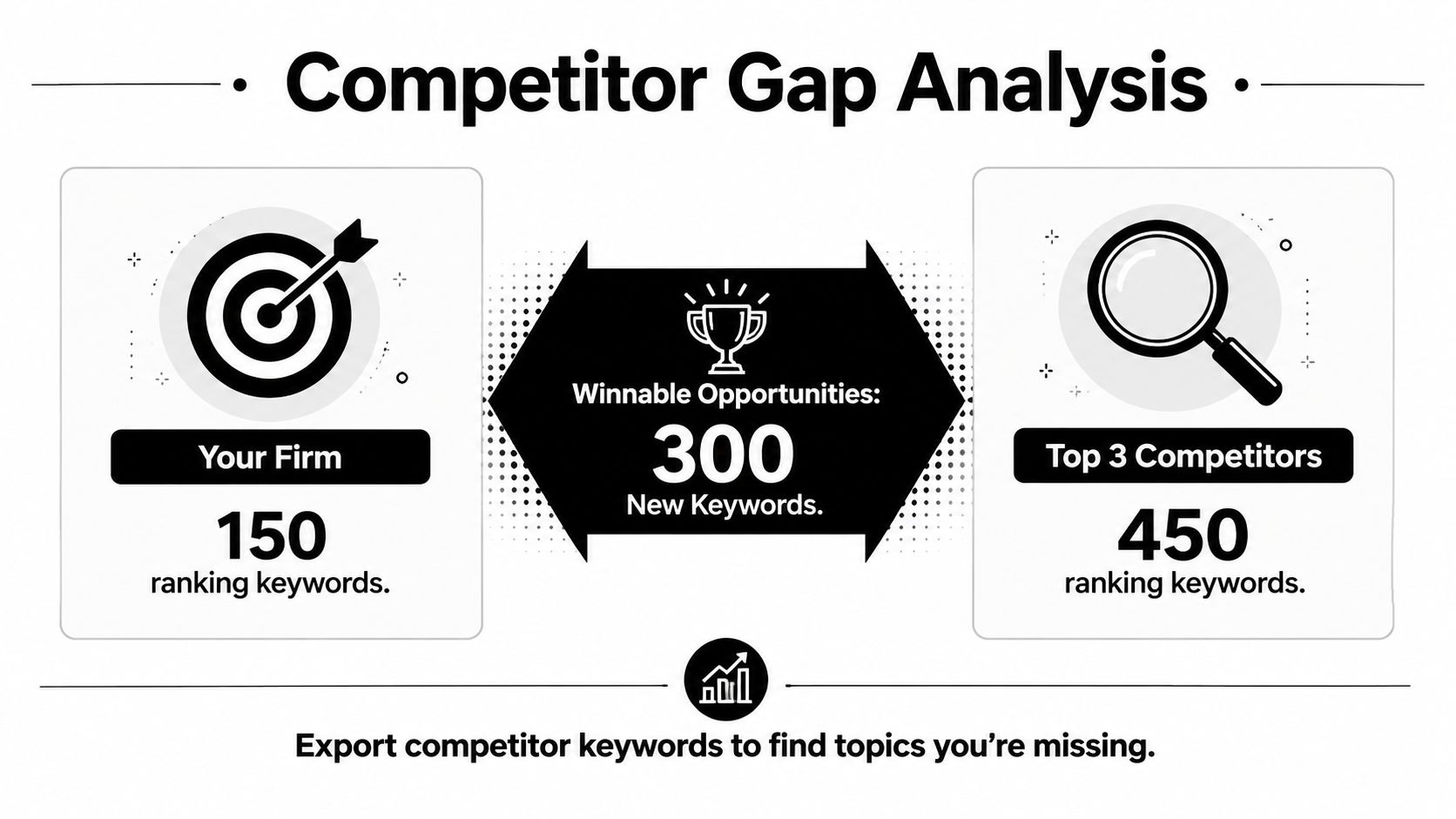
Once the seed list exists, the next move is to look at who already owns the search results. Export the top organic keywords from competing firms in Ahrefs or SEMrush, then compare those terms against your own footprint. The fastest wins usually sit where a competitor ranks on page one and your site is nowhere near the top 30.
Sort by feasibility, not just by similarity
A good competitor gap analysis isn't a copy exercise. It's a prioritization exercise. Some competitor terms will be a bad fit because the search intent is off, the page type is wrong, or the content is too far outside the firm's core work.
Start by ranking gaps in three layers:
- Relevance: Does the term match a case type the firm wants?
- Feasibility: Is the site realistically able to compete with the current pages?
- Value: Would the keyword support consultations, not just visits?
That's where page quality matters. A competitor may rank with a thin blog post, which creates an opening for a stronger practice page or a better-supported resource hub. Not every gap needs a blog. Sometimes a service page with clearer intent alignment is the better answer.
Use tools to expose what your site is missing
Ahrefs and SEMrush both help you see the shape of competitor coverage, but the actual work is filtering. If a rival ranks for a term tied to your services and your site has no equivalent page, that's a stronger opportunity than a random high-volume article topic. For a tactical walkthrough of this process, browse competitor keyword research tips alongside your own export workflow.
An internal content audit should sit beside this analysis. The gap often isn't just between you and competitors, it's between the keyword and the page type on your own site. A practice page, FAQ, or location page can sometimes close a gap faster than a new blog series.
If you're also planning intake growth, the way you prioritize these gaps should line up with attorney lead generation goals, not just content volume. The cleanest opportunities are the ones that match both search visibility and signed-case potential.
Segmenting Keywords by Local Intent and Audience Language
Most law firm keyword plans stop at city modifiers. That's too narrow. Real search behavior splits by neighborhood, radius, device type, and the language a community uses when looking for help.
Local intent is not one thing
Someone searching in a dense metro area may use a city name, a neighborhood, or a “near me” query depending on how urgent the need is and whether they're on mobile. A broader regional search can suggest comparison behavior, while a neighborhood-level query often implies immediacy. Those are different intents, even if the practice area is the same.
Mobile matters because it changes phrasing. On phones, people use shorter, faster, more conversational searches. That's one reason “near me” phrasing keeps showing up in legal acquisition, along with questions that sound like they were spoken into the device rather than typed carefully.
Language mismatch can hide demand
The bigger blind spot is multilingual search. Many firms write in formal English while their clients search in everyday language, transliterated terms, or another language entirely. If intake staff keeps hearing one set of phrases and keyword tools keep surfacing another, the firm is probably undercounting demand.
Search tools tell you what's visible. Intake calls tell you what clients are actually saying.
The best validation sources are usually internal, not external. Review bilingual intake notes, scan consultation transcripts, and segment Search Console where possible to see whether different language patterns appear in the same practice area. That's especially important in immigrant communities, where the wording a lawyer prefers may not match the wording a potential client trusts.
Build segments, not just lists
A useful segmentation model looks like this:
| Segment | What it captures | Why it matters |
|---|---|---|
| Practice-area core | Service terms like car accident lawyer | Anchors the page strategy |
| Local modifier | City, neighborhood, or radius language | Matches geographic demand |
| Conversational phrasing | Near me and question-style queries | Fits mobile behavior |
| Audience language | Non-English or transliterated variants | Reveals underserved demand |
This framework does more than expand the keyword list. It keeps the plan honest about who the firm is trying to reach. A page built only around formal English and city names can miss the people most likely to call.
Evaluating Click Potential in a Zero-Click SERP Landscape
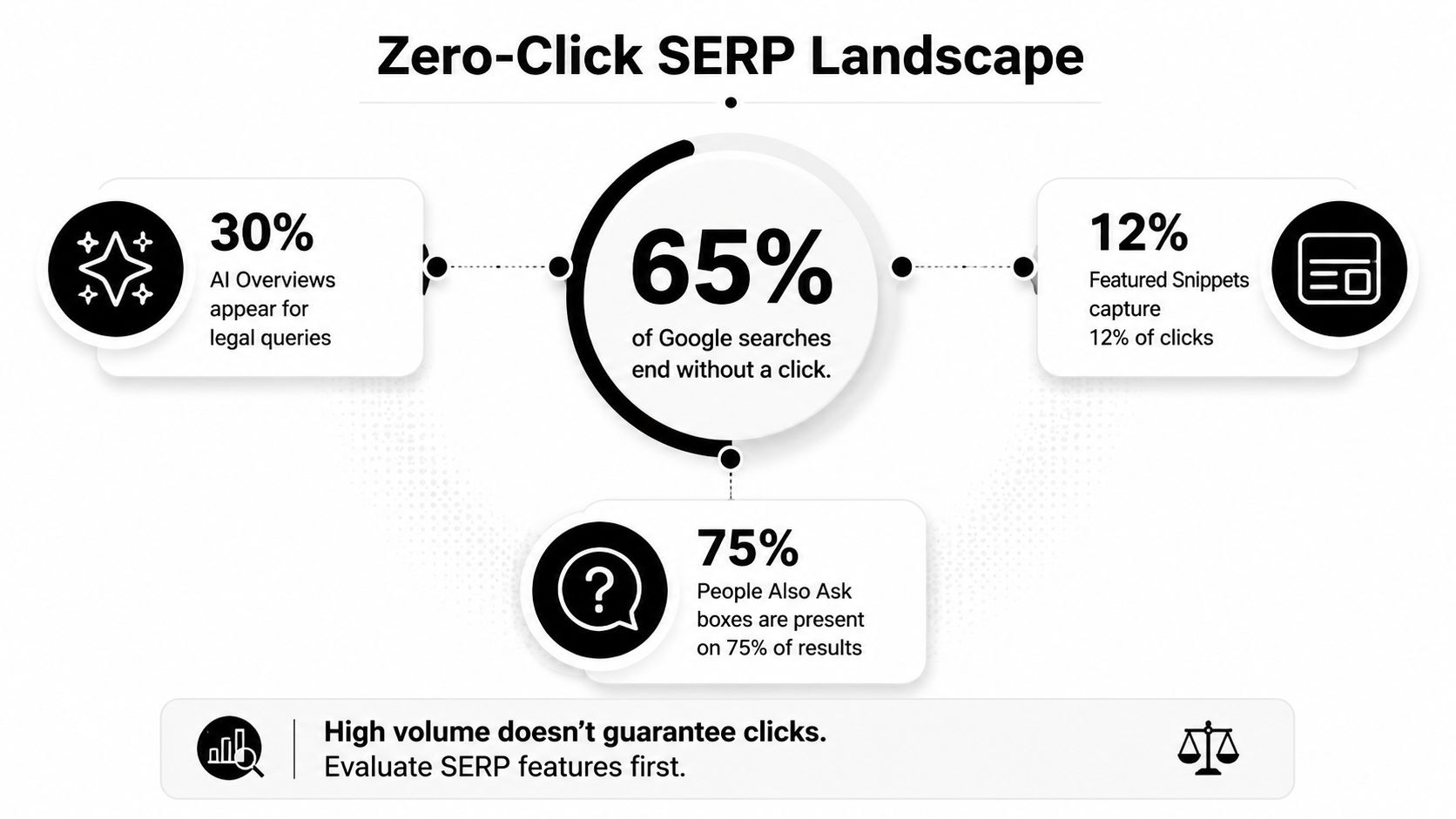
A keyword can look strong and still be a bad bet if Google answers it before the click. That's the reality legal marketers have to work around now. AI Overviews, featured snippets, and People Also Ask boxes can shrink the number of visits a page earns, even when the query volume stays attractive.
Scan the SERP before you commit
Search the target keyword in an incognito window and look at the page the way a client would. If the results are dominated by AI summaries, definitions, or answer boxes, the click potential is probably weaker than the volume suggests. If the page shows local pack results, practice pages, and strong organic listings, that keyword may still be worth pursuing.
The legal queries that are most vulnerable tend to be the ones people ask early in the journey. “What is”, “how much”, and “do I need a lawyer” often get partially answered on the results page. A firm can still win value from those queries, but only if the content has a specific angle Google can't fully replace on the SERP.
Decide with a simple matrix
A practical way to score terms is to combine three questions:
- Does the query show clear hiring intent?
- Does the result page still invite clicks?
- Would the visit support a consultation or intake action?
That gives you a better filter than volume alone. Some high-volume informational keywords deserve a place in the content plan because they support authority and internal linking. Others should be downgraded because they'll likely produce impressions without meaningful traffic.
The important shift is this. Don't ask whether a keyword is popular. Ask whether the search page leaves room for your firm to earn attention. That's a more realistic way to choose targets in a legal SERP environment that keeps getting more crowded.
Mapping Keywords to Intake Pages and Blog Content
A good keyword map tells every term where it belongs on the site. Without that step, firms end up with blog posts chasing service-page queries, or intake pages trying to answer educational searches they were never built to satisfy. The result is diluted relevance and weaker conversions.
Match intent to page type
Transactional keywords belong on pages that help someone take action. That includes practice area pages, city pages, and intake-focused landing pages with direct calls to call, submit, or schedule. Informational queries belong in blog posts, FAQ pages, and guides that answer a question without forcing a hard sell.
The rule is simple. If the searcher is trying to hire, route them to a page built for conversion. If the searcher is trying to understand, route them to a page built for trust.
| Keyword Example | Intent Type | Target Page Type | Content Format |
|---|---|---|---|
| hire a personal injury lawyer in Dallas | Transactional | Practice area or location page | Intake page |
| car accident lawyer near me | Transactional | Location page | Conversion-focused landing page |
| what to do after a car accident | Informational | Blog post | Long-form guide |
| how long does a personal injury claim take | Informational | FAQ or blog post | Educational article |
| rear-end collision attorney in Houston | Commercial and local | Practice area page | Service page with local signals |
Use internal links to move people forward
Once the pages are assigned, connect them with internal links that reflect the client journey. A blog post about crash aftermath should point to the relevant practice page. A location page should link to supporting FAQs that address common objections or concerns. That structure helps readers move from learning to contacting.
The other benefit is topical clarity. Search engines can better understand which page handles which query when the site doesn't reuse the same keyword on five different URLs. For a clean content architecture, the personal injury marketing for lawyers resource is a useful reference point.
Don't force every keyword onto the homepage. The homepage is a directory, not a catch-all ranking page.
The best mapping systems protect high-intent pages from informational clutter while giving support content a clear role. That makes the site easier to use and easier to convert.
Your Repeatable Keyword Research Process
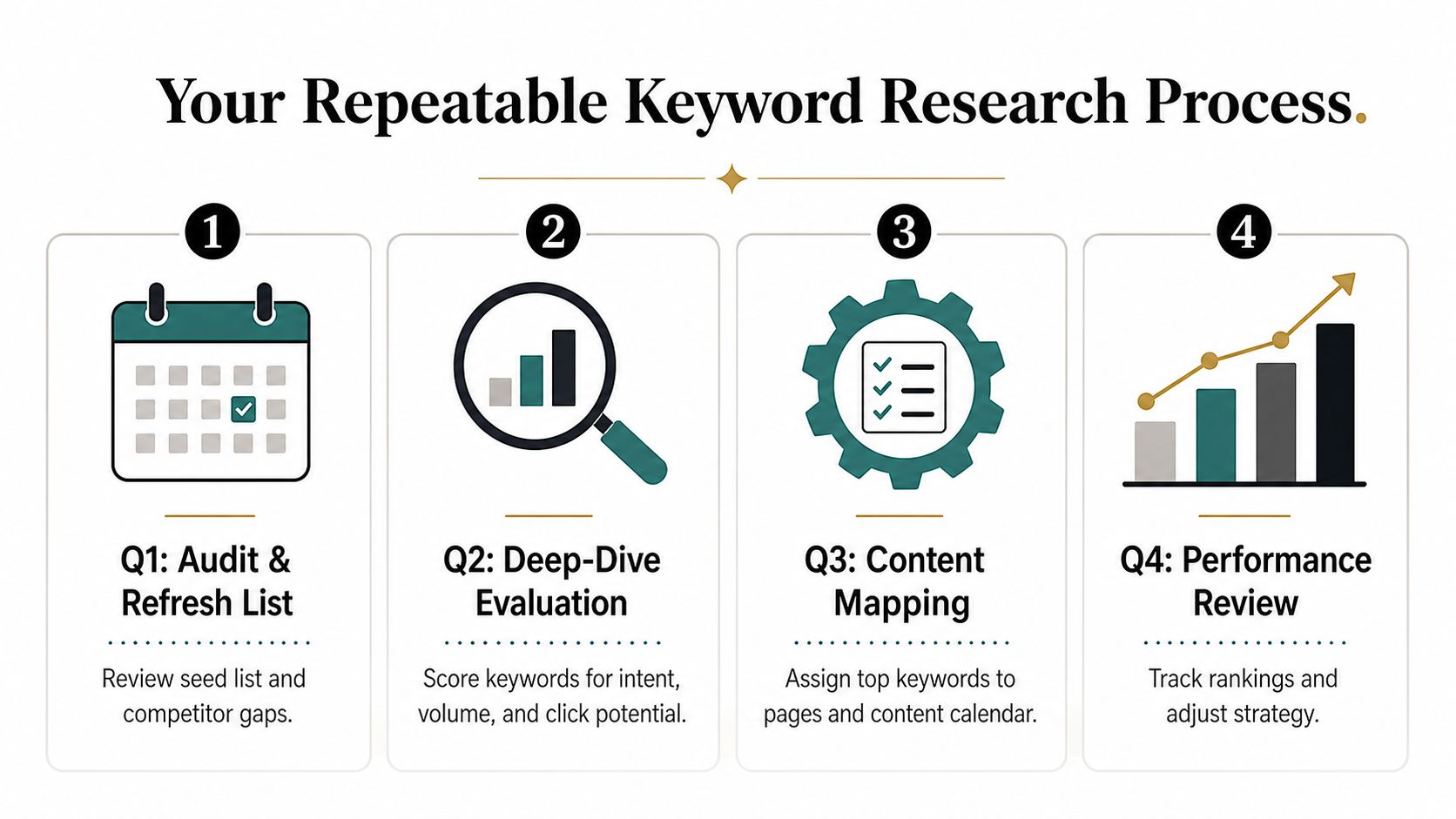
The firms that do this well don't treat keyword research as a one-time project. They run it as a repeatable quarterly process, with the same sequence every cycle. That keeps the site aligned with changing SERPs, changing client language, and changing service priorities.
The quarterly workflow
- Audit and refresh the seed list. Pull new intake language, update practice areas, and remove stale terms.
- Score competitor gaps. Recheck who's ranking, who moved, and where page-one ownership still looks vulnerable.
- Evaluate click potential. Review SERPs for AI answers, snippets, and other features that can suppress clicks.
- Map keywords to pages. Assign the best terms to intake pages, supporting pages, or blog content, then track performance.
The point isn't to create more work. It's to make the work consistent so the firm doesn't keep rediscovering the same opportunities every quarter.
Track outcomes, not just rankings
The metrics that matter most are the ones tied to business behavior. Watch keyword rankings by intent category, organic consultation rate by landing page, and how quickly content gaps get closed. If a term ranks but never drives qualified inquiries, it probably belongs lower on the priority list.
The common mistakes are predictable. Teams overvalue traffic, ignore non-English queries, and forget to revisit old assumptions after SERP features change. They also keep chasing terms that look large but don't survive the click test.
A strong keyword process doesn't end with a spreadsheet. It ends with pages that match real client language, real local demand, and real conversion paths.
If you want a keyword strategy that's built for personal injury intake, not just rankings, Ares can help your firm turn research into faster case work and stronger demand letters. Visit Ares to see how its AI platform helps personal injury teams organize medical records, spot key chronology faster, and keep momentum on the cases that matter most.