
The phone rings, a paralegal quits, and the calendar is already full of intake calls, medical records, and hearing prep. In too many firms, that's when hiring starts, under pressure, with a vacancy posted fast and a plan built later. That approach feels decisive in the moment, but it usually creates a longer drag on capacity, cash flow, and client service.
A better approach is a hiring needs assessment, a disciplined review of what the firm needs, what the team can already absorb, and which hire will move the practice forward. The legal market rewards firms that treat headcount like a strategic investment, not a reflex. In personal injury work especially, every missed deadline, delayed review, or overloaded attorney carries an operational cost that can be traced back to workforce planning.

If you want the plain-language version of the concept, it helps to compare it to understand TNA meaning. The same logic applies here, the firm stops guessing and starts defining the gap. That shift is what turns hiring from a scramble into a management tool.
From Reactive Hiring to Strategic Advantage
A reactive hire usually starts with frustration. A key employee leaves, case load keeps climbing, and a partner says, “We need somebody, now.” That urgency is understandable, but it often leads to a role that copies yesterday's job description without asking whether yesterday's structure still makes sense.
A strategic hiring needs assessment asks harder questions. What work is backing up? Which tasks are still sitting on an attorney's desk that should be handled by support staff? Where is the firm losing value because senior time is being spent on routine work instead of legal judgment, negotiation, or trial strategy?
The framework is business-first, not HR-first. The process described in the source material on recruitment needs analysis emphasizes measurable staffing formulas, attrition tracking, and lead-time planning, which is exactly how a law firm should think about hiring. If a firm can estimate required employees from projected workload and average output, it can stop treating staffing as a feeling and start treating it as a capacity decision.
Practical rule: if the work can be described, counted, and timed, it can be staffed with more discipline.
For law firms, that matters because the cost of a bad hire is not just payroll. It can mean slower matter movement, lower attorney utilization, weaker follow-up, and more client frustration. A thoughtful assessment also keeps the firm from overhiring into the wrong bottleneck, which is how practices end up with a full team and still feel behind.
Ares is a good example of why this mindset matters in a PI environment. If medical-record review and demand drafting are consuming attorney or paralegal bandwidth, the firm should ask whether the problem is headcount, workflow, or both. That question belongs in the planning stage, not after the backlog has already built up, and the same logic appears in why automation is required, where process design and staffing choices should work together.
Gathering Your Firm's Workload and Skill Data
Start with the work, not the org chart. A firm can't make a credible hiring decision until it knows who is doing what, how long it takes, and where the bottlenecks sit. The fastest way to expose that is to map the current team by role, task, and time drain.
Build a simple current-state inventory
List every person, their role, and the category of work they touch. That includes intake, lien work, records collection, draft preparation, scheduling, filing, discovery support, and client communication. For each function, note whether the task is handled by an attorney, paralegal, case manager, or admin team member, because delegation gaps are often more important than raw headcount gaps.
Then document workload in practical terms. In a PI firm, that can mean case volume per paralegal, number of active matters per attorney, or the time required for a specific step like medical record review. The point is not perfection, it's visibility. Once the team sees where hours are going, you can distinguish true capacity constraints from habits that have gone unchallenged.
The most useful audit is usually the one that makes existing waste visible before it makes the next hire seem obvious.
Separate skill inventory from workload
A busy team is not always an underpowered team. Sometimes the issue is skill mismatch, not volume. A junior legal assistant may be carrying a heavy inbox but still not be equipped to manage provider follow-up, while a seasoned paralegal may be stuck doing work that could be delegated.
A skill inventory pays off. Such an inventory helps to list core competencies, software fluency, file management strength, drafting ability, and judgment-based tasks that require higher experience. A good skills inventory also surfaces whether the firm has enough redundancy, because if only one person knows how a critical process works, the practice is fragile.
For firms that want better visibility into operational metrics, the internal dashboard perspective in dashboard analytics is useful as a management lens. The exact tooling matters less than the discipline of measuring work consistently and using the data to challenge assumptions. Once the workload and skill picture is clear, staffing conversations become specific instead of emotional.
Analyzing Gaps to Define Your Next Hire
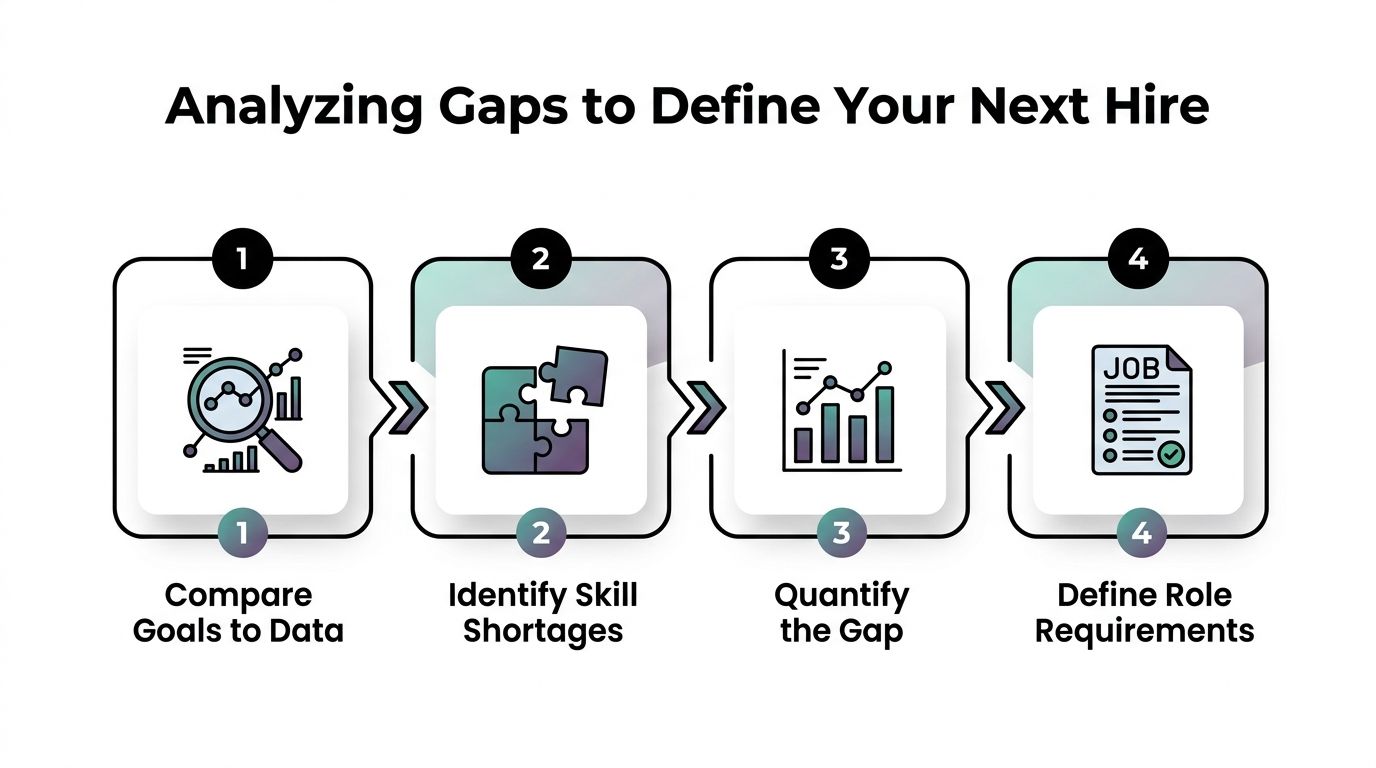
The value of a hiring needs assessment shows up when the firm stops saying, “We're overloaded,” and starts saying, “We have a capacity gap in intake,” or “We have a skill gap in medical chronology.” Those are not the same problem, and they should not produce the same hire.
Compare strategic goals against current capability
Start by naming the business objective in plain terms. Maybe the firm wants to handle more matters without adding attorney overload, reduce lag in demand prep, or improve client response times. Then compare that goal against the workload and skill inventory gathered earlier.
If the work is piling up because the current team is at full stretch, that's a capacity gap. If the work is getting done, but quality, consistency, or speed suffers because nobody has the right expertise, that's a skill gap. A firm that confuses one for the other usually hires the wrong person, then wonders why the problem survives the new headcount.
Translate the gap into role requirements
Once the gap is named, the role becomes easier to define. A capacity gap may call for more hands in a narrow workflow, while a skill gap may call for a specialist who can own a higher-value stage of the case. The role should be described by outcomes, not just duties.
The multi-step assessment approach in needs assessment guidance aligns with that logic, define the objective, identify the competencies, quantify the gap, validate with stakeholders, then finalize the plan. That sequence helps a firm avoid vague requisitions like “seasoned legal assistant” when what it really needs is someone who can triage records and move files through a defined pipeline.
Test the role against reality
The strongest plans are also honest about what can be supported internally. If the firm cannot train, supervise, or integrate the new hire effectively, the role definition is still incomplete. A good job profile should make it obvious what the person will own, where they'll hand off work, and how success will be judged in the first phase.
A precise role is more valuable than a long job description. Precision reduces recruiting noise and improves onboarding on day one.
Prioritizing Roles and Proving the ROI
Not every vacancy deserves immediate attention, and not every new role deserves the same budget. A law firm should rank hiring needs by what drives the practice, revenue generation, operational efficiency, and risk reduction. That's how you avoid spending scarce payroll on a role that feels important but doesn't change the firm's bottleneck.
The best filter is simple. Ask which role will maximize the most attorney time, improve case throughput, or reduce the chance of missed work. In a PI practice, an intake specialist may improve lead conversion and client responsiveness, while a case manager may stabilize file progression and reduce attorney interruptions. Those are different benefits, so they should be scored differently.
A practical scoring model can use three questions. First, does the role directly protect or create revenue? Second, does it remove work from higher-cost talent? Third, does it reduce operational risk, such as missed deadlines or inconsistent follow-up? A role that scores well on all three should usually be prioritized before a role that only solves a comfort issue.
A business case matters more than instinct. The firm should estimate the cost of the hire, then compare it with the value of the time or work that hire frees up. If a new paralegal takes repetitive work off an attorney's plate, the ROI comes from higher-value attorney time, better throughput, and fewer process errors. The internal rationale for an intake specialist law firm discussion follows the same logic; the hire should solve a defined intake or conversion problem, not just add another seat.
A useful rule is to treat hiring as a capital allocation decision. If two roles are equally needed, fund the one that has the clearest path to more capacity, faster cycle times, or lower rework. That discipline is what separates firms that grow cleanly from firms that grow expensively.
Creating Your Timeline and Sourcing Plan
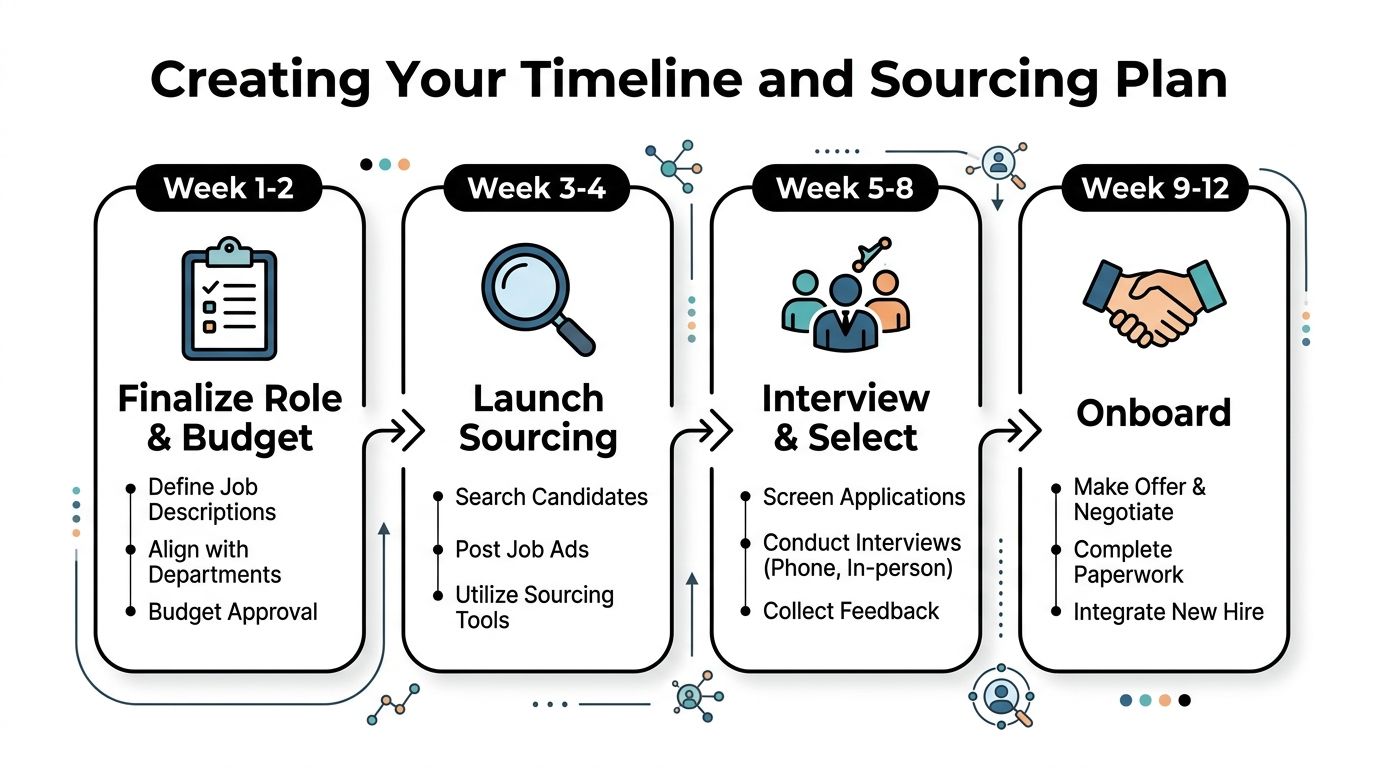
Once the role is defined, the next mistake is assuming the market will make the rest easy. It won't. A strong hiring plan has a calendar, a sourcing strategy, and a realistic view of the talent pool. Without that, even a smart requisition can turn into a months-long stall.
Build the timeline backward from the first day
Start with the date you need the person productive, then work backward. Give time for job description finalization, sourcing, interviews, selection, acceptance, notice period, and onboarding. A timeline that ignores these steps usually pushes the burden back onto the current team, which is how burnout gets worse while the role remains open.
Use the role itself to set the pace. A high-impact support role may need faster execution than a more specialized role that requires careful screening. The point is to align process speed with business urgency, not to rush every search just because the schedule feels tight.
Make the role supply-aware
Many firms get trapped. They write a wish list for a perfect candidate and then discover that the market won't support it, at least not on their terms. A supply-aware plan asks whether the firm can attract the talent it wants in the location, schedule, and compensation structure it offers.
The market-check mindset in how to reach underrepresented groups in your hiring process highlights an overlooked point, firms need to consider location flexibility, sourcing breadth, and whether their requirements unintentionally exclude strong candidates. That same logic applies here. If the role is too rigid, the job may look strategically neat and still be practically unfillable.
Match sourcing to the role
A generic job post is not a sourcing strategy. The firm should decide whether it needs targeted referrals, legal industry recruiters, broad online advertising, or internal promotion first. It should also decide which requirements are essential and which are preferences, because every unnecessary filter shrinks the pool.
If the role can only be filled by a unicorn, the firm hasn't defined a role, it has defined a fantasy.
A clear sourcing plan keeps the search grounded. It also protects the firm from overpromising on title, scope, or flexibility and then failing to close the right candidate. That is how the hiring plan becomes executable instead of aspirational.
Measuring Success and Refining Your Process
The hire is not successful because the offer was accepted. It's successful when the business problem got smaller. That means the firm needs to measure whether the new person improved the workload, reduced friction, and delivered the capability the role was meant to add.
Track outcomes, not just attendance
Retention matters, but it's only one signal. The more useful measures are role-specific, time-to-productivity, quality of output, and whether the original bottleneck eased. If the role was created to reduce attorney interruptions, then attorney focus time should improve. If the role was meant to move files faster, then case progression should become more consistent.
Quality-of-hire should be validated the same way the source material on assessment validity and actual hiring outcomes recommends, by comparing later job performance against the assessment process that led to the hire. In practice, that means the firm should review whether structured interviews, work samples, and job-knowledge signals were predictive of real performance. If they weren't, the process needs adjustment.
Turn hiring into a repeatable cycle
The best firms treat workforce planning as a loop. Assess the need, hire against the gap, measure the result, then refine the criteria for next time. That cycle is what converts scattered hiring decisions into a talent system.
A simple internal review should ask:
- Did the hire solve the original problem?
- Did the team become more efficient or just larger?
- Did the role definition match the work that appeared?
- Did the screening process predict performance well enough to keep using it?
If the answer is mixed, that's still useful. It means the next hiring decision can be better than the last one. Over time, that discipline protects margins, improves case handling, and keeps the firm from adding payroll where process improvement would have been enough.
A strong hiring needs assessment is not a one-time exercise. It's a management habit that keeps staffing aligned with case capacity, profitability, and the realities of the labor market.
If your firm wants a clearer way to connect staffing decisions to case capacity and profitability, visit Ares and see how AI-powered medical record review and demand drafting can help your team reclaim time and focus on higher-value legal work. For managing partners and operations leaders, Ares can support a more disciplined approach to planning, especially when you're deciding whether the next fix should be a hire, a workflow change, or both.