

An associate receives a stack of treatment records the evening before mediation. The partner needs a chronology, the demand needs updating, and nobody wants to discover during negotiations that the summary confused a prior injury with the accident at issue. Generative AI can help organize that file, but only if the team can move from every important statement back to the page that supports it.
For records-heavy personal injury practices, the useful question isn't whether software can write a convincing summary. It's whether your team can verify that summary faster than it could build one manually, without surrendering confidentiality or attorney judgment.
Where Generative AI Fits in Law Firm Work
Generative AI is software that produces new text by predicting likely wording from patterns it learned, using the documents and instructions supplied to it. In a law firm, that might mean a treatment chronology, a draft letter, or a summary of deposition testimony. Think of it as a fast junior paralegal who drafts quickly but never certifies a fact without the record in front of them.
The adoption gap explains why workflow design matters more than a persuasive demonstration. In the Thomson Reuters 2024 Generative AI in Professional Services survey, 81% of respondents across professional fields believed generative AI could apply to professional work, while only 12% of organizations reported regular use.
Match the output to a specific review task
A useful implementation produces something a named person can check. Asking software to analyze the case is too open-ended. Asking it to extract treatment events with source references creates a defined assignment.
Law firm workflows, AI output and attorney checks
| Workflow | What the AI produces | What the attorney verifies |
|---|---|---|
| Medical record review | Dated treatment chronology with provider and diagnosis fields | Source page for each entry and gaps in treatment |
| Demand letter drafting | First draft of injury narrative and specials built from validated events | Causation, prognosis and damages language |
| Discovery responses | Draft interrogatory answers and document responses from the case file | Objections, privilege calls and accuracy against records |
| Deposition preparation | Summaries of visits, imaging and provider details for quick lookup | Whether each summary matches the original record |
| Legal research | Candidate authorities with short summaries | Whether each authority exists and supports the point |
| Document drafting | Letters of representation, motions and mediation briefs from templates and case facts | Legal theory, tone, local rules and filing deadlines |
The distinction between extraction and interpretation matters throughout this table. A record may document pain after an accident without establishing that the accident caused every reported symptom. Software can locate the statement; counsel must decide what it supports.
Treat the first output as an evidence index, not a finished account of what happened.
For operations teams deciding who owns intake, review, and handoffs, Attorney Assistant's AI insights for legal operations managers provides a useful companion resource. Those ownership decisions deserve attention before anyone starts adjusting prompts.
List the workflows in your practice that repeat across matters and already end in a person's review. Choose a small shortlist, then ask whether each output has a clear source and a clear reviewer. Those are stronger pilot candidates than tasks that require the software to resolve disputed facts or exercise legal judgment.
Adoption by Firm Size and Measured Capacity Gains
Generative AI adoption by firm size
The figures below come from Thomson Reuters' discussion of ABA technology findings and legal-industry adoption reporting, including 46% AI use among firms with at least 100 attorneys, 39% generative-AI adoption among firms with at least 51 lawyers, 30% AI use among firms with 10–49 lawyers, 18% among solo practitioners, and approximately 20% legal-specific AI adoption among firms with 50 or fewer lawyers.
| Firm segment | Share using generative AI or the stated AI measure | What it signals |
|---|---|---|
| Firms with 100 or more attorneys | 46%, AI broadly | Larger organizations have more scope to fund vendor review |
| Firms with 51 or more lawyers | 39%, generative AI | Substantial adoption within this larger-firm grouping |
| Firms with 10 to 49 lawyers | 30%, AI broadly | Smaller firms are participating despite resource constraints |
| Solo practitioners | 18%, AI broadly | Adoption remains lower than in the listed firm groups |
| Firms with 50 or fewer lawyers | About 20%, legal-specific AI | Lower uptake of specialized tools |
These are overlapping segments and different measures, not a single mutually exclusive ranking. Don't turn them into a precise forecast for your firm.
Larger firms can allocate money and staff to vendor diligence, data policies, and case-management integration. Smaller firms have fewer resources for that work, even when repetitive record review consumes a substantial part of their available capacity.
Measure usable capacity, not generation speed
The practical benefit is room to handle work without automatically adding headcount. That might mean clearing a records backlog, preparing demands sooner, or giving an attorney more time to examine weaknesses before mediation.
Goody Law Group saves 15–20 hours per case with Ares. That's a customer-specific result, not a promise that another practice will recover the same time.
Build your own estimate:
- Count eligible matters. Identify the matters entering the selected workflow during a normal month.
- Record the baseline. Measure records review, drafting, correction, and final approval time separately.
- Isolate repetitive work. Distinguish reusable extraction and formatting from substantive analysis.
- Apply the pilot's net reduction. Multiply eligible matter volume by the repeated hours eliminated after review.
Include failed uploads, duplicate removal, corrections, and export work in the calculation. If a chronology appears instantly but requires extensive repair, the firm hasn't gained the capacity the demonstration suggested.
Hallucination, Bias and Ethics Risks to Control
A medical record summary can read smoothly and still misstate a treatment date. If that error enters a chronology and then a demand, the polished wording can make it harder to spot. Treat each AI-generated statement as an evidence index: it should lead the reviewer to the source page that supports it.
Stanford researchers report that general-purpose models frequently fabricate legal authorities, and that even specialized legal-research systems still hallucinate in a meaningful share of responses. Those findings concern legal research, not measured error rates for medical summaries. They still show why fluent output cannot substitute for checking the underlying source.
Separate the ways an output can fail
Output risks in personal injury files and their controls
| Risk | How it appears in a file | Control |
|---|---|---|
| Fabricated citation | Authority doesn't exist or doesn't support the point | Check every citation against the source before filing |
| Extraction error | Wrong date, dose, or provider merged from separate records | Link each field to its source page and confidence indicator |
| Omitted record | Missing prior injury or treatment interval | Reconcile output with the record index and inspect coverage |
| Biased emphasis | Summary weights particular providers or symptoms beyond what the record supports | Sample audits by document type and provider |
A page count helps reconcile intake, but it cannot establish that the summary captures every material fact. A system may process every page and still omit the sentence that changes the case assessment.
Bias is a review problem as well as a model problem. A summary can foreground favorable symptoms while compressing improvement, inconsistent histories, or alternative explanations. Compare its handling of emergency records, therapy notes, imaging, and prior medical history. A single fluent narrative is not enough to judge whether emphasis tracks the record.
Keep professional duties attached to named people
Competence requires understanding a tool's limits before assigning work to it. Supervision means checking how staff and vendors handle the file, not telling them to be careful.
Attorneys remain responsible for candor, confidentiality, and reasonable fees. Record actual review time, consider applicable disclosure obligations, and verify that software-generated assertions have support before they enter a firm template.
An AI policy template can help define approval rules, prohibited uses, and escalation instructions. Assign a named reviewer to confirm factual accuracy and assess how those facts are used legally.
Release rule: No AI-generated fact enters a filing or demand until a person has matched it to its supporting source page.
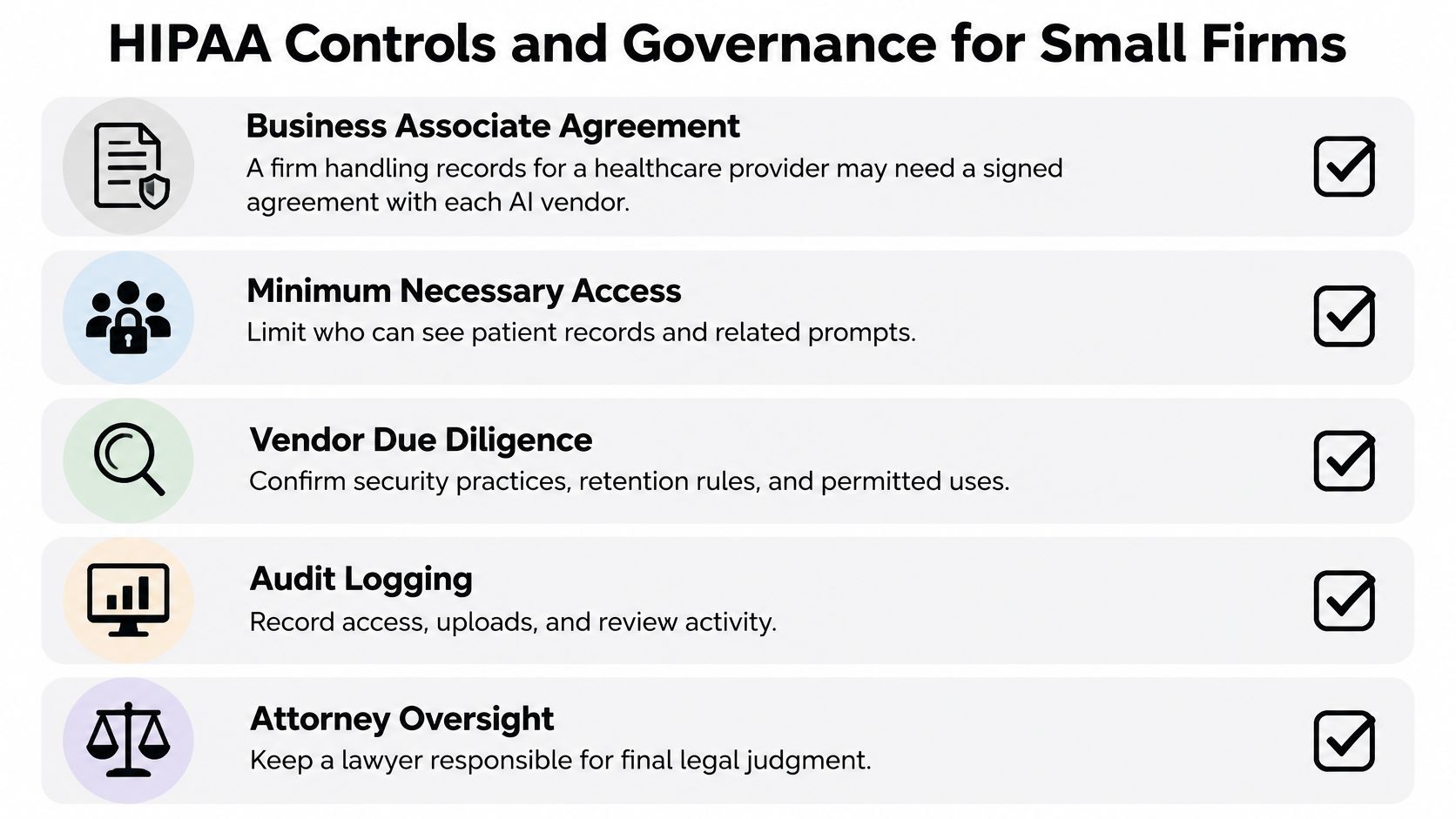
HIPAA Controls and Governance for Small Firms
A firm handling records for a healthcare provider should assess whether it acts as a business associate and whether its AI vendor needs a business associate agreement before receiving protected health information. Don't assume that representing an injured patient creates the same relationship, or that a vendor's compliance statement resolves the firm's obligations. Have counsel determine the applicable arrangements before uploading records.
The NIST Generative AI Risk Management Profile identifies privacy, provenance, reliability, security, and accountability as deployment concerns. Use those concerns to structure procurement and operating controls, not merely a security questionnaire.
Make the controls checkable
- Confirm agreements and permitted uses. Establish the appropriate contractual protections and prohibit unauthorized reuse of case content.
- Limit model context. Supply the documents needed for the assignment rather than unrelated portions of the client's file.
- Reduce identifiers where feasible. Separate matter identifiers from clinical text when the task doesn't require direct identification.
- Encrypt data. Cover transmission and storage, including exported summaries.
- Restrict access by role. Assigned personnel should see the matter; unrelated teams shouldn't.
- Define retention and deletion. Address uploads, prompts, outputs, backups, and subprocessors.
- Agree on incident handling. Specify notification procedures, investigation cooperation, and responsibility for preserving relevant logs.
Use this checklist when assigning responsibility for medical-record handling.
For our platform, we don't use customer content to train AI models. We also maintain zero-data-retention agreements with all AI infrastructure providers, and those providers don't store customer data after the processing request completes. Those commitments concern provider-side processing; firms should still document their own workspace and export practices.
Govern the workflow without building a committee
The 8am legal-industry report reports that 54% of surveyed legal professionals said their firms provided no responsible-use training and had no plans to do so, while only 9% reported a written, actively enforced policy. A policy nobody teaches or enforces doesn't provide an operational boundary.
Maintain an approved-tool register, an intake checklist, minimum-necessary data rules, and an escalation path for missing or conflicting records. Assign an owner to access reviews and preserve audit logs showing uploads, processing details, sources, and approval activity.
A blanket ban can leave personal-account use undiscovered. A narrow approved workflow gives staff a usable alternative and gives supervisors something they can audit.
Use our law firm HIPAA compliance guide to organize the legal review, and Foo Guard's crosswalk guide for AI agent compliance when comparing security-control documentation. Neither security assurance nor HIPAA compliance substitutes for checking output accuracy.
Send vendors a written questionnaire covering applicable agreements, training on customer data, subprocessors, storage locations, deletion, and incident notification. Require concrete answers and supporting contract language before approving the pilot.
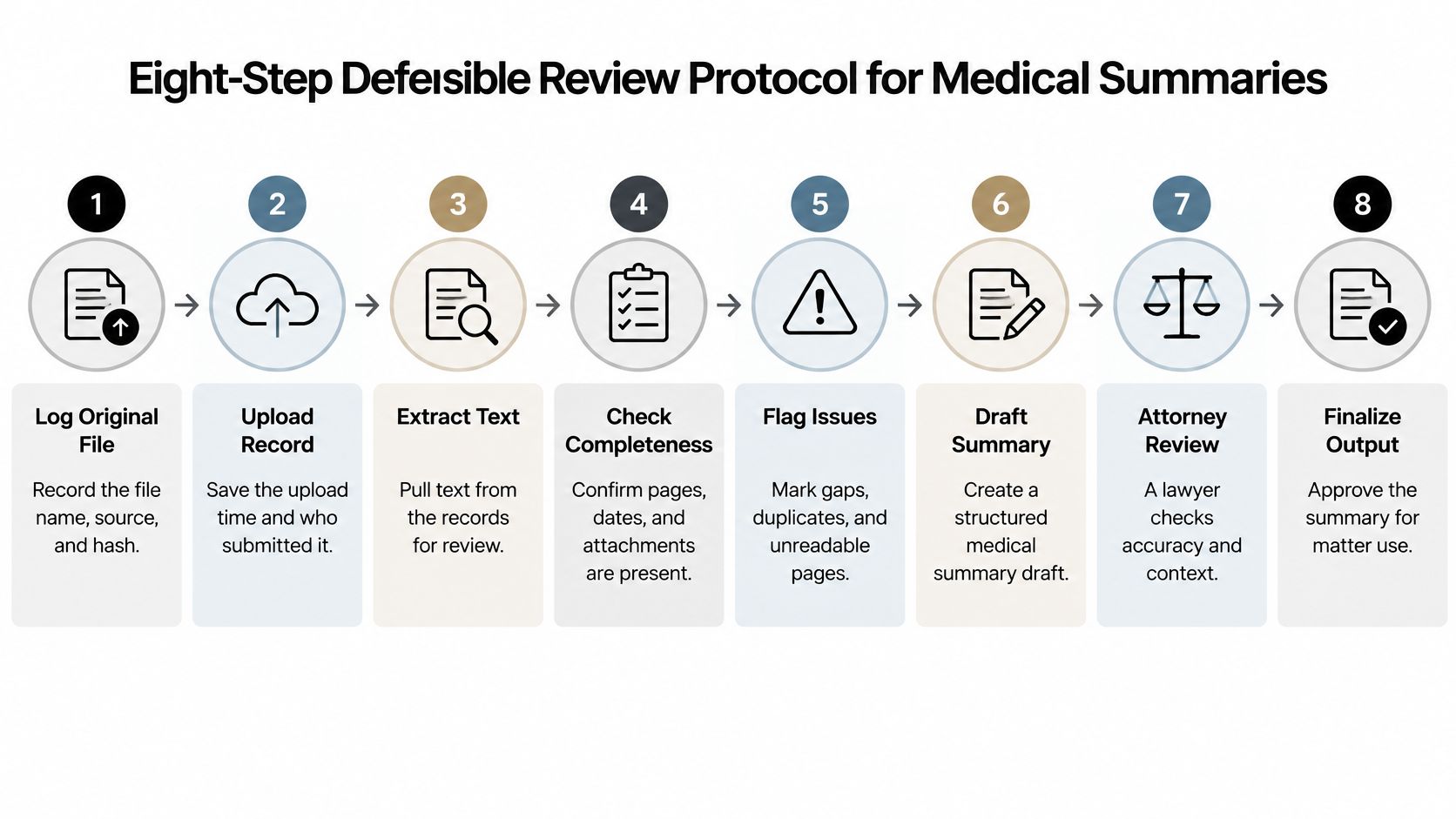
Eight-Step Defensible Review Protocol for Medical Summaries
Keeping a human in the loop is incomplete advice. A defensible protocol specifies what the person checks, which exceptions require escalation, and what the firm preserves after approval.
The summary should function as a reviewable evidence index. Its narrative is useful only when the underlying events remain accessible and the attorney can distinguish a documented fact from an inference.
Build a review trail from ingestion to approval
Log the original file. Preserve the file name, source, cryptographic hash, uploader, and upload time. Keep an unchanged original so later reviewers can identify exactly what the system received.
Extract structured events. Capture date, provider, diagnosis, and treatment with a page reference and confidence indicator. Distinguish the date of service from the date a note was signed; don't treat a confidence score as proof.
Create an exception queue. Route uncertain fields and high-consequence items to review. Causation, prognosis, prior injuries, policy limits, and damages deserve attention even when the system labels them confidently.
Draft from validated events. Generate the narrative from the checked event set. If an event lacks support, leave it unresolved rather than allowing the drafting stage to supply a plausible completion.
Display contradictions together. Put conflicting dates or histories side by side with their respective references. The reviewer should decide whether they concern separate encounters, documentation errors, or a substantive inconsistency.
Audit across document types. Choose a fixed sampling share before deployment and repeat the audit monthly against an attorney-checked reference set. Record unsupported statements, incorrect fields, omissions, and whether cited pages support the associated claims.
Require attorney certification. Record the approving attorney's name, approval date, and output version before a summary informs a demand, settlement position, deposition outline, or discovery response. Approval should identify the intended use, not imply suitability for every later purpose.
Archive the processing history. Preserve inputs, prompts, available model-version information, reviewer edits, and final output under the firm's retention policy. Restrict this archive because it contains sensitive case material and potentially privileged work product.
The process should make completeness checks and unresolved issues visible before approval.
Test the records most likely to expose weaknesses
Use fragmented records, duplicate notes, poor optical character recognition, and missing treatment intervals. Add files with similar provider names and conflicting histories so reviewers can test whether the system preserves uncertainty rather than smoothing it away.
Deloitte's legal-industry analysis reports that 37% of personal-injury professionals personally use generative AI at work. Put the protocol in place before informal use becomes the team's default process.
A useful audit doesn't ask whether the summary sounds right. It asks what a reviewer can prove from the underlying file.
Three-Phase Rollout and Quarterly Review
Roll out generative AI for law firms through approval gates, not an office-wide invitation to experiment. Assign a supervising attorney to policy and release decisions, and a staff lead to intake controls and audit records.
Establish permission before production
The first phase establishes the operating boundary. Approve a written policy, register a selected tool, confirm contractual protections, and train everyone who will touch the workflow.
Success means staff can identify permitted tasks, prohibited uploads, the required reviewer, and the escalation contact. The supervising attorney signs a go or no-go record before the team proceeds.
The second phase tests a bounded workflow on closed matters. Use records the firm is authorized to process and an attorney-checked reference set. The staff lead records total handling time, corrections, missing information, and review outcomes.
Set acceptance criteria before testing. Otherwise, an attractive demonstration can persuade the team to excuse failures it would've rejected at the outset.
Expand only after a documented decision
The third phase introduces the approved workflow into live matters. Expand by task rather than enabling every available feature, and decide whether engagement language or client-specific disclosure needs updating.
Use the implementation timeline as a planning aid, while making advancement depend on evidence rather than calendar dates.
- Attorney owner. Approves the legal use, evaluates serious errors, and signs each release decision.
- Staff lead. Maintains intake instructions, the tool register, training records, and audit logs.
- Matter reviewer. Records corrections and confirms that the output is suitable for its intended use.
After rollout, conduct a quarterly review of sampled outputs, escalation logs, permissions, and vendor changes. Test for cross-matter leakage and instructions embedded in uploaded documents that might divert the system from its task.
Update the policy when the workflow changes. Suspend the affected use if a new failure undermines the original acceptance decision, even if staff have grown comfortable with the tool.
Choose Your First Workflow and Decide on the Pilot
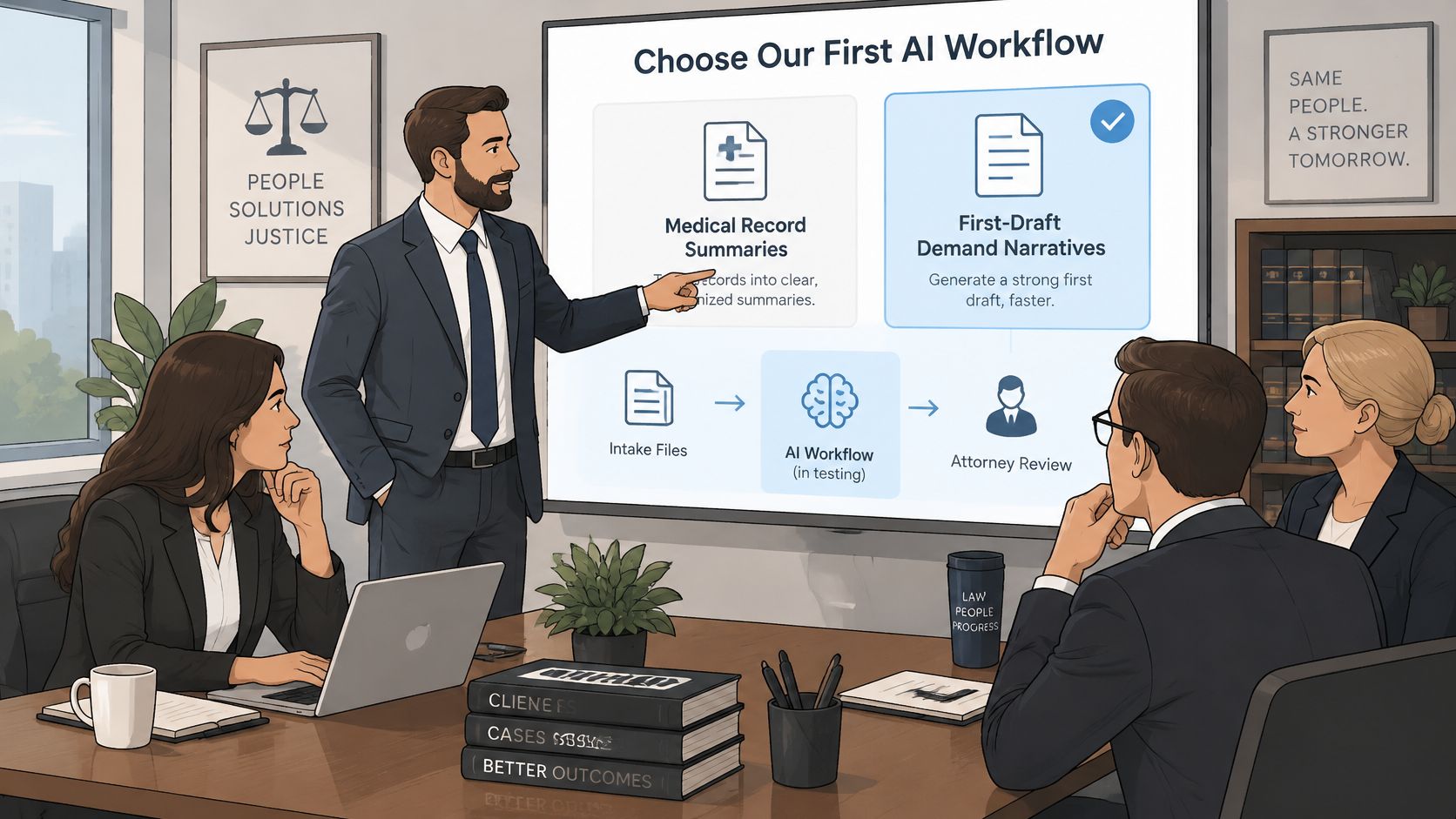
Choose a high-volume task that repeats across matters and ends in attorney review. Medical summaries and first-draft demand narratives are reasonable candidates when reviewers can efficiently inspect the supporting records.
Make the pilot decision with the people who will perform intake and approval.
Use a clear continuation test
Before starting, complete the applicable vendor agreements and establish permitted data use and deletion terms. Set acceptance measures for net hours saved, error rate against an attorney-checked sample, and source-page coverage. Continue only when the workflow meets every measure across the pilot, not just on its cleanest file.
Our Ares platform supports medical record summarization, demand generation, document drafting, deposition preparation, discovery assistance, and AI-powered legal research across document-heavy personal injury work from intake to settlement. That range isn't a reason to pilot everything together. Ares doesn't provide legal advice; the customer remains solely responsible for legal decisions, client communications, and filings made using service outputs.
Use the accompanying video as a discussion prompt for your evaluation team.
Ares helps personal injury teams turn case files into organized medical summaries and litigation drafts for attorney review. Visit Ares to evaluate a focused workflow, and bring a representative closed file plus your verification checklist to the discussion.