

You can usually spot the firms that are stuck before the first strategy call ends. The partners are frustrated with lead quality, intake says the phones ring but “nothing good comes through,” and nobody can say with confidence which channel produced the last batch of signed matters. The website looks respectable from a distance, but it doesn't match the cases the firm wants. Marketing exists. A pipeline doesn't.
That problem shows up constantly in employment law firm marketing because this practice area attracts two very different buying behaviors. An employee may search in private, late, and emotionally. An HR leader or in-house lawyer may compare firms methodically, involve multiple decision-makers, and care more about risk control than dramatic copy. If your positioning, intake, and measurement aren't built as one system, the firm ends up paying for attention it can't convert.
This is also why budget discipline matters. Law firms commonly spend about 2% to 10% of gross revenue on marketing, with many benchmarks clustering closer to 2% to 5%, while higher-growth firms can go further. At the same time, a 2024 estimate put U.S. legal-service advertising at more than $2.5 billion across more than 26.9 million ads according to Revenue Memo's legal marketing statistics roundup. In other words, employment law marketing isn't a side project. It's an operating decision.
Why Most Employment Law Marketing Falls Apart Before It Starts
A common version of the problem looks like this. A mid-size employment firm runs Google Ads every month, the website hasn't been meaningfully updated in too long, LinkedIn posting happens when someone remembers, and referrals used to carry the practice until a rainmaker left. Nothing is fully broken, but nothing compounds.
That firm doesn't need more tactics first. It needs a diagnosis.
The difference between activity and a system
When employment law firm marketing works, the firm can answer a few basic questions without a debate in the conference room:
- Who is the primary client type? An aggrieved employee, an employer, or a business buyer inside a legal department.
- Which matters are worth scaling? Wage and hour, discrimination, retaliation, advice and counsel, investigations, or litigation defense.
- Which channels produced signed matters last quarter? Not calls. Not form fills. Signed work.
- What happens after first contact? Who responds, how quickly, what gets logged, and how outcomes are categorized.
If those answers are fuzzy, marketing becomes a recurring expense instead of a repeatable intake engine.
Practical rule: If a firm can report call volume but can't report retained matters by source, it isn't measuring marketing. It's measuring noise.
The questions that expose weak foundations
Most firms don't have a lead problem. They have one of three operating problems.
First, positioning drift. The homepage says “labor and employment law,” the ads say “wrongful termination attorney,” and the intake team opens calls as if every matter is a general civil dispute. That disconnect lowers trust before a lawyer ever speaks to the prospect.
Second, intake blindness. Teams often log the fact that a call happened but not what happened next. Did the lead fit the case criteria? Was there a conflict? Did the prospect ghost after consultation? Did another firm respond faster? Without outcome data, budget decisions turn into partner opinions.
Third, channel confusion. Firms keep paying for channels they can't compare. Referral matters and paid matters land in the same bucket, local SEO isn't separated from branded search, and nobody can tell whether a practice page drives useful consultations or just pageviews.
What to fix before buying more visibility
Start with a short audit:
- Define the signed matter target. Name the case types and client profiles worth pursuing.
- Map the intake path. Website, form, call, follow-up, consultation, retainer.
- Standardize source tracking. Every inquiry needs a channel and sub-source.
- Review message consistency. Ads, homepage, practice pages, Google Business Profile, and intake scripts should sound like the same firm.
A campaign can hide operational problems for a while. A system exposes them and fixes them.
Positioning Your Firm So the Right Clients Self-Select
Broad positioning sounds safe. In employment law, it usually makes the firm easier to ignore. “We handle all labor and employment matters” tells the market almost nothing about who should call, why they should trust you, or what kind of problem you solve best.
Employment law firm marketing gets stronger when the message helps the right prospect recognize themselves immediately.
Why niche beats broad
Plaintiff-side firms, employer-side firms, and hybrid firms do not win with the same message.
A plaintiff-side practice often needs emotional clarity. Someone who believes they were fired after reporting harassment doesn't want a lecture on the full spectrum of labor relations. They want to know whether the firm understands the event, the fear, and the practical next step.
An employer-side practice sells a different kind of trust. HR leaders and owners want counsel that can prevent escalation, train teams, investigate complaints, and defend claims without drama. They are buying steadiness.
Hybrid firms have the hardest positioning problem. If they market both sides with equal emphasis, they often look unfocused to both sides. In most markets, hybrid firms need a dominant lane in public-facing messaging, then a separate business development path for the other side.
Positioning Differences by Firm Type
| Firm Type | Primary Audience | Core Message | Proof Points | Top Channels |
|---|---|---|---|---|
| Plaintiff-side | Employees with urgent workplace claims | Rights, clarity, responsiveness, case fit | Case results, testimonials, attorney bios, FAQs on claims process | Google Search, local SEO, reviews |
| Employer-side | HR leaders, owners, operations executives | Risk management, compliance, defense, practical advice | Industry experience, speaking, audits, training, representative matters | LinkedIn, referrals, search, email |
| Hybrid | Mixed audience with one dominant public lane | Clear lead offer for one side, separate nurture for the other | Distinct practice pages, segmented intake, differentiated bios | Search plus referral-based business development |
Build one positioning statement and carry it everywhere
A simple formula works:
We help [specific audience] solve [specific employment problem] through [distinct approach or strength].
Examples in plain English:
- We help employees evaluate wrongful termination, discrimination, and retaliation claims with fast, candid case assessment.
- We help employers reduce workplace risk through investigations, compliance counseling, and employment litigation defense.
Then carry that positioning into:
- Homepage copy
- Google Business Profile categories and descriptions
- Ad copy
- Attorney bios
- Intake scripts
The proof stack matters as much as the headline. If the message says “trusted counsel for HR teams,” the page should show signs of that trust. If your firm is navigating public scrutiny or negative review cycles while refining positioning, this TheBestReputation guide for legal crisis is a useful resource for thinking through reputation response in a law firm context.
A weak position forces the prospect to interpret the firm. A strong position lets the prospect qualify themselves.
The Three Employment Law Client Personas and How to Reach Them
Employment law buyers don't move through the funnel the same way. The search pattern, trust trigger, and intake expectation change depending on who's making the inquiry. Treating them as one audience causes sloppy content, poor routing, and weaker close rates.
Employment Law Client Personas at a Glance
| Persona | Search Behavior | Trust Trigger | Conversion Driver | Intake SLA |
|---|---|---|---|---|
| Aggrieved employee | Urgent, emotionally specific, often private searches | Empathy, clarity on claim types, plain-language process | Fast response, easy consultation path, confidence the firm handles similar facts | Immediate, same-session if possible |
| HR decision-maker | Comparative, business-hours research, local market evaluation | Industry familiarity, practical scope, professionalism | Clear next step, responsive follow-up, defined engagement path | Same business day |
| In-house counsel | Narrower evaluation, expertise-led review, referral-influenced | Credentials, thought leadership, subject-matter depth | Specialist fit, attorney access, confidence in strategic judgment | Prompt attorney-level response |
The aggrieved employee
This buyer often arrives in a state of uncertainty. They don't always know whether they have a claim, but they know the event felt wrong. Their search language is usually more fact-pattern driven than doctrinal. They want plain English, not legal taxonomy.
What converts them:
- Empathetic page structure that names the situation directly
- Clear fee or consultation expectations
- Fast callback workflow
- A short intake path that doesn't force them to relive everything in a long form
What loses them:
- Dense pages written like treatises
- Generic “contact us” calls to action
- Slow response
- Intake staff who sound skeptical or rushed
The HR decision-maker
This buyer cares less about emotional resonance and more about operational confidence. They want to know whether the firm can advise, investigate, train, or defend without creating new headaches. They compare websites, bios, and service scope carefully.
Digital credibility becomes decisive. Industry data shows 75% of prospective legal clients visit two to five law firm websites before contacting a firm, and 49% of firms have a dedicated marketing director, manager, or team, according to Clio's legal marketing statistics. For employer-side employment practices, that comparison behavior means your website is often doing early screening work before the first call.
The in-house counsel buyer
This persona is usually less responsive to broad consumer-style marketing. They look for narrow expertise, strong bios, practical analysis, and signals that the firm can slot into a legal team without hand-holding.
What tends to work best:
- Thought leadership with point of view
- Focused alerts and whitepaper-style resources
- Referrals from trusted lawyers or consultants
- Direct access to the attorney who'd handle strategy
For this group, a polished intake process still matters, but credentials and relevance usually carry more weight than design tricks.
Building SEO and Content Around the Matters You Actually Want
Most employment firms don't need “more blogging.” They need a content architecture that matches the matters they want to sign. Good SEO in this practice isn't a publishing habit. It's a case-selection tool.
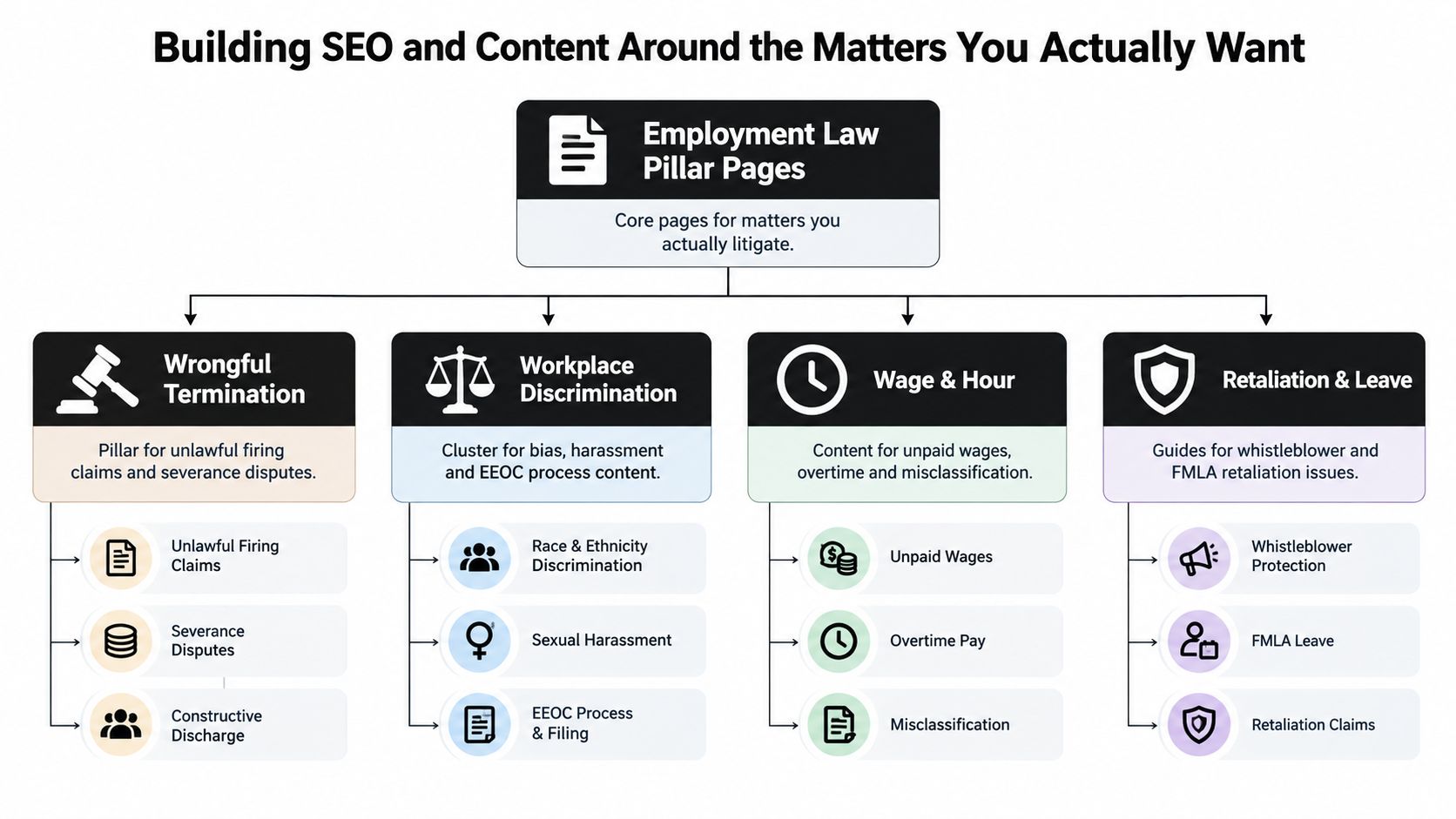
Start with pillar pages, not random topics
Build a core page for each matter category the firm wants. For many employment practices, that means pages around wrongful termination, wage and hour, discrimination, retaliation, leave issues, workplace investigations, or defense counseling.
Then add supporting content around questions people ask inside those categories. A wrongful termination pillar should connect to narrower pages and articles about specific scenarios, procedural questions, and jurisdiction-specific concerns. A wage and hour pillar should support the types of disputes your lawyers are willing to take, not every possible labor issue under the sun.
This structure aligns with how clients search and how firms qualify work.
Local intent and profile assets matter
Employment law often has strong local search behavior because prospects want counsel in their city or state and because laws vary by jurisdiction. That means your Google Business Profile, local practice pages, attorney bios, and legal directory citations need to support the same matter focus.
A few practical moves make a difference:
- Build city and state variants carefully. Don't mass-produce duplicate pages. Write pages that reflect local procedure, audience, and case mix.
- Use schema where it helps understanding. Attorney profile markup and FAQ markup can make service pages clearer and easier to parse.
- Update the Google Business Profile consistently. Practice descriptions, photos, posts, and review management should reflect current priorities.
- Retire non-performing content. If a post ranks but brings the wrong audience, it can waste intake time.
For firms refining their editorial process or outsourcing part of it, the overview of what Sibley Digital offers for content is a useful reference point for how structured content programs are typically framed.
A short visual walkthrough can help teams align around this model:
Don't separate SEO from conversion
SEO pages that rank but don't convert usually fail for one of three reasons:
- The page targets the wrong intent.
- The page gives legal information without giving a reason to contact the firm.
- The page creates friction at the point of action.
Field note: The best employment law content doesn't just explain the issue. It helps the visitor decide whether this firm is the right next step.
A clean topic cluster paired with focused intake calls to action does more for employment law firm marketing than a long editorial calendar nobody can connect to retained matters.
Paid Search as a Funnel Problem, Not a Traffic Problem
Paid search gets blamed for a lot of failures it didn't cause. The ads may be fine. The landing page may be generic, the intake response may be slow, or the CRM may not show which leads become retainers. That's why employment law firm marketing should treat PPC as funnel engineering, not click buying.
The benchmarks that matter
Legal search campaigns do convert, but they don't convert by accident. Benchmark data cited by JLB Works on law firm marketing benchmarks puts the average search advertising conversion rate for attorneys and legal services at 7%, with legal landing pages showing a 6.3% median conversion rate. The same benchmark set notes that stronger firms reach 8% to 12%+ website conversion and 12.5% top-decile landing-page conversion. It also reports that mobile accounts for 62.4% of law-firm traffic and mobile bounce is 64.2%. If your employment landing pages are slow, vague, or awkward on mobile, you're paying for avoidable drop-off.
That's why “more traffic” is often the wrong answer.
Segment by intent before you scale spend
Employment PPC should rarely run as one blended campaign. Separate the funnel into at least a few intent groups:
| Campaign Type | Avg. CPL | Lead-to-Retainer % | Notes |
|---|---|---|---|
| Brand defense | Qualitatively lower than broad non-brand in many markets | Qualitatively stronger because searchers already know the firm | Protects branded demand and keeps competitors from intercepting it |
| Employee-side matter-specific search | Average Google-search CPL for employment law is $150 to $400 | Varies by case quality, intake discipline, and geography | Best when tied to dedicated pages for specific claims |
| Broad category terms | Average Google-search CPL for employment law is $150 to $400 | Usually weaker without tight qualification | Often wastes budget if sent to the homepage |
| Competitor conquest | Qualitative only | Qualitative only | Requires careful messaging and usually stricter qualification |
The reason to segment is simple. A person searching a branded query behaves differently from someone searching a claim-specific phrase. They should not see the same copy or land on the same page.
If you want a simple way to think about campaign structure outside the legal category, this Google Ads for HVAC leads breakdown is a decent example of how service businesses separate intent and landing experiences. The principle carries over even though the buyer is different.
What actually improves signed matters
Three changes usually matter more than expanding keyword lists:
- Dedicated landing pages for wrongful termination, wage claims, discrimination, and retaliation instead of the homepage
- Closed-loop tracking through call tracking, recorded intakes where appropriate, and CRM outcome tags
- Monthly pruning of keywords and ads that create calls but not retained work
For firms working on the broader demand-capture side of new business, this guide to attorney lead generation pairs well with PPC planning because it forces the right question: which leads are worth operational attention?
The firms that win with paid search don't just buy visibility. They route intent into the right page, the right intake script, and the right follow-up sequence.
Turning Referrals From Rumor Into a Repeatable Pipeline
Most firms say referrals matter. Fewer can show which referral relationships consistently produce qualified employment matters. That gap exists because referral marketing is often treated as goodwill instead of channel management.
Employment work usually reaches non-lawyer professionals before it reaches a law firm. That's the opening.
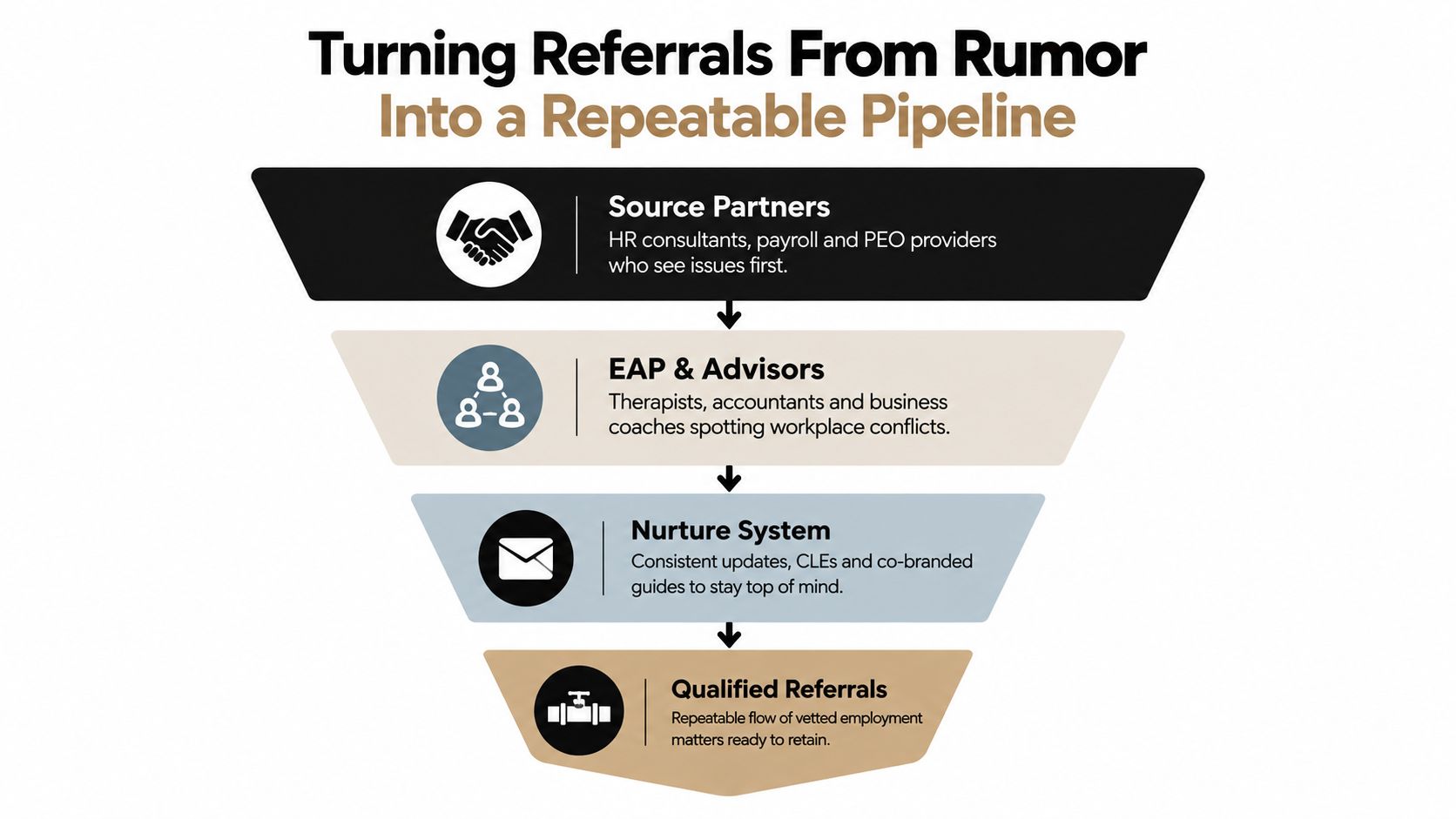
Build around the people who see issues first
The strongest referral partners often include:
- HR consultants and fractional HR leaders who encounter policy failures and complaint handling issues
- Payroll providers and PEO contacts who hear about wage disputes, classification problems, and termination friction
- Mediators and workplace coaches who see conflict before litigation
- Accountants and business advisors who get pulled into severance, owner disputes, or restructuring conversations
Each of these partners needs a different explanation of when to refer and what your firm handles best. A one-page referral explainer works far better than a vague “keep us in mind.”
Track referral sources like any other channel
Use the CRM to log:
- Source category
- Specific partner name
- Matter type
- Outcome
That record matters because not every warm introduction produces useful work. Some people are generous with introductions and weak on fit. Others send fewer matters but better ones.
The referral relationship isn't the asset. The repeatable fit between that partner and your intake criteria is the asset.
A simple operating rhythm helps:
- Quarterly check-ins
- Co-branded educational materials where appropriate
- Fast acknowledgment when a partner refers someone
- A closed-loop note on outcome when ethics rules and confidentiality allow
If your intake team needs clearer process design to support referral speed and handoff quality, this practical piece on the law firm intake specialist role is a useful companion read.
Firms that rely on “people know us” usually discover that only a few relationships are producing work. Once that's visible, referral growth becomes far easier to manage.
Measurement, Attribution, and Your 90-Day Implementation Plan
Marketing becomes durable when partner turnover doesn't erase institutional memory. That only happens if attribution, intake, and reporting live inside a process the firm can repeat. In employment law firm marketing, that process should answer one question every month: which activities produced qualified matters that the firm retained?
Start with the KPI stack that survives staff changes
You do not need a giant dashboard first. You need a reliable one.
Track:
- Qualified leads by channel
- Intake-to-retention rate
- Average matter value by source
- Blended cost per signed matter
Multi-touch attribution will never be perfect. That's fine. The goal isn't perfection. The goal is consistency. Use call tracking for paid campaigns, dedicated numbers or coded source entries for referral partners, UTM conventions for organic and email, and CRM stage tracking that remains readable when a coordinator leaves.
Industry channel benchmarks are useful here because they remind firms not to over-credit one tactic. MyCase's law firm marketing statistics reports an overall conversion rate of 7.9% across marketing channels, with referral at 8.8%, paid search at 7.8%, and organic search at 7.3%, while noting guidance that many firms allocate 45% of budget to SEO and 30% to PPC. Those figures don't tell you what your firm should spend blindly. They do tell you that channel mix and conversion discipline matter as much as raw budget.
A practical 90-day rollout
Days 1 to 30
Focus on alignment and instrumentation.
- Audit positioning. Make sure homepage, practice pages, profiles, ads, and intake scripts describe the same firm.
- Fix intake scripts. Intake should capture source, matter type, fit, disposition, and follow-up status.
- Install tracking. Calls, forms, UTMs, CRM stages, and source naming conventions need one owner.
- Clean local profiles. Update Google Business Profile and core directory listings to match current priorities.
Days 31 to 60
Launch only what the team can measure.
- Publish one content cluster around a target matter type
- Stand up one segmented paid search campaign
- Activate two referral partnerships with one-pagers and follow-up rhythm
This is also the right window to circulate a working planning document. If your team needs a framework for that, this guide to a marketing plan for lawyers is a practical starting point.
Days 61 to 90
Review what produced signed work, not just activity.
- Compare channels by qualified lead quality
- Review intake-to-retainer patterns
- Reallocate budget away from low-fit traffic
- Double down on pages, partners, and campaigns tied to retained matters
90-Day Employment Law Marketing KPI Benchmarks by Firm Size
| Firm Size | Blended CPL Range | Intake-to-Retain Rate | Monthly Qualified Leads | Signed Matters / Quarter |
|---|---|---|---|---|
| Solo or small firm | Qualitatively evaluated against target matter economics | Qualitatively tracked by source and matter type | Qualitatively based on capacity | Qualitatively based on staffing and case mix |
| Mid-size employment boutique | Employment law Google-search CPL averages $150 to $400 for paid search as one input | Qualitatively tracked within a defined response window | Qualitatively based on lawyer and intake capacity | Qualitatively based on target matter mix |
| Larger multi-office practice | Employment law Google-search CPL averages $150 to $400 for paid search as one input | Qualitatively tracked by office, channel, and practice lane | Qualitatively based on segmented intake teams | Qualitatively based on conversion discipline and staffing |
The key is not the table itself. The key is that the firm can update it every month without rebuilding the logic from scratch. That's when marketing stops depending on a single partner's relationships or a vendor's slide deck and starts behaving like an operating system.
Ares helps litigation teams turn document-heavy casework into a faster, more repeatable process by automating medical records review and demand drafting. For firms that want the same operational discipline in case prep that this article calls for in marketing and intake, it's worth seeing how Ares fits into the broader system.