A hospital can produce a polished policy binder and still fail the standard that matters. Under CMS Hospital Conditions of Participation, the question isn't whether a policy exists. It's whether the care delivered, the record created, and the transition documented on a specific date match what the policy promises.
That distinction changes how you should read a chart. Every Condition of Participation, or CoP, implies an artifact: an evaluation, a timestamp, a signature, a referral, a grievance log, or an audit trail. When that artifact is present, you can test its timing and content. When it's absent, you have a question to pursue, not yet a conclusion to argue. Treating each rule as an evidence question keeps review disciplined. It separates what the regulation requires, what the record shows, and what an expert still needs to establish.
Hospital Conditions of Participation Defined
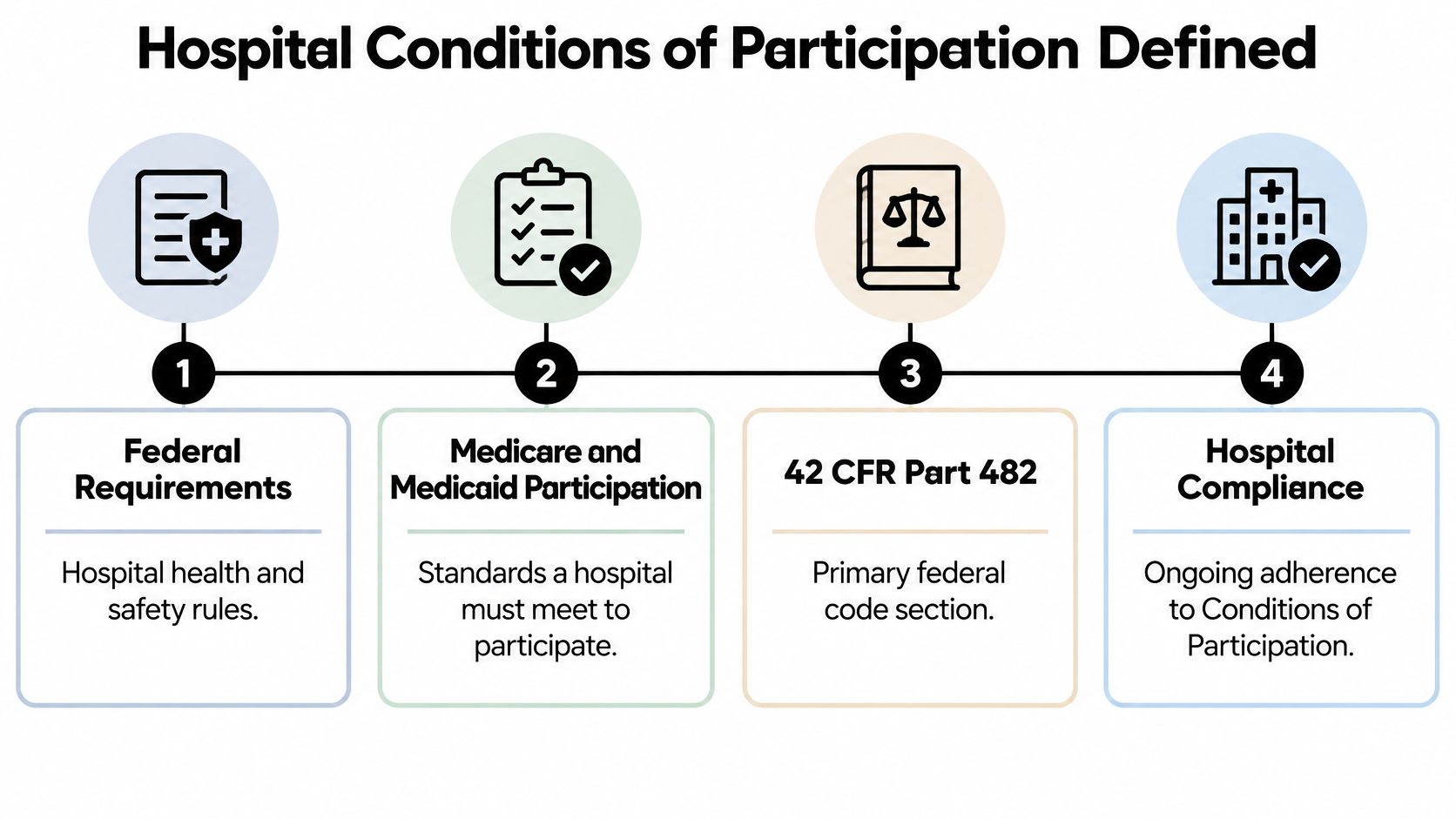
CMS Hospital Conditions of Participation are the federal health and safety requirements a hospital must satisfy to participate in Medicare and Medicaid. The CMS hospitals certification and compliance page states that they're codified primarily in 42 CFR Part 482 and apply across the hospital as a single provider institution under one CMS Certification Number (CCN).
That whole institution scope is the starting point for review. State Survey Agencies evaluate and certify participating hospitals across all covered services, departments, locations, and areas in the provider agreement, so governance, patient rights, nursing, medical staff, quality assessment, infection control, emergency services, medical records, and pharmacy can all affect certification. A gap in one department isn't automatically contained to that department.
The framework is also dated, which matters for case chronology. The principal modern hospital CoP rule was published June 17, 1986, at 51 FR 22010 and became effective September 15, 1986. Quality Assessment and Performance Improvement provisions followed on January 24, 2003, and Patients' Rights provisions were published December 8, 2006, effective January 8, 2007. The version in force on the dates of care controls your analysis.
Key CoP Sections and the Records That Show Them
Use this map before you open the chart, because it tells you which part of Part 482 governs a problem and which document should answer it.
| CoP area | What it governs | Typical compliance record |
|---|---|---|
| Governing body | Board accountability for quality and safety | Board minutes and oversight reports |
| Patients' rights | Notice of rights, record access and grievances | Rights notices, access requests and grievance files |
| Quality assessment and performance improvement | Ongoing data-driven quality program | QAPI committee minutes and performance data |
| Medical staff | Credentialing and medical staff bylaws | Credentialing files and medical staff minutes |
| Nursing services | Nursing care planning and staffing | Nursing notes and care plans |
| Medical record services | Complete, authenticated and confidential records | The chart and its audit trail |
| Infection control | Surveillance and prevention programs | Infection logs and surveillance reports |
| Discharge planning | Screening, evaluation and planning before discharge | Discharge planning evaluation in the chart |
How to Read Each Row
Treat each row as a question, not a finding. If the issue is a physician's authority to perform a procedure, you're asking whether credentialing files and medical staff minutes show current privileges that cover that procedure on that date. If the issue is a deterioration that nurses documented hours before a physician responded, you're asking whether nursing notes and care plans show an updated plan, escalation, and staffing consistent with the patient's acuity.
The record in the third column sets the discovery target. Board minutes alone don't prove bedside compliance, and a single nursing note doesn't prove board oversight failed. You're matching the level of the claim to the level of the evidence. Systemic allegations need committee, oversight, or program records. Individual care allegations need contemporaneous clinical entries tied to the encounter.
Where the Map Misleads Without Dates
A clean QAPI file from a later year doesn't answer whether the hospital tracked the same risk at the time of the injury. Ask for the QAPI committee minutes and performance data covering the period before and shortly after the encounter, then check whether the indicator at issue, such as falls, pressure injuries, infections, or readmissions, appears. If it doesn't, the question becomes why the program didn't capture it, not whether QAPI existed.
Similarly, infection control requires more than a policy statement. Infection logs and surveillance reports should let you see whether the organism, unit, and timeframe in your case were under surveillance and whether the hospital identified a cluster. A missing log entry might reflect a case that didn't meet a surveillance definition, poor documentation, or a gap in detection. The row tells you what to request so you can distinguish those possibilities.
Practical rule: A CoP row gives you a document request and a timing test. It doesn't give you liability, causation, or a breach opinion by itself.
Matching Functions to the Facts Pleaded
Start narrow and expand only when the chart justifies it. A disputed discharge usually begins with discharge planning, medical record services, and patients' rights, because those sections cover evaluation, documentation, and participation. It doesn't automatically require board minutes unless the record suggests a systemic pattern, a ignored prior finding, or a known staffing constraint the governing body had been asked to address.
Conversely, don't confine a case to the treating unit when the documentation points elsewhere. Repeated unauthenticated entries raise a medical record services question. Contradictory orders from multiple services raise a medical staff coordination question. A grievance filed during admission raises a patients' rights question about notice, investigation, and response. The table helps you name that second issue precisely instead of describing the whole chart as generally deficient.
That precision improves expert referrals. An expert can work faster with a question framed as, "Does the discharge planning evaluation address the mobility deficits documented in therapy notes," than with, "Review for negligence." You've identified the governing function, the expected artifact, and the conflicting source pages. The expert then supplies the clinical judgment the regulation doesn't supply on its own.
How Surveyors Test Compliance in Practice
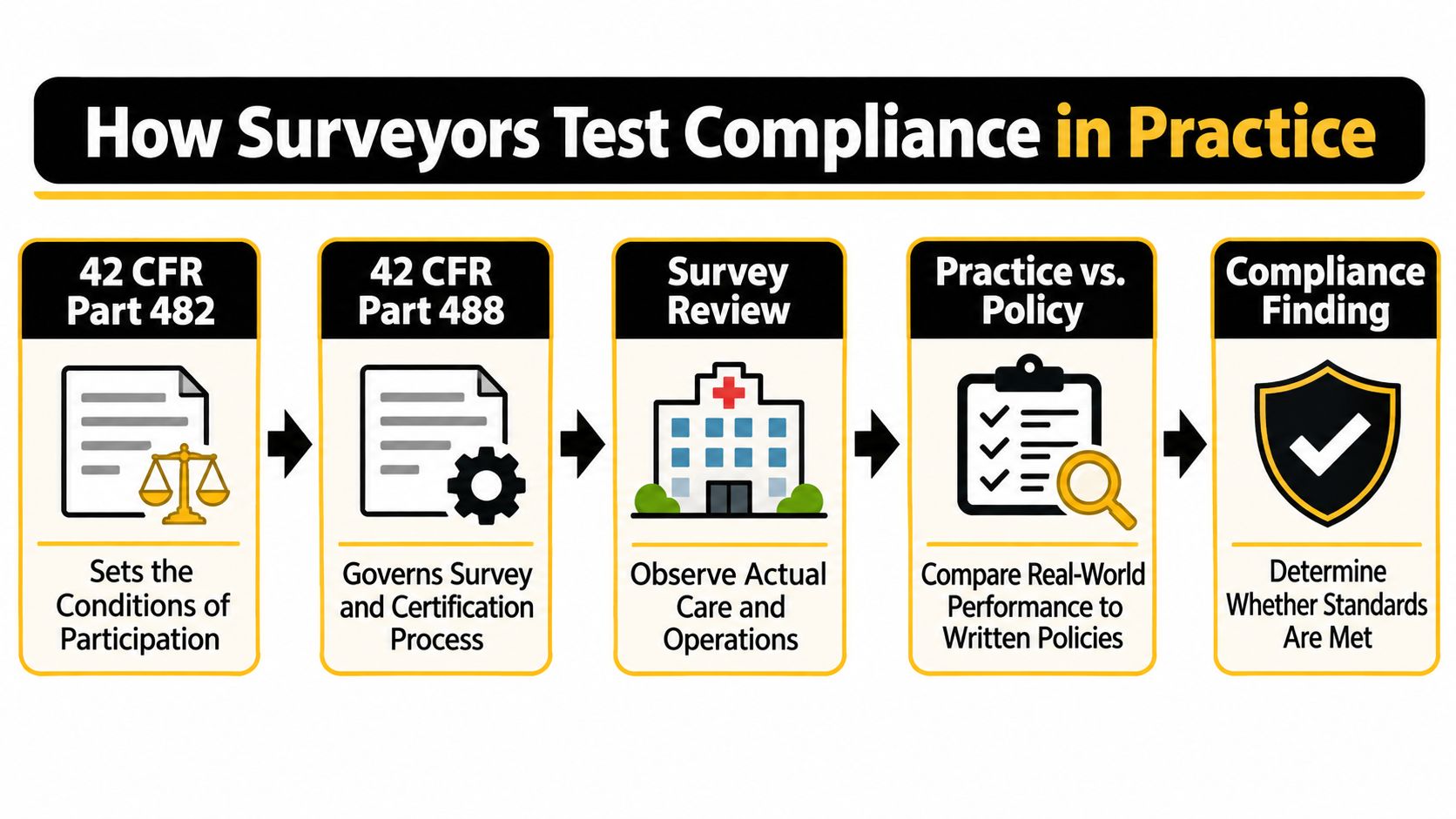
Surveys test whether the hospital's documented system survives contact with active care. The CMS hospital survey guidance in Appendix A identifies 42 CFR Part 482 as the source of the hospital CoPs and 42 CFR Part 488, Subpart A as the authority governing survey and certification procedures. Those citations define what surveyors may examine. They do not, by themselves, establish that a given chart meets the standard.
The Two Survey Routes
A State Survey Agency may survey the hospital directly for CMS. An approved accreditation organization with deeming authority may survey it instead. Under section 1865(b) of the Social Security Act, that organization can deem a provider compliant only after demonstrating to CMS that its requirements meet or exceed the Medicare conditions.
The route changes the evidence you can obtain. You need to know who surveyed, which standards governed the review, and whether the report is a CMS certification survey, an accreditation survey, or a complaint investigation. Those reports can ask different questions and produce different findings from the same underlying chart.
Surveyors also watch care as it happens. On hospital surveys, the method includes direct observation of active inpatient units alongside record review. That matters for litigation because an observation can capture a practice the chart never records, while the chart can show a documented decision the survey never tested.
The Survey Sequence in Practice
- Survey entry and entrance conference: Surveyors arrive, identify the scope, and establish who will produce documents and escort the team.
- Document request and policy review: The team obtains policies, rosters, committee records, and logs to learn what the hospital says it does.
- Observation of care on the units: Surveyors watch medication passes, infection control practice, patient identification, and handoffs as they happen.
- Sampling of charts and staff interviews: Reviewers sample records and ask staff to explain processes in their own words, testing whether knowledge matches policy.
- Comparison of practice with written policy: The team contrasts observed and documented practice against the hospital's own procedures and the CFR text.
- Findings tied to specific CFR sections: Each deficiency is anchored to a regulatory citation rather than expressed as a general concern.
- Correction and follow-up: The hospital states how it will correct the problem, and reviewers verify whether the fix occurred.
The video below places that sequence in a broader survey context before you apply it to a specific report.
The Litigation Use and Its Limit
For a case team, the most useful gap is often policy versus execution. If the fall prevention policy requires reassessment after a change in condition and the chart shows a new sedating medication with no reassessment, you have a specific, dated inconsistency. If staff interviews in a survey describe a workaround that also appears in your client's chart, that alignment is stronger than either source standing alone.
A survey finding gives you an authoritative, dated reference point for hospital practice. It does not prove what happened in a different encounter on a different date. Nor does a clean survey prove that the chart in hand was compliant, because survey samples are not the same as a complete case file. Use the finding to frame targeted questions and document requests, then prove the encounter-specific facts from the chart, testimony, and expert analysis.
What Survey Findings Mean for Certification
A survey finding converts an observation into a certified compliance problem. Surveyors tie each deficiency to a specific CFR section, describe the evidence supporting it, and place it in the survey report that the hospital must answer.
The hospital responds with a plan of correction stating what it'll do, who owns the action, how completion will be monitored, and when correction will be achieved. CMS or the State Survey Agency then evaluates that plan and may verify implementation through follow up review. A written promise isn't the end of the process. Demonstrated correction is.
Severity affects urgency. Deficiencies presenting immediate jeopardy to patient health or safety require prompt action and can escalate quickly. If a hospital doesn't achieve required correction, consequences can reach continued Medicare and Medicaid participation, including termination of the provider agreement. That escalation explains why hospitals treat condition level findings as institutional events, not departmental paperwork.
Apply a Timing Test to Every Finding
Use a disciplined sequence when a report looks helpful.
- Locate the report and citations: Identify each cited CFR section and the factual examples surveyors relied on.
- Read the plan of correction: Note promised actions, responsible roles, monitoring, and completion dates.
- Compare dates with care: Place the survey, deficiency period, correction date, and your encounter on one chronology.
- Check resolution: Look for follow up surveys or acceptance showing the deficiency was corrected and remained corrected.
A finding dated after the care at issue doesn't, by itself, establish the same conditions existed during that care.
That's the central caution. A later finding can justify discovery into whether the problem predated the survey, but you still need evidence bridging the periods. Conversely, a corrected finding before the encounter can raise a monitoring question if the same behavior recurs. Timing determines whether the report is context, notice, or largely unrelated background.
Medical Record Requirements That Prove Necessity and Access
The chart has to do more than list services. The current text of 42 CFR Part 482 in the eCFR requires the record to justify admission and continued hospitalization, support the diagnosis, and document the patient's progress and response to medications and services.
Read that as three separate proof burdens. Justification asks why inpatient care was needed at admission and why it remained needed each day. Diagnostic support asks whether histories, examinations, imaging, labs, and consultations substantiate the diagnoses carried forward. Progress and response ask whether the record shows improvement, deterioration, or nonresponse after each intervention. A chart can satisfy one burden and fail another.
Confidentiality and Patient Access
Hospitals must protect record confidentiality, restrict release to authorized individuals, and prevent unauthorized access or alteration. For case review, that makes provenance part of the evidence. You need to know who created an entry, when it was authenticated, whether it was amended, and whether the version produced matches the version relied on during care.
Access rights are equally concrete. Records must be provided in the requested form and format when readily producible, including electronic format for electronically maintained records, within a reasonable time frame. If a production arrives as flattened images while the hospital maintains structured electronic data, ask what was requested, what was readily producible, and what metadata or audit information was withheld from the export.
Our detailed breakdown of 42 CFR 482.24 medical record services requirements is useful when you need to test completeness and authentication against the regulatory text. Apply it to the actual production, not to a hospital's description of its system.
Five Checks for a Defensible Review
- Preserve document provenance: Keep file names, production batches, page numbers, author identifiers, and timestamps attached to every excerpt you extract.
- Separate contemporaneous entries from later summaries: Weight a bedside note written during the shift differently from a discharge summary dictated days later.
- Reconcile conflicting dates and diagnoses: Resolve discrepancies across emergency, operative, nursing, therapy, pharmacy, and billing records against source pages.
- Confirm progress and response: Check whether each medication, procedure, and service is followed by a documented effect, side effect, or reason for change.
- Maintain an auditable source link: Connect every extracted fact to its source page so another reviewer can verify it without repeating the full search.
These checks matter because missing or inconsistent documentation changes interpretation. An absent response note can make continued hospitalization look unsupported even when nurses observed the patient frequently. A copied diagnosis can create false continuity after imaging excluded that condition. A therapy note documenting dependence for transfers can contradict a discharge note describing independent mobility on the same day.
Functional status deserves special attention in injury cases. Compare physician summaries with nursing flow sheets, physical and occupational therapy notes, intake and output records, medication administration records, and progress notes. The most granular source often describes what the patient could do. The summary may describe what the author expected at discharge.
Summaries Don't Replace the Chart
A generated or manually prepared summary is a finding aid. It isn't a substitute for the underlying record. Retrieval, indexing, export format, confidentiality controls, and role-based access determine whether you can verify statements efficiently and protect sensitive information while doing so.
Before relying on any chronology, sample it against the chart. Verify dates, provider names, medication amounts, laterality, and quoted symptoms. If a summary doesn't preserve source citations, rebuild the critical events yourself. The time you spend there prevents a deposition concession built on a transcription error rather than the hospital's actual documentation.
Discharge Planning Evidence Checkpoints
Discharge planning isn't a signature on the final day. It's an effective process centered on the patient's goals and treatment preferences, with the patient and caregivers or support persons participating as active partners. The discharge planning rules in 42 CFR Part 482 Subpart C require a timely evaluation of likely post-hospital needs that considers service availability and the patient's access to those services.
That evaluation must be placed in the medical record, discussed with the patient or representative, and regularly reevaluated when the patient's condition changes. Needs can include hospice, extended care, home health, non-health-care services, and community-based providers. A plan that names a service without testing availability, eligibility, transportation, caregiver capacity, or cost related access barriers is incomplete as evidence, even if the referral box is checked.
| Stage | Required action | Record evidence | Gap signal |
|---|---|---|---|
| Screening | Screen inpatients for post-discharge risk | Screening result in the chart | No screening entry before discharge |
| Evaluation | Assess likely post-hospital service needs | Evaluation with timing, services considered and access barriers | Evaluation dated after the discharge decision |
| Participation | Involve patient, caregiver or representative | Documented discussion and stated preferences | No record of patient or caregiver input |
| Plan and start before discharge | Develop and begin the plan before discharge | Referrals, medication and follow-up instructions | Referrals or follow-up pending at discharge |
| Reevaluation | Revise the plan when condition changes | Entries after each change in condition | Plan unchanged after a decline in function |
Four Checkpoint Questions
- Was the evaluation completed before discharge: Check the evaluation date and time against the discharge order and actual departure.
- Were post-acute needs and availability assessed: Look for services considered, providers contacted, acceptance or denial, and barriers to access.
- Were results communicated: Confirm discussion with the patient or representative and transmission of instructions, medications, and follow up details.
- Did clinical changes trigger revision: Compare new symptoms, functional decline, medication changes, or complications with later planning entries.
Reading the Table Without Overreading It
Timing is often more revealing than presence. An evaluation completed after a bed was assigned elsewhere may document a decision already made rather than an assessment that informed the decision. A screening tool scored as low risk alongside therapy notes showing maximal assistance raises a reconciliation question. The issue isn't whether a form exists. It's whether the form incorporated the risks documented elsewhere in the same chart.
Participation evidence should be specific. Look for who participated, what options were presented, what the patient preferred, what concerns the caregiver raised, and how disagreement was resolved. A note saying "family in agreement" without identifying the family member or the plan discussed gives you little to test in testimony. Ask for case management notes, social work notes, patient education records, interpreter documentation, and signed choice forms where applicable.
Reevaluation is where many charts become vulnerable. Say a patient progresses well for two days, then develops oxygen needs, confusion, uncontrolled pain, or inability to bear weight. If the discharge plan remains word for word unchanged, ask who reassessed home safety, equipment, caregiver availability, and follow up urgency. The unchanged plan might still be appropriate, but the chart should show why.
These checkpoints help you analyze continuity of care, delayed treatment, preventable readmission risk, and whether documented support needs were recognized before discharge. They don't prove the discharge caused a later injury. That connection still requires clinical expertise linking the unmet need, the transition failure, and the harm alleged.
Electronic Admission, Discharge and Transfer Notifications
Start with a yes or no applicability question. The CMS ADT patient event notification FAQ says the ADT notification CoP applies only to hospitals, psychiatric hospitals, and critical-access hospitals that use electronic medical record or administrative systems conformant with the specified interoperability standard.
If the hospital's system doesn't meet that condition, you can't analyze a missing electronic notification as though the duty applied identically. Establish the system in use on the encounter dates, its conformance status, and how it was configured for admission, discharge, and transfer events. Policy language, vendor capability, and actual configuration are three different facts.
Questions the Applicability Test Creates
- What counts as a qualifying system: Identify the electronic medical record or administrative system and the standard it met at the time.
- Which recipients required notice: Determine the organizations or practitioners the hospital's process was required to notify.
- How quickly notice had to occur: Compare event time, message creation, transmission, and acknowledgment rather than relying on a date alone.
- How incomplete data were handled: Ask whether missing identifiers, recipient addresses, or consent related limits affected transmission.
- Where the event was recorded: Distinguish a missing notification from a notification that occurred but wasn't filed in the chart produced to you.
Evidence to Collect in Transition Cases
Look for ADT event timestamps, recipient acknowledgments, medication reconciliation records, transfer forms, referral communications, and post-discharge follow up appointments. Place them beside emergency department arrival, inpatient bed assignment, unit transfers, discharge, rehabilitation admission, skilled nursing admission, and outpatient visits. That sequence can explain apparent treatment gaps, duplicate imaging, contradictory medication lists, or a specialist's lack of knowledge about a recent hospitalization.
Say the chart shows discharge on Friday and a primary care visit on Monday with an outdated medication list. The question isn't only whether the hospital gave the patient instructions. It's whether an ADT message was sent, whether the practice received and acknowledged it, whether the medication list matched the discharge reconciliation, and whether anyone confirmed the follow up appointment. Each step has a distinct artifact and a distinct custodian.
Caution: The absence of an electronic event is not conclusive proof that no clinical handoff occurred.
Check phone logs, fax confirmations, referral packets, transfer center records, and direct messages before drawing that conclusion. A hospital may have made a manual handoff, the recipient may have failed to file the notice, or the production may omit system logs. Your strongest position acknowledges those alternatives and uses discovery to eliminate them one by one.
Turning CoP Gaps Into Deposition and Expert Questions
Having a discharge plan is not the same as proving a safe transition. A discharge summary can exist while delayed referrals, unresolved symptoms, failed handoffs, and unaddressed functional limits remain invisible in the workflow underneath it.
That's the underserved gap in many reviews. The CMS State Operations Manual transmittal on hospital survey guidance makes clear the medical record must be used in establishing an appropriate discharge plan, but it doesn't provide a litigation oriented evidence map. You have to build that map yourself, requirement by requirement.
Use a neutral four part framework: requirement, expected record evidence, missing-data implication, and question for deposition or expert review. Neutrality matters because it prevents a missing entry from becoming an unsupported accusation. It also forces you to ask the witness who can answer the question.
| CoP area | Deposition question | Expert question | Caution |
|---|---|---|---|
| Discharge planning | Who completed the discharge planning evaluation, and when? | Did the plan address the documented functional and support needs? | A plan can exist but be generic |
| ADT notification | Does the hospital's system meet the conformance standard? | Were required recipients notified, and when? | No electronic event is not conclusive proof of no handoff |
| Medical record access and accuracy | Is the chart complete and authenticated, and where is the audit trail? | Do the dates and diagnoses reconcile across providers? | Missing entries can reflect documentation practice |
| Patient rights and participation | Was the patient or representative involved in planning? | Were stated preferences reflected in the discharge plan? | Absence of a record may not mean absence of discussion |
Separate Fact Questions From Opinion Questions
Deposition questions should establish authorship, timing, system configuration, policy, and document location. Ask the case manager who completed the evaluation, when she completed it, which records she reviewed, whom she contacted, and where the responses are filed. Ask the health information witness what constitutes the complete chart, how amendments appear, and how the audit trail can be produced. Those are factual predicates.
Expert questions should test clinical significance. Ask whether the plan addressed therapy documented transfer dependence, whether medication reconciliation created a foreseeable risk, or whether follow up timing matched the unresolved condition. For structured preparation, our deposition support platform is relevant only if your questions remain anchored to source pages and witness roles.
Cautions That Preserve Credibility
A missing entry may reflect poor documentation rather than a missed service. A documented plan may be timely but generic and not specific to the risks in the record. A patient may have participated in a conversation nobody charted well. A receiving provider may have been notified by phone despite no electronic acknowledgment.
State those alternatives in your internal analysis before opposing counsel does. Then identify the evidence that would confirm or exclude each one. That approach turns a gap into a precise discovery plan and keeps your expert from building an opinion on silence alone.
Ask every framework question against the source chart, not against a generated summary. Summaries compress nuance, omit contradictory entries, and sometimes normalize dates or terminology. The witness should be confronted or supported with the document the hospital created, authenticated, and produced. Your framework is only as reliable as the citation underneath each cell.
Build a Compliance-Ready Record Review Workflow
A defensible hospital record review follows the surveyor's sequence: identify the standard, locate the artifact, and only then draw a conclusion. That order keeps hindsight from steering the document search and makes each later question traceable to a source page.
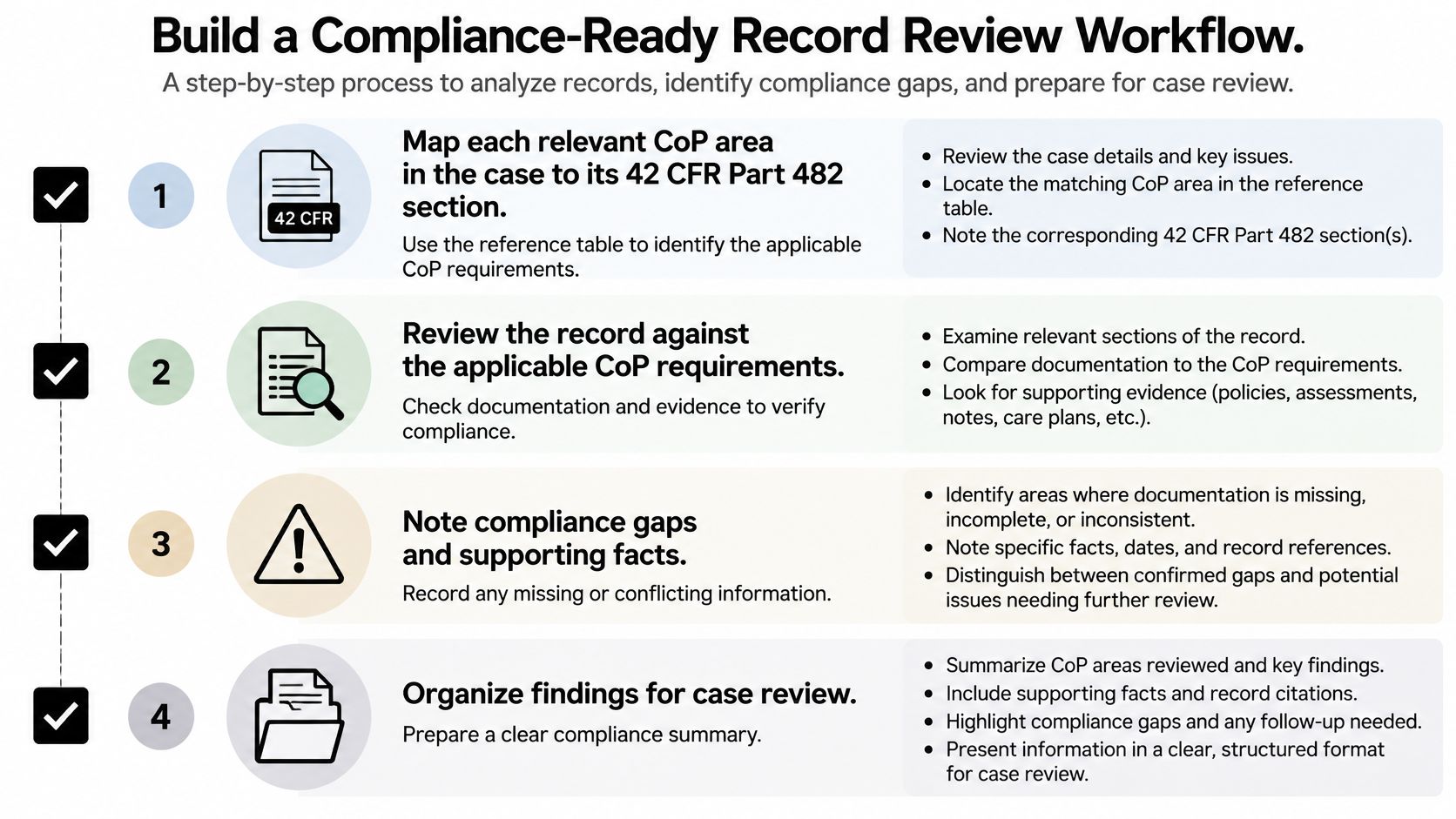
The Seven Step Method
- Map CoP areas to Part 482. Use the reference table to assign each alleged problem to a regulatory function and the record that function should generate.
- Confirm status and rule version. Identify the hospital's survey and accreditation route and the rules in force on the care dates at issue.
- Build a cited chronology. Link every event to a source page and apply the five medical record checks: provenance, contemporaneity, conflicts, response, and auditability.
- Resolve conflicts at the source. Flag inconsistent dates, diagnoses, laterality, provider names, and functional descriptions. Document how each conflict was resolved or why it remains disputed.
- Run discharge checkpoints. Test screening, evaluation, participation, implementation before discharge, and reevaluation stage by stage.
- Test ADT applicability. Confirm whether the system qualifies, then collect event timestamps and acknowledgments. Treat a missing event as a question, not as proof.
- Convert gaps into questions. Record each unresolved gap as a deposition or expert question. Do not put the conclusion in the chronology itself.
Quality Control Before Anyone Relies on It
Check each output against the source chart before use in a proceeding, client communication, demand, or expert referral. Sample high-risk details carefully: medication names and doses, procedure laterality, discharge times, therapy assistance levels, and follow-up intervals. A small error in one of those fields can alter causation analysis more than a long narrative error.
Compare nearby survey findings with your chronology without merging them. Keep the survey report, plan of correction, and follow-up result in a separate regulatory timeline. Draw a line to the encounter timeline only where dates, units, personnel, or processes overlap. That separation prevents a reviewer from treating institutional history as encounter evidence.
For method discipline across providers, follow a structured approach to medical record review for attorneys that keeps chronology, billing, and source verification separate. Hospital records are one segment of an injury case, but they often carry the densest timestamps and the most conflicting authors.
For medical malpractice matters, Ares processes hospital records, operative reports, nursing notes, and discharge summaries into structured, cited timelines. Those chronologies and narratives are formatted for expert review, with every clinical event cited to its source, and Ares is HIPAA compliant. That structure supports the workflow described here, but it does not replace the reviewer's verification duty. The reviewer who signs off must still confirm that each material event matches the chart.
End the workflow with an unresolved issues log. List the missing artifact, the custodian likely to hold it, the exact request or deposition question, and the expert issue affected if it stays missing. That log becomes a discovery checklist and gives the next reviewer a clean audit trail showing what was proved, what was inferred provisionally, and what was deliberately left open.
If you're reviewing hospital records against these CoPs, Ares can turn hospital records, operative reports, nursing notes, and discharge summaries into structured chronologies with every clinical event cited to its source for expert review. Visit Ares to see how cited chronologies can support your medical record review.