
You can settle liability in the first phone call and still spend the next two years fighting over one question, whether the crash, fall, or exposure caused the injury claimed. That's the part that turns a seemingly clean file into a hard case, because defense counsel knows jurors don't award damages for negligence alone. They want proof that the defendant's conduct and the claimed harm are connected by evidence, not just timing.
A rear-end collision is a good example. The driver at fault admits the impact, the property damage photos are ugly, and everyone agrees the plaintiff had pain afterward. Then the defense expert opens an old MRI, points to degenerative disc disease, and the whole case shifts from fault to causation in personal injury cases.
That's where good litigators win or lose. The job is to build a record that shows what changed after the event, what was already there, and why the injury story still holds up under cross-examination. That means knowing the but-for test, choosing the right medical expert, sequencing records in a way a jury can follow, and using tools that expose the gaps defense counsel hopes nobody notices. If you're also tracking vehicles, scene data, or collision timing, the Fleetalyse dashcam GPS guide is a useful companion resource because it shows how location and time-stamped data can support the timeline around an incident.
Why Causation Is the Battleground in Injury Cases
A liability admission is not the finish line. In practice, it's often just the point where the fight gets more expensive, more technical, and more personal for the injured client.
What the defense is really disputing
In many files, the defense never seriously contests the impact, the fall, or the exposure. They attack the bridge between the event and the condition, especially when there's a prior scan, a chronic diagnosis, or a lag in treatment. The Supreme Court of Canada reaffirmed the familiar “but for” approach in Athey v. Leonati (1996), and the broader principle is the same across common-law injury litigation, the plaintiff must connect the conduct to the harm with case-specific evidence, not speculation or general likelihoods. That long-standing default approach is described in NIH-hosted analysis of personal injury causation, which also emphasizes that once causation is proven to the civil standard, it's established as a matter of legal certainty for compensation purposes. Athey v. Leonati and the civil causation standard
That's why a file with admitted liability can still settle for nuisance value if the causation record is thin. The defense doesn't need to prove an alternative universe, just enough doubt to make a jury wonder whether the crash mattered or whether the symptoms would have happened anyway.
Practical rule: If the medical story is loose, the defense will make the case about degeneration, delay, or coincidence, not the collision itself.
What good causation work changes
Strong causation proof does three things at once. It ties symptoms to the event, addresses preexisting conditions directly, and shows why alternative explanations don't fit the timeline or the anatomy. In a serious file, that can be the difference between a meaningful verdict and a settlement that never reflects the actual harm.
It also changes how you value risk. A defense team that sees a clean chronology, a coherent treating physician narrative, and an expert who can explain mechanism without overclaiming is negotiating a very different case than one built on scattered notes and a hopeful demand letter.
The But-For Test and Proximate Cause Explained
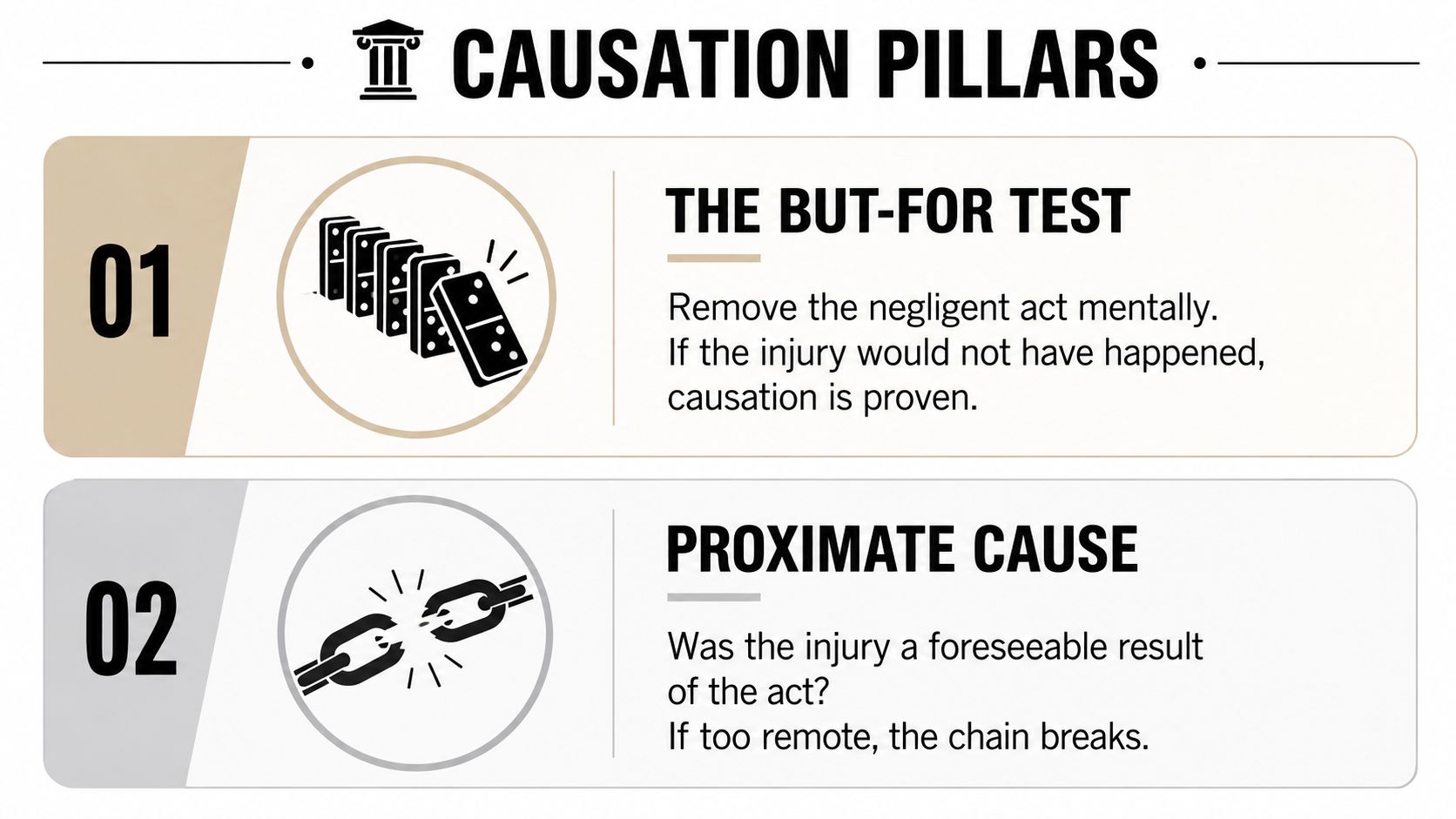
A claim for causation usually turns on two separate questions. Did the defendant's conduct cause the injury in fact. If it did, is the resulting harm close enough to count as a legal consequence rather than a remote one.
The but-for test in plain English
The but-for test asks whether the injury would still have happened if the negligent act had been removed from the story. If the answer is no, the conduct is an actual cause of the harm. Ninth Circuit civil jury instructions describe this as injury that would not have occurred absent the defendant's conduct, and they pair it with proximate cause, which limits liability to harm that is a natural, direct, and foreseeable consequence of the act. Ninth Circuit causation instructions
The work starts once the timeline stops being tidy. A client may report pain immediately after a fall, yet the file still has to answer whether that event changed the medical picture or overlapped with an existing problem. Prior symptoms, prior treatment, and incomplete records are where defense experts usually press hardest.
Proximate cause and the chain of events
Proximate cause is the legal filter that keeps liability from reaching every later consequence. Foreseeability matters, and intervening acts matter too. An independent later event can break the chain, while the eggshell plaintiff rule still requires the defendant to take the injured person as found when a hidden vulnerability makes the damage worse. Smith v Leech Brain & Co remains the classic eggshell skull case, and Scott v Shepherd is still used to show indirect chains and intervening acts in causation analysis. Modern summaries continue to rely on those cases to distinguish factual causation, legal causation, and remoteness.
A case can satisfy factual causation and still fail on remoteness. It can also go the other way, where the mechanism is clear enough but the defense argues the harm is too attenuated from the event. In practice, that means causation has to be built as a record, not assumed from the accident itself.
| Causation Concept | What It Asks | Why It Matters |
|---|---|---|
| But-for cause | Would the injury have happened without the negligent act? | Establishes actual causation |
| Proximate cause | Was the harm a foreseeable, non-remote result? | Limits legal responsibility |
| Eggshell plaintiff | Did a preexisting vulnerability make the injury worse? | Expands damages once causation is shown |
| Intervening act | Did something else break the chain? | Can defeat liability or reduce scope |
Concurrent causes need careful handling
When two causes both matter, the record has to show what each one did. Courts sometimes address that through substantial factor concepts or narrow substitution rules, but the practical point stays the same. You need evidence that explains why the event in suit still belongs in the causal chain, and why a defense expert's alternate explanation does not fit the chronology, the anatomy, or the treating notes.
Jurisdictional Variations in Causation Standards
A case can be strong on the facts and still fail on the governing rule. The forum controls the causation test, and that choice shapes pleading, expert selection, and how hard a defense can press an alternative explanation.
The three frameworks that matter most
Most U.S. states still rely on but-for and proximate cause. In theory the test is simple. In practice, it gets difficult fast when the injury is layered, the medical history is uneven, or the defense has a clean alternate narrative.
The UK and some other common-law settings leave more room for material contribution or related doctrines in narrow multi-cause settings. Those rules matter most when one cause cannot be separated cleanly from another, especially in indivisible injury claims.
Canada remains anchored to but-for causation as the default. The point from Athey v. Leonati is practical, not academic. Negligence alone does not carry the claim, and once the plaintiff meets the civil standard, causation is established for compensation purposes.
| Jurisdiction | Primary Test | Key Trigger | Practical Burden |
|---|---|---|---|
| Most U.S. states | But-for plus proximate cause | Straightforward accident-to-injury disputes | Prove actual cause and foreseeable scope |
| UK | But-for, with material contribution in limited cases | Indivisible or multi-factor injury settings | Show the defendant's conduct materially contributed |
| Canada | But-for as the default | Civil causation disputes in personal injury | Connect event to harm with case-specific proof |
Why forum selection and pleading language matter
Cumulative, progressive, or scientifically hard-to-isolate injuries make forum selection matter just as much as the underlying facts. That choice affects how you plead, what you ask your expert to say, and whether you frame the case as aggravation, acceleration, or material contribution.
Courts do not reward a loose causation story. They reward a theory that fits the medical record and the governing doctrine.
A practical rule helps. In a single-event trauma with clear onset, but-for and proximate cause usually do the work. In a multi-factor, latent, or indivisible injury, counsel has to check whether the jurisdiction allows a narrower causation route and how hard that doctrine is to trigger. The record has to be built around the chronology, not around a hopeful assumption that the defense will leave the gap alone.
Medical and Forensic Expert Evidence on Causation
Causation rarely survives on patient testimony alone when the mechanism is disputed. The record has to carry a qualified expert who can explain why the event probably caused the injury and why the cleaner alternative explanations do not fit the medical facts.
What the court wants from the expert
Courts focus on whether the opinion rests on reliable reasoning, not confidence alone. In Martin v. Ramos, the benchmark is framed in probabilistic terms, and that matters in the courtroom because an expert who says only “it could have happened this way” usually leaves the defense room to argue speculation. The opinion has to reach the “probably did” level, often described as a reasonable degree of medical certainty or a similar civil standard. Expert causation and reasonable medical certainty
The Daubert screen in practice
Under Daubert, the court looks at methodology, not just credentials. The usual prongs ask whether the theory can be tested, whether it has been peer reviewed, what the error rate looks like, and whether the reasoning is generally accepted. That does not mean the judge decides causation for the jury. It does mean a weak foundation can keep an opinion out, or at least strip it of force.
| Daubert Prong | What Court Evaluates | Evidence to Assemble |
|---|---|---|
| Testability | Can the method be checked or challenged? | Differential diagnosis, imaging, clinical exams |
| Peer review | Has the approach been discussed in medical literature? | Articles, guidelines, specialty materials |
| Error rate | Is the method controlled and repeatable? | Protocols, validated testing, clear records |
| General acceptance | Do professionals in the field use it? | Treating notes, standard clinical practice |
Who helps most
Treating physicians often carry more weight than retained experts because they saw the patient in real time. Retained experts matter when the mechanism is technical, such as biomechanics or accident reconstruction, but their opinions need to match the clinical file or they will look hired rather than earned.
If you need to source and organize experts efficiently, a practical starting point is the expert witness resource, especially when a file needs both medical and forensic support. The goal is not to collect more titles. It is to match the expert's lane to the causation problem.
A strong expert does not just say the injury was caused by the event. The expert explains why the record excludes better explanations.
Before deposition, make the expert walk through alternative causes, preexisting conditions, and the specific facts that support the opinion. If the opinion cannot survive differential etiology or basic cross-examination on the records, it probably will not help at trial.
Building a Causation Record From the Medical File
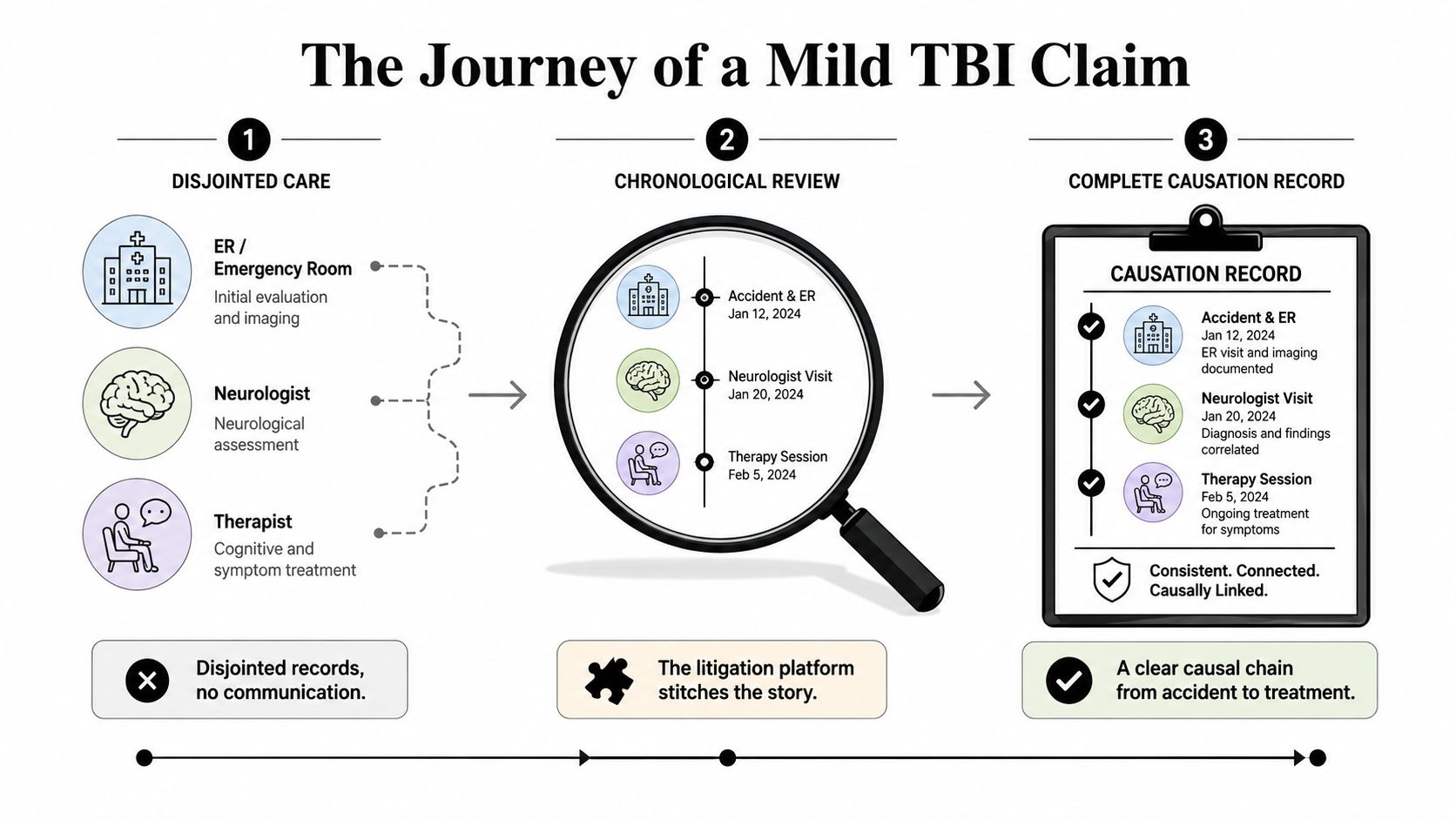
A mild TBI file can go sideways fast when the client waits to treat and visits multiple providers who never build a shared narrative. Defense counsel loves that setup because each disconnected note gives them room to argue that the symptoms came from somewhere else, or that the timeline is too thin to support the claimed mechanism.
What the chronology has to show
The cleanest causation records start with the earliest materials and move forward in order. EMS run sheets, ER records, primary care notes, imaging reports, specialist consults, and neuropsychological testing all matter, but only if they're placed in sequence and tied to the reported symptom progression. That process turns raw documents into a causal chain instead of a pile of PDFs.
If you want a practical model for what organized provider documentation can look like, the patient care report examples are helpful because they show how structured reporting makes later review easier. That same logic applies in litigation, consistent entries make inconsistency obvious.
How the file gets built
First, pull the complete chart, not just the face sheet and discharge summary. Then request imaging discs, provider narratives, billing records, therapy notes, and any follow-up studies that show whether symptoms persisted or changed. The first complaint of pain or cognitive change matters because it anchors the timeline, and gaps become easier to explain when the chronology is complete.
A simple internal workflow keeps the case from drifting:
- Sort every record by date: Put EMS, ER, specialist, and therapy notes into one timeline.
- Flag first symptom reports: Identify the first pain complaint, dizziness note, or cognitive concern.
- Check for treatment gaps: Mark every unexplained gap the defense could exploit.
- Compare imaging to symptoms: Match scan findings to the reported body part and onset.
- Build demonstratives early: Use an annotated timeline, side-by-side imaging, and pain diagrams.
The medical records organization guide is worth a look if the file is still in the sorting stage, because the first pass through records often determines whether the chronology will hold up later.
The best visual exhibit is usually the simplest one. A jury can understand a one-page timeline in under a minute if each entry shows the date, provider, complaint, and relevant test result. Anything more complicated than that tends to look like effort without clarity.
Common Defense Tactics That Attack Causation
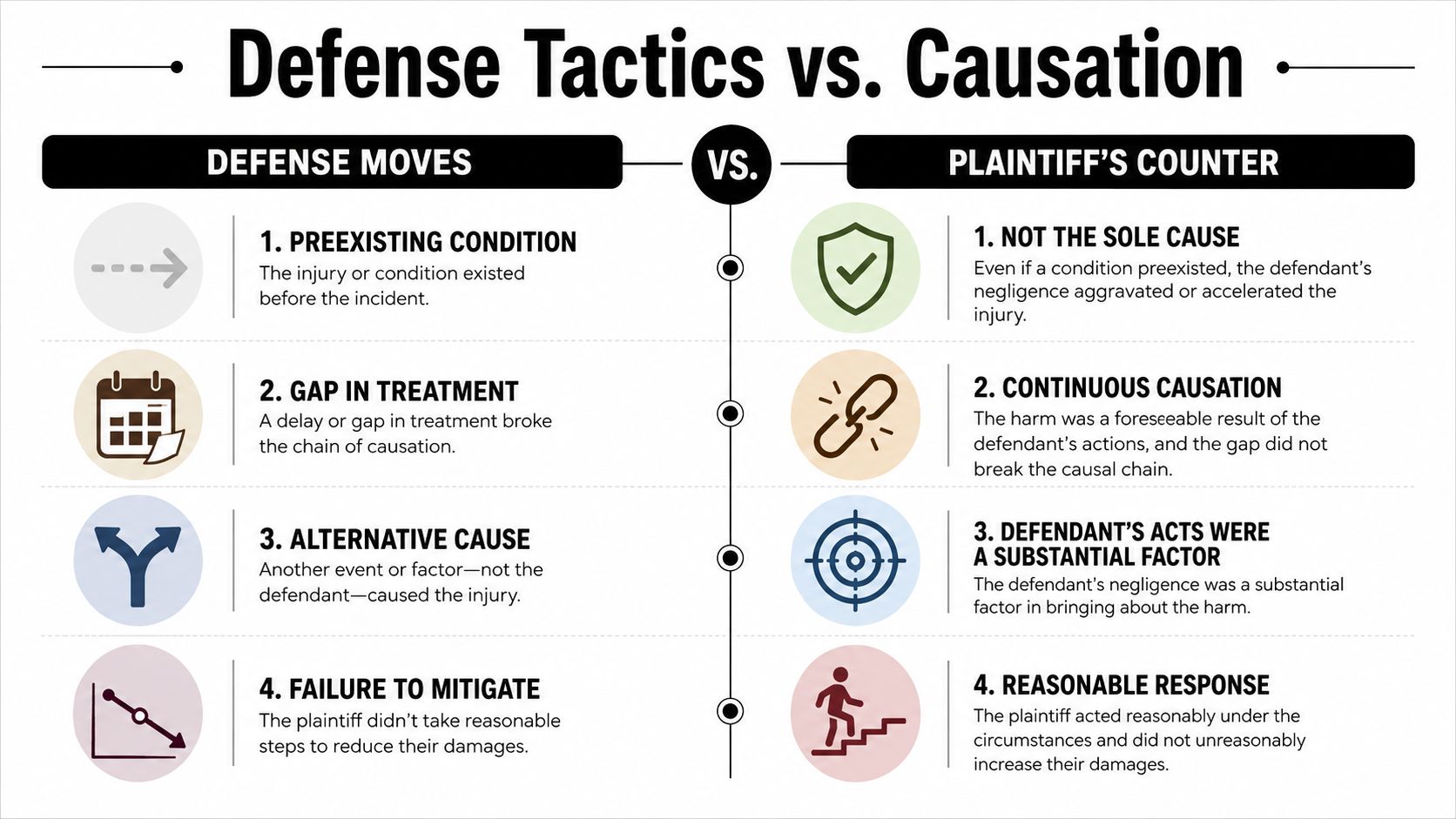
Defense lawyers rarely need to defeat liability outright if they can weaken the causal chain. They attack the record in familiar ways, and each move has a direct answer if the file is built with discipline.
The four attacks you'll see most
Preexisting condition is the classic move. The defense argues the plaintiff brought the condition into the case and the event only exposed it. The response is to separate baseline degeneration from aggravation, then use treating records to show the post-event shift in symptoms, function, or need for treatment.
Gap in treatment comes next. If the plaintiff waits too long, the defense says the later symptoms must have another source. Contemporaneous notes matter because a clear chronology can explain delayed care, missed appointments, or symptoms that developed over time. Recent practice-oriented coverage flags treatment gaps as a frequent causation issue in personal injury disputes. Causation disputes in personal injury cases
Alternative cause is where the defense points to another accident, aging, genetics, or a later event. The answer is usually documentary, not rhetorical. Keep the timeline tight, tie provider notes to the injury mechanism, and use a treating-doctor narrative when the record supports one explanation better than the defense theory.
IME cherry-picking rounds out the playbook. The defense examiner lifts one line from a long chart and ignores the rest. The clean response is to confront the selective reading with the full record, context, and, when useful, evidence of prior function or surveillance that shows what changed after the injury.
Rebuttal strategy
The defense attack usually falls apart when the proof is built from both medical and factual sources. Treating-provider letters carry weight because they come from firsthand care, not litigation hindsight. Differential diagnosis helps when it is applied carefully. In files involving a condition with a known natural history, specialty or epidemiological literature can also show that the plaintiff's presentation does not fit the defense story as neatly as claimed.
The mistake is arguing with the defense instead of rebuilding the chain. If the chart is messy, clean it up. If the chronology is weak, make it readable. If the alternative-cause theory looks stronger on paper, address it before a jury ever sees it.
Using AI and Case Management Tools to Prove Causation
A causation file lives or dies on the record. AI tools earn their place by clearing the clerical work that obscures the legal judgment, not by making the judgment for you.
What the software should do
The useful output is concrete. A platform should turn a stack of notes into a chronology that reads like this: “3/4, ER visit after rear-end collision, neck pain noted; 3/10, primary care follow-up, radiating arm symptoms; 3/18, MRI ordered; 4/2, ortho consult, suspected cervical disc injury.” That kind of timeline lets you see the sequence, the gaps, and the points the defense will try to exploit.
It should also pull out the details that matter to causation, dates, providers, symptoms, diagnoses, treatment, and missed testing, then show where the chart supports the injury theory and where it does not. Ares is one platform built for that workflow, with AI-driven medical record review and demand-letter drafting for personal injury matters. Used well, it organizes source documents into a case-ready chronology, and the AI case management guide explains the broader process if your team is standardizing that work.
What still needs a lawyer
AI can flag a gap, but it cannot tell you whether the gap matters legally. It can line up dates, but it cannot decide whether the proximate cause theory will persuade a judge, whether an expert will hold up under cross, or whether the jury will understand a complex injury mechanism. That part stays with counsel.
A practical workflow looks like this:
- Run OCR on the full chart: Get every note into searchable form before you start.
- Generate a chronology: Let the platform map symptoms, visits, and test results by date.
- Check for missing studies: Look for imaging, referrals, or diagnostics the defense will ask about.
- Verify every citation: Match AI output against the source page before it goes into a demand.
- Draft from the records: Anchor each injury allegation to a specific note or report.
If disputed activity or outside context matters, a private investigator can document follow-up events, surveillance issues, or other facts the medical chart will never capture. That becomes useful fast when the defense is building an alternative-cause story around what the plaintiff did after the injury.
Where AI helps the most
The biggest gain is consistency. When everyone on the file sees the same chronology, it is harder for a weak defense theory to hide inside a missing page or a mislabeled scan. The lawyer still owns causation, but the record is cleaner, faster to audit, and harder to pick apart in deposition or mediation.
Causation Checklist Before You File or Negotiate
A causation file is ready when the law, the medicine, and the chronology all point in the same direction. If even one of those pieces is loose, the defense will usually find it.
Use this as a final prefiling and premediation check:
- Confirm the governing test: Make sure the controlling jurisdiction uses but-for, proximate cause, or a recognized narrow alternative like material contribution.
- State the theory clearly: Put the causation theory into the complaint, demand, or mediation brief in plain language that matches the records.
- Lock in expert support: Retain qualified experts whose opinions are expressed in probabilistic terms and survive reliability review.
- Audit the medical timeline: Make sure there are no unexplained gaps, missing reports, or unaddressed prior complaints.
- Deal with preexisting conditions head-on: Separate baseline findings from aggravation or acceleration, and say so explicitly.
- Organize demonstratives by injury: Keep timelines, imaging comparisons, pain diagrams, and provider summaries tied to each claimed injury.
- Verify every AI-generated chronology: Cross-check each entry against the source page before using it in correspondence or filing.
- Prepare a short causation summary: Opposing counsel should be able to read it in ten minutes and understand why the defense theory fails.
- Decide your concessions early: Know what the client will not accept on diagnosis, permanency, or apportionment before mediation starts.
If you want a cleaner way to build causation records, Ares turns medical files into organized chronologies and demand drafts tied to source citations. Visit Ares to see how that workflow can help your team move from scattered records to a defensible causation story faster.