

The most important fact in many cases of malpractice is established before anyone discusses a verdict. A serious injury can attract attention, but the claim usually turns on whether counsel can prove when the provider knew or should have known something, what the provider did next, and how that decision changed the outcome. Historical records show why this discipline matters: U.S. appellate medical malpractice cases rose 950% between 1840 and 1860, and by 1850 medical liability litigation had taken on a recognizable modern form (historical review of medical malpractice litigation).
The eight patterns below are practical case-building and prevention playbooks. Each requires the same questions: what was the alleged breach, which records prove it, how does the breach connect to damages, what defense will likely lead, and what should a PI firm change in intake or review? The examples include delayed cancer diagnosis, wrong-site surgery, medication error, birth injury, anesthesia awareness, cardiac misdiagnosis, hospital-acquired infection, and informed-consent disputes.
Malpractice standards, consent rules, limitation periods, recoverable damages, and expert requirements vary by jurisdiction. A qualified attorney and the appropriate medical experts must evaluate the claim under the governing law.
1. Failure to Diagnose Cancer in Delayed Treatment Cases
A missed cancer diagnosis rarely presents as one dramatic error. More often, the decisive proof sits across a chain of symptoms, test results, referrals, pathology, and communications. A mammogram may require additional imaging, an abnormal colorectal screening result may require follow-up, or a suspicious skin lesion may be recorded without a biopsy. The claim becomes viable when the records show that a reasonable provider should have acted at a particular point, but the diagnostic process stalled.
The most useful chronology starts before the diagnosis. Record the first symptom, every presentation to a provider, each test ordered, the date a result became available, who reviewed it, and whether anyone communicated the next step to the patient. Then compare the plaintiff's condition at the missed opportunity with the condition at actual diagnosis. That comparison supports causation, but it must be tied to expert testimony rather than assumption.
A recent historical review illustrates why delayed diagnosis cases carry serious exposure. One reported 2025 verdict involved a recurrent skin cancer that allegedly went untreated after high-risk pathology and a later lesion that was removed without biopsy. The case demonstrates the value of linking pathology, follow-up obligations, recurrence, and the treatment consequences into one coherent sequence, rather than treating each visit as an isolated event (account of high-value medical malpractice verdicts).
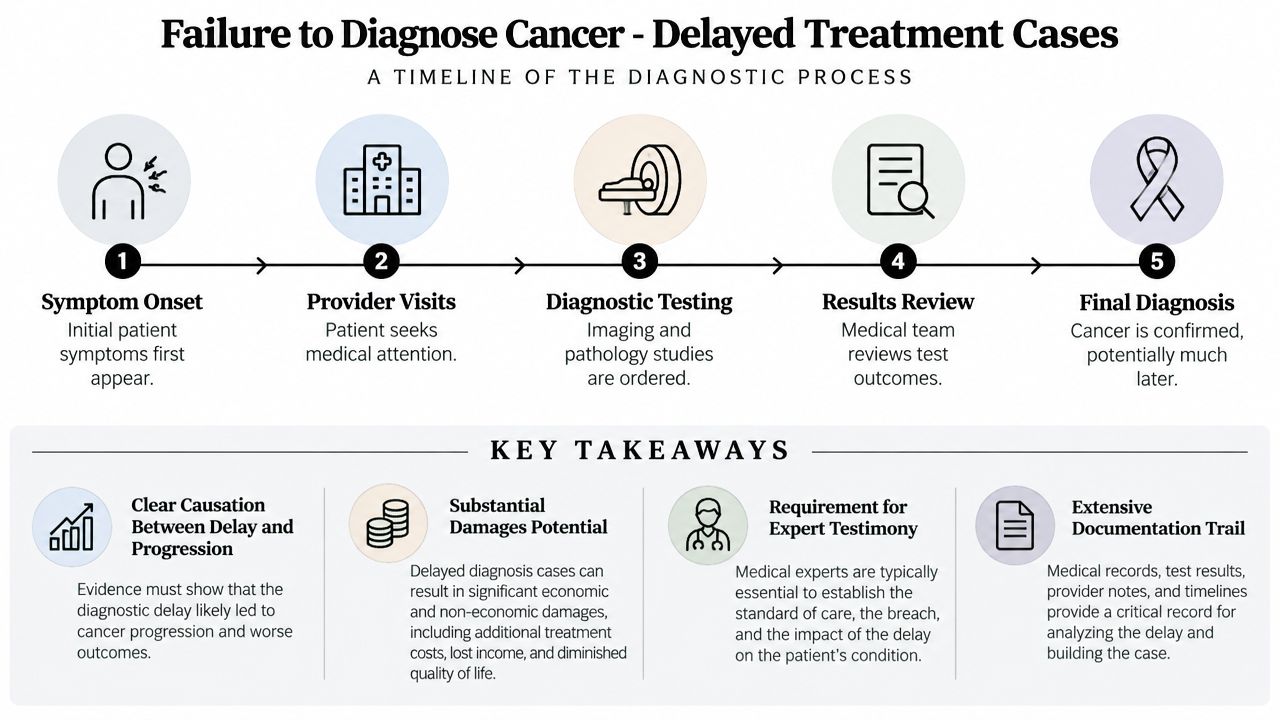
Build the breach-to-damages record
Organize the file around four questions:
- Find the trigger: Identify the symptom, lab, image, or pathology finding that should have prompted further action.
- Verify ownership: Determine which provider received the result and whether the practice had a follow-up system.
- Test causation: Ask an oncology expert what treatment options and prognosis existed at the earlier date.
- Anticipate the defense: Expect arguments about aggressive disease, patient delay, missed appointments, or unavoidable progression.
For a broader reference point on examples of medical malpractice cases, use the same approach. Don't label a case “failure to diagnose” until the record identifies the missed decision and an expert can explain why it mattered.
2. Surgical Error in Wrong-Site or Wrong-Patient Surgery
Wrong-site and wrong-patient surgery cases often begin with unusually clear evidence. The operative report, consent form, identification band, scheduling record, and surgical time-out documentation may all reveal whether the team verified the patient and procedure. The challenge isn't usually finding an injury. It's preserving the institutional record before edits, incident reports, or incomplete chart exports obscure how the error passed through multiple checkpoints.
A wrong-extremity procedure, removal of the wrong organ, or operation on the wrong patient creates a direct breach theory. Still, counsel should collect more than the operative note. Obtain preoperative verification forms, nursing records, anesthesia documentation, instrument and specimen logs, scheduling communications, and the hospital's applicable safety policy. The policy can show that the facility required a verification step the team failed to perform.
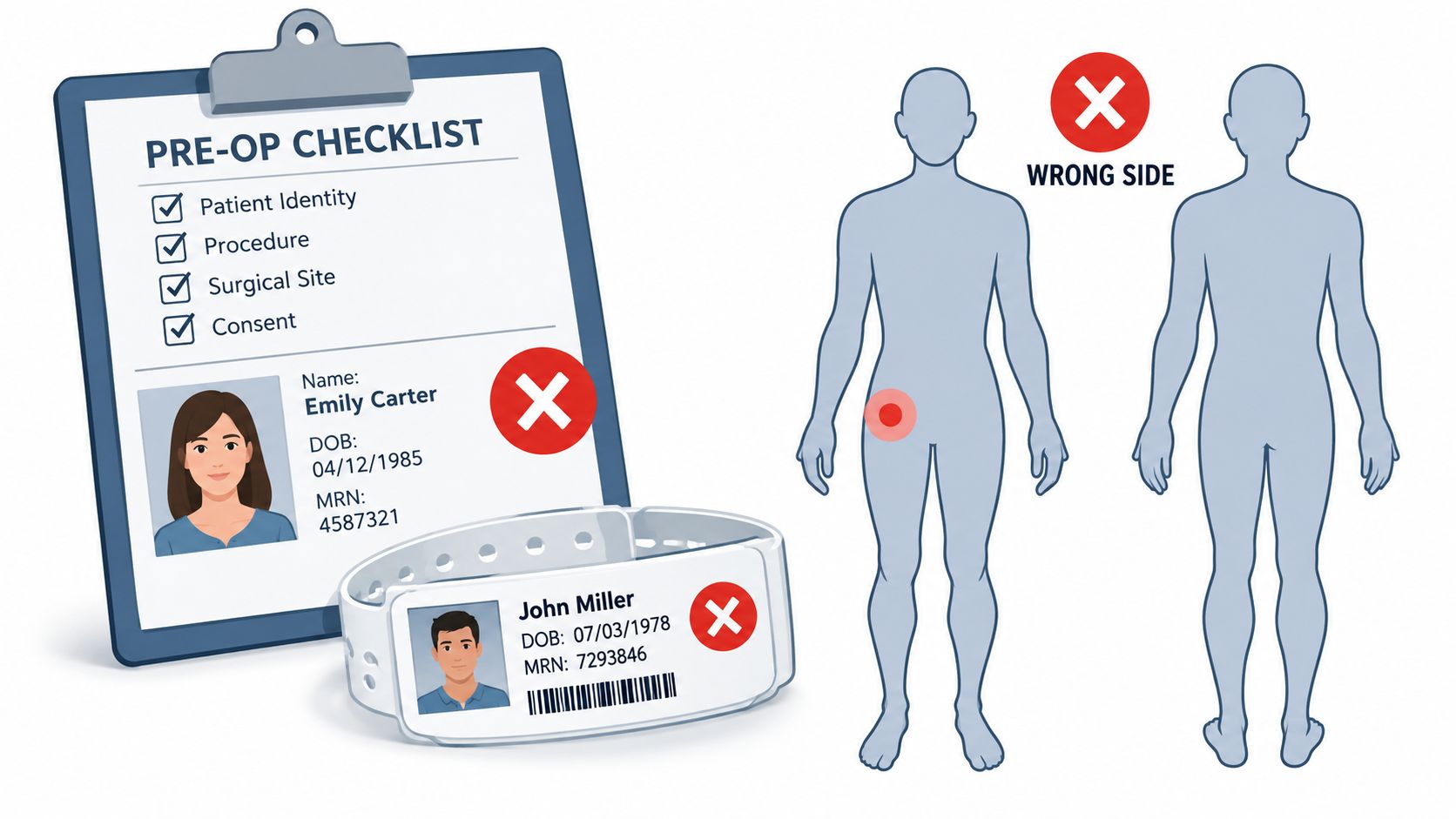
Practical rule: Treat every identity and site-verification document as evidence of the decision process, not merely as administrative paperwork.
The strongest defense may concede that an error occurred while disputing who caused it, whether the hospital is vicariously liable, or the extent of damages. Defense counsel may also challenge the necessity of corrective treatment or argue that the patient's underlying condition caused part of the loss. Those issues make a complete perioperative chain essential.
A short expert review can often confirm whether the documented process departed from accepted surgical safeguards. For firms handling cases of medical malpractice, the intake workflow should immediately flag mismatched consent language, inconsistent laterality, missing time-out records, and unexplained changes between scheduling and operative documents.
This video provides a visual overview of common surgical identification failures:
3. Medication Error in Dosing or Administration
Medication claims demand arithmetic, sequence, and source verification. The prescription may be correct while the pharmacy dispenses the wrong drug. The pharmacy record may be accurate while the medication administration record shows a different dose. Or the provider may select a medication without accounting for an allergy, contraindication, renal impairment, or interaction documented elsewhere in the chart.
Start by creating a medication event grid. Put the prescribed drug, strength, route, frequency, dispensing event, administration time, allergy list, relevant laboratory values, and first symptoms in separate columns. Compare each entry with the order, pharmacy dispensing record, MAR, nursing notes, barcode-verification data, and discharge instructions. A ten-fold chemotherapy overdose, an antibiotic dispensed despite a documented allergy, and an IV medication given by the wrong route each require a different expert analysis.
Causation often presents the central dispute. The plaintiff must show not only that the medication process failed, but that proper prescribing, dispensing, or administration would probably have avoided the injury. The defense may argue that the patient's underlying disease, an unavoidable reaction, or delayed symptom reporting caused the outcome.
Use the records to identify the failure point
A focused review should answer:
- What was ordered: Capture the original order, not only the medication listed in a later summary.
- What was supplied: Compare pharmacy records with the medication container, dispensing data, and reconciliation history.
- What was administered: Check the MAR against nursing notes and infusion documentation.
- What changed afterward: Link symptom onset, laboratory changes, treatment escalation, and monitoring to the administration event.
- Who could intervene: Identify the prescribing clinician, pharmacist, nurse, supervising physician, and relevant verification system.
Experts in pharmacology, nursing, or the relevant specialty should review the same source documents. A clean timeline can reveal whether the case concerns a prescribing judgment, a communication failure, a dispensing error, or an administration mistake. That distinction affects defendants, agency theories, and settlement strategy.
4. Birth Injury in Obstetric Negligence and Erb's Palsy
Birth injury cases are built around a time-sensitive fetal and maternal record. Fetal monitoring strips, labor progression, medication administration, cervical examinations, nursing notes, physician orders, and delivery records must be read together. Erb's palsy and other brachial plexus injuries may involve delivery mechanics, shoulder dystocia, traction, maternal risk factors, or an alternative cause unrelated to the delivery itself.
The intake interview should capture what happened before admission, including prenatal complications and prior warnings about a high-risk pregnancy. Then establish the labor timeline minute by minute. Identify the first abnormal fetal heart-rate pattern, the provider's response, the timing of escalation, the delivery technique, and the newborn's condition immediately afterward.
A strong defense may argue that the injury occurred before the delivery, resulted from unavoidable shoulder dystocia, or reflects maternal or fetal factors rather than excessive traction. In fetal distress cases, the defense may challenge interpretation of the strips or argue that an earlier intervention wouldn't have changed the neurological outcome. An obstetric expert addresses the standard of care, while a pediatric neurologist or neonatologist may be needed for causation.

Separate delivery conduct from lifelong damages
The damages file should extend beyond the initial diagnosis. Gather therapy records, developmental assessments, neurology records, functional limitations, caregiver needs, educational services, and projected future treatment. Don't assume that a brachial plexus injury or cerebral injury has one uniform trajectory. The medical evidence must describe the child's actual impairment and the care required over time.
A useful firm control is a two-review process. First, a clinician reconstructs the delivery and identifies possible deviations. Second, counsel tests whether the expert can explain the counterfactual clearly: what should have happened, when it should have happened, and what injury that intervention would probably have prevented or reduced.
5. Anesthesia Complication and Awareness During Surgery
Anesthesia awareness cases depend heavily on patient memory and contemporaneous anesthesia data. A patient may recall voices, pressure, pain, or an inability to move while surgery continued. That account should be recorded carefully and compared with the anesthesia chart, medication administration times, vital-sign tracing, airway notes, monitoring records, and recovery documentation.
The case theory is not only that the patient remembers the operation. Counsel must establish whether the anesthesia plan, dosing, monitoring, or response to physiological signs departed from the applicable standard. Tachycardia or hypertension may support the timeline, but those signs can have competing explanations. An anesthesia expert must interpret the records in context.
Psychological injury also requires disciplined proof. Obtain psychiatric evaluations, trauma treatment records, medication history, work limitations, and testimony describing changes in sleep, relationships, daily functioning, and willingness to undergo later medical care. A defense may characterize the account as unreliable, attribute symptoms to preexisting mental-health conditions, or argue that the anesthetic course was reasonable given the operation and patient risk factors.
The patient's narrative can identify the event, but the anesthesia record and expert analysis must explain how the event occurred.
For intake, ask focused questions rather than relying on a general statement that the patient “woke up.” When did awareness begin? What could the patient hear or feel? Could the patient communicate? Did anyone acknowledge the experience during recovery? Were postoperative symptoms documented immediately? Those answers help distinguish awareness from ordinary postoperative confusion or recall during emergence.
Review the minute-by-minute record for unexplained gaps, changes in drug administration, monitoring omissions, and discrepancies between the anesthetic plan and what was delivered. The damages assessment should address both the immediate experience and the documented psychological sequelae, without overstating either.

6. Misdiagnosis of Heart Attack in Acute Coronary Syndrome
Emergency cardiac claims often turn on disposition. A patient arrives with chest pain, arm symptoms, shortness of breath, nausea, or other concerning signs. The emergency department labels the complaint anxiety, indigestion, or a musculoskeletal problem and discharges the patient. The later infarction may be obvious, but the litigation question is whether the available information required more evaluation and whether timely treatment would have changed the damage.
Build the record from arrival to discharge. Include triage notes, vital signs, physician assessments, EKGs, serial troponin results, laboratory timestamps, medication orders, nursing observations, discharge instructions, and return precautions. Pay particular attention to whether a result became available after the physician's note, whether someone communicated it, and whether a later review changed the interpretation.
A useful patient interview should distinguish the presenting symptoms from symptoms that emerged after discharge. Counsel can also provide patients with neutral educational context, such as the distinction discussed in this resource on cardiac arm pain versus a muscle pull, without treating general information as proof of negligence.
Test the emergency-department defense
The defense may argue that the symptoms were atypical, the initial tests were reassuring, the patient had a low apparent risk profile, or the later event wasn't preventable. It may also contend that the patient declined observation or failed to follow discharge instructions. Each position must be tested against the actual chart, not a generalized description of chest-pain protocols.
An emergency-medicine expert should identify the precise decision that fell below the standard. Was the EKG misread? Was an abnormal troponin ignored? Were serial tests omitted? Was consultation or admission indicated? Then a cardiology expert can address the counterfactual treatment and the relationship between delay, infarct severity, disability, and future care.
The firm's screening rule should be simple: don't accept the case based on the later heart attack alone. Accept it when the records identify a missed signal, a defensible alternative response, and a medically supportable path from delay to injury.
7. Hospital-Acquired Infection and Sepsis After Surgery
A postoperative infection claim turns on the first preventable decision, not the fact that infection occurred. The record trail should cover prophylactic antibiotics, MRSA screening, sterile technique, wound checks, vital signs, laboratory results, cultures, escalation, and any transfer to intensive care.
Start with the perioperative timeline. Record the antibiotic, dose, route, administration time, incision time, redosing, allergies, and applicable protocol. Check whether the patient received documented MRSA screening or testing when the clinical setting called for it. Where rapid screening would have informed precautions or antibiotic selection, counsel may order MRSA PCR kit online as part of the facility's testing workflow, subject to its clinical policies.
Then map symptoms after surgery. Fever alone does not prove a breach. Fever with worsening pain, abnormal vital signs, wound changes, delayed cultures, or delayed antibiotics may support a failure-to-recognize theory. The decisive question is when the clinical picture required investigation or escalation.
Reconstruct the escalation pathway
- Prevention: Compare prophylaxis, MRSA screening, hand hygiene, sterile-field practice, and environmental controls with written policy.
- Recognition: Place every fever, wound complaint, vital-sign change, and nursing escalation on one timeline.
- Diagnosis: Compare cultures, imaging, laboratory testing, and specialist consultation with the patient's progression.
- Treatment: Track antibiotic choice and timing, source control, fluids, monitoring, and transfer decisions.
- Outcome: Separate direct infection injuries from organ failure or disability allegedly caused by delayed treatment.
Infection-control experts can assess prevention and facility practices. Infectious-disease physicians can address the organism, likely source, treatment timing, antibiotic selection, progression to sepsis, and the counterfactual course.
The strongest defense may be that the organism entered through an unavoidable route, the patient carried material risk factors, or sepsis was advanced before symptoms became actionable. Preserve original records, culture materials, medication-administration data, and staffing documentation early. The intake rule is practical: accept the case only when an expert can identify a specific missed intervention and a medically supportable path from that delay to the claimed injury.
8. Failure to Obtain Informed Consent and Undisclosed Risks
Informed-consent cases ask a different question from ordinary treatment-negligence claims. The procedure may have been performed competently, yet the patient may contend that the provider failed to disclose a material risk, reasonable alternative, or consequence of declining treatment. The central issue is often whether adequate information would have changed the patient's decision.
Begin with the patient's own account. What did the provider say? What questions did the patient ask? Was the procedure elective or urgent? Were alternatives discussed? Did anyone explain the possibility of repeat treatment, permanent impairment, infertility, cardiac toxicity, anesthesia complications, or other material consequences? Then compare that account with the actual consent form, office notes, patient education materials, portal messages, and witness testimony.
A signed form is important, but it isn't automatically conclusive. A form may list broad risks without showing that the provider discussed the risk relevant to the patient's decision. The defense may argue that the risk was known, disclosed elsewhere, medically immaterial, or that the patient would have proceeded regardless. The plaintiff still needs evidence supporting the decision-making counterfactual, often through the patient's testimony and the circumstances surrounding the recommendation.
Consent documentation should show a decision conversation, not just a signature.
Medical literature can help establish whether the risk was significant and whether alternatives were reasonably available. It doesn't by itself prove what this provider said or what this patient would have chosen. Counsel must keep those questions separate.
The timing of the claim also requires immediate jurisdiction-specific review. Limitation rules and special doctrines can materially affect viability, so firms should evaluate the malpractice statute of limitations at intake rather than waiting until expert review is complete.
Comparison of 8 Medical Malpractice Cases
| Case Type | Implementation Complexity | Resource Requirements | Expected Outcomes | Ideal Use Cases | Key Advantages |
|---|---|---|---|---|---|
| Failure to Diagnose Cancer, Delayed Treatment Cases | High, complex timeline and multi-provider reconstruction | High, oncology/pathology experts, imaging, long record review | Potentially very large damages; protracted litigation if causation proven | Missed tests or follow‑ups with worsened prognosis | Strong documentation trail; high damages; sympathetic narrative |
| Surgical Error, Wrong Site/Wrong Patient Surgery | Low–Medium, facts often clear and protocol‑based | Moderate, OR logs, consent forms, limited expert need | Rapid settlement likely; clear liability; variable damage scope | Sentinel events with broken time‑out or ID procedures | Indisputable breach; strong negotiating position; minimal complex experts |
| Medication Error, Incorrect Dosing or Administration | Medium, multiple failure points across prescribing/dispensing | High, pharmacy/MARs, pharmacology/toxicology experts | Outcomes range minor to catastrophic; objective records aid causation | Dispensing/admin discrepancies or allergy violations | Detailed medication records; objective standards; multiple liability points |
| Birth Injury, Obstetric Negligence and Erb's Palsy | High, fetal monitoring analysis and long‑term causation review | High, obstetrics, pediatrics/neurology experts, lifelong care estimates | Very high damages; long litigation; strong jury sympathy | Shoulder dystocia, abnormal tracings, delivery technique deviations | Significant lifetime damages; detailed prenatal/delivery records; sympathetic plaintiff |
| Anesthesia Complication, Awareness During Surgery | Medium–High, minute‑by‑minute anesthesia record analysis | Moderate–High, anesthesiology and psychiatric experts, monitoring data | Substantial psychological damages; patient testimony impactful but hard to quantify | Documented anesthesia monitoring gaps with patient memories | Powerful first‑hand testimony; established monitoring standards; objective logs |
| Misdiagnosis of Heart Attack, Acute Coronary Syndrome | Medium, ED protocol and objective test comparison | Moderate, EKGs, troponins, ED notes, cardiology expert | Significant damages if MI worsened; clear protocol deviations possible | Chest pain discharged without appropriate cardiac evaluation | Objective test evidence; established chest pain protocols; strong causation |
| Hospital‑Acquired Infection (HAI), Sepsis from Surgical Site Infection | Medium–High, infection control and multi‑factor causation analysis | High, perioperative records, cultures, ID experts, antibiotic timelines | Substantial damages; causation can be complex with multiple risks | Prophylaxis timing failures or contaminated surgical fields | Comprehensive hospital records; identifiable protocol deviations; high damages |
| Failure to Obtain Informed Consent, Undisclosed Risks | Low–Medium, focuses on communication rather than technical care | Moderate, consent forms, witness interviews, literature on risks | Can succeed without proving negligence; damages for undisclosed complications | Elective procedures where material risks were not disclosed | Legal theory requires disclosure only; strong patient testimony; does not need technical breach |
Turn Case Patterns Into Stronger Claim Controls
Across these eight cases of malpractice, the same proof architecture appears repeatedly. Start with a date-driven medical chronology, preserve original records and communications, identify the alleged breach, separate breach from causation, and then quantify immediate and future damages. The injury may be catastrophic, but severity doesn't replace proof that a specific decision or omission probably changed the outcome.
The record review should also expose uncertainty early. Missing test results, copied-forward notes, late entries, inconsistent timestamps, undocumented calls, and unexplained changes in diagnosis may matter as much as the positive evidence. A polished summary that hides those gaps creates risk. A useful review identifies them and tells counsel what must be subpoenaed, clarified, or addressed by an expert.
A practical PI workflow can follow this sequence:
- Define the alleged event: State the suspected failure in one sentence, such as delayed imaging, wrong-site verification, medication administration, fetal-monitor response, or risk disclosure.
- Locate the decisive records: Identify the specific EKG, pathology report, MAR entry, fetal strip, anesthesia interval, culture, consent note, or communication that can confirm or defeat the theory.
- Flag missing documentation: Record absent pages, inconsistent dates, unsigned notes, missing audit trails, and references to attachments that weren't produced.
- Choose the expert perspective: Match the issue to the specialty. Oncology, surgery, pharmacology, obstetrics, anesthesia, emergency medicine, infectious disease, neurology, and life-care experts answer different questions.
- Test the strongest defense: Ask what the defense will say about preexisting disease, unavoidable complications, patient conduct, timing, alternative causation, or the limits of the intervention.
- Model the damages: Separate past treatment from future care, lost income, functional limitations, household services, psychological injury, and life-care needs.
The economics of screening deserve equal attention. A national benchmarking report based on claims and suits filed or closed between 2007 and 2016 found that overall claim frequency fell 27%, while case-management expenses rose an average of 3.5% annually, including 4.7% annually for zero-indemnity cases (medical malpractice benchmarking report). Fewer viable filings don't make inefficient review harmless. A case that produces no indemnity payment can still consume attorney time, expert fees, staff capacity, and settlement negotiations.
Current data also point to a harder screening environment. A recent report states that claim frequency fell to about 4.6% in 2025 from 7.5% in 2016, while the average of the top 50 verdicts reached about $50 million in 2025 and 60 verdicts exceeded $10 million that year (severity and medical malpractice claim trends). The practical lesson isn't to chase dramatic injuries. It's to recognize that the strongest remaining cases may require deeper chronology work, more specialized experts, and sharper venue and narrative analysis.
Large verdicts also shouldn't distort every valuation. A Harvard-linked analysis found that physicians won about 80% to 90% of jury trials when negligence evidence was weak, about 70% in borderline cases, and about 50% even when evidence of strong negligence existed. The same evidence base reported physician reviewers finding favorable verdicts in 91% of cases where care was proper and 57% where an error occurred, while average damages were $326,009 in no-error cases won by plaintiffs and $765,486 in cases involving error (analysis of malpractice claims and trial outcomes). Liability strength matters, but presentation, severity, causation, and jury dynamics shape results.
Ares can support this workflow by organizing hospital records, operative reports, nursing notes, and discharge summaries into structured, cited timelines. It can help surface treatment decisions, chronology gaps, and source-linked clinical events for attorney and expert review. That support doesn't replace legal judgment, medical expertise, HIPAA-aware handling, or jurisdiction-specific analysis. It gives the team a more consistent starting point for deciding whether the records support a claim and what evidence remains missing.
The best prevention control is a repeatable review standard. Every intake should identify the alleged event, the decisive record, the causation theory, the strongest defense, the right expert, and the damages path. If the firm can't answer those questions, it should know exactly why before committing substantial resources.
Ares turns hospital records, operative reports, nursing notes, and discharge summaries into organized, cited timelines for medical malpractice review, helping teams surface gaps and prepare expert-ready summaries. Visit Ares to evaluate a workflow for building clearer malpractice chronologies and case-ready medical insights.