
A new personal injury matter rarely stalls because nobody is working on it. More often, everyone is working on a different piece of it. Intake is complete, but the authorization is sitting in an inbox. Medical records are arriving from several providers, while a paralegal starts a chronology in one spreadsheet and an attorney reviews a separate PDF. The demand letter waits because nobody can confirm whether the treatment timeline is complete.
That's a case management workflow problem, not a productivity problem.
A scalable workflow moves structured facts, documents, decisions, and ownership from intake through settlement readiness without forcing people to rebuild the same information at every handoff. It makes delays visible, separates routine processing from judgment-heavy review, and gives managers a way to distinguish a busy team from a healthy operation.
The most useful way to learn this subject is to follow the work itself. Start with the basic flow, then examine each PI stage, measure the time spent between stages, repair the connections between systems, and introduce automation with clear human controls. The result isn't a longer task list. It's a reliable operating system for moving cases forward.
Why Your PI Cases Stall Before Demand
The familiar stalled matter
A prospective client signs the representation agreement. The intake specialist enters the incident details, identifies the providers, and assigns the matter. The case manager requests records, but one provider requires a portal submission and another responds only by mail. A billing statement arrives without the corresponding treatment note. Meanwhile, the attorney asks whether the client's symptoms were documented before the accident, and the case manager has to search email, a shared drive, and a chronology draft to answer.
Nothing looks completely broken. Tasks are assigned. Messages are being sent. Files are accumulating. Yet the demand remains unfinished because the workflow can't reliably tell the team what is missing, who owns the next action, and whether the case is ready for legal judgment.
That distinction matters. A person can complete many activities while the matter makes little progress. Uploading documents, sending reminders, and editing a chronology create visible motion, but they don't necessarily produce a usable case file. Throughput depends on completed stages and dependable handoffs.
Practical rule: If a case manager must ask three people where the latest version lives, the workflow has already created rework.
A strong workflow gives every stage a defined input, an expected output, an owner, and an exception path. It also records how long the matter remains in each stage. That lets a managing attorney see whether the delay starts during intake, records collection, chronology review, causation analysis, or demand assembly.
This guide focuses on those operational details. You'll learn how to map a PI matter from first contact to resolution, use clearance rate and stage-duration deltas to diagnose capacity, recognize when integration is the problem, and apply AI without surrendering accountability. The central lesson is simple: consistent routing and measurable handoffs determine throughput more reliably than individual effort.
What a Case Management Workflow Really Is
A case management workflow is a connected system that moves work through defined stages, with each handoff producing something the next person can use. In a PI firm, a matter may begin with intake and triage, pass through evidence and medical review, then reach settlement, litigation transfer, or closure. The workflow controls turnaround time, ownership, and the queue of matters waiting for attention.
A small assembly line provides a useful comparison. One station receives the matter, another gathers records, and another organizes evidence and tests the factual story. A later station prepares the demand or litigation package. If one station passes incomplete material forward, the next worker stops to search, request clarification, or send the file backward. Activity continues, yet completed matters fail to keep pace with new demand.
Workflow performance can be measured through clearance rate, which means dispositions divided by filings and expressed as a percentage. The National Association for Court Management caseflow workflow review identifies 100% as a balanced long-term target. A rate below that allows backlog to grow, while short-term variation of about 5% above or below the goal is common. PI firms are not courts, but the operating principle applies: completed matters must keep pace with new matters over time.
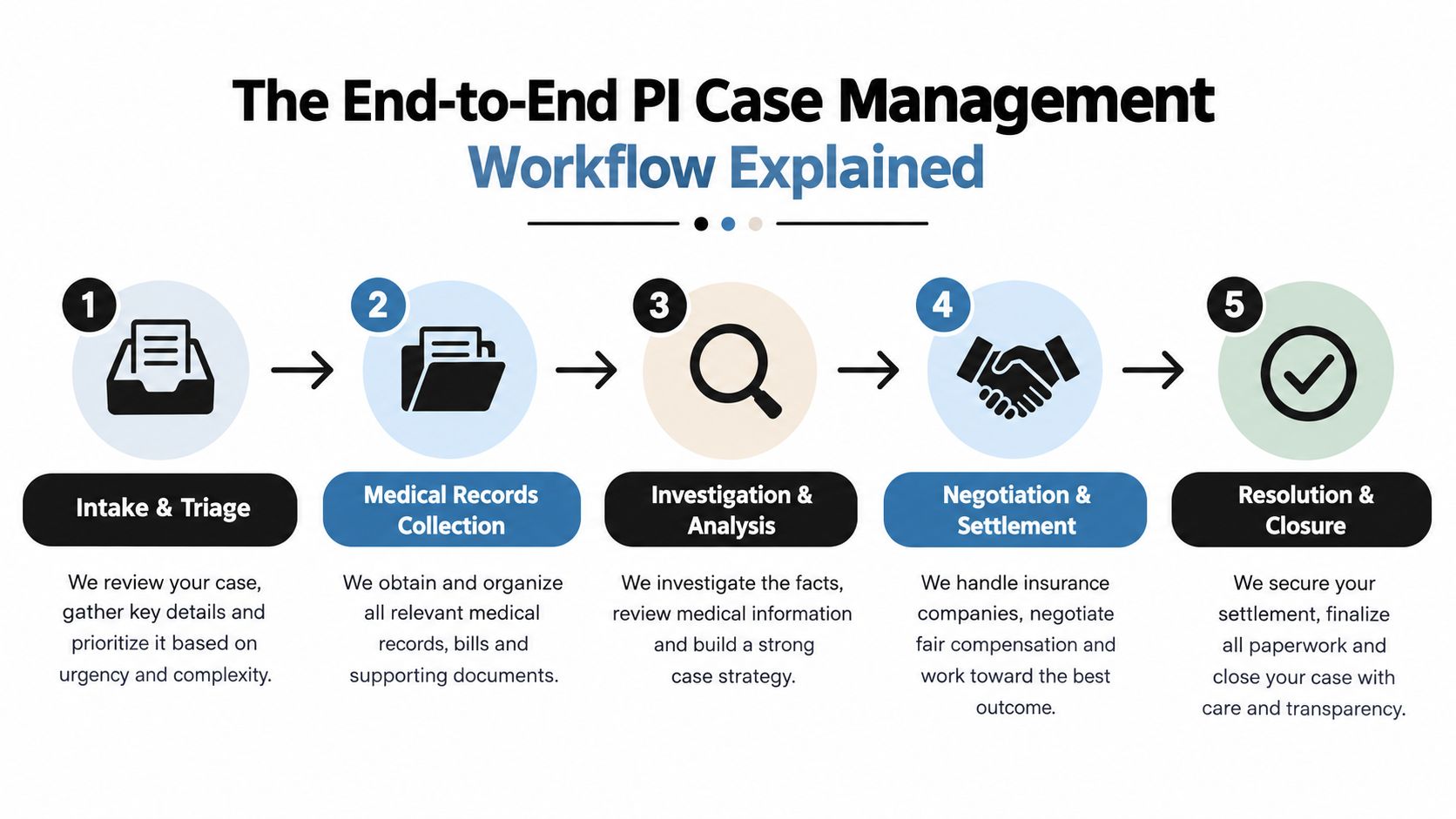
Five functions keep the work moving
- Intake and triage captures the incident, parties, limitations concerns, injuries, and immediate risks, then selects the appropriate route.
- Scheduling and collection arranges appointments, requests records, tracks authorizations, and monitors outstanding evidence.
- Processing and analysis turns raw documents into organized facts, chronologies, issue lists, and attorney-review materials.
- Disposition preparation produces the demand package, settlement strategy, or litigation handoff.
- Resolution and closure records the outcome, completes required administrative work, and preserves the matter history.
Postponements and schedule reliability measures can reveal bottlenecks and explain why matters take longer than expected. In PI practice, comparable signals include delayed records requests, repeated chronology revisions, and demands returned for missing support. Tracking the time between stages also exposes stage-duration deltas, so managers can distinguish a busy queue from a handoff that is creating rework.
A case management system stores matter information, while the workflow defines how that information moves and what happens next. Firms setting ownership rules and reducing unnecessary internal requests can consult practical productivity tips for support teams. For the distinction between software and operating process, review what a case management system is.
Use this video as a visual refresher, then translate each stage into your firm's roles, systems, approval points, and accountability rules.
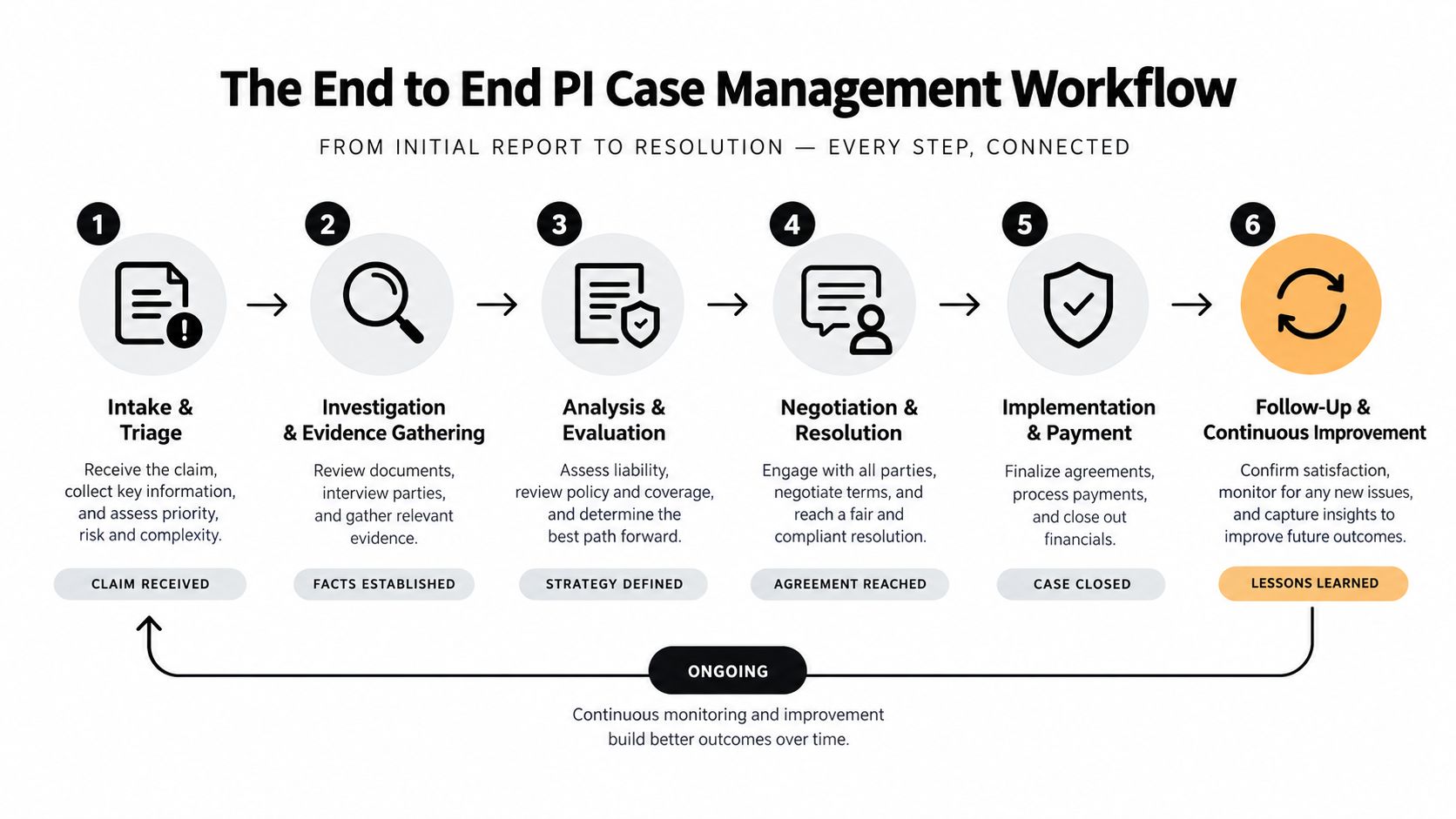
The End to End PI Case Management Workflow Explained
The workflow becomes useful when each stage produces a defined handoff. A status label such as “records pending” isn't enough. The team needs to know which records were requested, what arrived, what remains outstanding, and who must act next.
Intake and triage
The intake specialist owns the first screen. Inputs include the client's account, incident date, injury description, parties, insurance information, prior treatment, and signed engagement materials. The output should be a complete matter record with conflict status, urgency flags, initial provider list, and a clear next owner.
Good triage separates matters needing immediate attorney attention from matters that can enter the standard collection queue. Common failures include incomplete incident dates, unconfirmed representation, duplicate matters, and missed limitation concerns. A required-field check helps, but it should escalate uncertainty rather than accept guesses.
Records collection
The case manager owns requests, follow-up, receipt logging, and document classification. Every request should connect to a provider, date range, authorization status, and expected document type. When records arrive, the system should preserve the source and route the files into the matter rather than leaving the next worker to search an inbox.
The output is not merely a folder of PDFs. It's a collection status that shows received, missing, rejected, or still-unverified materials. That distinction prevents a team from treating a partial chart as a complete record set.
Review and chronology
A reviewer organizes treatment by date, provider, diagnosis, procedure, complaint, and functional effect. The chronology should distinguish what the provider documented from what the client reported, and it should preserve the source page or document reference for important facts.
For multiple providers, use one date standard and one naming convention. Record the treatment date, provider, facility, document type, and event summary in the same order every time. Flag overlapping visits, unexplained gaps, duplicate notes, and changes in symptom descriptions instead of smoothing them into a cleaner story.
Gap analysis and causation review
The attorney or designated senior reviewer tests completeness and legal significance. Questions include whether the records support the claimed injury, whether earlier conditions require explanation, whether treatment gaps have a documented reason, and whether objective findings align with the narrative.
The output is an issue list, not a vague approval. Each unresolved issue should have an owner, a next action, and a decision deadline.
Demand drafting
The demand owner works from approved facts, damages information, liability materials, and the firm's drafting standards. A draft should be traceable back to the source record. If a statement cannot be verified, the workflow should route it for review rather than allowing it to become part of the final narrative through copy-and-paste.
Negotiation, resolution, and litigation handoff
The attorney owns strategy and negotiation. Support staff maintain communication logs, update offers and counteroffers, and preserve the decision history. If settlement is reached, closure includes the required financial, client, lien, and file tasks. If litigation follows, the handoff package should show what was established, what remains disputed, and which deadlines or evidence issues require attention.
A reliable handoff transfers context, not just a status.
How to Measure and Improve Workflow Performance
Activity counts can make a team appear productive while cases remain stuck. A better dashboard connects work to elapsed time, completion, rework, and capacity.
Matter cycle time is the elapsed time from matter open date to close date. Legal operations teams compare it within similar matter types rather than averaging litigation, contract, and transactional work together, because different work follows different paths. The LexisNexis CounselLink discussion of legal operations metrics also places workload per attorney and budget variance beside cycle time, giving managers context for interpreting delays.
For PI matters, instrument the workflow at the stage level:
- Source-record intake: Track when a record is received, classified, and made available for review.
- Chronology extraction: Record time spent converting documents into dated treatment events.
- Consistency checks: Log missing records, conflicting dates, duplicate notes, and returned work.
- Attorney causation review: Measure waiting time before review and rework after review.
- Draft assembly: Track the interval from approved facts to a usable demand draft.
The useful comparison is the stage-duration delta, the difference between expected or historical stage time and the current stage time. A large delta tells you where to investigate. It doesn't, by itself, prove that a person is underperforming. The cause could be poor document quality, unclear ownership, a portal failure, or a missing integration.
A practical decision matrix
| KPI Signal | What It Reveals | Priority Action |
|---|---|---|
| Clearance rate falls below the balanced pace | Completed matters aren't keeping up with incoming demand | Identify the queue where new work accumulates and add routing or capacity there |
| Matter cycle time expands within the same matter type | End-to-end latency is increasing | Compare stage-duration deltas and isolate the slowest handoff |
| Rework rises after attorney review | Earlier stages are passing incomplete or inconsistent work forward | Add a validation checkpoint before legal review |
| Workload per attorney rises while completion stays flat | Capacity pressure may be creating a downstream queue | Reassign routine preparation and protect judgment-heavy review time |
| Budget variance widens | Process effort may be exceeding the matter plan | Examine administrative work, duplicate review, and late changes |
| Dashboard data is inconsistent | Reporting depends on manual updates or disconnected tools | Standardize fields and automate status capture |
Automated dashboards reduce reporting noise and help teams compare current performance with their own history and peer departments, according to legal operations KPI guidance from Checkbox. A useful dashboard should let a manager open a delayed matter and see the last completed stage, current owner, missing input, and time waiting.
For firms building that visibility, dashboard analytics for legal workflows provides a relevant reference point. Start with a small set of signals. A dashboard crowded with every available field can hide the one delay that needs intervention.
Where Workflows Break and How Integration Fixes It
Many firms don't have a task problem. They have a handoff problem.
A case may touch a practice management system, medical-record portals, email, spreadsheets, shared folders, billing records, and document templates. The case manager manually reconciles provider names in one tool with file names in another. An attorney receives a chronology that doesn't reflect the latest upload. A referral source sends information by email, but nobody maps it to the structured matter record.
The IBM research on next-generation knowledge worker processes identifies cross-department coordination and integration as major barriers to achieving case management goals. That finding fits the PI environment because evidence is both structured and unstructured. A date field, a scanned note, an email, and a portal status all need to describe the same matter without creating competing versions.
Manual and integrated handoffs
| Manual handoff | Integrated handoff |
|---|---|
| A worker downloads a file, renames it, and emails someone else | The received file is associated with the matter and routed to the next queue |
| A spreadsheet records outstanding records separately from the case system | Collection status updates the matter record and triggers the appropriate follow-up |
| An attorney asks for the latest chronology | The reviewer sees the current approved version with source references |
| A status change depends on someone remembering to update it | A completed stage creates the next task and records the transition |
| Errors appear after several people have edited the same material | Validation rules surface missing or conflicting fields earlier |
Static recordkeeping answers, “Where is the file?” Outcome-driven orchestration answers, “What must happen next, and what evidence supports that action?” Buyers increasingly look for API-first architecture, low-code configuration, and real-time dashboards because those features connect work across systems instead of merely storing a matter history.
Handoff test: If moving a matter from one stage to another requires copying facts by hand, treat that movement as a process risk.
Integration doesn't mean automating every decision. It means creating a dependable path for documents, structured fields, ownership, and exceptions. Firms evaluating the business case can also review how software integration improves ROI to frame the discussion around reduced duplication and better use of staff time.
To diagnose your own problem, watch what happens when a record arrives. If the team knows it arrived but can't see whether it's classified, reviewed, or complete, the weakness is connectivity. If everyone sees the same status but ignores the next action, the weakness is routing or role design.
Where Automation and AI Fit in a Modern PI Workflow
Automation works best when the firm first decides which actions are repetitive and which decisions require legal judgment. In a PI workflow, software can extract dates, providers, diagnoses, treatments, and symptom references from medical records. It can organize those findings into a chronology, identify apparent gaps for review, and assemble a draft from approved facts.
The attorney still decides how the facts affect causation, damages, credibility, settlement posture, and litigation strategy. A system can flag an unexplained treatment gap. It shouldn't decide that the gap has no explanation.
Independent workflow automation research reported a dispute-resolution process where resolution time fell from 12 hours to 3 hours, a 75% decrease, while the error rate fell from about 32% to 4.5%, an 86% reduction. Those results appear in the workflow automation study, and they illustrate why document-heavy case work is a strong candidate for structured automation. The figures describe that study, not a guaranteed PI-firm outcome.
Assign roles before assigning AI
A responsible design separates four roles:
- The system extracts and routes: It handles repeatable transformations and sends work to the correct queue.
- The case manager verifies completeness: The case manager checks missing providers, unclear documents, duplicate records, and collection status.
- The attorney exercises judgment: The attorney approves causation analysis, legal framing, damages treatment, and negotiation strategy.
- The manager monitors exceptions: The manager reviews stalled cases, failed processing, unusual outputs, and recurring rework.
Recent discussion of agentic CRM and workflow systems emphasizes boundaries for autonomous actions, supervision, permissions, and observability in the CIO coverage of CRM trends. Those controls matter in PI work because an inaccurate extracted date can distort a chronology, and an incorrect summary can influence a demand unless a reviewer catches it.
A firm can use Ares as one option for this document-heavy stage. Ares allows teams to upload case files, organize extracted dates, diagnoses, treatments, providers, and symptom chronology, then export medical overviews and demand drafts for collaboration. Its publisher describes HIPAA-compliant handling and enterprise-grade privacy controls, but the firm should still define its own access, verification, retention, and approval rules. For broader process design ideas, an healthcare workflow automation guide can help teams think through intake, routing, and human review.
Read more about AI for personal injury lawyers when evaluating where extraction and drafting fit in your existing controls.
Verification should be visible in the matter history. Preserve source references, identify the reviewer, record corrections, distinguish generated text from approved text, and require human confirmation before a demand leaves the firm.
Building a Repeatable Workflow That Settles Faster
A scalable PI practice doesn't depend on one exceptional case manager remembering every detail. It depends on a repeatable path that moves facts and responsibility forward.
Start by defining the stages from intake through closure. Give each stage an owner, an input standard, an output standard, and an exception route. Then instrument the stage durations so you can see whether delays come from records collection, chronology work, attorney review, or demand assembly.
Use this implementation checklist:
- Measure the flow: Track clearance rate, matter cycle time, waiting time, and rework within comparable matter groups.
- Repair one handoff first: Choose the stage with the clearest duration delta and remove duplicate entry or unclear ownership.
- Standardize evidence: Use consistent provider names, date formats, document labels, chronology fields, and source references.
- Automate repeatable work: Apply extraction, classification, reminders, and drafting only where the output can be verified.
- Protect judgment: Require attorney review for causation, damages, credibility, settlement strategy, and exceptions.
- Review the queue: Hold a regular operational review focused on stalled matters and failed handoffs, not just completed tasks.
Faster settlements follow when the attorney receives a complete, trustworthy case narrative at the right time. The firm then gains capacity through discipline and visibility, not by asking people to work indefinitely at a faster pace.
Ares helps PI teams organize medical records, extract treatment facts and chronology, and produce collaborative medical overviews and demand drafts within a structured case workflow. Visit Ares to see how it can support a measurable, verification-first process from records receipt to settlement preparation.