

A case manager has a stack of medical records that keeps growing. The paralegal assigned to review it is working late, the attorney is waiting for a demand draft, and the intake team insists every file was sent over on time. Everyone looks busy, yet cases still sit idle.
That pattern is where bottleneck identification matters. A visible queue is evidence that work has accumulated, not proof that the person or stage holding the queue is the true constraint. In personal injury firms, the slowdown may begin earlier, inside unstructured document intake, or later, when incomplete summaries trigger repeated attorney review.
Why Your Firm Feels Slow Even When Everyone Is Busy

The firm sees the records pile and concludes that medical-record review is the bottleneck. Management adds another reviewer, asks the existing team to work faster, or moves a few files to an attorney. The queue may shrink briefly, but demand drafting still lags because reviewers are receiving inconsistent files, missing provider records, or rebuilding the same chronology repeatedly.
A true bottleneck is the stage whose limited capacity constrains the output of the entire workflow. A backlog is only a symptom. It may reflect a genuine capacity problem, but it may also reflect poor sequencing, incomplete inputs, unclear handoff standards, or downstream work that isn't ready to receive the file.
Practical rule: Don't optimize the busiest-looking stage until you know that increasing its capacity improves end-to-end throughput.
This distinction changes how a managing partner investigates delay. The question isn't “Who has the most work?” It's “Which condition prevents the next completed case from moving through the system?” A reviewer may appear overloaded because every file requires manual sorting. The underlying constraint may be document complexity rather than reviewer headcount.
Why utilization alone misleads
A person can be fully occupied without limiting the firm's output. An attorney may spend substantial time reviewing drafts, but if the drafts repeatedly return for missing treatment dates, the source problem is upstream case preparation. Likewise, a paralegal may have a small visible queue while spending most of the day searching across inconsistent folders and attachments.
Manufacturing research describes bottleneck detection as a logical decision process, not a single-metric rule. Practical analysis considers buffer levels, blockage time, and starvation time, while defining the bottleneck through its sensitivity to system throughput in the data-driven bottleneck framework. The same reasoning applies to a PI workflow. A long queue deserves investigation, but it doesn't settle attribution.
The cost of fixing the wrong constraint
Hiring before diagnosing creates more coordination. Extra reviewers can increase the number of handoffs, create inconsistent summaries, and give attorneys more drafts to reconcile. Longer hours can hide process defects while increasing fatigue and error risk.
Teams exploring automation should also separate capacity expansion from sound workflow design. Resources on team productivity with AI coworkers can help leaders think about where AI supports human work, but technology won't repair an undefined handoff or an intake process that lacks required information.
The better starting point is observation. Trace one matter from document receipt through review, chronology, demand drafting, and attorney approval. Record where work waits, where people search, and where the same file returns for correction. That trail usually tells you more than the tallest pile on a desk.
Selecting the Right KPIs and Collecting Meaningful Data
Bottleneck identification becomes reliable when the firm measures elapsed time, waiting time, rework, and flow, not just completed tasks. A case-management system may show that a matter entered “medical review” and later moved to “demand drafting,” but those status changes don't explain how long the file waited, how much work was performed, or why it moved backward.
Start with a narrow workflow, such as records received to demand approved. Use existing timestamps wherever possible. If the system doesn't capture a meaningful event, add a lightweight field or a standard note rather than asking staff to maintain a separate manual log that will quickly become stale.
| KPI | What It Measures | What It Reveals |
|---|---|---|
| Stage cycle time | Elapsed time from entry to exit at each stage | Where work spends time before completion |
| Handoff latency | Time between one role finishing and the next role beginning | Waiting caused by ownership, scheduling, or unclear readiness |
| Rework rate | How often a file returns to a prior stage | Missing information, inconsistent standards, or poor first-pass quality |
| Buffer level | Work waiting between connected stages | Accumulation and imbalance across the workflow |
| Handoff throughput | Completed files moving through a transition | Whether a stage can sustain the pace of incoming work |
| Active review time | Time staff spend actually handling the file | Whether delay comes from labor or waiting and searching |
Build the baseline without disrupting casework
Use a consistent event vocabulary. “Records received” should mean the file is available for processing, not merely that someone saw an email. “Review complete” should mean the chronology and key facts meet the firm's handoff standard, not that a reviewer opened the folder.
For each matter, capture:
- Document intake: receipt date, file completeness, and source format.
- Review activity: review start, review completion, and missing-record follow-up.
- Handoffs: sender, recipient, transfer time, and acceptance time.
- Demand preparation: draft start, draft return, attorney review, and approval.
- Rework: reason for return, responsible upstream stage, and resolution.
The reason for return matters as much as the return itself. “Attorney changes” is too broad. “Missing treatment gap,” “unsupported damages statement,” and “provider chronology unclear” point to different causes and different fixes.
A dashboard can make these patterns visible when the underlying events are trustworthy. Firms assessing their measurement practices can use the HelpWithMetrics KPI guide for broader guidance on metric definitions, ownership, and governance. For PI operations specifically, dashboard analytics for legal teams can help organize workflow signals into a view managers can review without asking staff for one-off status updates.
Read the KPIs together
No single metric should decide the diagnosis. A long stage cycle time combined with low active review time points toward waiting, while high active review time and repeated returns suggest a work-content or quality problem. A growing buffer before attorney review may reflect attorney capacity, but it may also indicate that drafts arrive in batches or fail readiness checks.
Compare the metrics by matter type where practical. A complex catastrophic-injury file and a straightforward soft-tissue matter shouldn't be treated as interchangeable work units. The purpose isn't to create elaborate reporting. It's to create enough evidence to distinguish work, waiting, and rework.
Diagnostic Techniques That Separate Symptoms from Root Causes
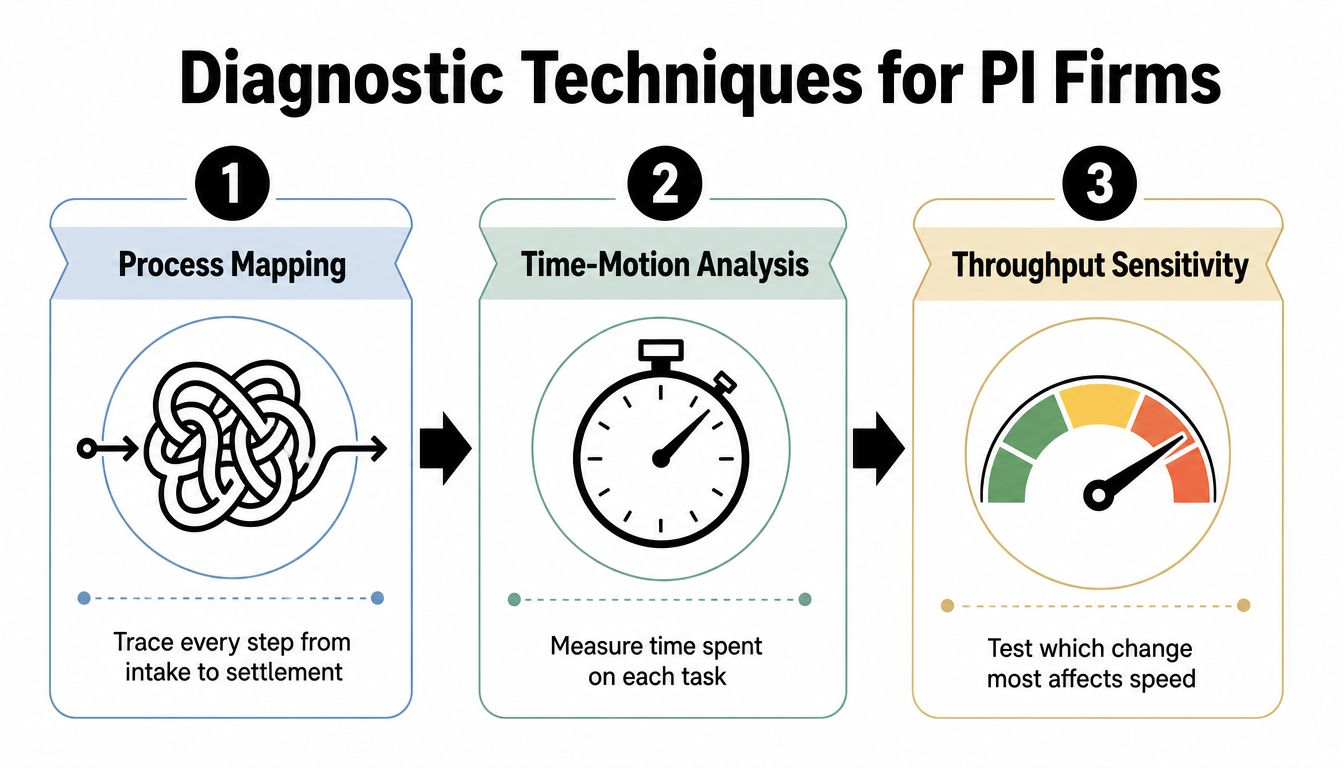
A useful diagnosis combines three views of the same workflow. Process mapping shows dependencies, time-motion analysis shows where elapsed time accumulates, and throughput sensitivity testing shows which capacity change affects the system rather than merely improving one person's queue.
Map the work as it actually happens
Map the path from intake through settlement preparation, including exceptions. A clean process diagram that omits missing records, provider follow-up, attorney questions, and rework is not a process map. It's an aspiration.
For each step, identify:
- The owner: who performs or accepts the work.
- The input: documents, facts, or decisions required to begin.
- The output: what the next stage must receive.
- The wait state: what causes the file to sit.
- The return path: why work goes backward.
This often exposes a hidden dependency. A reviewer may not be slow. The reviewer may be waiting for a complete set of records, then manually arranging files from multiple providers before any substantive analysis can begin. Conversely, a demand writer may be producing drafts quickly, but attorneys send them back because the case summary doesn't support the narrative.
Separate active work from elapsed time
Time-motion analysis doesn't require staff to record every minute. Sample representative matters and mark the broad categories of time: searching, reading, extracting facts, writing, waiting, requesting clarification, and correcting prior work.
The distinction is decisive. If a file spends most of its elapsed time waiting for a handoff, adding a faster reviewer won't address the delay. If staff spend the majority of active time interpreting dense records, a scheduling change may have little effect because the constraint is informational.
Research on automatic bottleneck identification from unstructured data points toward methods that can analyze process-oriented signals beyond simple queue inspection in the academic review of automated identification approaches. For PI firms, that means looking at document characteristics and rework paths alongside status timestamps.
Test the suspected constraint
Simulation-based manufacturing workflows use two passes. First, the existing system is modeled using utilization, arrival and departure timing, and bottleneck-rate indicators. Then each candidate stage is tested by increasing its capacity. A stage is confirmed only when that change improves throughput. If throughput doesn't change, the candidate is reclassified and the test moves to the next stage as described in the simulation-based bottleneck workflow.
A PI firm can apply the same logic without building a digital twin. Ask structured “what would change?” questions:
- If another reviewer handled files, would approved demands increase?
- If intake delivered complete, organized records, would review completion rise?
- If attorney review capacity increased, would drafts be approved, or would more incomplete drafts accumulate?
- If rework at the summary stage declined, would downstream work move faster?
The answers should be tested against observed flow, not accepted as assumptions. Teams considering AI-assisted operations can also review practical approaches to boost output with AI agents, while keeping the same discipline: automate a verified constraint, not an attractive symptom.
Real-World Scenarios in Medical Records Review and Demand Drafting
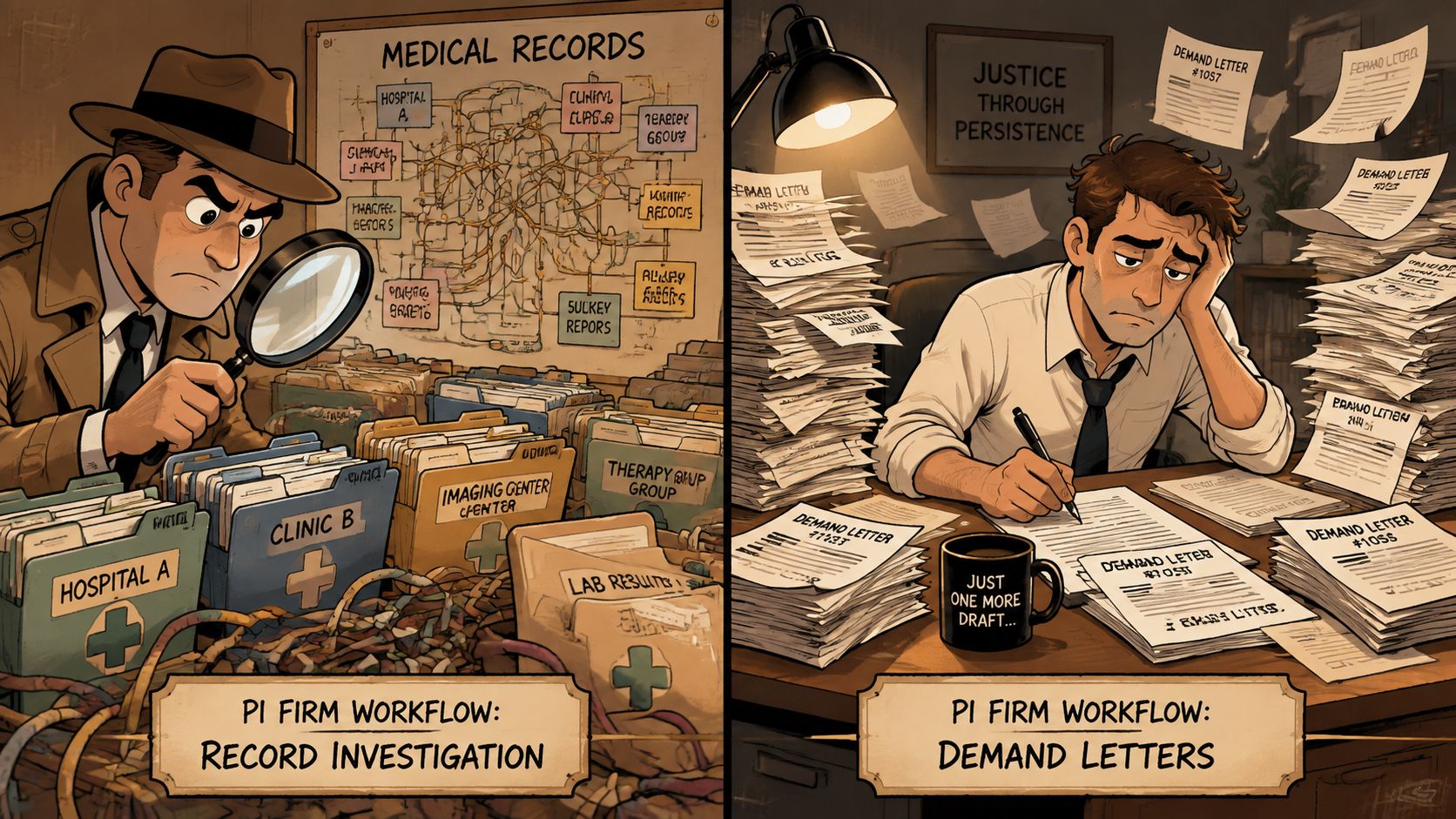
A medical-record queue is easy to see and hard to interpret. A demand-drafting queue is less visible, but it can create an equally misleading diagnosis. The following scenarios reflect common PI workflow patterns and show how the same symptom can arise from different causes.
Scenario one medical records review
A firm sees reviewers carrying a large queue of unprocessed medical files. The initial conclusion is that reviewers need more time or additional support. A closer trace shows that files arrive as mixed PDFs, duplicate productions, handwritten notes, billing records, and records from several providers. Reviewers spend substantial effort locating dates, identifying providers, and reconstructing the order of treatment before they can write a useful chronology.
The visible bottleneck is “review.” The causal bottleneck is unstructured document intake and interpretation. The firm confirms this by comparing files that arrive organized with files that require manual sorting. Organized matters move cleanly into chronology building, while disordered matters generate searches, clarification requests, and later corrections.
The intervention isn't just to assign more people. The firm can standardize intake naming, require a completeness check, define what a review-ready file contains, and separate duplicate removal from substantive analysis. A medical-record workflow such as medical record reviews for PI firms can also help teams evaluate how chronology work and fact extraction fit into the broader process.
The diagnostic lesson is important. A reviewer who appears slow may be absorbing upstream disorder. Measuring only reviewer utilization would blame the person doing the visible cleanup.
Scenario two demand drafting
A second firm believes its demand writers are the constraint because attorneys receive drafts later than expected. Time stamps show that writers complete initial drafts on schedule, but attorneys return many files for revisions. The return reasons reveal incomplete summaries, unsupported treatment statements, unresolved gaps, and inconsistent damages narratives.
The true constraint sits before drafting. Writers are starting with case information that isn't sufficiently structured, so the firm creates a draft, sends it for review, receives questions, and repeats the cycle. The attorney queue is real, but it is partly a rework queue.
The fix combines a readiness checklist with a structured case summary. The summary must identify the treatment chronology, providers, diagnoses, unresolved gaps, and source documents before drafting begins. Attorney review then becomes a substantive quality and strategy review rather than a reconstruction exercise.
For the firm, the meaningful measure isn't "demands drafted." It is approved demands moving forward without avoidable return loops. That measure connects production to usable output.
A short visual explanation can help teams discuss where document interpretation enters the workflow before they choose an intervention.
Both scenarios show why correlation isn't causation. The stage with the largest queue may be the place where upstream defects become visible, not the place where the constraint originates.
Quick-Win Remediation and AI-Powered Acceleration
Once the firm identifies the constraint, intervene at the narrowest point affecting flow. Start with changes that reduce waiting and rework before buying technology or redesigning roles. A quick fix should remove a specific failure mode, not make the team process more files.
Apply low-friction fixes first
Control work in progress. If reviewers receive more files than demand writers can accept, stop pushing matters forward without a readiness threshold. A smaller queue of prepared files is more useful than a large inventory of partially organized matters.
Standardize intake. Use a checklist covering record completeness, provider identification, date coverage, duplicate handling, and missing-document follow-up. It should define what “ready” means for the next person, not merely confirm that a folder exists.
Create reusable templates. Templates for chronology summaries, provider sections, treatment gaps, and demand components reduce variation. They do not resolve missing information, but they prevent staff from rebuilding the same structure for every matter.
Make rework visible. Require each returned file to include the missing fact or defective handoff. Managers can then distinguish intake defects from review problems, drafting errors, or unclear attorney instructions.
These interventions fit a process defect. They will not remove the time required to interpret dense, inconsistent records.
Recognize the informational bottleneck
Some PI firms are not facing a simple labor shortage. They have a document-complexity problem. Staff must convert raw records into dates, diagnoses, treatments, providers, symptoms, and a coherent chronology before attorneys can assess the matter or authorize a demand. The visible queue may form in drafting or review, while the causal constraint is the unstructured information arriving there.
That distinction should guide technology decisions. Unclear ownership calls for clearer roles and handoffs. Repetitive extraction and organization across dense records may justify AI-assisted workflows for personal injury practices, provided the firm can verify how the system handles source material.
Ares provides medical-record review and demand-letter drafting workflows that organize key case facts from uploaded documents into case-ready outputs. Teams can use drag-and-drop file intake, review structured medical overviews, and export materials for collaboration. The platform states that it is HIPAA compliant and uses enterprise-grade privacy and security controls. Firms evaluating this category should examine source traceability, human review, permissions, retention, and the handling of sensitive PHI. Faster extraction is useful only when reviewers can confirm where each material fact came from.

Match the intervention to the evidence
Use a process fix when handoffs are unclear, files arrive incomplete, or approval rules create avoidable waiting. Use AI-assisted analysis when staff spend substantial active time extracting and organizing recurring facts from unstructured records. In many firms, the durable approach combines both: standardize inputs, automate structured extraction, and keep attorneys responsible for judgment, strategy, and final review.
Judge the intervention by workflow results, not output speed. Review whether return loops decline, handoffs become predictable, and approved work reaches the next stage without transferring the queue elsewhere.
Validating Improvements and Building a Continuous Feedback Loop
A fix isn't validated because the original queue looks smaller. The backlog may have moved to attorney review, missing-record follow-up, or quality control. Re-run the same workflow trace after the intervention and compare the full path from intake to approved output.
Track the measures that correspond to the original diagnosis:
- Throughput: Are more usable matters completing the target handoff?
- Cycle time: Has elapsed time fallen at the constrained stage and across the whole flow?
- Rework: Are files returning less often, and are the reasons changing?
- Capacity: Can the team handle additional matters without creating a new queue?
- Quality: Are attorneys finding fewer unsupported facts, missing dates, or chronology gaps?
Set targets from the firm's own baseline. Avoid importing generic benchmarks that don't reflect matter mix, staffing, record complexity, or litigation strategy.
Confirm that the constraint moved
A successful intervention often reveals the next constraint. That isn't failure. It means the first constraint no longer dominates the system. The firm should document what changed, which metric moved, what trade-off appeared, and which stage now deserves attention.
Schedule a recurring bottleneck review rather than waiting for complaints. A practical review can examine current buffers, handoff latency, rework reasons, and throughput by stage, then select one constraint for focused testing. Keep the review operational, with named owners and a defined follow-up date.
The repeatable loop is straightforward: measure the flow, trace the cause, test one intervention, validate the result, and document the next constraint. That discipline prevents teams from confusing busyness with productivity and turns bottleneck identification into a management capability rather than an emergency response.
Ares helps personal injury firms structure medical records, surface chronology and treatment details, and prepare organized demand-work materials so teams can investigate whether document complexity is limiting workflow capacity. Visit Ares to evaluate whether its AI-assisted workflows fit your firm's bottleneck diagnosis and review process.