

The popular advice about AI for law firms is incomplete. It usually starts with a tool demonstration, lists a few impressive prompts, and ends with a recommendation to “start small.” That approach treats adoption as a software purchase. In practice, the hard part isn't getting one lawyer to produce a summary or first draft. The hard part is deciding which uses are permitted, who reviews the output, how confidential information is protected, and how the workflow becomes repeatable across matters.
That distinction matters because individual experimentation is moving faster than firm management. A firm can appear technologically advanced while lawyers use disconnected tools, staff follow inconsistent practices, and nobody owns the final risk decision. The firms that gain durable value will treat AI as an operating model change, not as an optional productivity shortcut.
The AI Adoption Gap in Legal Practice
AI adoption in legal practice isn't straightforward. A lawyer can open a general-purpose assistant and receive a useful first pass within minutes. A firm must answer harder questions before that output can enter a client matter: whether the platform retains data, whether the prompt contains privileged information, whether citations can be verified, and whether the responsible attorney has approved the process.
Recent reporting captures the gap. 69% of legal professionals use general-purpose AI for work, while only 46% of firms have implemented it formally and legal-specific AI reaches 34% firm-wide, according to reporting on the 8am legal AI adoption findings. The same source reports that 81% of firm leaders remain concerned about reliability. Those figures describe a management problem, not a lack of interest.
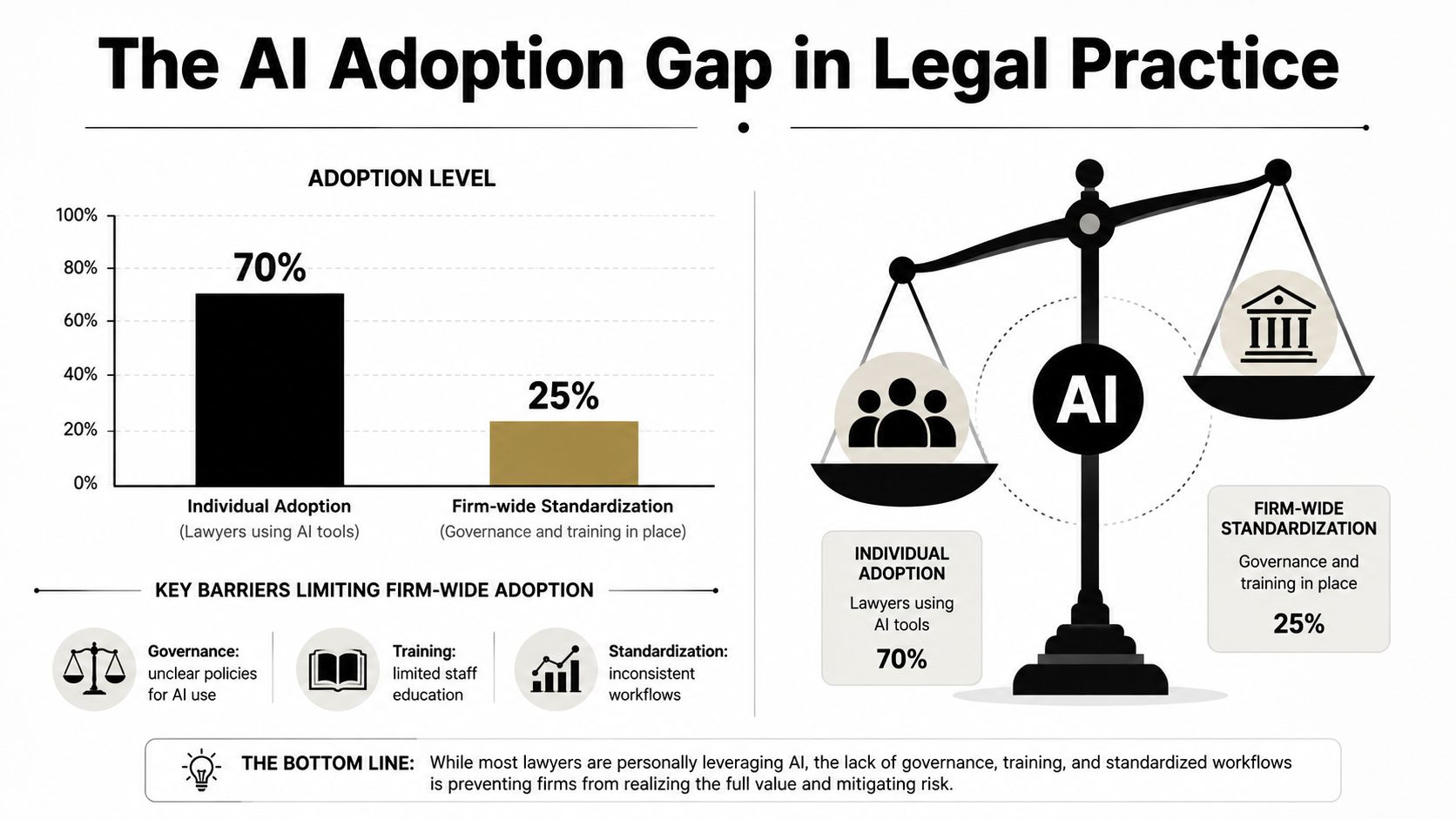
Why personal use doesn't become firm capability
Individual lawyers optimize for immediate usefulness. They may use AI to organize a deposition transcript, compare clauses, or create a research outline. Firm leaders must optimize for consistency, supervision, confidentiality, and defensibility. Those incentives naturally diverge unless the firm supplies an approved path.
Thomson Reuters reported that 26% of legal organizations were actively using generative AI in 2025, up from 14% in 2024, while 78% of legal professionals expected it to become central to their workflow within five years. The report put adoption at 28% for law firms and 23% for corporate legal departments, showing meaningful momentum without universal deployment. These findings are summarized in Thomson Reuters' legal workflow adoption coverage.
A workable policy should identify approved tools, restricted data, permitted tasks, required human review, and escalation routes. It should also name an owner. If “everyone is responsible” for AI quality, nobody is accountable when an unsupported statement reaches a client.
For a broader view of how technology changes legal operations, firms can consult law firms and technology. Teams also need a reliable way to communicate process changes, document approved practices, and keep lawyers aligned. A focused NewsletterAsAService for law firms can support that internal communication without making governance dependent on informal conversations.
Operational rule: Don't measure adoption by the number of lawyers who have tried AI. Measure whether the firm has an approved workflow, trained users, review checkpoints, and an owner who can intervene.
Core AI Capabilities for Personal Injury Firms
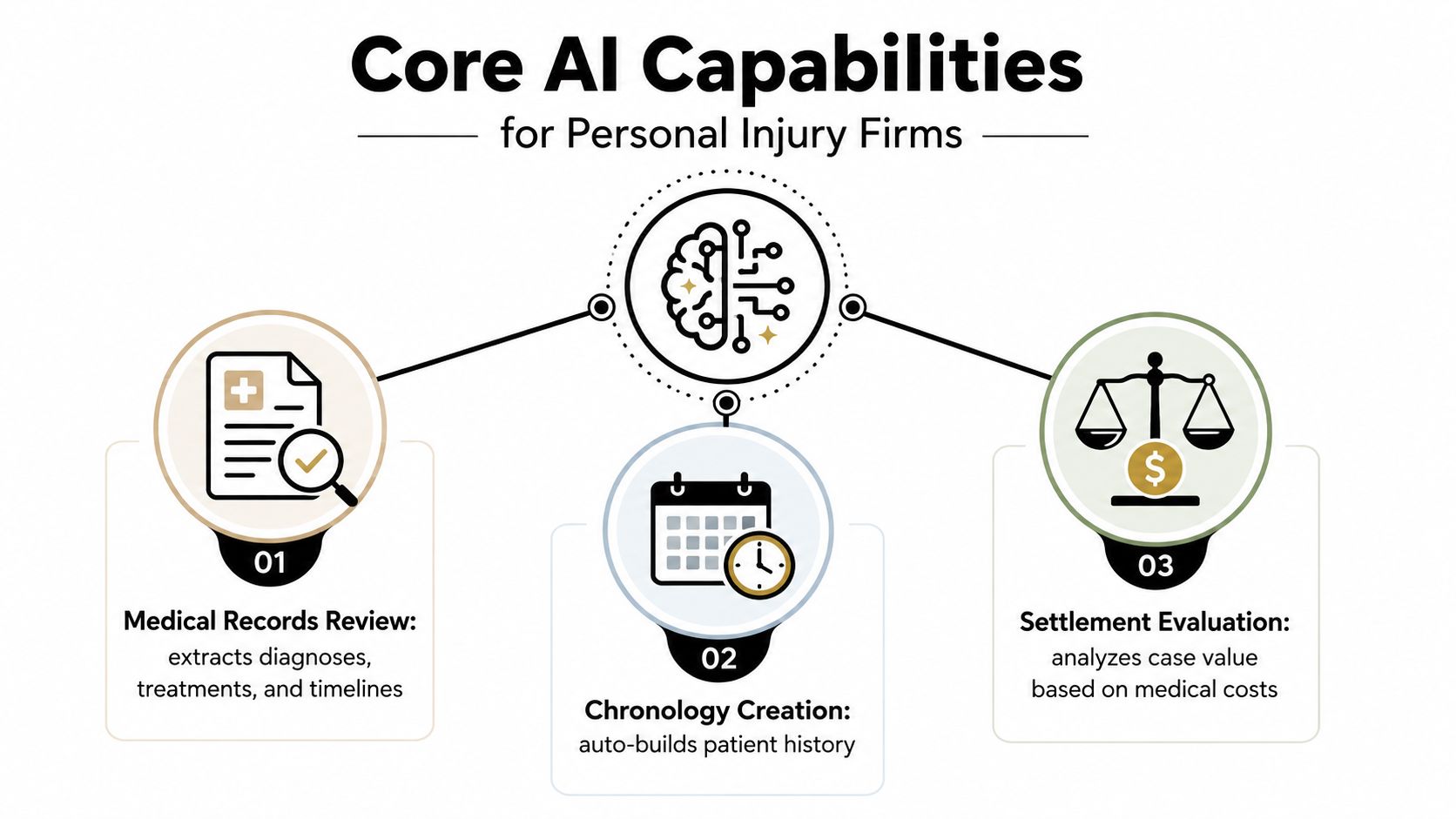
Personal injury practice offers a clear starting point because the work contains recurring document-heavy tasks, but those tasks still demand legal judgment. AI can organize a medical file, surface a chronology, and prepare a draft. It can't decide whether a symptom is causally related, whether a defense argument will succeed, or whether a settlement position reflects the client's actual objectives.
Medical records review
A useful system does more than shorten a document. It should extract diagnoses, treatments, providers, dates, medication changes, and symptom progression, then connect those facts into a structure a lawyer or paralegal can inspect. That structure helps the team identify missing records, inconsistent histories, delayed treatment, and references to providers whose records haven't been collected.
The right division of labor is straightforward. AI performs extraction and organization. A trained legal professional verifies the source records, resolves ambiguity, and decides which facts belong in the case strategy. A summary without traceable evidence is just a faster way to create a mistake.
Chronology and case narrative
Chronology creation is often where a firm feels the operational benefit first. Instead of reading every record in sequence and manually transferring dates into a spreadsheet, the team receives a working timeline that can be checked against the source file. The reviewer then spends attention on turning points, gaps, contradictions, and developments that affect liability or damages.
Demand letter drafting can follow the same pattern. AI can assemble a narrative from verified case facts, organize treatment and damages sections, and produce a reviewable first draft. The attorney still controls tone, legal theory, causation analysis, and the final factual assertions. A strong workflow requires citations or source references throughout the draft, not just a polished paragraph at the end.
Settlement and document analysis
AI can also compare settlement language, identify unusual provisions, and flag terms that deserve attorney attention. In a personal injury matter, it may help organize medical costs and treatment history for settlement evaluation, but it shouldn't be treated as an autonomous valuation engine. Case value depends on facts outside the medical file, including liability evidence, venue, policy limits, witnesses, liens, client priorities, and negotiation posture.
The best sequence is therefore narrow and controlled:
- Start with extraction: Validate whether the system captures the facts your team needs.
- Add chronology: Compare generated timelines against source records.
- Introduce drafting: Require attorney approval before any external use.
- Expand analysis: Use structured outputs to identify gaps and strategic questions.
A 2026 field study of AI-based document review found 94% average recall and 96% median recall across twenty-one results, with every data point exceeding the 80% recall benchmark used in the study. The authors reported that the validated AI workflow outperformed both eyes-on review and traditional machine-learning TAR workflows, as described in the 2026 document-review field study. That result supports disciplined validation. It doesn't eliminate the need for human review.
Measuring ROI Beyond Time Savings
Time saved is a useful starting metric, but it's a weak finish line. If a paralegal completes a review faster and the firm fills the recovered time with unrelated tasks, the business case remains unclear. Managing partners need to see how AI affects capacity, matter progression, quality control, and economic value.
Track the workflow at matter level. For medical review, record the time from file receipt to usable chronology, the number of records reviewed, the number of unresolved gaps, and the time required for attorney verification. For drafting, compare time to a review-ready demand letter, revision rounds, factual corrections, and the interval between demand and settlement activity. The point isn't to reward speed at the expense of accuracy. It's to identify where the process is compressing without creating downstream rework.
Four measures that connect operations to strategy
Cases per attorney shows whether the firm can absorb more appropriate matters without reducing supervision. Paralegal utilization reveals whether staff are spending less time on mechanical extraction and more time on client communication, evidence collection, and case preparation. Time to settlement indicates whether better-organized files help the team move decisions forward. Average claim value can be tracked as an outcome measure, but it must be interpreted carefully because case mix and liability facts change over time.
A reliable business case separates direct savings from strategic value:
| ROI category | What to measure | Management question |
|---|---|---|
| Direct efficiency | Review and drafting time, rework, overtime | Where is labor being released? |
| Capacity | Active matters per attorney and support professional | Can the team accept suitable work safely? |
| Quality | Missing facts, unsupported assertions, review corrections | Is the workflow reducing preventable errors? |
| Client service | Response time, update consistency, matter visibility | Does the client experience improve? |
| Economic value | Settlement cycle, matter economics, staffing mix | Does the change improve firm performance? |
A 2026 Thomson Reuters case study involving a financial-services legal team reported that generative AI reduced document-review time by 50% to 75% and generated approximately $200,000 in annual outside-counsel savings. The case study coverage attributes the economic effect primarily to compressing first-pass review and accelerating issue spotting. That's the lesson to carry into a law firm evaluation: value comes from redesigning the handoff between machine-supported review and human judgment, not from counting prompts.
Use a baseline period, define the quality threshold before deployment, and review results with both operations and supervising attorneys. A faster process that increases corrections isn't ROI. It's deferred cost.
The following video provides additional context for evaluating AI's role in legal workflows.
Implementation Framework for Law Firms
Firm-wide AI adoption fails when individual experimentation is mistaken for implementation. A successful rollout starts with a defined workflow, assigned owners, documented controls, and an agreed standard for acceptable output. Choose one process with a clear beginning and end, then identify where AI can assist and where attorney judgment remains required. Medical record review is often a practical pilot for personal injury firms because the inputs, extraction fields, and review checkpoints can be specified before testing begins.
Assess the workflow before choosing the platform
Map who receives records, names and stores files, reviews them, prepares the chronology, and approves the demand. Record each transfer between the case management system, document repository, email, and drafting environment. This exposes integration requirements and shows where staff re-enter information or create avoidable handoff risk.
Security review must go beyond a vendor's marketing page. Ask how the platform handles protected health information, privileged material, access permissions, retention, audit logs, data deletion, and model training. Confirm whether matter-level access can be enforced and whether the firm can retrieve or remove data when required. A lifecycle reference such as the Freeform Company AI diagram can help stakeholders discuss responsibilities, but the firm's own data-flow assessment must determine the decision.
Pilot with checkpoints
Use a defined matter type, a small group of trained users, and evaluation files that reflect ordinary complexity. Set the review rubric before users see the outputs. Test extraction accuracy, missing information, unsupported inferences, citation quality, formatting, and the attorney correction required. Include an escalation path for unclear or unsafe results.
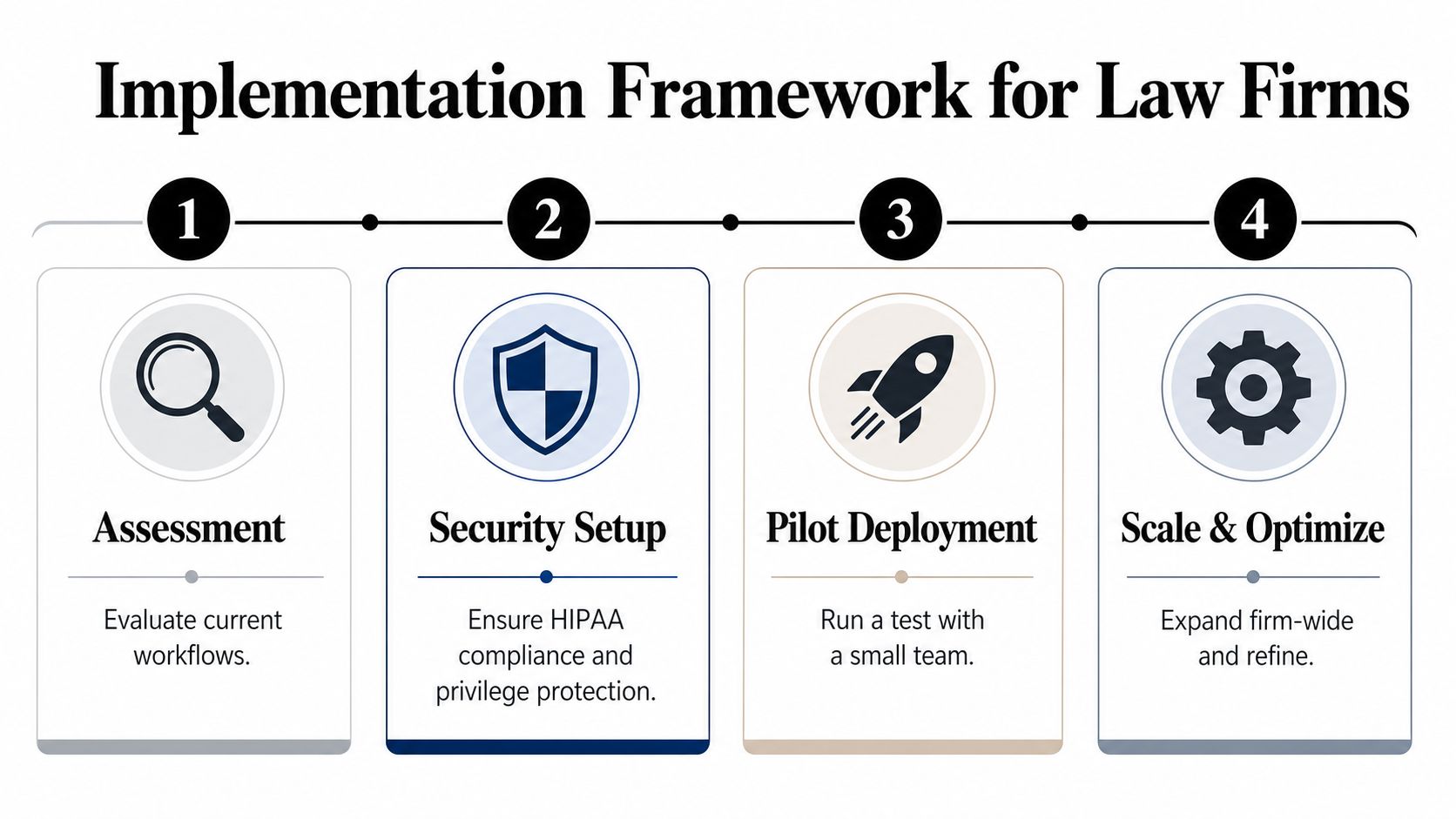
A practical rollout sequence follows four operating stages:
- Assessment: Document the current workflow, baseline effort, risk points, owners, and success criteria.
- Security setup: Complete privacy and privilege review, configure permissions, and approve data handling.
- Pilot deployment: Train selected users, run representative files, and review outputs at predetermined checkpoints.
- Scale and optimize: Expand only after defects are addressed, the policy is updated, and ongoing ownership is assigned.
Training must match each role. Attorneys need verification and professional-responsibility guidance. Paralegals need file-preparation and exception-handling procedures. Administrators need access, retention, and audit-control instructions. The firm can use training and onboarding guidance to organize that work, but the materials should reflect the approved workflow rather than generic prompt advice.
Implementation test: If a new user cannot explain what the AI may do, what it may not do, and who must approve the result, implementation is incomplete.
Common failures have identifiable causes. Poor source files produce poor outputs, unclear ownership leaves errors unresolved, and prompt-focused training ignores judgment and escalation. Maintain a feedback log, review it on a defined schedule, and change the workflow when the same failure recurs. The operational owner should also report unresolved risks to supervising attorneys instead of treating the pilot as a technology project alone.
Vendor Selection Criteria That Matter
Feature lists don't tell you whether a legal AI product is ready for a real matter. A vendor demo can make any system look capable when the documents are clean, the prompt is carefully prepared, and the presenter knows where the product performs well. Your evaluation should force the system to handle representative files and show how it behaves when information is missing or contradictory.
Separate general-purpose platforms from legal-specific tools. A general-purpose model may be flexible and useful for low-risk brainstorming or internal organization, subject to the firm's policy. A legal-specific platform may provide stronger matter controls, document workflows, source grounding, or domain-oriented review features. Neither category removes the attorney's duty to verify output.
| Criteria | Questions to Ask | Red Flags |
|---|---|---|
| Data security | Where is client data processed and stored? Is it used to train models? Can access be restricted by matter? | Evasive answers, unclear retention, or shared workspaces without matter controls |
| Accuracy validation | How does the vendor test extraction, summaries, citations, and omissions? Can the firm run its own evaluation set? | Broad accuracy claims without methodology or error reporting |
| Source grounding | Can users trace statements to specific documents or passages? | Polished output with no evidence trail |
| Workflow integration | Does the product connect with the firm's document and case systems? Can users export structured results? | Manual copying between systems as the default process |
| Privacy and privilege | What contractual protections govern confidential and privileged information? | Terms that permit broad secondary use |
| Administration | Are there role permissions, audit logs, usage reporting, and configuration controls? | No practical way to monitor adoption or investigate an incident |
| Support | Who responds when a matter is blocked or an output is wrong? | Support limited to generic help articles |
| Pricing | What drives cost, and how does usage change as deployment expands? | Ambiguous units, surprise limits, or pricing that prevents a realistic pilot |
Ask the vendor to explain a failure, not just demonstrate success. Request sample output from a redacted matter, require the source trail, and ask what the system does when it can't answer. The most useful product is one your lawyers can supervise, not one that produces the most fluent prose.
Ethics and Risk Management in AI Deployment
AI doesn't transfer professional responsibility to the vendor. The supervising lawyer remains responsible for competence, confidentiality, client communication, and the accuracy of work product. A firm's policy should make that responsibility operational by specifying which tasks require review and what evidence the reviewer must preserve.
Confidentiality is the first control. Staff should know which information can enter an approved system, which information requires redaction, and which tools are prohibited for matter data. Privilege protection also depends on access design, retention settings, vendor contracts, and the firm's ability to audit use. A secure platform can still create risk if employees upload documents to the wrong workspace or share outputs outside the matter team.
A usable governance model
Create a small governance group with representation from practice leadership, legal operations, information security, and risk management. Give it authority to approve use cases, suspend a workflow, update training, and review incidents. Each approved workflow should have a named business owner and a supervising attorney.
A policy can use plain language:
Sample policy: Lawyers and staff may use only firm-approved AI systems for client or matter information. AI-generated work product must be reviewed by an appropriately qualified lawyer before it is sent externally, filed, or used to advise a client. Users must verify material facts, authorities, calculations, and citations against reliable source documents.
Approval should be proportionate to risk. Internal organization may need a lighter review than a client-facing demand, court filing, or legal opinion. Every workflow should define the point at which a human must stop, investigate, and escalate.
Firms also need an incident process. Preserve the prompt, source files, output, reviewer notes, and corrective action when an AI error is discovered. A vendor security assessment can help structure procurement review, but ongoing governance must continue after contract signature. Reliability concerns should produce testing and supervision, not indefinite inaction.
Real-World Implementation Scenarios
The safest way to plan adoption is to compare operating patterns, not chase a universal promise. A solo practitioner may need immediate organization and drafting support with minimal administration. A mid-sized personal injury firm may need consistent review standards across case teams. A high-volume operation may care most about permissions, structured exports, and exception management.
Solo practice
A solo lawyer can begin with medical record organization and chronology creation. The lawyer reviews the generated timeline against the file, corrects omissions, and uses the verified structure to prepare a demand draft. The principal risk is concentration of responsibility. Without a second reviewer, the lawyer must create a deliberate pause between AI output and client-facing work.
The success measure should be the quality of the review process, not the number of documents processed. Track unresolved gaps, attorney corrections, and whether the system helps the lawyer identify questions that would otherwise remain hidden.
Mid-sized practice
A mid-sized firm should pilot with a defined group of paralegals and one supervising attorney. The firm can standardize intake fields, chronology format, naming conventions, and demand-letter review. A shared exception log helps the team distinguish product limitations from training problems and file-quality issues.
This structure also exposes the adoption gap early. Individual users may already have preferred tools, but the firm needs one approved workflow that can be taught, audited, and improved. The managing partner should receive a short operational report covering usage, review findings, incidents, and capacity effects.
High-volume operation
A high-volume firm needs governance before expansion. Matter-level permissions, approved templates, source-linked outputs, escalation procedures, and integration with existing systems become more important as more people touch the workflow. The firm should test whether AI-created work can move into the case system without manual duplication or loss of provenance.
The 2025 legal industry reporting summarized by the American Bar Association found that personal generative AI use was growing among more than 2,800 legal professionals, while firm-wide adoption lagged because of policy and ethical concerns. Separate reporting found that 80% of respondents said their firms were using or exploring generative AI, and Bloomberg Law reported that every one of the 40 firms with at least 500 attorneys that shared technology data was using legal-specific AI tools. Those findings are collected in the American Bar Association's 2025 legal industry report. The pattern is clear: large firms are moving, but deployment quality still depends on governance.
Ares provides personal injury firms with AI tools for medical record review and draft generation, including demand letters, with case-file question answering and source-cited drafting features. If your firm wants to turn individual experimentation into a controlled workflow for organizing records and preparing case-ready work, visit Ares to evaluate how the platform fits your implementation plan.