
A new personal injury client arrives with a fractured treatment history, several providers, incomplete billing records, and medical files that don't follow any convenient order. The intake team has to identify what happened, establish the injury timeline, find gaps in care, and decide what needs attention next, often before anyone has a complete view of the claim. A rigid checklist can record those tasks, but it can't reliably determine which task matters most when the facts change.
That distinction is why adaptive case management software matters to PI firms. It treats a matter as evolving legal work rather than a fixed sequence of database fields. The practical question isn't whether a platform can automate routine steps. It's whether attorneys and paralegals can adapt the case at runtime while preserving evidence, accountability, security, and a defensible record of decisions.
The Reality of Modern Personal Injury Case Intake
A typical intake may begin with a police report, a client interview, and a handful of emergency department records. Days later, the firm receives imaging, primary-care notes, specialist evaluations, therapy records, pharmacy information, and correspondence from an insurer. Each document adds context, but it may also change the working theory of causation, damages, liability, or treatment continuity.
Traditional case management systems handle the administrative shell well. They can create a matter, assign an owner, schedule a deadline, and store a document. The friction starts when the matter refuses to follow the expected path. A client may disclose a prior injury, a provider may send records in an unusual format, or a missed appointment may require a new line of investigation. Staff then create side spreadsheets, email reminders, and manual notes to compensate for the system's rigidity.
Practical rule: If the team has to work around the case-management system to understand the case, the system is recording activity rather than managing the matter.
A strong guide to modern case management is useful for separating basic recordkeeping from systems that coordinate work, information, and accountability. For PI firms, that distinction becomes immediate during intake. The platform should help the team connect the client narrative to supporting records, unresolved questions, deadlines, and next actions without forcing every claim into the same template.
The same issue appears in discussions of legal intake solutions. Intake isn't a single form submission. It's a continuing process of clarifying facts, collecting evidence, assessing fit, and deciding what the firm must do next. A dynamic case model gives the team room to handle that uncertainty without losing structure.
Why rigid stages create hidden cost
A predefined workflow assumes that the firm knows the sequence before the facts arrive. That assumption works for repeatable administrative processes, but personal injury investigations depend on judgment. One case may require an immediate records request, another may require witness development, and a third may turn on a medical gap that only becomes visible after chronology review.
The operational cost isn't limited to extra clicks. Paralegals spend time reconciling duplicate information, attorneys review incomplete summaries, and managers struggle to see which matters are stalled because the official status doesn't reflect the actual work. These are process-control failures, not individual performance failures.
Adaptive case management gives the firm a more realistic operating model. The matter starts with a goal, such as evaluating liability or preparing a demand, then changes as new evidence, decisions, and exceptions appear. The system provides guardrails while allowing authorized users to adjust the work.
Core Architecture of Adaptive Case Management Software
The central architectural shift is simple: the case is the working unit, not merely a row in a table. Adaptive case management software treats it as a container for documents, tasks, rules, services, and contextual data. That container gives the platform the information needed to determine what should happen next.
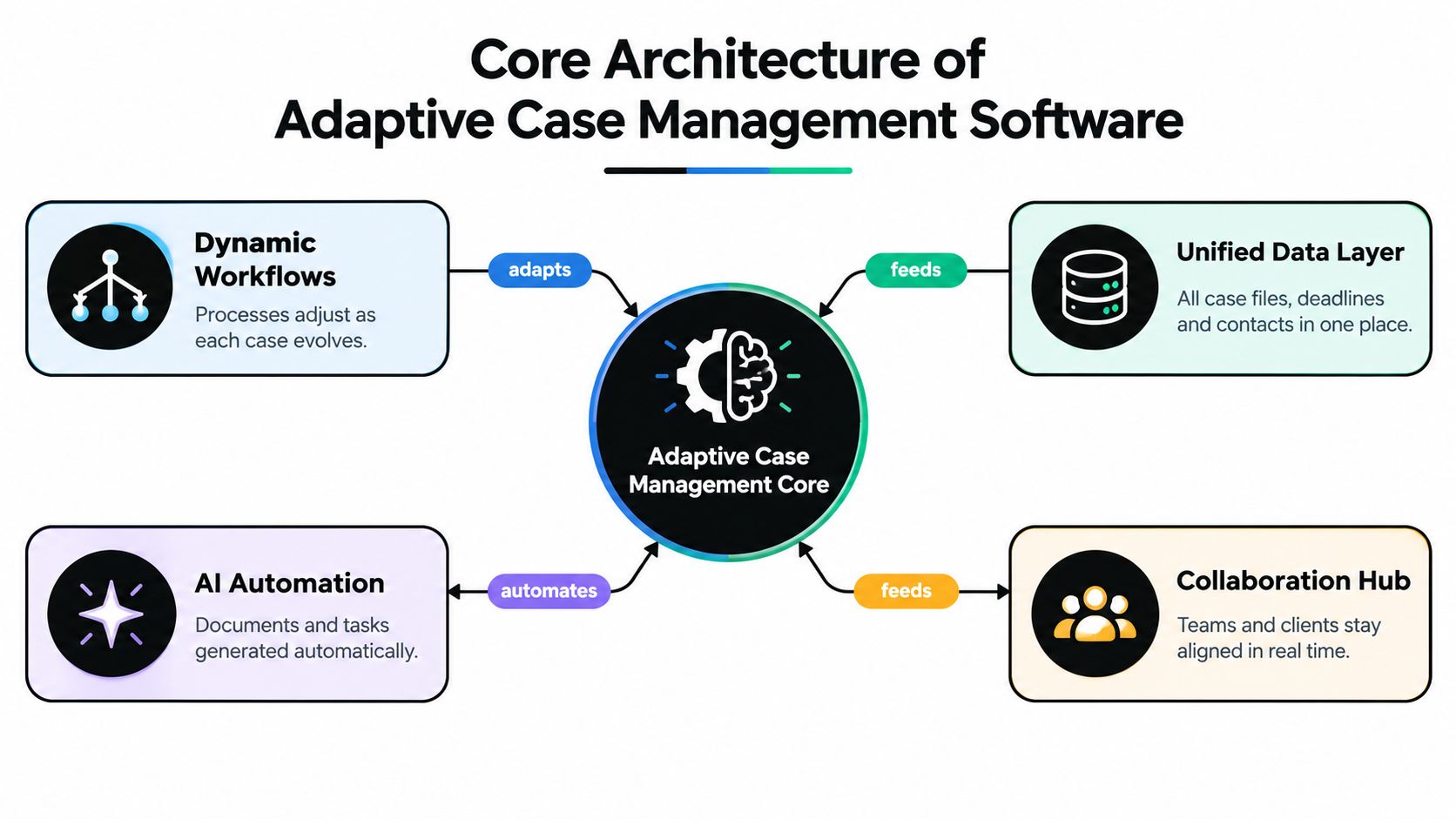
The formal idea emerged in 2009, when the Workflow Management Coalition proposed adaptive case management to address the rigidity of traditional case management and the rapid growth of data. The WfMC definition described technology that exposes structured and unstructured business information and supports both routine and emergent work in a secure, transparent manner. A later academic review also framed ACM as a system that supports decision-making and data capture while giving knowledge workers freedom to apply expertise in changing circumstances. The academic review of ACM definitions provides the historical context for that distinction.
From predefined paths to runtime decisions
Traditional BPM commonly starts with a design-time process. The analyst maps a sequence, often represented through a BPMN-style flow, and the system routes work from one step to the next. That approach is valuable when the organization can predict the process and wants strict consistency.
PI litigation is different. The sequence may depend on what a medical record contains, whether a provider responds, whether a diagnosis changes the damages picture, or whether an attorney identifies a new theory of liability. A runtime model doesn't abandon process. It moves the control point from a fixed path to the current facts of the case.
That is the difference between telling the system that every claim must follow steps A through F and allowing authorized users and rules to determine whether the next action is a records request, a provider follow-up, a chronology review, or attorney escalation. The technical analysis of rule-based ACM modeling explains this movement from structured process flow toward declarative, rule-based case management.
Why the data payload controls the work
Case data isn't just descriptive metadata. It can drive routing, auditability, and orchestration. Oracle's documentation describes a case instance as a collection of documents, data, and activities used to process and audit progress, with case data stored in the BPM database and passed into the case as input. Oracle's case data documentation shows why the information inside the case must remain connected to the work performed.
For a PI firm, that could mean linking a treatment date to a chronology task, a missing provider record to an outstanding request, or a newly identified diagnosis to attorney review. AI can assist by extracting and organizing information, but the platform still needs clear permissions, traceability, and human control over consequential decisions.
The case model also needs to connect with the firm's communication and operational systems. Teams evaluating CRM with VoIP integration benefits should ask whether calls, contacts, notes, and follow-up actions can remain connected to the relevant matter rather than living in disconnected tools. A useful case management system explanation should lead buyers back to the same test: does the software create a reliable operational record, or does it merely collect information?
Traditional Workflow Automation Versus True Adaptability
Workflow automation and ACM aren't interchangeable. A workflow tool can send a reminder when a deadline approaches, assign a standard task, or require a form before a matter advances. Those functions are useful, but they don't prove that the platform can support unpredictable legal work.
The test is whether a non-programmer can adapt the case at runtime when an exception changes the work. Adding an ad hoc task is only a narrow form of flexibility. True adaptability lets an authorized knowledge worker change participants, sequence, information requirements, and decision paths while preserving governance.
Academic work on ACM emphasizes this runtime freedom for exceptions and changing conditions. The ECIS paper on adaptive case management is particularly relevant for buyers because it separates genuine case adaptation from broad vendor language about flexible workflows.
| Feature | Traditional BPM / Workflow | Adaptive Case Management (ACM) |
|---|---|---|
| Process design | Defines the route before execution | Establishes goals, rules, and controls while allowing runtime adaptation |
| Exception handling | Sends exceptions outside the standard flow or requires redesign | Lets authorized users adapt the active case to new facts |
| Work sequence | Follows a predefined order | Allows tasks and participants to change as the matter develops |
| User role | Executes assigned steps | Uses judgment to shape the next action within governance controls |
| Data function | Records process inputs and outputs | Acts as a payload that informs routing, decisions, and auditability |
| Best fit | Repeatable, predictable administrative work | High-variance investigations, claims, and legal matters |
The vendor demo test
Ask the vendor to demonstrate a matter that changes halfway through. Start with an ordinary intake, then introduce a prior injury, an unexpected diagnosis, and a missing provider record. Watch whether the user can add the necessary work, change the sequence, assign the right specialist, and preserve an explanation of the decision without opening a developer ticket.
A task list that allows manual additions may still fail this test. The platform should connect the new task to the evidence or rule that caused it, surface the resulting dependencies, and keep the matter's status meaningful.
The trade-off is real. A fully fixed workflow offers simplicity and predictable reporting. ACM introduces more discretion, which requires stronger permissions, training, and review practices. Firms shouldn't use adaptability as an excuse for uncontrolled variation. They should use it to make justified variation visible and accountable.
Strategic Benefits for Personal Injury Litigation Teams
Medical records expose the weakness of rigid systems faster than almost any other PI workload. A single claim can contain repeated diagnoses, inconsistent descriptions of symptoms, treatment interruptions, referrals, imaging results, and provider notes written for different purposes. Manual review can identify important facts, but it makes the firm's capacity depend heavily on staff time and individual memory.
AI-driven ACM changes the unit of work. Instead of asking a paralegal to read every document and then manually rebuild the chronology, the platform can extract dates, diagnoses, treatments, providers, and symptom developments into a structured case context. The attorney still evaluates significance, but the raw material arrives in a form that supports strategy.

Turning records into litigation decisions
The value isn't a prettier document repository. It's the connection between extracted facts and legal work. A treatment date can support a chronology review. A gap can prompt a provider follow-up. A new diagnosis can trigger attorney analysis of causation or damages. A conflicting account can become a targeted investigation rather than a detail buried in a file.
That structure also helps teams collaborate. Attorneys, paralegals, medical record reviewers, and case managers can work from the same matter context instead of maintaining separate summaries. The system should show who added information, what source supported it, and which action followed.
Security must remain part of the workflow
Medical records contain protected health information, so convenience can't override access control. The case container should support role-based permissions, secure document handling, audit trails, retention policies, and controlled collaboration. Firms should verify the platform's privacy posture and contractual responsibilities rather than relying on a generic claim that data is secure.
A well-designed ACM environment keeps sensitive information accessible to the people who need it while limiting unnecessary exposure. That balance matters during settlement preparation, litigation, and handoffs between teams. AI output also needs human review, especially when a summary may influence a demand, deposition preparation, or trial strategy.
The practical result is better visibility into what the firm knows, what it doesn't know, and what should happen next. ACM doesn't replace legal judgment. It reduces the administrative distance between evidence and judgment.
Vendor Evaluation and Security Implementation Checklist
A vendor demo can make any platform look adaptive. The purchase decision should depend on what the system does under pressure, with real records, real permissions, and real exceptions. Evaluate the product as an operating environment for sensitive litigation work, not as a collection of automation features.
A practical evaluation sequence
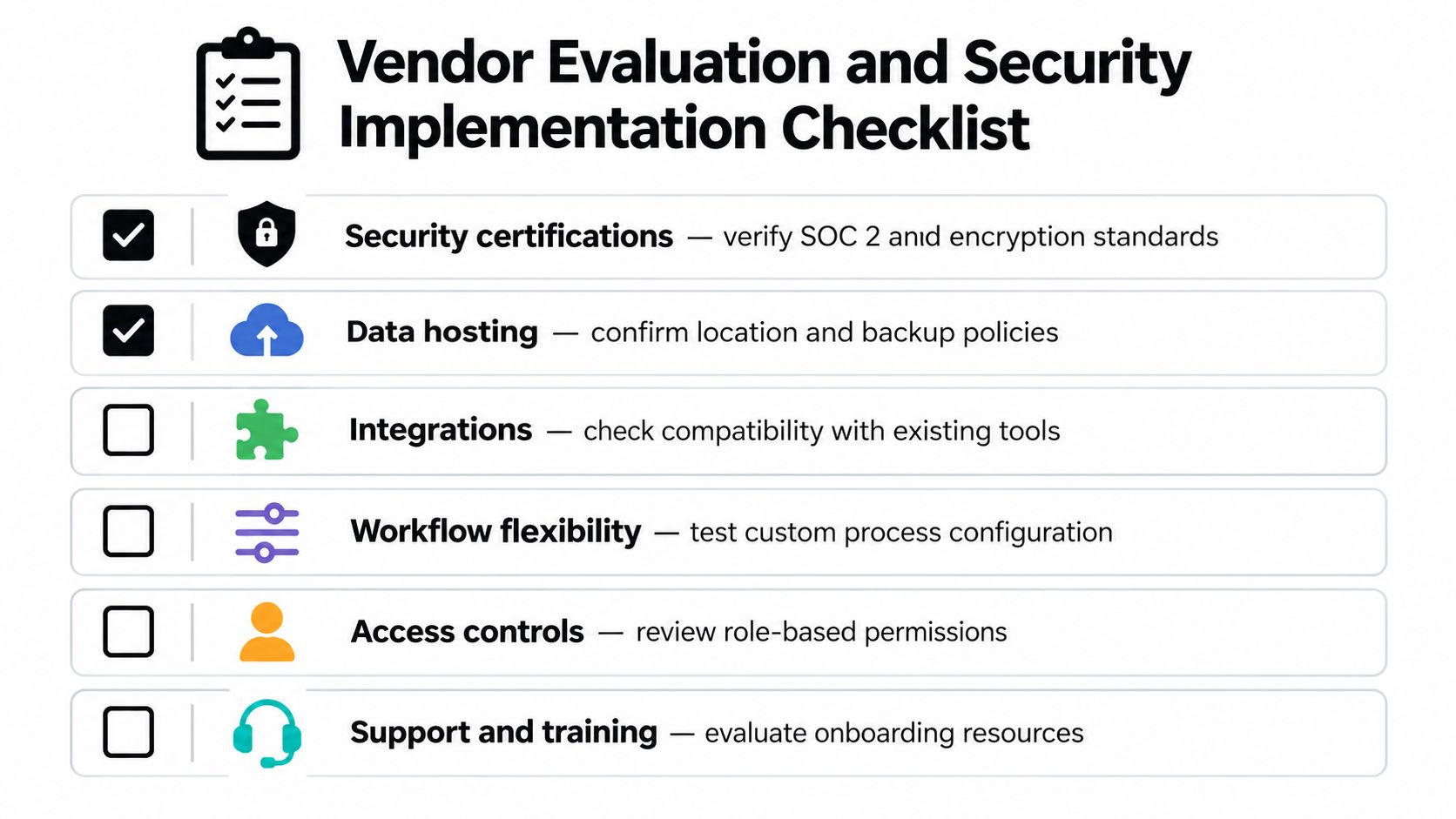
Test the security model. Ask how the vendor handles encryption, role-based access, audit logs, tenant separation, incident response, and data deletion. Require documentation rather than accepting a sales summary.
Confirm the hosting arrangement. Cloud delivery is already the dominant deployment model in ACM. An independent market estimate assigns 58.3% of ACM revenue share to cloud deployment, while also estimating that the global market will reach $5.37 billion in 2025 and $13.93 billion by 2034, a projection based on an 11.2% CAGR. These figures come from Dataintelo's ACM market estimate, and they should be treated as market estimates, not a guarantee of vendor performance. Ask where data is hosted, how backups work, and how the firm retrieves information if the relationship ends.
Inspect the AI workflow. Use representative medical records and look for source references, confidence indicators, correction tools, and human approval points. Don't evaluate summaries only by how polished they sound. Check whether reviewers can verify each important fact against the underlying record.
Test runtime configuration. Have a paralegal add a new provider request, alter an assignment, create an escalation, and revise the next action. The vendor should show what the user can change without code and what remains controlled by administrators.
Map integrations. Review connections to document storage, calendaring, communication tools, billing, e-signature, and reporting. An isolated platform creates another information silo, even if its internal workflow is strong.
Assess implementation support. Ask who configures the first use case, how training is delivered, how changes are governed, and how the vendor handles failed automation or inaccurate extraction.
Software represents the largest portion of the ACM market in the cited estimate, with 62.5% of revenue, or about $3.36 billion in 2025, attributed to software. That reinforces the importance of evaluating the product itself, not just consulting promises. Firms reviewing their wider approach can also use guidance on protecting your practice with Cloudvara as part of a broader security conversation.
Implementation warning: Don't migrate every matter on the first day. Prove that the platform handles one difficult workflow before making it the firm's system of record.
Measuring ROI with AI-Powered Platforms Like Ares
ROI begins with a baseline, not a feature list. Measure how much time the team currently spends collecting medical records, reviewing them, building chronologies, drafting demands, locating gaps, and correcting duplicated work. Then compare those activities with the time required for the same matters after implementation.
Ares provides one example of an AI-powered platform for PI firms. Its workflow is designed to turn uploaded case files into structured medical information, including dates, diagnoses, treatments, providers, and symptom chronology, then support medical overviews and demand letter drafts. Firms report eliminating 10+ hours of manual review and drafting per case, based on the publisher's stated product information.

The financial calculation should remain specific to the firm. Multiply verified hours saved by the loaded cost of the staff performing the work, then account for review time, implementation expense, training, and subscription cost. Add capacity only when the firm can show that saved time supports more matters, faster preparation, or higher-value attorney work.
What to measure beyond hours
Time savings are useful but incomplete. A PI partner should track whether the system improves the quality and timing of decisions.
- Review throughput: How quickly can the team produce a usable chronology from a new record set?
- Gap identification: How often does the review surface missing records, treatment interruptions, or unresolved factual questions?
- Draft preparation: How much attorney and paralegal editing does a demand draft require before approval?
- Matter visibility: Can a manager identify stalled cases and the reason for the stall without asking several people?
- Quality control: Can the firm trace important summary points back to source documents?
A structured workflow can also increase capacity without treating staff as an unlimited buffer. If a paralegal spends less time reconstructing medical histories, that time can move toward provider follow-up, client communication, evidence development, or attorney support. The return comes from redeploying time deliberately, not from assuming automation automatically creates profit.
For a closer look at the operating model, firms can review AI case management from Ares. The key discipline is validation. Track the baseline, run a controlled comparison, record corrections, and decide whether the improvement is large enough to justify expansion.
Next Steps for Upgrading Your Firm's Case Management
Start with one high-variance workflow, not an enterprise-wide replacement. Medical record review is often a sensible pilot because the inputs are messy, the work is labor-intensive, and the outputs can be evaluated against source documents. Choose matters with enough complexity to test runtime adaptability, but keep the scope narrow enough for the team to learn quickly.
A controlled pilot plan
Define the baseline. Record current review time, drafting time, correction patterns, handoffs, and delays. Include the people who perform the work daily. Partners may approve the purchase, but paralegals and case managers will reveal whether the workflow is usable.
Set acceptance criteria. Require source traceability, human review, permission controls, exportable outputs, and a clear process for correcting AI-generated information. Decide what the platform must do before the firm considers the pilot successful.
Run representative matters. Don't choose only clean files. Include fragmented records, multiple providers, missing information, and changing instructions. A system that performs well on orderly input hasn't proven that it can manage PI reality.
Review the exceptions. Ask where the platform misread a fact, missed a gap, or failed to trigger the next action. The firm's response to errors matters as much as the initial extraction quality. Build a correction process that improves consistency without hiding uncertainty.
Expand in stages. After the pilot, connect the next workflow, such as demand preparation, provider follow-up, or settlement review. Keep ownership clear, document configuration decisions, and review access as the platform's role grows.
The objective isn't to eliminate every human decision. It's to reserve human attention for decisions that require legal judgment while the system organizes evidence, coordinates work, and makes unresolved issues visible. That is the practical standard for adaptive case management in a PI firm.
Ares helps personal injury firms organize uploaded case files, extract medical facts, and produce case-ready medical overviews and demand drafts within an adaptive workflow. Visit Ares to evaluate whether its AI-powered medical record review can reduce manual work and give your team a clearer path from intake to strategy.