
For any personal injury firm, the case lives and dies by the medical evidence. Yet, the old-school way of collecting these critical documents is often the biggest bottleneck in the entire process, quietly siphoning away time, money, and momentum. Modern records retrieval solutions are built to completely overhaul this broken system, swapping out manual grunt work for a smart, automated workflow.
Why Manual Record Retrieval Is Costing Your Firm More Than You Think
Trying to manage records retrieval manually is a bit like navigating a labyrinth blindfolded. Every single day, your paralegals and support staff are burning hours on tedious, repetitive tasks that do almost nothing to actually move a case forward. This isn't just inefficient—it’s a massive hidden cost that’s putting a ceiling on your firm's profitability and growth.
The daily grind is a familiar one: endless phone calls, wrestling with fax machines, and constant manual follow-ups. Staff are forced to chase down records from a dozen different providers, each with its own bizarre set of rules and frustratingly slow response times. This piecemeal approach is not only agonizingly slow but also ripe for human error, leading to missing documents, jumbled files, and costly delays.
The True Cost of Inefficiency
The financial drain goes far beyond what you see on a payroll report. Think about it: every hour a talented paralegal spends on hold with a hospital's records department is an hour they aren't spending on high-value work like case strategy, client communication, or deposition prep. That misallocation of expertise is where the real costs start piling up.
Let's break down the tangible impact:
- Delayed Case Velocity: Manual retrieval slams the brakes on your case lifecycle. When you're waiting on evidence, you're waiting to draft demand letters, start negotiations, and ultimately, get your clients paid.
- Reduced Caseload Capacity: When your team is drowning in administrative quicksand, they simply can't handle more cases. This directly caps your firm's revenue potential.
- Increased Risk of Errors: Juggling dozens of manual requests is a recipe for disaster. It’s far too easy to miss a critical record or blow past a deadline, which can seriously weaken a case or even open the door to a malpractice claim.
Manual retrieval doesn't just cost money; it costs momentum. The delays it creates can frustrate clients, stall negotiations, and hand the advantage right over to the defense.
To really see the difference, let's compare the two approaches side-by-side.
Manual vs Modern Records Retrieval: A Comparison
The gulf between the traditional, manual process and a modern, automated solution is vast. The old way is defined by friction and delay, while the new approach is built for speed and accuracy. This table highlights just how stark the contrast is.
| Aspect | Manual Retrieval Process | Automated Records Retrieval Solution |
|---|---|---|
| Initial Request | Staff manually faxes, mails, or calls each provider individually. | A single request is submitted digitally; the platform handles all provider outreach. |
| Follow-Up | Daily phone calls and emails to check status, consuming hours of staff time. | Automated, real-time tracking with status updates pushed directly to your dashboard. |
| Time to Delivery | 60-90+ days on average, highly variable and unpredictable. | 15-30 days on average, with much greater predictability. |
| Organization | Records arrive as disorganized stacks of paper or scattered PDFs. | Documents are delivered digitally, organized, bookmarked, and fully searchable. |
| Cost | High internal labor costs, plus provider fees and mailing expenses. | A predictable service fee, drastically reducing hidden labor and administrative costs. |
| Accuracy & Gaps | High risk of missing pages, incomplete records, or human error. | System flags missing records and ensures the file is complete before delivery. |
Ultimately, the choice becomes clear. One path is a constant struggle that drains resources, while the other is a strategic investment that pays for itself in efficiency and faster case turnarounds.
Moving from Tactical Task to Strategic Advantage
This is precisely why modern records retrieval solutions are becoming a non-negotiable tool for successful PI firms. They transform retrieval from a painful administrative chore into a genuine strategic asset. By automating the entire workflow—from the first request to the final, organized delivery—these platforms hand your team back its most precious commodity: time.
These systems can manage thousands of requests at once, tracking every single one with digital precision and providing a clear view of where everything stands. This completely eliminates the need for manual follow-ups and guarantees that a complete, organized, and searchable case file lands on your desk in a fraction of the time.
In the end, adopting a modern solution isn't about convenience. It’s a core business decision that enables your firm to operate more efficiently, scale up its caseload, and secure better, faster outcomes for your clients. It turns the frustrating maze of manual retrieval into a straight, clear path to the evidence you need to win.
How AI-Powered Retrieval Platforms Actually Work
If you peel back the curtain on a modern records retrieval solution, you’ll find a sophisticated engine humming along—a sequence of technologies working together. Think of it as an automated assembly line built specifically for personal injury firms. It’s designed to take a chaotic pile of documents and turn it into clear, organized, and actionable intelligence for your case.
It all starts with a simple digital command, not a flurry of phone calls and faxes. Your team enters the case details and client authorizations into the platform, and the system immediately gets to work. It dispatches secure, HIPAA-compliant requests to every hospital, clinic, and specialist involved, tapping into a huge, pre-vetted network.
This single first step erases dozens of hours of mind-numbing administrative work. The platform’s engine manages all the follow-ups, gives you real-time status updates, and navigates the unique submission rules for thousands of providers across the country. Nothing gets missed.
From Scanned Page to Searchable Text
Once the records start rolling in—whether as a scanned PDF, a fax, or even paper files the service digitizes for you—the next piece of the puzzle kicks in. Optical Character Recognition (OCR) is the technology that acts as a universal translator for all these documents.
Imagine painstakingly retyping every single word from a 500-page medical file into a searchable Word document. That's essentially what OCR does, but in seconds. Without it, that massive file is just a static image of text. With OCR, it becomes a dynamic resource where your team can instantly search for terms like "herniated disc," a specific doctor's name, or a key prescription. This is the foundational step that makes everything else possible.
The old, manual way of doing things was bogged down by friction at every turn.
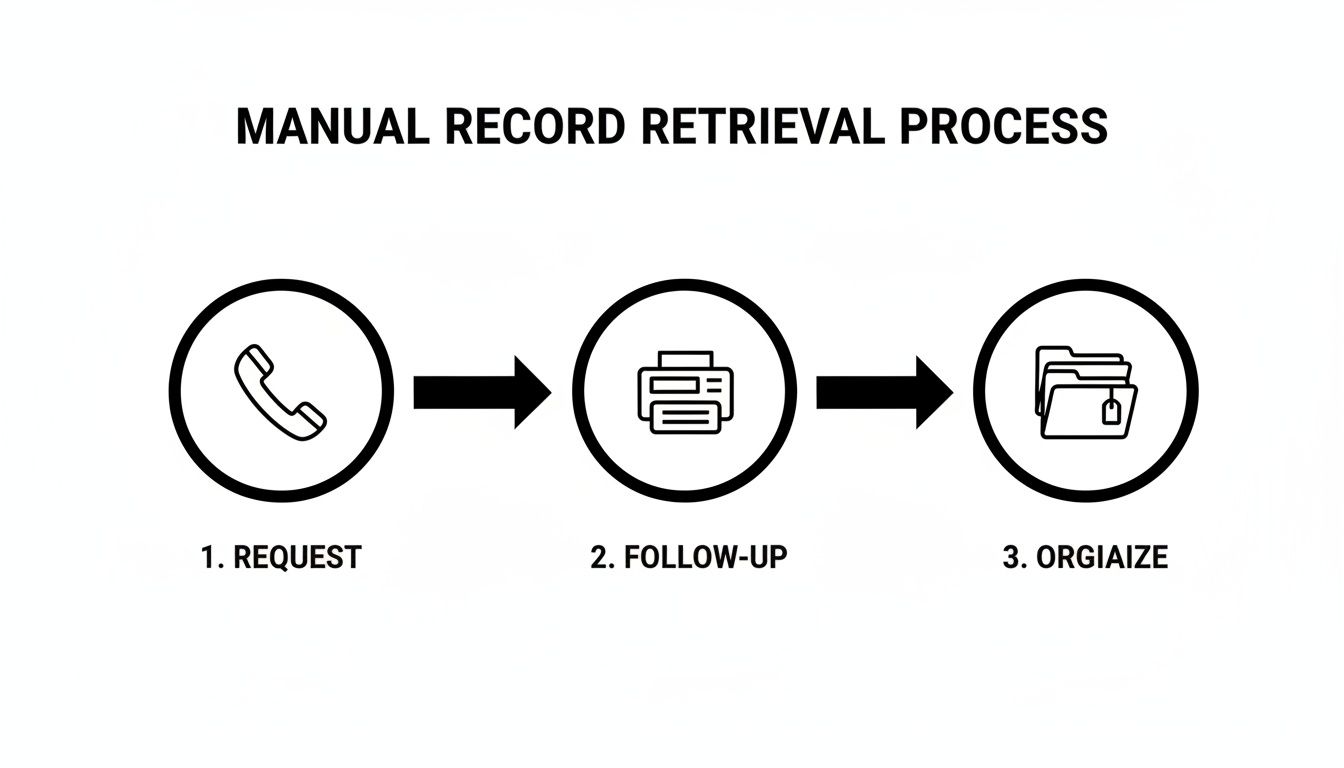
This flowchart really highlights the frustrating cycle of manual requests, constant follow-ups, and painful organization that eats up so much valuable time and opens the door to costly mistakes.
The AI Brain That Reads and Understands
With the records digitized and searchable, the "brain" of the operation takes over. This is where Natural Language Processing (NLP), a specialized branch of artificial intelligence, comes into play. NLP is what allows the software to not just read, but actually understand the context of human language in complex medical and legal documents.
An NLP model doesn't just see words; it recognizes concepts. It knows that "Dr. Smith" is a provider, "MRI of the lumbar spine" is a procedure, and "ibuprofen 800mg" is a prescription. This contextual understanding is the key to unlocking true insights.
The platform’s NLP engine methodically scans every page, identifying and pulling out the critical data points you need to build a winning personal injury case.
- Key Medical Events: It pinpoints every diagnosis, symptom, treatment, and procedure buried in the text.
- Case Timeline: It automatically extracts relevant dates to construct a precise chronology of care.
- Provider Information: It identifies every doctor, clinic, and hospital that treated your client.
- Billing Data: The system can even find and pull out billing codes and the costs tied to medical services, which is a massive help when calculating damages.
If you're curious about how this technology fits into the bigger picture, we have a guide that explores the broader use of AI for personal injury lawyers.
Putting It All Together: From Data to Action
This last step is where the magic really happens. The platform doesn't just dump a list of extracted facts on your desk. It synthesizes all that information into organized, easy-to-use formats that directly inform your case strategy.
The system compiles everything into a structured medical summary or a detailed chronology, giving you a clear, high-level view of the entire case file in a fraction of the time. Some of the more advanced records retrieval solutions can even use this data to generate a first draft of a demand letter, complete with a narrative summary and an itemized list of medical expenses. What used to take a paralegal weeks can now be done in minutes, giving your team an incredible head start.
Protecting Client Data with HIPAA-Compliant Solutions
In a personal injury firm, your client's medical records are the lifeblood of their case. But these documents are more than just evidence; they contain incredibly sensitive Protected Health Information (PHI). Your firm has a profound legal and ethical duty to protect this data. A slip-up here isn’t just a minor mistake—it can lead to staggering legal penalties, hefty fines, and a damaged reputation that’s hard to rebuild.
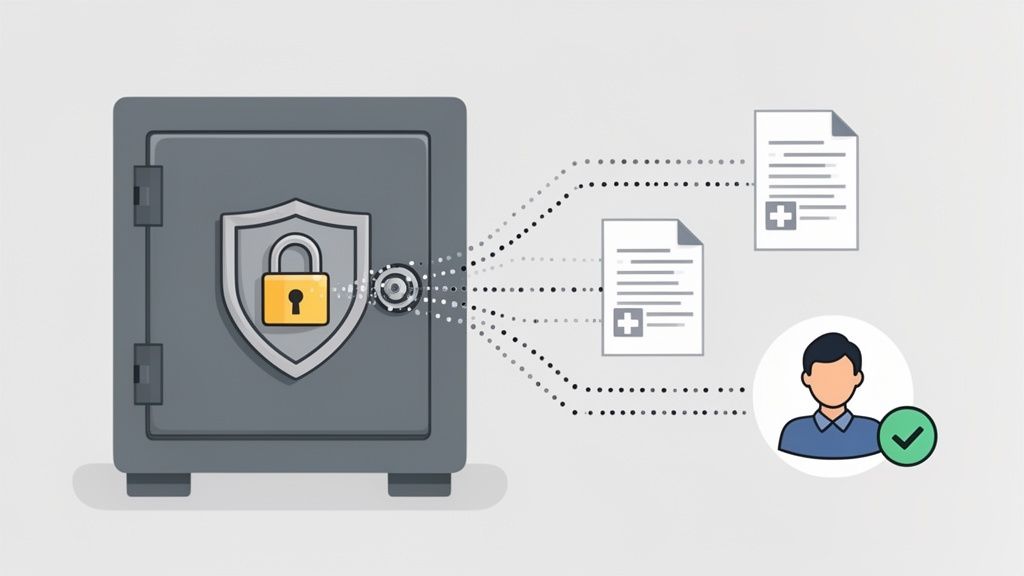
This reality makes data security a non-negotiable part of any records retrieval solution. Partnering with a vendor who cuts corners on compliance is a gamble no firm can afford. Think of a truly HIPAA-compliant platform as a digital Fort Knox, engineered from the ground up to shield sensitive information from any and all unauthorized access. It’s not just another feature; it's the very foundation of the service.
What True HIPAA Compliance Looks Like
Real compliance isn't just a badge on a website. It's a deep-seated commitment backed by a solid framework of technical safeguards and strict operational rules that protect data integrity from the moment a request is sent to the final case summary. Your technology partner needs to prove their commitment, not just state it.
The second your firm hires a retrieval service to handle PHI, that vendor legally becomes a "Business Associate" under HIPAA. This designation requires them to sign a Business Associate Agreement (BAA), a contract that binds them to the exact same stringent data protection standards your firm must follow.
Without a signed BAA, your firm is left wide open to liability. Make this document your first and most critical checkpoint when vetting any potential records retrieval partner. To truly lock down security and regulatory adherence, it's wise to implement a robust HIPAA compliant document management system.
Core Security Features to Demand
When you're evaluating a platform, you need to look past the marketing and dig into the specific, tangible security measures they have in place. These features are the digital locks, alarms, and surveillance systems guarding your client's most private information.
Here are the absolute essentials you should verify:
- End-to-End Encryption: Data must be scrambled and unreadable both in transit (as it travels over the internet) and at rest (when it's stored on a server). This makes the information useless to anyone who might intercept it.
- Strict Access Controls: The platform must let you assign specific roles and permissions, ensuring paralegals, attorneys, and assistants can only access the case files they're actively working on.
- Multi-Factor Authentication (MFA): A simple password is no longer enough. MFA adds a vital security layer by requiring a second form of verification, like a code sent to a user's phone, before granting access.
- Auditable Activity Logs: Every single action taken within the system—from who viewed a document to when a summary was exported—must be logged. These audit trails are crucial for accountability and for investigating any potential security issue.
Even though 96% of hospitals have adopted EHRs, the systems often don't talk to each other, causing frustrating delays. HIPAA gives providers 30 days to respond to records requests, but the best retrieval services now cut that time in half, with an average 15-day turnaround. This is exactly why a secure, efficient platform is so indispensable for a modern PI practice.
Choosing the right partner means you prioritize security just as highly as you do speed. Your duty to protect client confidentiality is paramount. A truly compliant solution is the only way to honor that trust while building winning cases. Dig deeper into HIPAA-compliant document management to further strengthen your firm's data security.
Measuring the Real ROI for Your Personal Injury Firm
Investing in new technology is always a big decision, and it really comes down to one thing: does it deliver a clear, measurable return? When you start looking at modern records retrieval solutions, the ROI goes way beyond a simple cost-benefit calculation. The real value is in the tangible gains you'll see across your firm's efficiency, its financial health, and its ability to win bigger for clients.

It’s easy to get stuck on just the saved labor costs, but that’s only one small piece of the puzzle. To really understand the impact, you have to look at how automating your retrieval process touches every part of your practice. Let's break down where you'll see the biggest gains.
Quantifying Gains in Operational Efficiency
The first and most obvious win is getting your team’s time back. Manual retrieval is a notorious black hole for paralegal and admin hours—a swamp of non-billable tasks that drains resources.
Just think about the daily grind of manual follow-ups. A paralegal can easily burn hours every single week just calling providers, checking on the status of a request, and meticulously documenting every interaction. An automated platform simply erases that work from their to-do list. This frees up your best people to focus on tasks that actually drive a case forward, like drafting motions or prepping for a deposition.
Firms that make this switch consistently report saving 10 or more hours of administrative work per case. If your firm handles 50 cases a year, that’s a minimum of 500 hours of high-value time you’ve just reclaimed. This isn't just about efficiency; it's about better morale and faster case progression.
Analyzing the Impact on Financial Performance
Saving time is great, but a modern records retrieval solution also directly bolsters your firm's bottom line. The clearest win is the reduction in administrative overhead. When you automate retrieval, you can handle a higher caseload without having to hire more support staff, allowing your firm to scale much more profitably.
Take a look at these direct financial benefits:
- Reduced Overhead: You're spending less on the tangible costs of printing, postage, and all the other little expenses that come with manual processing.
- Increased Capacity: Your current team can manage more cases without burning out. This directly boosts the firm’s revenue potential without a matching jump in payroll.
- Predictable Costs: Many solutions offer flat-fee or predictable pricing. This gets you out of the nickel-and-dime game of surprise provider fees and staff overtime, making budgeting far easier.
By transforming a major operational bottleneck into a streamlined, automated process, a retrieval platform allows your firm to do more with less. It’s a direct lever for improving your profit margin on every single case you handle.
This improved financial stability gives you the resources to take on more complex, high-value cases, which is what really fuels a firm's growth and reputation.
Connecting Technology to Better Case Outcomes
This is where the ROI becomes truly powerful. When you get complete, organized medical evidence faster, you empower your attorneys to build stronger arguments, negotiate from a position of strength, and secure better settlements. This isn't some abstract benefit—it has a direct, measurable impact on your results.
Imagine having a complete, searchable, and summarized medical file weeks or even months earlier than you do now. Your legal team gets a critical head start. They have more time to dig in, find the smoking gun, spot potential weaknesses, and craft a truly compelling narrative for the demand letter.
This advantage translates into real-world wins:
- Faster Settlements: With all the evidence in hand sooner, demand letters go out faster. This shortens the entire case lifecycle, from intake to check in hand.
- Stronger Negotiations: Attorneys walk into negotiations completely prepared, with every piece of medical evidence organized and at their fingertips. This confidence leads to higher settlement offers.
- Improved Client Satisfaction: Faster resolutions and better outcomes are what every client wants. A happy client is your best source of referrals, building your firm's reputation for years to come.
Ultimately, the ROI of a modern records retrieval solution acts as a multiplier for your entire firm. It starts with making your operations more efficient, which strengthens your finances, and culminates in what matters most: delivering superior results for the clients who trust you.
How to Choose the Right Records Retrieval Partner
Picking a records retrieval partner is one of those decisions that can quietly make or break your firm’s efficiency. On the surface, it seems like a simple administrative task, but get it wrong, and you're stuck with bottlenecks that slow down every single case. The goal is to move past the slick sales decks and find a true operational partner, not just a document courier.
This isn't a niche service anymore. The global market for medical records retrieval recently topped $1.1 billion, and the legal sector is the primary driver. Personal injury, mass tort, and med-mal firms are now responsible for roughly 35% of all retrieval requests nationwide. This tells us something important: retrieval has grown from a back-office chore into a strategic function that demands serious technology. You can dig into more of the numbers and market drivers on Insightace Analytic.
Because the stakes are higher, your evaluation process needs to be just as sophisticated. A thoughtful approach ensures you find a partner that can keep up with you today and scale with you tomorrow.
Go Beyond Retrieval to Full-Workflow Support
The first question you should ask is, "What happens after the records arrive?" If the answer is that your team has to start from scratch organizing, reviewing, and summarizing, you're only solving a fraction of the problem. Simply getting a PDF faster isn't the win you think it is.
Look for a partner that sees the whole picture and handles the entire workflow:
- Hands-Off Retrieval: They should manage every phone call, follow-up, and secure delivery without you ever lifting a finger.
- Intelligent Organization: The records you receive shouldn't be a 500-page mess. They should arrive OCR'd, indexed, and fully searchable from day one.
- AI-Powered Summarization: The platform should be able to instantly generate accurate medical chronologies and case summaries, turning weeks of paralegal work into minutes.
- Demand Letter Drafting: The best solutions use all that extracted data to produce a solid first draft of your demand letter, giving your team a massive head start.
A true end-to-end partner doesn’t just speed up one step; they remove entire stages of manual work from your plate. That’s how you start handling more cases without burning out your staff.
Insist on a Real-World Pilot Program
Never sign a contract based on a canned demo. Demos are designed to be flawless. Your cases are anything but. The only way to know if a platform can handle the chaos of real-world personal injury work is to put it to the test with your own files.
A live pilot using one of your complex case files is the ultimate litmus test. It cuts through sales pitches and provides concrete evidence of how the platform performs when faced with real-world provider delays, mixed document formats, and unique case requirements.
Before you commit, ask to run a pilot with a handful of your active cases. Track everything: turnaround times, the accuracy of the AI summaries, and how quickly their support team responds when—not if—something goes sideways.
Evaluate Key Technical and Support Criteria
As you start comparing records retrieval solutions, a simple checklist can help you cut through the noise and make a fair, apples-to-apples comparison. Your final decision should hinge on a clear-eyed look at these crucial factors.
| Feature Category | Critical Questions to Ask Vendors | Why It Matters |
|---|---|---|
| Integration | Does your platform talk to our case management software (like Filevine or Clio)? | If it doesn't integrate, you're just creating more manual data entry for your team. Seamless integration is a must-have for real efficiency. |
| AI Accuracy | What’s the validated accuracy of your AI for pulling medical data? Can you show me what it does with one of my files? | The entire value proposition rests on the AI's ability to reliably spot diagnoses, treatments, and dates. You need proof, not just promises. |
| Security | Where is your HIPAA Business Associate Agreement (BAA)? Are you SOC 2 certified? | This is non-negotiable. A security misstep could expose your firm to massive legal and reputational damage. Don’t take their word for it; ask for the paperwork. |
| Pricing | Is it a flat fee per request, a subscription, or some hybrid? Are we paying provider fees directly, or are they baked in? | You need a predictable pricing model to budget effectively. Hidden fees and surprise "pass-through" costs can completely destroy your return on investment. |
| Support | What does onboarding look like? Will we have a dedicated person to call when we have a problem? | A great platform with poor support is a useless platform. Look for a partner who will invest in your team's success with structured training and responsive help. |
Using this structured approach, you can move beyond the marketing hype and choose a records retrieval partner that will genuinely act as a force multiplier for your firm—helping you save time, build stronger cases, and win better outcomes for your clients.
Integrating a New Solution into Your Firm's Workflow
Even the best software on the market will just sit there collecting digital dust if your team doesn't actually use it. Bringing a new records retrieval solution into your firm isn't as simple as flipping a switch. It takes a smart, deliberate strategy to weave the platform into the daily rhythm of your operations, making it a natural, indispensable part of how you manage cases.
The journey starts with a solid implementation plan. This isn't just about the technical setup; it’s a full roadmap covering everything from securely migrating data to running hands-on training sessions. That training is absolutely key, and it needs to speak directly to the different roles in your firm. A paralegal's needs are different from a managing attorney's, and both have to see exactly how this tool makes their specific job easier.
Establishing Standardized Workflows
Consistency is everything when you're trying to get the most out of a new tool. If you let every team member figure out their own way of doing things, you’ll never see the real efficiency gains. The goal is to establish a single, repeatable process from the very beginning, so every case gets the same streamlined treatment.
Your firm's new standard operating procedure should include a few key things:
- Creating Request Templates: Build out a library of ready-to-go templates for your most common requests—initial medical files, billing ledgers, radiology reports, you name it. This cuts down on repetitive work and dramatically reduces the risk of manual errors.
- Defining User Roles: Set up clear permissions within the software. This is about control and security, making sure only the right people can access sensitive client information or sign off on retrieval expenses.
- Centralizing Status Tracking: Make the new platform the one and only place to track request status. No more scattered spreadsheets or lost email threads. This creates a single source of truth that everyone on the case team can rely on.
By putting these clear guidelines in place, you’re not just adding a new system; you’re making it incredibly easy for your team to adopt it the right way. Thinking about how modern legal practice management software works can provide a great framework for optimizing these new internal processes.
Driving Adoption and Ensuring Collaboration
A successful launch is about more than just good training—it's about genuine buy-in. Leadership has to be the biggest champion of the new solution. You need to constantly communicate how it helps the firm’s bottom line, sure, but more importantly, how it makes each person's day-to-day work less of a grind. Show them exactly how it gets rid of their most hated tasks, like spending hours on the phone chasing down providers.
True adoption happens when a tool moves from being a mandate to a preference. When your team sees the platform as the easiest and fastest way to get their work done, you've successfully integrated it into your workflow.
The other huge win here is seamless collaboration. The right platform demolishes information silos. Suddenly, everyone working on a case, from the paralegal handling the intake to the senior partner planning the strategy, can see the exact same real-time status of every record request. This shared visibility keeps the entire team in sync and gives them the confidence to push cases forward without delay.
If you want to dig deeper into improving your firm's processes, check out our guide to legal workflow automation. Following these steps will help you sidestep the common pitfalls of new software rollouts and turn your records retrieval solution into a powerful asset from day one.
Unpacking the Details: Your Questions Answered
Switching from the old, manual way of doing things always brings up questions. It's a big move. You're not just buying software; you're investing in your firm's future efficiency, so you need straight answers. Let's tackle some of the most common questions we hear from personal injury firms just like yours.
The whole point here is to cut through the tech talk and get to what really matters: how this kind of platform actually changes your day-to-day work, shortens your case cycles, and ultimately, helps you serve your clients better.
How Much Time Can We Really Save on a Case?
This is usually the first thing everyone wants to know, and for good reason. The answer is significant. Most firms that make the switch report saving 10 or more hours of pure administrative work on every single case.
Where does that time come from? It's all the tedious, soul-crushing stuff your staff is currently stuck doing. Think about the hours spent on hold with a provider's office, the back-and-forth with fax machines, and the endless follow-up calls just to check a status. A great platform handles all of that automatically, freeing up your team to focus on work that actually moves cases forward.
The time saved isn't just about getting paperwork done faster. It’s about empowering your most valuable asset—your people—to spend their brainpower on legal strategy, deep-dive analysis, and the client communication that wins cases.
Can We Actually Trust an AI-Generated Summary?
Accuracy is everything in this business, and modern records retrieval solutions are built from the ground up with that in mind. The AI isn't just a generic tool; it's a highly specialized model that has been trained on millions of medical documents. It knows how to spot and pull out crucial details like diagnoses, treatment dates, and provider names with incredible precision.
The best way to think about it is this: the AI gives you an incredibly thorough and well-organized first draft. It lays out all the facts in a structured, searchable format. A paralegal or attorney then steps in to review and refine it, adding the critical legal context and strategic thinking that only a human expert can bring to the table.
What Happens With Old-School Providers Who Still Use Fax and Paper?
Let's be realistic—plenty of healthcare providers are still stuck in the age of paper and fax machines. A truly modern retrieval platform is built for this messy, hybrid world.
- Digital First: When a provider is on a digital network, the system sends a secure electronic request. It's fast and efficient.
- Old-School Handled: For providers who insist on fax, mail, or phone calls, the service takes care of it. Your team doesn't have to touch a fax machine or pick up the phone to chase them down.
- Paper to Pixels: The moment paper records arrive, they are immediately scanned with powerful OCR technology. This turns them into a fully digital, searchable file that lives right alongside your other case documents.
This approach means you get a single, organized, and completely digital case file, no matter how the records started out. It's the only way to really tame the chaos of the current healthcare system.
Ready to stop the manual grind and get your cases moving faster? With Ares, your firm can put medical record review and demand letter drafting on autopilot, saving over 10 hours per case. See how our AI-powered platform transforms stacks of confusing documents into clear, case-winning insights. Get started with Ares today.