
Don't think of an auto accident demand letter sample as a simple form you just fill in. A well-crafted demand letter is your first real move in the negotiation game. It's about taking control of the story from the outset and anchoring the conversation around a number that works for your client. This isn't just a procedural step; it's your opening argument.
Beyond Templates: The Strategy of a Demand Letter

Too many lawyers treat the demand letter like a box to check before the real work begins. They grab a generic template, plug in some dates and numbers, and send it off. Honestly, that’s a huge missed opportunity. You’re letting the insurance carrier set the tone and the terms.
A truly effective demand letter is a persuasive story backed by cold, hard evidence. The goal is to make the adjuster see the person behind the claim number, making it much harder for them to send back a lowball offer. It lays out the facts, pins down liability, and paints a full picture of the damages before you ever get to formal discovery.
Crafting a Narrative, Not Just a Document
The best demands take a jumble of medical records, bills, and timelines and weave them into a clear, compelling story about your client's life post-accident.
Don't just say your client has a "herniated disc." Explain what that actually means for them. Detail how that injury now prevents them from picking up their toddler, how the pain keeps them awake at night, and how it's putting their entire career in jeopardy.
This storytelling approach is non-negotiable for a few key reasons:
- It anchors the negotiation. Your valuation becomes the starting point. You're forcing the adjuster to argue down from your well-supported number, not the other way around.
- It shows you're ready to fight. A meticulously detailed, evidence-heavy letter sends a clear signal: we are organized, we are thorough, and we are not afraid of litigation.
- It humanizes the claim. You shift the focus from a sterile financial calculation to the real, painful consequences of the defendant’s negligence.
Globally, the scale of this problem is staggering. The World Health Organization's 2023 report found that road traffic accidents kill approximately 1.19 million people every year. This statistic underscores just how critical it is to have sharp, effective legal strategies in place for these cases. You can read more about these global road safety findings on who.int.
A great demand letter makes the adjuster's job easier while simultaneously making it much harder for them to justify a low offer. It lays out the case so logically that a fair settlement becomes their path of least resistance.
While this guide focuses on the strategy behind the letter itself, using tools like legal document automation software can help organize the chaos. It’s about turning a stack of medical files into that persuasive narrative you need to kick off negotiations on the right foot. For a deeper dive, you might find value in our guide that further breaks down https://areslegal.ai/blog/what-is-a-demand-letter and its core purpose.
Breaking Down a Winning Demand Letter
Let's get practical. A powerful demand letter is more than just a summary of facts; it’s a carefully crafted narrative that walks the insurance adjuster through exactly what happened, why their insured is at fault, and precisely what it will take to make your client whole.
Each section should flow logically into the next, building a compelling argument that’s tough for any adjuster to poke holes in. We'll dissect the core components and look at sample language, focusing on the strategy behind every word. This is how you turn a file of dry medical records into a persuasive story about a real person.
The Opening: Setting a Professional Tone
Your introduction needs to be direct, professional, and leave no room for confusion. It’s a simple but critical section that immediately identifies everyone involved, establishes the context, and clearly states your purpose.
Here's an example of how to do it right:
"This letter is a formal demand for settlement on behalf of my client, Ms. Jane Doe. We are seeking compensation for the significant personal injuries and financial damages she suffered in the motor vehicle collision on January 15, 2024. The accident was caused by the clear negligence of your insured, Mr. John Smith, under policy number XYZ-12345."
This opening gets straight to the point. It names our client, the at-fault driver, the policy number, and the date of the incident. Most importantly, it asserts negligence from the very first paragraph, setting a firm but professional tone for everything that follows.
The Narrative: Establishing Clear Liability
This is where you tell the story of the crash. Your goal here is to present a clean, objective summary of the facts that points to one inescapable conclusion: their insured was at fault.
If you have an official police report, lean on it. Citing an officer's conclusion adds a powerful layer of third-party authority to your account. Your description should be simple and chronological.
- Set the Scene: Briefly describe the location, time of day, and any relevant conditions.
- Detail Your Client's Actions: Explain what your client was doing, making sure to highlight that they were following all traffic laws. (e.g., "Ms. Doe was traveling eastbound on Maple Avenue, well within the posted 35 MPH speed limit, and proceeded into the intersection on a green light.")
- Pinpoint the Negligence: State exactly what the at-fault driver did wrong. (e.g., "Your insured, Mr. Smith, who was traveling northbound on Oak Street, disregarded his solid red light and drove directly into the path of Ms. Doe's vehicle, causing a violent T-bone collision.")
A Quick Word of Advice: Resist the urge to use emotional or accusatory language here. Let the facts and the evidence, like a citation from the police report, do the heavy lifting. A calm, evidence-based account is far more convincing to a claims adjuster than an angry rant.
The Human Element: Injuries and Medical Treatment
Now, we shift from the mechanics of the crash to its human cost. This is your chance to translate cold medical terminology into a compelling story of pain, suffering, and a long road to recovery. Don't just list the injuries—describe their impact.
Take a look at this example:
"The force of the impact caused Ms. Doe to sustain a Grade II cervical sprain (whiplash) and a herniated disc at L4-L5. She was transported by ambulance to City General Hospital, where ER staff documented her immediate and severe pain. Her road to recovery has involved a six-week course of physical therapy at Motion Rehab, a series of three epidural steroid injections with Dr. Susan Jones, and ongoing use of prescription pain medication."
See the difference? We didn't just say "whiplash." We connected the specific diagnoses to the violent nature of the crash and then laid out a clear timeline of all the medical care she needed. This paints a vivid picture for the adjuster, showing a logical and necessary progression of treatment.
The Bottom Line: Calculating Damages and Making the Demand
This is it—the culmination of your entire letter. Here, you'll meticulously break down all the economic ("special") and non-economic ("general") damages before stating your final settlement demand.
- Economic Damages: This is the easy part. Present a clear, itemized list of every verifiable financial loss.
- Total Medical Bills: $21,450.80 (All records and bills are attached and tabbed as Exhibit A)
- Lost Wages: $5,600.00 (Verification letter from her employer is attached as Exhibit B)
- Out-of-Pocket Costs: $7,890.00 (Includes property damage deductible and rental car expenses)
- Non-Economic Damages: This is where your narrative skills come back into play. You need to justify your valuation for pain and suffering by referencing the story you've already told about the injuries, the grueling recovery, and the lasting impact on your client's life.
- The Final Number: State your total demand in a clear, unambiguous sentence. For example: "Based on the clear liability of your insured and the significant damages detailed above, we hereby demand the sum of $95,000.00 to resolve this claim."
To help you organize your next letter, we've put together a quick-reference table breaking down these essential components.
Key Components of an Effective Demand Letter
This table summarizes the core sections of a demand letter, highlighting the strategic purpose of each and offering an expert tip to make your draft as effective as possible.
| Letter Section | Core Purpose | Pro Tip for Maximum Impact |
|---|---|---|
| Introduction | To clearly state the parties, date of loss, and intent to seek a settlement. | Immediately reference the claim number and at-fault party's policy number to expedite routing. |
| Liability Narrative | To present an undeniable, fact-based account of the insured’s negligence. | Quote the police report directly or reference the specific traffic statute the insured violated. |
| Injuries & Treatment | To detail the medical consequences and the path to recovery. | Create a chronological summary of treatment to show a clear and logical progression of care. |
| Damages & Demand | To itemize all financial and non-financial losses and state the final settlement figure. | Organize all supporting documents with exhibit tabs (A, B, C) and reference them in the letter. |
By thinking about each section strategically, you can ensure your letter not only presents the facts but also tells a compelling story that justifies your demand and puts your firm in the strongest possible position to negotiate.
How To Calculate And Justify Your Demand
The number you put at the end of your demand letter is more than just a figure—it’s the anchor for your entire negotiation. This isn't a number you just pull out of thin air. It has to be a meticulously constructed argument, built on a solid foundation of real-world losses and justifiable suffering. When you get this part right, your demand letter stops being a hopeful request and becomes a credible threat of what a jury might award.
The whole process boils down to two distinct categories of damages: special damages (the economic stuff) and general damages (the non-economic, human stuff). Think of special damages as the receipts—the concrete, calculable costs your client has shouldered because of someone else's negligence.
This flowchart really breaks down the anatomy of a powerful demand letter. It shows how framing the facts and building a compelling story leads directly to the final number.
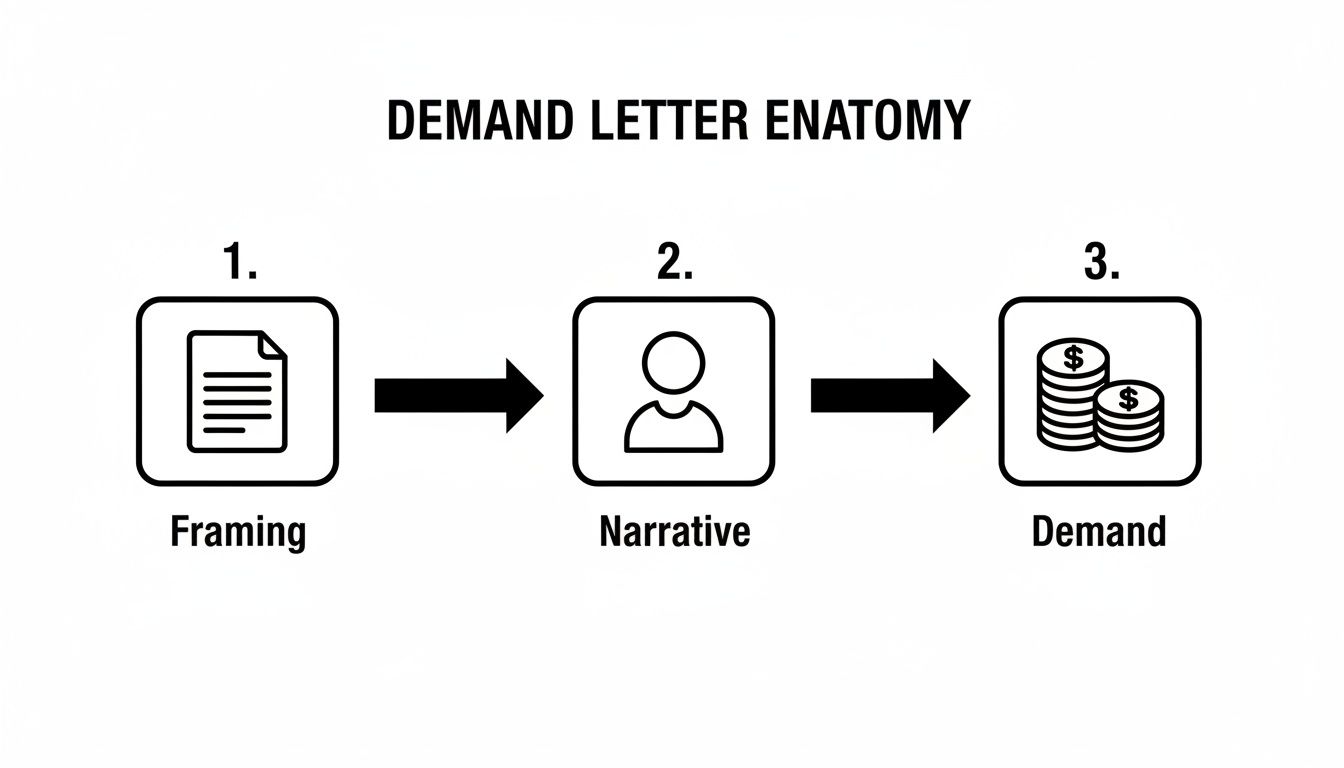
As you can see, the demand isn't just a number tacked on at the end. It's the logical conclusion to the story you've just told.
Tallying the Tangible Costs
Let’s start with the easy part: special damages. These are the objective, verifiable financial losses that came directly from the accident. Your job here is to create an itemized list so clean and clear that an adjuster can tick off each item against the evidence you provide.
Your list must cover everything:
- Past Medical Expenses: Every single bill. From the ambulance ride and ER visit to the physical therapy sessions, specialist consultations, and pharmacy receipts.
- Future Medical Costs: If your client’s recovery is ongoing, you have to account for it. This isn't guesswork. You'll often need a solid opinion from a physician or a life care planner to project the cost of future surgeries, therapy, or long-term medication needs.
- Lost Wages: This is the income your client lost because they couldn't work. To prove it, you’ll need pay stubs and a verification letter from their employer.
- Loss of Earning Capacity: This is a big one and it’s different from lost wages. It comes into play when an injury permanently hobbles your client's ability to earn a living in the future. Proving this usually requires a report from a vocational expert.
- Out-of-Pocket Expenses: Don't let the small stuff slide. I'm talking about the cost of gas for medical appointments, property damage deductibles, and even the cost of hiring help for household chores your client could no longer do.
These numbers add up, and they add up fast. Just look at the national statistics. The annual economic toll of fatal crashes alone is a staggering $417 billion. Even crashes that don't involve a death, like the ones caused by distracted driving that injured 324,819 people in 2023, contribute to this massive financial burden. Using figures like these can provide powerful context for why your settlement demand is not just reasonable, but necessary.
Quantifying the Intangible Pain
Now for the hard part. General damages—what we all know as pain and suffering—are far more subjective, but they're often the largest piece of the settlement pie. This is where you make the case for the physical pain, the emotional trauma, and the sheer loss of quality of life your client has endured.
A go-to method for this is the multiplier method. You take the total special damages (mostly the medical bills) and multiply it by a number, usually somewhere between 1.5 and 5. The multiplier you choose is everything, and it depends entirely on the severity of the case.
A low-impact rear-ender where the client recovers quickly might get a 1.5x or 2x multiplier. But a catastrophic injury that leaves someone with a permanent disability, chronic pain, or deep emotional scars could easily justify a 4x or 5x multiplier.
The trick isn't just picking a number; it's justifying it. You have to tie that multiplier directly to the evidence.
Let’s look at a real-world example. Say your client suffered a traumatic brain injury (TBI).
- A Lower Multiplier (e.g., 2.5x): Your client had a concussion and dealt with headaches for a few months. But their neurologist confirms they made a full recovery with no lasting cognitive deficits. The story has a clear ending.
- A Higher Multiplier (e.g., 4.5x): The TBI resulted in permanent memory loss, noticeable personality changes, and an inability to return to their career. You have medical records from multiple specialists, plus powerful testimony from family members, all documenting a life that has been permanently and devastatingly altered.
Your demand needs to explicitly state the multiplier you used and then launch into a narrative that defends that number, referencing specific medical records and life impacts. When you build your case this way, you make it much, much harder for an adjuster to just take a red pen to your demand for non-economic damages.
For a deeper dive into these calculations, check out our guide on how to calculate pain and suffering damages.
Building An Undeniable Evidence Package
A demand letter without a robust evidence package is just an opinion. The letter tells the story, but the attachments are what prove it. Frankly, the entire weight of your argument rests on the quality, organization, and completeness of the documents you provide. I always tell my team to think of it as building a trial binder before we ever even think about filing a lawsuit.
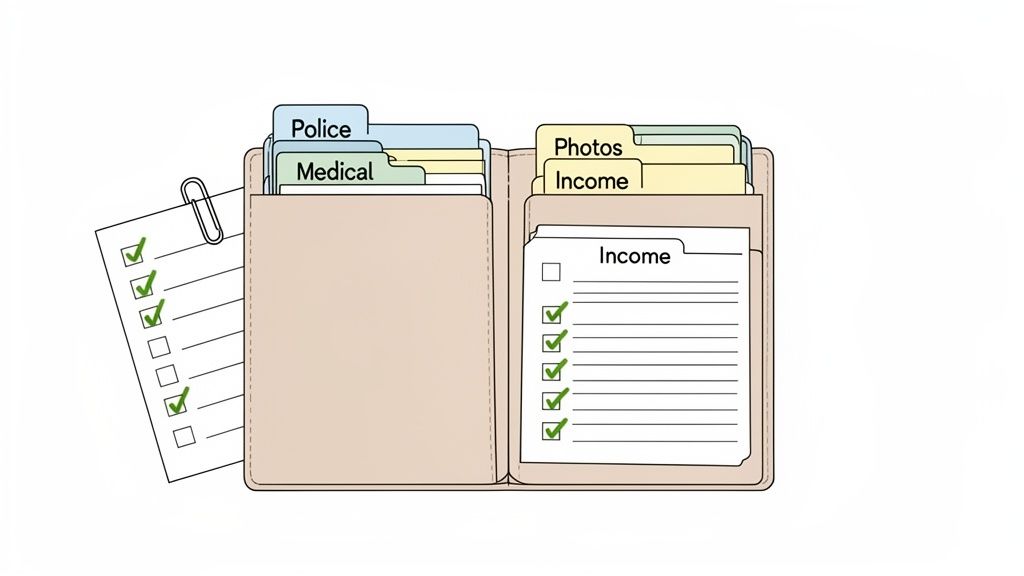
Imagine you're the adjuster. When a thick, meticulously organized set of exhibits lands on your desk, it sends a powerful message. It says you're not just fishing for a quick payout; you're fully prepared to litigate. This simple act of thorough preparation often gets you higher, faster offers because you’ve made the adjuster's job easier while simultaneously showcasing the undeniable strength of your case.
Documents That Establish Liability
Before you can even get to the money, you have to nail down fault. No question. The documents you present here are the bedrock of your claim, leaving zero room for the adjuster to argue about who caused the collision.
Your liability evidence absolutely must include:
- The Official Police Report: This is your cornerstone. Be sure to highlight the officer’s narrative, any citations slapped on the at-fault driver, and the crash scene diagrams.
- Witness Statements: If you have statements from independent third parties, they are gold. An unbiased account that backs up your client's story is incredibly difficult for an adjuster to ignore.
- Scene and Vehicle Photographs: You need clear, compelling photos of everything—the vehicle damage, skid marks, road conditions, and any relevant traffic signals. These visuals help the adjuster see exactly what happened.
By leading with this evidence, you frame the entire negotiation. The other driver’s negligence is a settled fact. You're not asking the adjuster to believe your story; you're showing them irrefutable proof.
The Core of Your Damages Claim: Medical Records
This is where the real work begins and where most of your evidence package will live. Disorganized or incomplete medical records are a giant red flag for adjusters. It immediately signals that you might not have a full grasp on the case, and they will pounce on that weakness.
A common mistake I see is attorneys simply dumping a stack of unsorted bills on the adjuster. A winning strategy involves organizing every record chronologically, tabbing each provider, and creating a medical summary that directly connects each treatment to the injuries from the accident.
Your medical evidence package needs to contain:
- Initial Treatment Records: This means the ambulance run sheets, ER admission forms, and the first doctor consultations. These documents capture the immediate aftermath and are critical for establishing causation.
- Diagnostic Imaging Reports: Don't just send the bill for the MRI. You need to include the radiologist's actual report detailing findings like disc herniations, fractures, or soft tissue damage.
- Treatment Notes and Bills: Every single bill from physical therapists, chiropractors, specialists, and pharmacies must be included and organized logically.
Curating these documents is a major undertaking, but there are no shortcuts. For a deeper dive into this crucial process, you can explore our guide on how to organize medical records for maximum impact.
Proving Financial and Non-Economic Losses
Finally, you need to document every single dollar of economic loss and provide powerful context for the non-economic damages. These are the documents that translate your client’s pain and suffering into concrete figures the insurance company can actually process and pay.
Your proof of damages should always include:
- Lost Wage Verification: A letter from the client's employer on official letterhead is the standard. It must detail the client’s pay rate, all hours missed, and the total income lost as a direct result of the accident.
- Repair Estimates and Property Damage Photos: Always include the professional body shop estimate and clear photos showing the full extent of the damage to your client’s vehicle.
- Pain and Suffering Documentation: This is subjective, but you can substantiate it. Use photos of visible injuries, excerpts from a client’s personal journal detailing their daily struggles, or even letters from family members describing the dramatic change in the client's quality of life.
When you assemble it all correctly, this undeniable evidence package transforms your auto accident demand letter sample from a simple request into a formal, evidence-backed presentation that demands a serious, top-dollar response.
Costly Mistakes That Weaken Your Demand Letter
Drafting a compelling demand letter is as much about what you don't do as what you do. I've seen beautifully documented cases get kneecapped right out of the gate by simple, unforced errors that completely tank a firm's credibility with an insurance adjuster. These missteps can turn what should be a strong opening into a frustrating, uphill negotiation.
One of the most common and damaging mistakes is letting emotion creep into the letter. It’s tempting to use aggressive language, calling the other driver's actions "outrageous" or "appalling," but this is a rookie move. To an experienced adjuster, that kind of language screams that your arguments are built on emotion, not on cold, hard facts.
Keep it professional and dispassionate. Let the police report, the medical records, and the crash scene photos tell the story of how severe the incident was. A calm, fact-driven tone demonstrates that you're confident in the merits of your case and are approaching this negotiation like a serious professional, not a hothead.
Ignoring Potential Weaknesses in Your Case
Another fatal flaw is pretending your case is perfect. It never is. Maybe your client had a pre-existing condition, or perhaps there's a whiff of comparative negligence. Simply ignoring these issues and hoping the adjuster won't notice is a strategy that always backfires.
Trust me, the adjuster’s job is to find these weak spots. When you pretend they don't exist, you lose all credibility and hand them the exact ammunition they need to slash your demand. A far more powerful approach is to get out in front of these issues and frame them on your own terms.
- Pre-existing Condition? Acknowledge it directly. Then, use the medical evidence to draw a clear line showing precisely how the crash aggravated or exacerbated that specific injury.
- Comparative Fault? Concede a minor point—maybe your client was going 5 mph over the speed limit. Then, immediately pivot to show how the defendant’s far more reckless action, like running a red light, was the primary and overwhelming cause of the collision.
When you address these points proactively, you show the adjuster you've done your homework and are negotiating in good faith. It completely deflates their counterargument before they can even make it.
When you control the narrative around a case weakness, you frame it on your terms. When you hide it, you give the adjuster the power to define its significance, almost always to your client's detriment.
The Dangers of Vague and Unsupported Claims
Your demand is only as strong as the evidence you attach to it. General statements and unsupported claims are basically an open invitation for a lowball offer. Every single assertion you make, from medical diagnoses to lost income, must be directly tied to a specific document.
Just look at the difference between these two examples:
- Weak & Vague: "My client suffered serious back pain and couldn't work for a while."
- Strong & Supported: "As documented in Dr. Smith's report (Exhibit C), the collision caused a disc herniation at L4-L5. This injury directly resulted in Ms. Davis being placed on a no-work order for six weeks, leading to $5,600 in lost wages (see Exhibit D)."
The second version is infinitely more persuasive because it’s precise, factual, and backed by proof. An adjuster can't easily dismiss a doctor's report or an employer's wage verification. This kind of detail in your auto accident demand letter sample sends a clear signal that you are organized, prepared, and not someone they can push around. Using case management software or other tools to meticulously review records can help you catch inconsistencies before they turn into costly errors.
Answering the Tough Questions: Demand Letter FAQs
Even seasoned paralegals and attorneys run into tricky situations when drafting a demand letter. The theory is one thing, but the real-world application is another. Getting the strategic details right can be the difference between a quick, fair settlement and a protracted fight.
Here are some of the most common questions that pop up, along with practical, field-tested answers.
How Long Should I Wait for a Response?
This is a classic question. While no law dictates a response time, you absolutely need to set the pace. Don't leave it open-ended.
The industry standard is to give them 30 days. For most adjusters, that’s a reasonable window to review the file, run the numbers, and get settlement authority. It shows you’re serious but fair.
Of course, you have to use your judgment. If it’s a straightforward soft-tissue case with a few chiro visits, 30 days is more than enough. But if you’ve sent them a mountain of paperwork for a catastrophic injury—complete with expert reports and a life care plan—you might extend it to 45 or even 60 days. The key is to be reasonable but firm. State your deadline clearly in the letter, and be ready to follow up the very next day if you haven't heard back.
Should I Make the First Offer or Wait for Them?
Your demand letter is your first offer. Full stop.
One of the biggest blunders you can make is to send a demand package without a specific dollar amount. Asking the adjuster, "So, what are you willing to pay?" is a rookie move that immediately puts you on the defensive. You're handing them all the power.
By putting a well-supported number on the table first, you achieve two critical goals:
- You anchor the negotiation. Your number becomes the high-water mark. The entire conversation now revolves around why they should pay less than your figure, rather than you clawing your way up from their inevitable lowball.
- You frame the case's value. A meticulously calculated demand shows the adjuster you’ve done your homework. It projects confidence and signals that you won't be easily pushed around.
Never, ever wait for the adjuster to make the first move. Your demand sets the financial and psychological tone for everything that follows.
What if Their First Offer is Insultingly Low?
First, take a breath. A lowball offer isn't personal; it's business. It’s a standard play from the adjuster’s handbook, designed to test your resolve and see if you really know what your case is worth. The absolute worst thing you can do is fire back an angry email or an equally ridiculous counteroffer.
Instead, see it for what it is: an invitation to school them on the facts.
A lowball offer is a chance to re-emphasize your case's strengths. Don't get emotional—get surgical. Systematically take their valuation apart by pointing back to the evidence you’ve already sent.
Your response letter shouldn't just say "no." It needs to explain precisely why their offer is unacceptable. For example: "Your offer of $25,000 seems to disregard the $42,000 in documented medical bills, which were attached as Exhibit C, as well as the permanent impairment rating from Dr. Evans, found in Exhibit F." This forces them to contend with your evidence, not just haggle over arbitrary numbers.
Should I Mention the Policy Limits?
This is a strategic judgment call. In most run-of-the-mill cases, you'll focus on justifying your client's damages. But when your client's damages are clearly and massively in excess of the available insurance, making a "policy-limits demand" can be a very powerful tactic.
This move puts incredible pressure on the insurance carrier. You're essentially telling them: "Here's your one chance to do the right thing and pay the full policy." If they refuse a reasonable demand to pay the limits and you later secure a jury verdict for more, they can be held liable for the entire judgment under a "bad faith" claim—even the amount above the policy.
Just be careful. This is a high-stakes move best reserved for cases with clear liability and truly catastrophic damages. For the average car wreck case, it's usually more effective to build your argument around the actual damages.
Drafting a demand letter that truly moves the needle takes time, skill, and an almost painful level of detail. Ares is built to handle the heavy lifting so your team can focus on high-level strategy. Our platform reads and analyzes medical records in minutes, pulling out the crucial facts you need. It then generates a structured, powerful demand letter draft, turning hours of tedious work into a few clicks. Stop drowning in paperwork and start settling cases faster and for what they're truly worth.
See how Ares can sharpen your firm's edge at https://areslegal.ai.