
In personal injury law, the clock is not just a suggestion—it's an unforgiving opponent. The 'statute of limitations' dictates the absolute deadline for filing a lawsuit, and missing it can invalidate an otherwise strong case, leading to malpractice claims and catastrophic client outcomes. This critical deadline isn't a single, national rule; it's a complex patchwork of state-specific laws, each with its own nuances, exceptions, and procedural traps that can easily derail a claim.
For any modern personal injury firm, mastering this complexity is non-negotiable. This guide provides a definitive statute of limitations by state personal injury roundup, designed specifically for legal professionals. We will explore the critical exceptions every attorney must know, from the discovery rule and tolling for minors to the distinct timelines for government and wrongful death claims.
In particularly complex cases, such as those involving a fatality, the timeline is just one piece of the puzzle. Securing objective scientific truth is paramount, and this often involves expert testimony. For a deeper dive into this aspect, understanding the crucial role of a wrongful death expert witness can provide valuable context on building a robust case from the ground up.
This article moves beyond simple lists to offer actionable insights and reveal how modern tools can transform this high-stakes administrative burden into a strategic advantage. Our goal is to ensure your firm never misses a critical date, protecting your clients, your practice, and your reputation.
1. Thomson Reuters Westlaw – 50 State Surveys
For legal professionals seeking authoritative, citable, and meticulously updated information on the statute of limitations by state personal injury, Thomson Reuters Westlaw's 50 State Surveys tool is a benchmark resource. It provides a comprehensive, at-a-glance comparison of state laws, saving practitioners countless hours of manual research across disparate jurisdictions. This platform is designed for litigation-grade accuracy, making it indispensable for firms handling multi-state cases or those needing to quickly verify deadlines for a new matter.
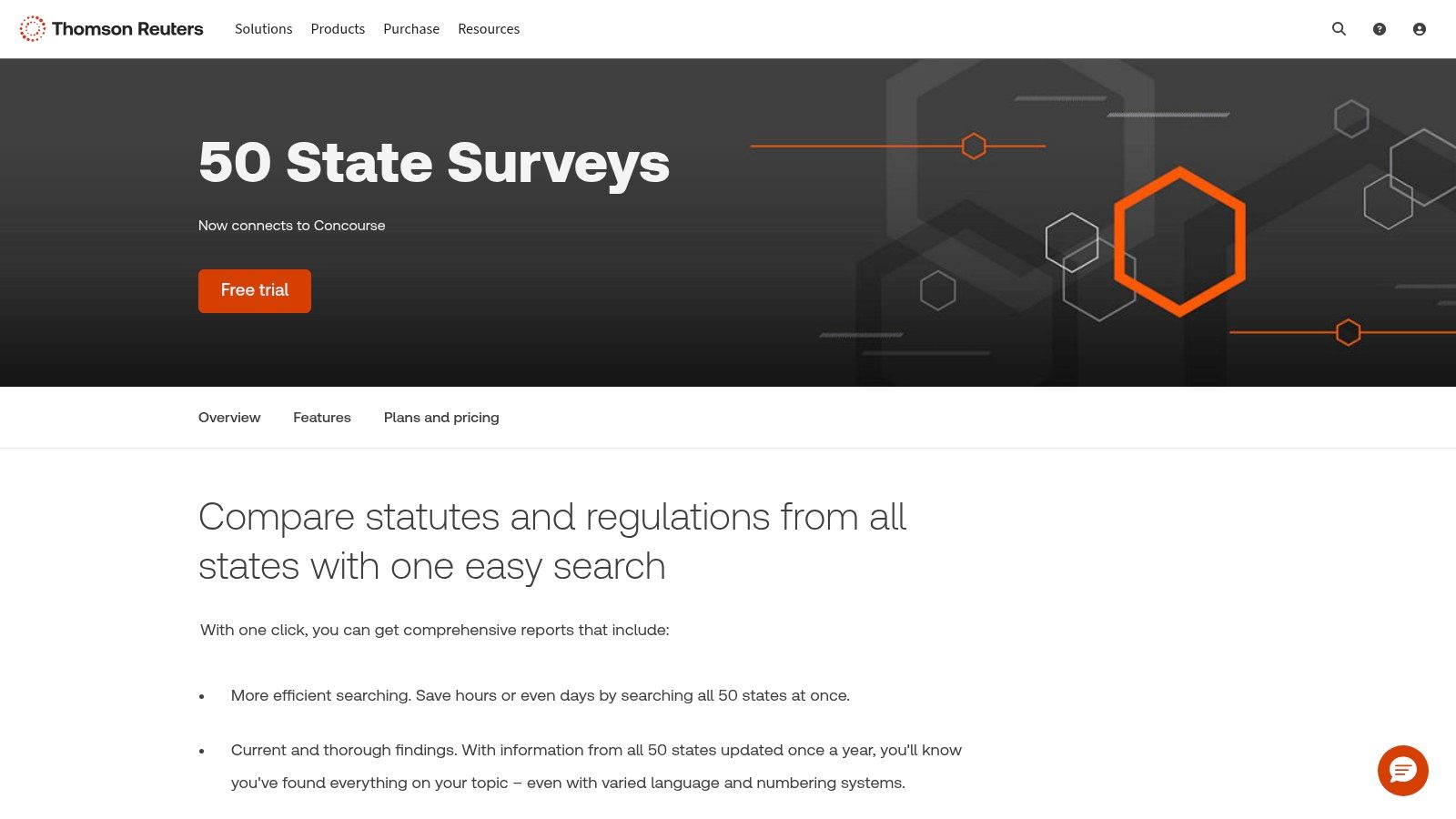
Unlike free online resources, Westlaw’s surveys are editorially curated and enhanced, providing not just the statutory text but direct links to controlling statutes, relevant case law, and secondary sources. This deep integration allows a litigator to move from a summary table to the primary source documents in a single click, a critical feature for efficient legal analysis. The platform's interface is built for legal research, presenting complex data in clear, exportable tables perfect for internal memos or client communications. Understanding these deadlines is a crucial first step in the litigation process, and you can see how they fit into the broader case lifecycle by reviewing a detailed personal injury settlement timeline.
Key Features and Practical Use
Westlaw’s primary advantage lies in its synthesis of information, which is a significant time-saver. Users can instantly generate a table summarizing the statute of limitations for general negligence, medical malpractice, or wrongful death across all 50 states.
- KeyCite Integration: Each statutory reference is linked to KeyCite, Westlaw’s proprietary citation validation tool. This allows you to instantly check if a statute is still good law or has been affected by recent legislation or court decisions.
- Export Options: The survey results can be easily exported into various formats, including Word and PDF, which is ideal for creating practice checklists or incorporating data into a case management system.
- Annotated Content: The platform doesn't just list the statutes; it links to annotated versions, providing access to notes of decisions from courts that have interpreted or applied the law.
Access and Considerations
Access to Westlaw and its 50 State Surveys feature requires an enterprise-level subscription, making it a significant investment best suited for established law firms. The primary drawback is that some surveys are updated on an annual basis. While this provides a strong baseline, practitioners must use the integrated KeyCite feature to capture any interim legislative changes or judicial rulings that could alter a critical deadline.
2. LexisNexis – Jurisdictional Surveys
For legal teams seeking practical, issue-focused analysis on the statute of limitations by state personal injury, LexisNexis Jurisdictional Surveys offer a distinct advantage. Rather than presenting raw data alone, these resources are often practice guides and compendia that delve into the nuances of accrual, discovery rules, and specific tort topics. This makes them particularly valuable for practitioners who need not just the deadline but the contextual legal analysis surrounding it, including critical discussions on exceptions and tolling provisions.
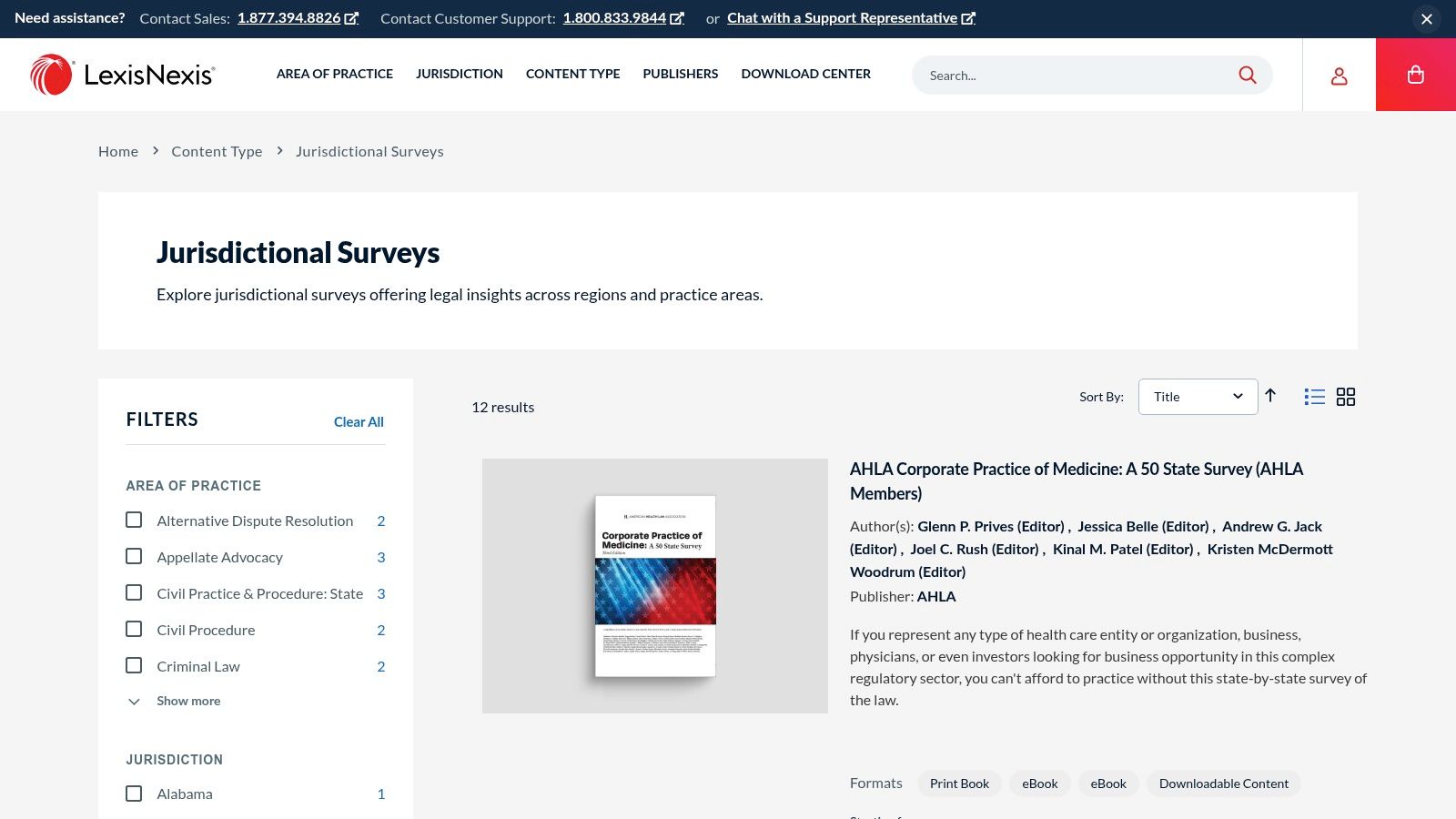
Unlike monolithic database tools, LexisNexis provides a browseable catalog of multi-jurisdictional surveys, many published in partnership with respected legal organizations like the American Bar Association (ABA). This approach allows firms to acquire targeted content specific to their practice areas, such as medical malpractice or product liability. When integrated with a full Lexis+ subscription, these surveys transform from static references into dynamic research tools, with direct hyperlinks to cited statutes, pivotal case law, and further analytical materials. This functionality is crucial for building a well-supported legal argument or confirming the viability of a potential claim.
Key Features and Practical Use
The primary strength of LexisNexis's offering is its blend of statutory compilation with expert commentary, providing a more narrative and explanatory approach to complex legal deadlines. This makes the content accessible and immediately useful as a desk reference for litigation teams.
- Practice-Focused Analysis: Many titles go beyond simple citation lists, offering detailed discussions on how courts interpret and apply statutes of limitation in real-world scenarios, including common exceptions.
- Flexible Access: Firms can purchase specific survey titles à la carte from the LexisNexis store or access a wider library through an enterprise-level Lexis+ subscription, offering scalability for different firm sizes and needs.
- Lexis+ Integration: For subscribers, the eBook versions offer powerful cross-references. A practitioner can read an analysis of a discovery rule in a survey and click through to the full text of the referenced court opinion or statutory section without leaving the platform.
Access and Considerations
Access is flexible, with options to buy individual titles or leverage a firm-wide Lexis+ plan. This à la carte option is a key differentiator, allowing smaller firms or solo practitioners to obtain high-quality, targeted information without a massive subscription commitment. However, the best user experience and deepest research capabilities are unlocked with a full Lexis+ subscription. A potential drawback is that the quality, depth, and update frequency can vary between different titles and publishers, so it is advisable for buyers to confirm the scope and latest publication date before making a purchase.
3. Bloomberg Law – State Chart Builder (subscriber tool)
For legal teams that require dynamic, visually-oriented data for internal strategy or client communication, Bloomberg Law’s State Chart Builder offers a powerful solution for comparing the statute of limitations by state personal injury. This subscriber-only tool moves beyond static tables, allowing users to generate and customize multi-state comparison charts across a vast range of legal topics. Its primary function is to transform complex statutory data into clean, exportable visuals perfect for presentations, intake playbooks, and strategic case assessments.
Unlike traditional research platforms that present data in dense text formats, the Chart Builder is designed for speed and clarity. A paralegal or associate can quickly assemble a chart comparing personal injury deadlines in specific jurisdictions, complete with editorial notes and direct citations to the underlying legal authority. This functionality is invaluable for firms handling multi-jurisdictional matters, as it facilitates rapid side-by-side analysis without the need to manually compile information from disparate sources.
Key Features and Practical Use
Bloomberg Law's strength lies in its ability to present curated legal intelligence in a highly accessible format. The State Chart Builder streamlines the initial phase of jurisdictional analysis, enabling firms to quickly evaluate potential venues and identify critical deadlines.
- Customizable Chart Generation: Users can select specific states and legal topics to build a tailored chart, filtering out irrelevant information and focusing only on the data pertinent to their case.
- Collaboration-Friendly Exports: The charts can be easily exported into formats like Excel or PDF, making them simple to share with colleagues, integrate into case management software, or include in client-facing reports.
- Integrated Legal Authority: Each data point in a chart is linked to the primary source, allowing for immediate verification and deeper research into the controlling statutes and relevant case law.
Access and Considerations
Access to the State Chart Builder is included with a Bloomberg Law subscription, positioning it as a premium tool for well-equipped law firms and corporate legal departments. While excellent for creating high-level overviews, users should be aware that the depth of coverage can vary by specific legal topic. Therefore, it is essential to verify that the personal injury statute of limitations data meets the specific granularity required for a particular matter before relying on it exclusively for calendaring critical deadlines.
4. Nolo / AllLaw – Personal Injury Statutes of Limitations by State
For a quick, accessible overview of the statute of limitations by state personal injury, the resources provided by Nolo and its affiliate AllLaw serve as an excellent starting point. This free, consumer-facing platform is designed for clarity and speed, making it an invaluable tool for intake teams, paralegals, or attorneys needing a fast, high-level answer before diving into formal legal research. It presents a straightforward table that simplifies the initial stages of case assessment, especially when triaging new client inquiries.
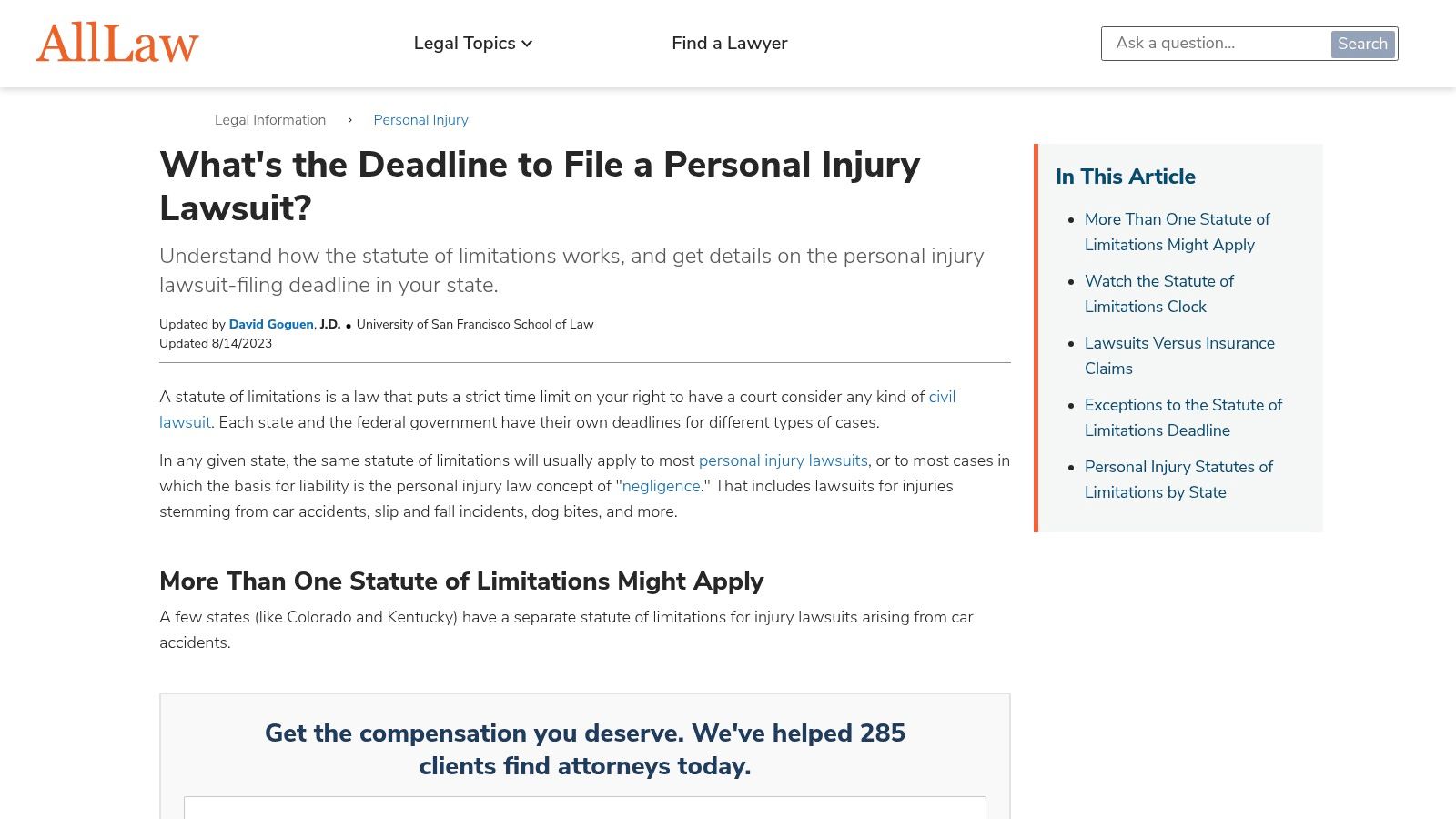
Unlike paid legal research databases, Nolo’s strength is its directness. The Personal Injury Lawsuit Deadlines by State page offers a scannable 50-state list with the general time limit for filing a personal injury lawsuit, accompanied by direct statutory citations. This provides an immediate reference and a "breadcrumb trail" back to the primary source law, allowing for efficient verification. While not a substitute for comprehensive statutory analysis, it is a highly effective first-pass resource that helps legal professionals quickly orient themselves.
Key Features and Practical Use
Nolo's AllLaw page is built for practical, everyday use where a quick reference is more valuable than an exhaustive treatise. It excels at providing initial data points that can guide further investigation or inform preliminary client communications.
- 50-State Table: The core feature is a clean, easy-to-read table listing the general personal injury statute of limitations for each state, from Alabama to Wyoming.
- Statutory Citations: Each entry includes a citation to the relevant state code. This is a critical feature that elevates the resource above generic legal advice, as it empowers the user to locate and verify the primary law.
- State-Specific Links: The table often links to more detailed articles on a specific state’s laws, offering deeper context on common exceptions like the discovery rule or special rules for claims against the government.
Access and Considerations
The Nolo/AllLaw resource is completely free and requires no subscription, making it universally accessible. Its primary value is for initial intake screening and quick-reference scenarios. However, legal professionals must recognize its limitations. The information focuses on general personal injury claims and may not cover nuanced deadlines for specific torts like medical malpractice, product liability, or defamation. Furthermore, as a secondary source, the information must always be verified against the most current version of the state statutes and recent case law to ensure accuracy and avoid malpractice risk.
5. FindLaw – State Statutes of Limitations hub
For attorneys and paralegals needing a quick, reliable, and free resource to verify the statute of limitations by state personal injury, FindLaw's State Statutes of Limitations hub is a standout option. Published by Thomson Reuters, FindLaw offers a well-organized portal linking to state-specific pages that summarize key civil deadlines. It bridges the gap between high-cost legal research platforms and unreliable general web searches, providing practitioner-oriented overviews that are also clear enough for client communications. This makes it an excellent first-stop for case intake or preliminary matter assessment.
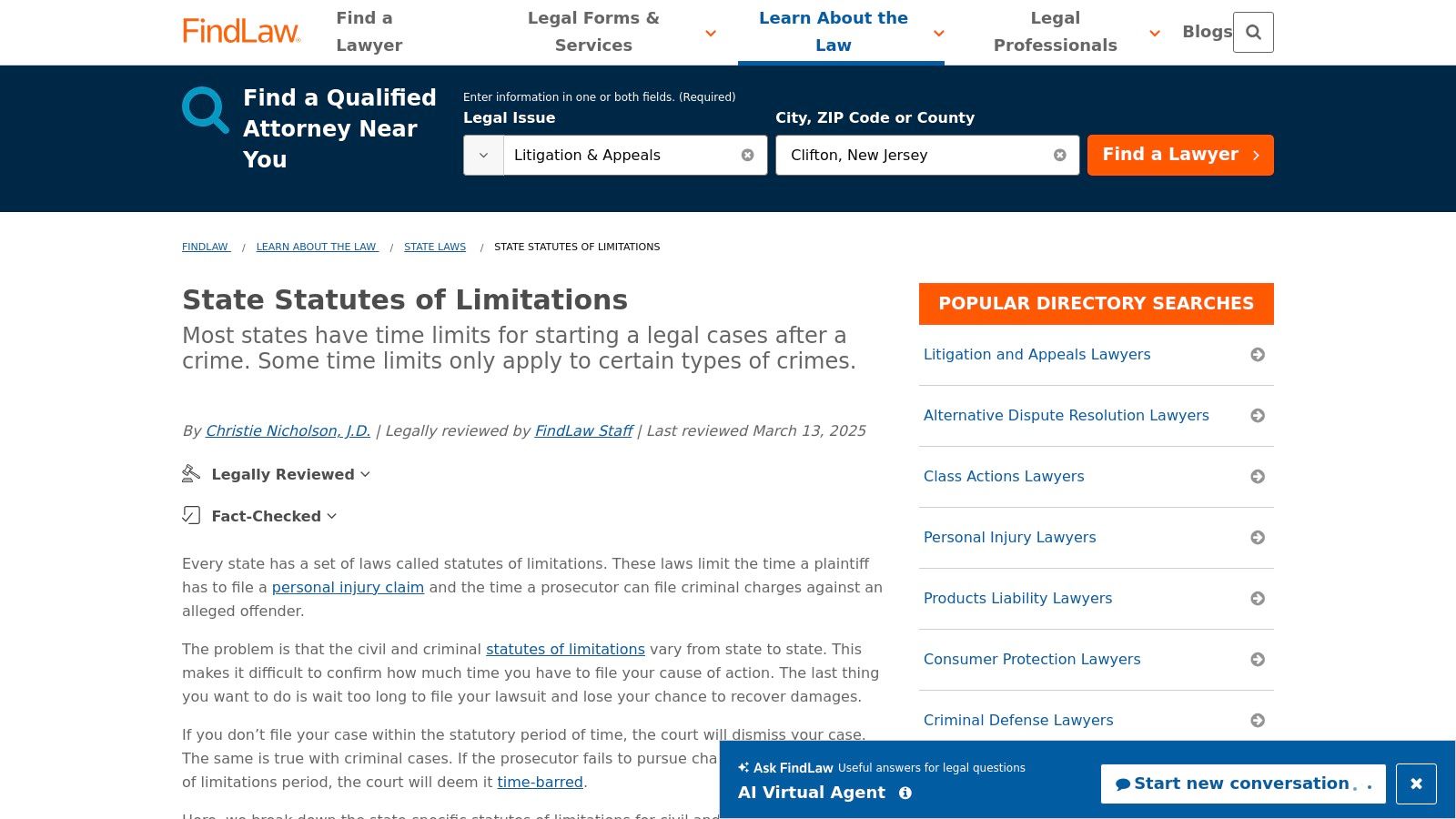
Unlike a static chart, FindLaw's hub is dynamic, with each state page providing context and cross-linking to more specific topics like medical malpractice or wrongful death. This structure is particularly useful for quickly understanding how different types of tort claims are treated within a single jurisdiction. The content is written to be accessible yet legally sound, making it a practical tool for educating clients about crucial deadlines or for training new paralegals on the importance of timely filings.
Key Features and Practical Use
FindLaw's primary benefit is its blend of credibility and accessibility, offering dependable information without a paywall. It serves as an essential quick-reference tool for confirming deadlines before calendaring a new case or during an initial client consultation.
- State-by-State Navigation: The hub provides a simple map-based and list-based navigation system, allowing users to quickly access a dedicated page for any U.S. state's civil statute of limitations.
- Practitioner-Oriented Summaries: Each state page presents the core deadlines for personal injury, property damage, and other civil actions in a clear, summarized format, often citing the relevant state code.
- Cross-Links to Related Topics: The platform effectively connects users to deeper content on related areas, such as specific rules for wrongful death claims or medical malpractice, providing a more complete picture of a state’s liability landscape.
Access and Considerations
The entire FindLaw hub is completely free and publicly accessible at https://www.findlaw.com/state/statutes-of-limitations.html, making it an invaluable resource for solo practitioners, small firms, or any legal professional without access to a premium legal research subscription. However, its main limitation is its structure. To get a 50-state overview, users must click through each state's page individually, as there is no single comparative table. Furthermore, while the summaries are excellent, they may not capture every specific nuance, such as complex tolling rules for minors or unique notice requirements for claims against government entities. Therefore, it is best used for preliminary verification and should be supplemented with primary source research for litigation purposes.
6. Forbes Advisor – Personal Injury Statute of Limitations by State
For legal professionals or their support staff needing a quick, no-cost reference for the statute of limitations by state personal injury, Forbes Advisor provides a remarkably clean and accessible resource. It presents a compact, single-page table that summarizes the primary personal injury deadlines for all 50 states, along with direct citations to the relevant state code sections. This makes it an excellent tool for preliminary case assessment, cross-jurisdictional issue spotting, or for non-attorney staff who need a reliable starting point without navigating complex legal databases.
Unlike paid legal research platforms, Forbes Advisor is designed for a broader audience, translating complex legal information into an easy-to-digest format. The single-page layout is highly efficient; a user can find the general negligence deadline for multiple states in seconds. While it doesn't offer the deep analytical tools of a service like Westlaw or LexisNexis, its value lies in its simplicity and speed for high-level "sanity checks" before committing to a more in-depth investigation. For a paralegal screening a potential new client from another state, this resource offers immediate, actionable information.
Key Features and Practical Use
The primary advantage of the Forbes Advisor guide is its streamlined presentation of essential data, making it a practical first-stop resource for quick lookups. The inclusion of statutory citations adds a layer of credibility not always found in free consumer-facing legal content.
- Compact 50-State Table: The core of the resource is a well-organized table listing each state, its general personal injury statute of limitations, and the corresponding state code section. This format is perfect for quick comparisons.
- Statutory Citations: By providing the direct statutory reference (e.g., "Cal. Code Civ. Proc. § 335.1"), the guide gives practitioners the exact starting point for their own primary source verification.
- Consumer-Legal Focus: The content is written clearly, avoiding dense legal jargon, which makes it an ideal resource to share with clients or train junior staff members who are new to personal injury work.
Access and Considerations
The Forbes Advisor guide is completely free and publicly accessible at forbes.com, requiring no subscription or login. This accessibility makes it a valuable bookmark for any legal professional. However, its main limitation is that it is not a live-updated, practitioner-grade treatise. The content is refreshed periodically, but it may not capture the most recent legislative amendments or judicial interpretations between updates. Therefore, it should be used as a preliminary screening tool, and the information must always be verified using a primary legal source or a dedicated legal research platform before calendaring critical deadlines.
7. Association of Corporate Counsel (ACC) – Statutes of Limitations in All 50 States
For in-house legal departments and corporate counsel who frequently manage claims across multiple jurisdictions, the statute of limitations by state personal injury chart from the Association of Corporate Counsel (ACC) offers a streamlined, high-level reference tool. This resource is designed for quick-glance utility, providing corporate legal teams with a rapid and reliable starting point for assessing potential liabilities or litigation exposure without the granular detail required for active litigation. It is tailored for practitioners who need a fast, credible multi-state overview to inform initial case assessments and strategic decisions.
Unlike comprehensive legal research platforms, the ACC's tool prioritizes conciseness and accessibility for its specific audience. The chart presents the statutes of limitations in years across common civil actions, including personal injury, in a clean, easy-to-read table format. This makes it an excellent resource for corporate teams, insurers, or risk managers who need to quickly compare deadlines for claims arising in different states. Its backing by the ACC, a major professional organization, provides an assurance of quality control and relevance for the corporate legal environment.
Key Features and Practical Use
The ACC's primary advantage is its simplicity and focus on the needs of in-house practitioners. It cuts through the complexity of primary source research to deliver a straightforward, comparative summary that is perfect for initial triage.
- Concise 50-State Chart: The resource consolidates the statute of limitations for various civil actions into a single, centralized table, allowing users to instantly find and compare personal injury deadlines from Alabama to Wyoming.
- Designed for In-House Teams: The format and content are specifically curated for corporate legal departments, who often need to evaluate potential claims or manage outside counsel across numerous states without immediately delving into deep statutory analysis.
- Part of a Broader Library: The chart is one component of the ACC's extensive resource library, offering members a wide range of tools and materials relevant to corporate law practice.
Access and Considerations
Access to the "Statutes of Limitations in All 50 States" chart is an exclusive benefit for members of the Association of Corporate Counsel. This means it is behind a membership paywall and is not available to the general public or non-member law firms. While highly practical for its intended audience, it is a high-level summary. For active litigation, practitioners must use this chart as a preliminary guide and then conduct a thorough verification of the specific statute and relevant case law to confirm the exact filing deadline and any applicable exceptions.
State Personal Injury Statutes of Limitations — 7-Source Comparison
| Resource | Implementation complexity | Resource requirements | Expected outcomes | Ideal use cases | Key advantages |
|---|---|---|---|---|---|
| Thomson Reuters Westlaw – 50 State Surveys | Low — ready-made surveys, minimal setup | Westlaw subscription (enterprise pricing) | Litigation-grade, citable 50-state comparisons with statute links and KeyCite updates | Formal litigation research, drafting memos and pleadings | Trusted editorial content; KeyCite validation; deep linking |
| LexisNexis – Jurisdictional Surveys | Low–Medium — browse or purchase specific titles | Lexis+ subscription or individual purchases | Practice-focused surveys with citations, case discussion, and exceptions | Desk reference for litigation teams needing topic-specific nuance | Practical analysis; à la carte access; publisher partnerships |
| Bloomberg Law – State Chart Builder | Medium — build and customize charts within platform | Bloomberg Law subscription | Dynamic, exportable multi‑state charts with editorial notes and citations | Client presentations, internal playbooks, visual side-by-side comparisons | Fast custom visuals; collaboration-friendly exports |
| Nolo / AllLaw – Personal Injury SOL by State | Very low — immediate online lookup | Free (public website) | Consumer-friendly 50-state overview with citations and basic exception notes | Intake teams, non-lawyers, quick triage and initial scoping | Free, easy to scan; good starting point for intake |
| FindLaw – State Statutes of Limitations hub | Very low — click-through state pages | Free (public website) | Practitioner-oriented summaries plus consumer explanations; state-specific links | Quick verification, client communications, preliminary research | Reputable publisher; frequent updates; practitioner and client language |
| Forbes Advisor – Personal Injury SOL by State | Very low — single-page reference | Free (public website) | Compact single-page table of SOL numbers with statutory citations | Non-lawyers or teams needing a quick sanity-check across states | Clean, concise single-page roundup for fast scoping |
| ACC – Statutes of Limitations in All 50 States | Low — access concise chart | ACC membership required | At-a-glance 50-state SOL chart expressed in years for common civil actions | In-house legal teams and corporate multi-jurisdictional checks | Organization-backed, concise reference tailored to legal departments |
From Manual Checks to Automated Certainty: Future-Proofing Your Firm's Deadlines
Navigating the complex web of the statute of limitations by state for personal injury is not merely a task; it is a core professional responsibility with case-altering consequences. As this comprehensive roundup has shown, resources from Westlaw to FindLaw provide essential, high-level guidance. Yet, they represent only the first step in a critical workflow. Relying exclusively on manual lookups, static charts, and human memory in a high-volume practice introduces a level of risk that is both unnecessary and unsustainable in today's legal landscape.
The true takeaway is not just knowing where to find the deadline for a specific jurisdiction, but fundamentally rethinking how your firm manages these critical dates from the moment a client walks through the door. The transition from a reactive, manual process to a proactive, automated one is the single most impactful change a modern personal injury firm can make to mitigate risk and enhance operational efficiency.
Key Takeaways: From Information to Implementation
This state-by-state analysis has underscored several critical themes that demand strategic action:
- Exceptions Are the Rule: The standard deadlines are merely the starting point. The discovery rule, tolling for minority or incapacity, and specific notice requirements for government claims can dramatically alter the calendaring for any given case. A successful system must account for this variability.
- Data Accuracy is Non-Negotiable: The "date of injury" is not always a straightforward, single date. It can be the date of an accident, the date a latent injury was diagnosed, or the date a reasonable person should have discovered the harm. Pinpointing this trigger date with absolute certainty is paramount.
- Systemic Safeguards Outperform Human Diligence: Even the most meticulous attorney or paralegal can make a mistake. A robust system with automated, multi-layered alerts and calendar entries is the only reliable way to build a true safety net against missed deadlines.
Actionable Next Steps: Building Your Firm's Deadline Defense System
To move beyond simply referencing lists and into the realm of automated certainty, your firm needs an integrated technology stack. The goal is to create an ecosystem where critical date information flows seamlessly from source documents to your master calendar without error-prone manual entry. To truly embrace automated certainty and future-proof your firm's deadlines, it's essential to understand the central role of a robust platform. For a deeper dive into this foundational technology, consider this resource: What is a Case Management System? A Game Changing Tool for Modern Law Firms.
This is where AI-powered tools like Ares become indispensable. Instead of a paralegal spending hours poring over thousands of pages of medical records to find the date of injury, Ares ingests and analyzes these documents automatically. It intelligently extracts key dates, such as the initial incident, first diagnosis, and key treatment milestones, creating a structured, data-driven case chronology. This AI-generated timeline becomes the "single source of truth" that powers your entire deadline management system, ensuring that every calendar entry is based on verified information directly from the case file.
By integrating this automated data extraction with your case management software, you can build a powerful, proactive alert system. This transforms the high-risk, high-stakes task of managing the statute of limitations by state for personal injury from a manual burden into a reliable, automated, and future-proofed component of your firm's operations. This shift frees your talented legal professionals to focus on what they do best: advocating for your clients and winning cases.
Ready to eliminate deadline anxiety and build an unbreachable defense against missed statutes of limitation? Discover how Ares uses AI to automatically extract critical dates from medical records and build the foundation for a flawless calendaring system. See how your firm can move from manual checks to automated certainty by exploring Ares today.