
A settlement demand letter is your opening move in the chess match against an insurance company. It's the formal document where you lay out the facts of your client's personal injury case, detail their suffering and losses, and state exactly what it will take to make things right. More than just a letter, it's the first real test of your case's strength and signals to the opposing side that you are organized, serious, and ready to fight.
This single document sets the entire tone for negotiations and can be the difference between a quick, fair settlement and a long, drawn-out court battle.
The Power of a Masterfully Crafted Demand Letter
In the world of personal injury law, the demand letter is easily the most potent tool in your pre-litigation arsenal. It's not just a procedural step; it's the primary engine that drives results for your clients long before a courtroom ever comes into view. Think of it as your opening argument in a trial you're trying to win before it even begins.
The Cornerstone of Pre-Litigation Strategy
A great demand letter accomplishes two critical goals at once. First, it tells a compelling, evidence-backed story to an insurance adjuster who sees hundreds of claims a week. Your job is to make your client’s case stand out, building a narrative that makes the adjuster see a real person whose life has been upended, not just another claim number. To get this right, you have to master the persuasive writing technique and build an argument that truly connects.
Second, the demand letter serves as a clear warning shot. A detailed, well-organized letter shows the insurance company you've done your homework and are fully prepared to take the case to trial. This demonstration of readiness is often the very thing that convinces them a fair settlement is a much smarter move than facing you in court.
Core Components of a High-Impact Demand Letter
Before we dive into the nitty-gritty of drafting, let's look at the foundational elements every powerful demand letter must contain. This table breaks down the core components, giving you a quick reference for the framework we're about to build.
| Component | Strategic Purpose | Why It's Non-Negotiable |
|---|---|---|
| Compelling Narrative | Tells the client's story and establishes the human cost of the injury. | Connects with the adjuster on an emotional level, moving beyond a simple list of facts. |
| Clear Liability Theory | Explains exactly why their insured is at fault, citing laws and evidence. | Removes any ambiguity about legal responsibility and shuts down early defenses. |
| Detailed Damages Proof | Quantifies every loss—medical bills, lost wages, pain, suffering, and more. | Provides the concrete financial justification for your settlement demand. |
| A Specific Demand Amount | States a clear, well-supported number required to resolve the claim. | Creates a firm starting point for negotiations and shows you've valued the case. |
| Professional Tone | Conveys confidence, seriousness, and a readiness for litigation if necessary. | Establishes credibility and signals that lowball offers will not be entertained. |
Getting these five elements right is the key to creating a document that doesn't just ask for compensation—it commands it.
Why Mastering This Document Matters
The statistics are clear: the pre-trial phase is where personal injury cases are won. A powerful settlement demand letter is the driving force behind the fact that over 99% of all personal injury cases settle before ever reaching a trial verdict. With nearly 400,000 personal injury claims filed annually in the U.S., this document is the absolute linchpin of case resolution.
A great demand letter does more than just list facts and figures. It tells a story so compelling that the adjuster can't ignore the human cost of the defendant's negligence. It transforms a case file into a vivid account of suffering, loss, and the undeniable need for fair compensation.
However, the manual process of drafting these letters is notoriously difficult. Sifting through hundreds of pages of medical records, piecing together a timeline, and accurately calculating damages can eat up dozens of hours. This bottleneck not only slows down your firm but also opens the door to costly mistakes—like a missed diagnosis or an overlooked expense that could reduce your client's settlement by thousands.
This guide will walk you through overcoming these challenges, helping you craft demand letters that are not only persuasive but also efficient to create.
Telling a Compelling Story of Liability and Injury
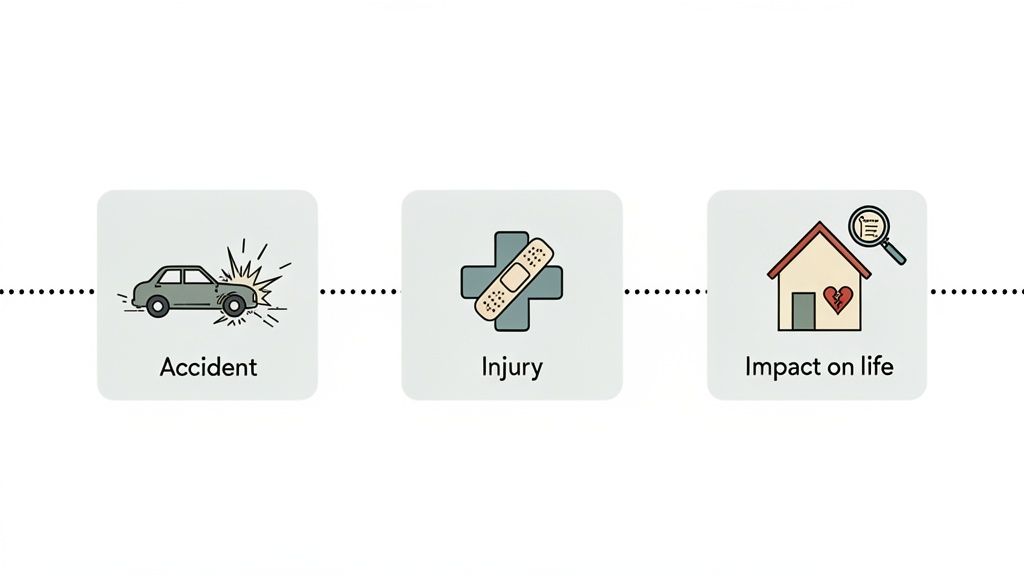
A great settlement demand letter does more than just list the facts. It tells a story—an evidence-based story that forces an insurance adjuster to see your client as a real person whose life was upended by their insured’s carelessness. The objective is simple: build a narrative so clear and human that the adjuster can't just dismiss it as another claim number.
This all starts by laying out an undeniable sequence of events. You have to paint a vivid, moment-by-moment picture of the incident itself, leaving zero room for doubt or creative interpretation by the defense. This is where you anchor liability, making the defendant’s fault an inescapable conclusion.
Constructing the Scene of Negligence
First, you need to put the adjuster right at the scene. The official police report is your anchor, so use it—cite the officer's diagrams, their conclusions, and any tickets they issued. But don't just stop there. Weave in details from witness statements to add color and depth.
For instance, instead of a flat "The defendant ran a red light," you can bring it to life: "According to witness Jane Doe, who was stopped in the northbound lane, she saw the defendant's car 'accelerate through the intersection' a full two seconds after the light had turned solid red." That one small change transforms a simple mistake into active, conscious negligence.
To build an airtight liability case, I always make sure to include:
- A Chronological Breakdown: Detail what happened leading up to, during, and immediately after the crash. Use clear, simple language that walks the reader through the timeline.
- Reference to Specific Evidence: Explicitly call out your proof. Phrases like "See Exhibit A - Police Report" or "Exhibit B - Witness Statement of John Smith" show you're organized, prepared, and ready for a fight.
- Violation of Statutes: If you can, cite the specific traffic law the defendant broke. This reframes their action not just as a poor choice, but as a clear violation of their legal duty of care.
By meticulously building the scene this way, you dismantle common defenses before they’re even raised. You’re creating a solid, fact-based platform to stand on when you start talking about the consequences.
The most powerful narratives connect the dots for the adjuster. They don't just present evidence; they interpret it, showing precisely how each piece of proof contributes to a singular, unavoidable conclusion: the defendant is 100% at fault.
From Medical Jargon to Human Suffering
Once you've locked down liability, the story has to pivot to the human cost. This is, without a doubt, the most important part of your demand. You have to translate cold, clinical medical records into a powerful story of pain, struggle, and loss. Adjusters are numb to terms like "cervical sprain" or "lumbar herniation." It's your job to make them feel what those diagnoses actually mean in a person's daily life.
Start with the impact itself. Describe the terror of the collision, the immediate shock and pain, the disorienting ambulance ride, and the cold fear of the emergency room. This makes the event personal, moving it beyond a sterile accident report.
From there, walk the adjuster through the grueling recovery. Don't just list treatments; explain what they entailed for your client.
- Physical Therapy: It's not just "three sessions per week." It’s "three hours of agonizing, painful exercises each week, as she fought to regain the simple ability to lift a bag of groceries without searing pain shooting down her leg."
- Injections: An epidural isn't a simple shot. It's "an invasive procedure where my client had to endure a large needle being pushed into his spine, all in a desperate attempt to find even a few hours of relief."
- Surgery: Describe the anxiety before the operation, the brutal post-op recovery, the complete reliance on family for basic needs, and the permanent scars—both physical and emotional.
This is how you build empathy and justify the non-economic damages you’re about to demand. To get a better handle on organizing this complex medical information, take a look at our guide to creating a medical record chronology.
Painting the Picture of a Diminished Life
Finally, your story must show how these injuries have fundamentally changed your client's life. This is where you connect the medical facts to real-world consequences, showing the true scope of their loss. This is the "so what?" of the injury.
I find that creating "before and after" snapshots is incredibly effective.
| Before the Accident | After the Accident |
|---|---|
| An avid gardener who spent every weekend in her yard. | Now unable to kneel for more than five minutes without excruciating back pain. |
| The dad who coached his son's team and tossed him around. | Now can't even pick up his toddler, creating an emotional distance he feels daily. |
| A skilled carpenter whose work was his pride and passion. | Now on permanent disability, having lost not just his livelihood but his identity. |
When you detail these specific, personal losses, the claim becomes about so much more than medical bills. You're demonstrating a profound loss of joy, function, and quality of life. This narrative makes your final demand amount feel not just like a number, but a fair and just reflection of a life that has been forever changed.
Translating Suffering into a Defensible Dollar Figure
After you’ve laid out the irrefutable facts of liability and painted a vivid picture of your client’s injuries, the demand letter needs to get down to brass tacks: the money. This is where the story you've told translates into a specific, justifiable dollar amount.
An arbitrary number is just that—a number. An adjuster will see it as a flimsy opening bid. But a figure built on a solid foundation of documented losses becomes a powerful negotiating anchor, forcing them to take your demand seriously from the outset.
The starting point is to meticulously itemize every single economic loss your client has suffered. We call these "special damages," and they represent the tangible, out-of-pocket costs that flowed directly from the defendant's negligence. Getting this part right isn't just important; it’s the bedrock of your entire demand.
Itemizing Economic Damages
Calculating economic damages is less about legal artistry and more about obsessive organization. Every dollar you claim must be backed by a piece of paper—a receipt, an invoice, a pay stub. There's simply no room for guesswork here.
Your list has to be exhaustive. I’ve seen attorneys leave money on the table by overlooking seemingly minor costs. Make sure you include:
- All Medical Bills: This isn't just the big-ticket items like surgery. It’s everything. The ambulance ride, the ER visit, hospital stays, physical therapy, co-pays, prescription medications, and any durable medical equipment like crutches or a brace.
- Lost Wages and Income: Calculate every hour of work your client missed because of the injury, their recovery, or follow-up medical appointments. You'll need a letter from the employer confirming their rate of pay and the exact time lost.
- Loss of Future Earning Capacity: This is a huge one for serious injuries. If the injury is permanent and hobbles your client's ability to earn a living, you absolutely need a vocational expert and an economist to project this loss over their expected career.
- Out-of-Pocket Expenses: Don't forget the small stuff. It adds up. This includes mileage to and from the doctor's office, parking fees, home modifications (like a ramp), or hiring someone to do yard work your client can no longer manage.
Present these items in a clean, itemized list within the demand letter. The total sum of these special damages should be clearly stated. This hard number becomes the floor for your negotiations—the absolute minimum the carrier must consider.
A well-structured demand letter transforms a messy pile of receipts into an undeniable record of financial devastation. When you present economic damages with this level of clarity and proof, you strip the adjuster of their ability to chip away at the foundation of your claim.
The Art of Quantifying Non-Economic Damages
While special damages are about cold, hard math, non-economic damages—or "general damages"—are about translating human suffering into a monetary value. This is obviously far more subjective, but it's where the real value of a case often lies. It’s how you put a number on the pain, the emotional distress, the sleepless nights, and the loss of enjoyment of life your client has been forced to endure.
In my experience, there are two primary methods that insurance carriers understand and respect for calculating these intangible losses.
1. The Multiplier Method This is the workhorse of personal injury valuation. You take the total amount of economic damages and multiply it by a number, usually somewhere between 1.5 and 5. The specific multiplier you choose depends entirely on the severity of the case.
- A 1.5x to 2x multiplier might be used for a straightforward soft-tissue case where the client made a full and relatively quick recovery.
- A 3x to 4x multiplier is more appropriate for more serious injuries, like a bone fracture that needed surgery but healed well over time.
- A 5x or higher multiplier is reserved for the truly catastrophic cases—those involving permanent disability, significant disfigurement, or severe, chronic pain.
For instance, if a client has $50,000 in medical bills and lost wages from a serious car crash, you might reasonably apply a multiplier of 3. This would result in a non-economic damages claim of $150,000.
2. The Per Diem Method The "per diem" (or per day) method assigns a daily dollar amount for your client's suffering, running from the date of the accident until they reach Maximum Medical Improvement (MMI). A common and defensible way to set the daily rate is to tie it to the client's daily earnings. The argument is simple and powerful: enduring constant pain is at least as hard as going to work every day.
While it’s used less often than the multiplier, this method can be incredibly effective for injuries with a long, drawn-out, and painful recovery period. If your client earns $200 a day and it takes them 180 days to recover, the per diem calculation for their pain and suffering would be $36,000.
You can get a much deeper look into both of these valuation techniques by reading our firm's guide on how to calculate pain and suffering damages.
Arriving at the Final Demand
Your final demand is the sum of your total economic damages and your calculated non-economic damages. Don’t bury it. Present this total demand clearly and confidently near the end of your letter. It should feel like the logical, inevitable conclusion to the compelling story and hard evidence you’ve already presented.
Never forget the power of this single document. While personal injury is a major legal need, many victims never file a claim. An effective letter is what unlocks fair compensation. The national average payout sits around $52,900, and with over 99% of PI cases settling before trial, mastering the demand is arguably the most critical revenue-generating activity in any personal injury firm.
How AI Automation Breaks the Demand Letter Bottleneck
In any personal injury firm, the single biggest roadblock isn't the back-and-forth with adjusters. It's the mountain of medical records you have to conquer first. Sifting through hundreds, sometimes thousands, of pages is a thankless, non-billable chore that drains your paralegals' time and brings case progress to a grinding halt.
This manual grind isn't just slow; it's a minefield for human error. One missed diagnosis, an overlooked treatment date, or a misinterpreted provider note can gut the strength of your settlement demand letter, potentially costing your client thousands. Modern AI platforms were built to solve this exact problem, turning a week of tedious work into a task you can knock out in minutes.
From Manual Slog to Instant Intelligence
Picture this: you upload your client's entire, jumbled medical history—ER reports, specialist notes, physical therapy logs, billing statements, the works—into a secure system. Instead of a paralegal spending days reading every line, an AI engine scans, organizes, and extracts every critical data point almost instantly.
This isn't just a fancy keyword search. The technology understands medical context, which allows it to:
- Catch Every Diagnosis: It pulls every single diagnosis, from the initial ER visit to the final follow-up, giving you a crystal-clear picture of how the injury progressed.
- Build a Perfect Timeline: The AI automatically constructs a precise chronology of every appointment, procedure, and prescription, complete with dates and provider names.
- Flag Crucial Medical Facts: It can instantly highlight game-changing details like pain scores, permanent impairment ratings, or a doctor's explicit statement on causation.
What you get back is a structured, actionable summary of the entire case, ready for you to start building your legal strategy. It fundamentally changes how you prepare a settlement demand, moving your team away from mind-numbing data entry and toward high-value legal analysis.
The real power here is the AI's ability to create a flawless foundation for your narrative. It guarantees every medical fact is accounted for, giving you total confidence that your demand is built on a complete and accurate record of your client's journey.
A Real-World Scenario: AI in Action
Let’s take a common car accident case involving a client with a herniated disc. Traditionally, a paralegal might spend 10-15 hours poring over 500 pages of records from an orthopedist, a physical therapist, and a pain management specialist. They'd have to build a spreadsheet from scratch to track dates and treatments—a truly soul-crushing task.
With an AI platform like Ares, the entire workflow is different.
- Upload: Your paralegal simply drags and drops all 500 pages of scanned records into the system. No sorting needed.
- Analyze: The AI gets to work, processing the documents in under ten minutes. It identifies every provider, treatment date, diagnosis code, and billed amount.
- Draft: The system then generates a comprehensive medical chronology and a solid first draft of the medical narrative for your demand letter.
What once ate up two full workdays is now done before you’ve finished your morning coffee. This isn't just about being efficient; it's about being able to scale. It empowers your team to handle a larger caseload without ever compromising the quality or detail of a single demand.
What This Means for Your Firm's Bottom Line
Bringing this kind of technology into your firm has a direct and immediate impact on profitability. By cutting out dozens of non-billable hours on every case, you free up your best people to focus on tasks that actually make money—like negotiating with adjusters and mapping out case strategy. You can explore this concept further in our article on legal workflow automation.
This newfound efficiency gives you a serious competitive edge. For example, using the right tools can dramatically accelerate document preparation, much like how other businesses are using AI for legal document creation to their advantage. For a PI firm, this translates to filing stronger, more accurate settlement demands much faster than your competition.
Ultimately, automation drives better results. An error-free, meticulously documented demand signals a high level of preparation that insurance adjusters immediately recognize and respect. That often leads to faster negotiations, fewer insulting lowball offers, and bigger settlements for your clients.
Assembling Your Demand Package for Maximum Impact
You've put in the hard work: the narrative is compelling, and the damages are calculated. Now, it's time to assemble the demand package itself. This isn't just a matter of paper-clipping a few documents together; you're building the complete case file that an adjuster can't ignore or easily dispute.
A sloppy, incomplete package signals you're disorganized, practically inviting a lowball offer. A polished, comprehensive one tells the adjuster you mean business and are ready for anything. The goal here is to anticipate every question they might have and provide the answer—backed by proof—right there in the exhibits.
The Essential Attachments Checklist
Your attachments are the evidence that turns your arguments into facts. Each document has a job to do, from proving who was at fault to justifying every last penny of your demand. Before you even think about hitting "send," run through this checklist to make sure nothing critical is missing.
- Police and Incident Reports: This is ground zero for establishing liability. It's the official, unbiased account.
- Medical Records and Bills: Be thorough. This includes everything—ER visits, specialist notes, physical therapy logs, imaging scans—and an itemized bill for each.
- Proof of Lost Wages: You absolutely need a formal letter from the client's employer on company letterhead. It must detail their exact pay rate, the hours they missed, and the total income lost.
- Photographs and Videos: Don't underestimate the power of visuals. Clear photos of the scene, vehicle damage, and your client's injuries can often say more than words ever could.
- Expert Witness Reports: If you've brought in an accident reconstructionist or a vocational expert, their reports are crucial for backing up claims about complex liability or future earning losses.
This isn't just about being organized; it's about building an ironclad case from the start.
Strategic Timing and Professional Tone
When you send the demand is just as critical as what's in it. The sweet spot is almost always after your client has reached Maximum Medical Improvement (MMI). Sending it too early means you risk leaving money on the table because you haven't captured the full scope of their medical costs or future needs.
Your tone needs to walk a fine line. It has to be firm, confident, and leave no doubt that you're prepared to go to trial if you don't get a fair offer. At the same time, an overly aggressive or hostile letter can poison the well and kill any chance of a productive negotiation. Keep it professional and stick to the facts. You want to come across as a serious advocate, not a hothead.
This pre-suit strategy is more important than ever. We're seeing a significant rise in the use of strong demand letters across the legal field to force early resolutions. This trend underscores a simple truth: a powerful opening move often dictates the outcome of the entire case. You can explore more insights on this trend and how it's changing settlement dynamics.
A settlement demand letter isn’t just about tallying up past damages; it’s your tool for controlling the future of the negotiation. By setting a firm but reasonable response deadline—typically 30 days—you take control of the timeline and force the adjuster to engage.
The process of gathering and organizing all this evidence can be a major time-sink. Modern tools are changing that.
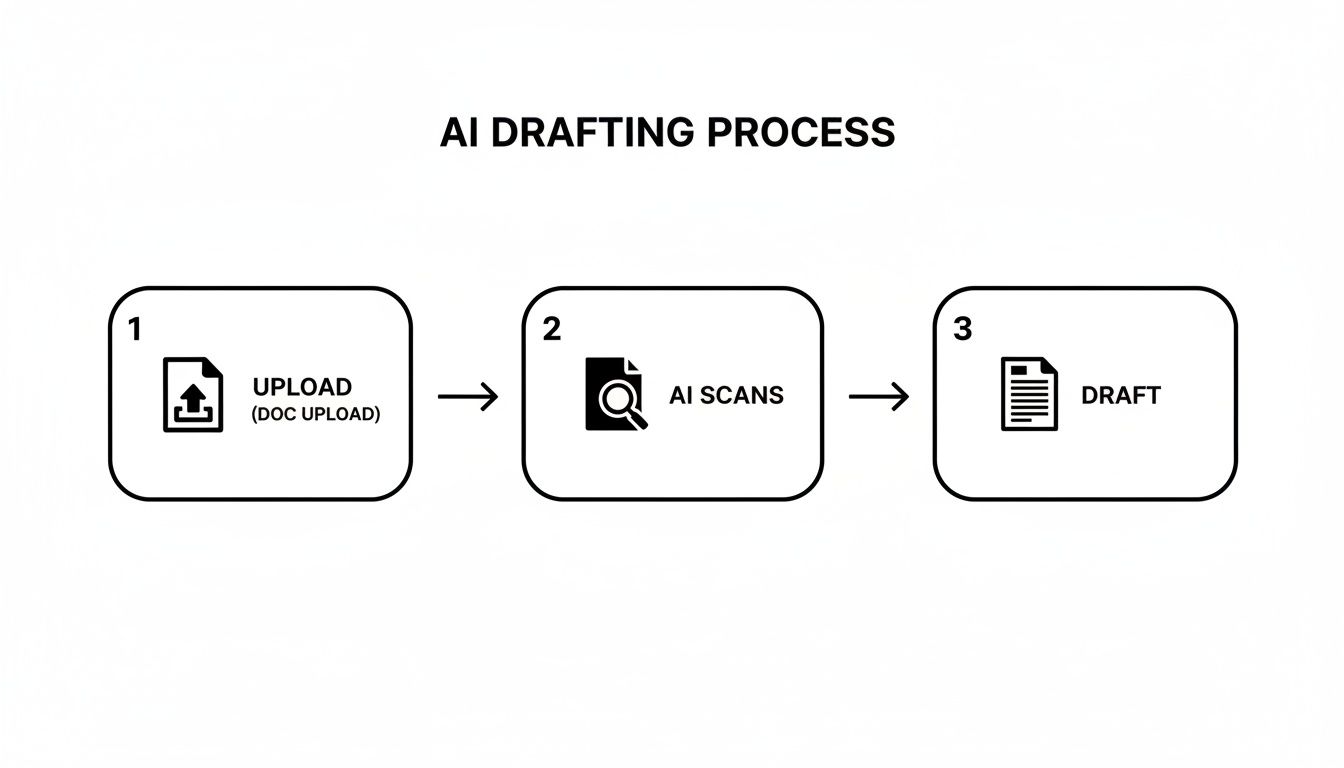
As you can see, technology can take the mountain of documents and turn it into a manageable, three-step workflow, which is a game-changer for case prep speed. Your demand is the opening shot; make sure it's backed by flawless organization and strategic foresight.
Frequently Asked Questions About Settlement Demand Letters
Even after drafting hundreds of these, experienced attorneys still grapple with the finer points of a settlement demand letter. The dance of timing, tone, and tactics can dramatically shift the final outcome. Here are some straightforward answers to the questions that come up most often in our line of work.
What’s the Single Biggest Mistake to Avoid?
The most common—and damaging—mistake is failing to tell a compelling human story. Insurance adjusters are inundated with dry, clinical letters that are little more than a list of facts and figures. They blur together.
What cuts through the noise is a demand that connects the defendant’s negligence to a real person’s pain and suffering. It has to be an organized, easy-to-follow narrative that doesn't just list the injuries, but shows how those injuries shattered your client's life—their ability to work, their role in their family, their plans for the future. A letter that makes the client's pain real and backs it up with perfectly organized evidence is infinitely more persuasive.
What’s the Ideal Length for a Demand Letter?
There's no magic number. The right length is dictated entirely by the case's complexity. A simple soft-tissue injury claim might only require 5-7 pages. On the other hand, a catastrophic injury case involving multiple surgeries and expert reports could easily run over 20 pages.
The goal isn't brevity; it's clarity and completeness. Your letter needs to be long enough to convincingly argue liability, detail every single medical treatment, articulate the full scope of the impact on your client's life, and meticulously document every dollar of damages claimed. Always choose to be thorough and persuasive over hitting an arbitrary page count.
A common myth is that shorter is better. The truth is, a detailed, well-supported demand signals that you've done your homework and can justify a high value. A brief letter often gets interpreted as a sign of a weak or poorly developed case.
Should I Demand a Specific Amount or a Range?
Always demand a specific, lump-sum dollar amount. This is non-negotiable from a tactical standpoint.
The moment you propose a range—say, "$75,000 to $100,000"—you've told the adjuster you'll take the bottom number. You’ve immediately weakened your negotiating position before the conversation has even started.
By stating a single, well-justified figure, you set a firm anchor for the entire negotiation. This number should be your calculated "ceiling"—an ambitious but completely defensible amount. It gives you plenty of room to negotiate downward while still landing on a settlement that's a major win for your client.
When Is the Best Time to Send the Demand Letter?
The ideal moment to send the demand is after your client has reached Maximum Medical Improvement (MMI). This is the point where their medical condition has stabilized, and their doctor can offer a clear prognosis about future medical needs, permanent limitations, or lasting impairment.
Sending the letter at this stage ensures your damages are complete. You can include all past medical bills and reasonably project future costs, leading to a final, comprehensive valuation. If you send a demand too soon, you run a massive risk of undervaluing the claim, especially if unforeseen complications show up later. Remember, once a case is settled, you can't go back and ask for more.
Stop drowning in medical records and start building stronger cases faster. With Ares, you can automate the entire evidence extraction and demand drafting process, eliminating 10+ hours of manual work per case. See how our AI-powered platform turns chaotic documents into clear, compelling narratives that win bigger settlements. Discover the Ares advantage today.