A well-crafted demand letter is far more than a simple formality. It’s your firm's opening argument, the first and best chance to resolve a personal injury claim before it ever sees the inside of a courtroom. Think of it as the foundational document that sets the entire tone for negotiations, establishing your credibility and laying out a compelling, evidence-backed story. A powerful sample attorney demand letter isn't just a template; it's a blueprint for persuading an insurance adjuster to see things your way.
The Strategic Power of a Demand Letter
In the chess game of personal injury law, the demand letter is your opening move. It's the first comprehensive look an insurance adjuster gets into the facts, the injuries, and the cold, hard math behind your settlement figure. A weak or disorganized letter—one that’s poorly substantiated—is an open invitation for a lowball offer. It signals to the other side that you might not be ready for a real fight.
A strong demand, on the other hand, accomplishes several critical objectives right out of the gate.
- It Establishes Immediate Credibility: A professional, meticulously detailed letter, complete with organized medical records and a clear-eyed liability argument, tells the adjuster you’re serious and you’ve done your homework.
- It Controls the Narrative: This is your opportunity to tell your client's story. You get to transform a clinical list of injuries into a very human experience of pain, suffering, and life-altering disruption.
- It Sets the Negotiation Anchor: By presenting a well-supported demand figure, you establish a reasonable starting point for talks. This makes it much harder for an adjuster to justify an absurdly low offer.
- It Demonstrates You're Trial-Ready: A thorough demand package implicitly communicates that you've already done the legwork to file a lawsuit, giving you immense leverage from day one.
The Bedrock of a Favorable Settlement
Think of the demand letter as a trial argument on paper. You’re presenting the evidence, connecting the legal dots, and drawing a clear, undeniable conclusion about what constitutes fair compensation. The ultimate goal is to make it easier for the adjuster to say "yes" than to say "no." You're essentially handing them all the documentation and reasoning they need to justify the settlement to their supervisors.
This initial step is becoming even more vital. In the third quarter of 2025, legal demand shot up by 3.9% compared to the previous year, with litigation demand itself climbing 4.9% year-over-year. For PI attorneys, that surge means more pressure to manage higher caseloads without sacrificing quality. This is precisely where a solid process, guided by a strong sample attorney demand letter, becomes a non-negotiable tool for driving settlements and avoiding drawn-out litigation. You can dig into these legal industry trends in the Law Firm Financial Index analysis from Thomson Reuters.
A powerful demand letter doesn't just ask for money. It builds a logical and emotional case so compelling that settling becomes the most sensible path for the insurer. It preemptively answers the adjuster’s questions and dismantles their likely objections before they can even voice them.
To get there, your letter needs to include several non-negotiable elements. Each piece serves a specific strategic purpose, working together to build a persuasive and defensible claim.
Anatomy of a High-Impact Demand Letter
Here's a breakdown of the core components every effective demand letter must have. Leaving any of these out weakens your position and gives the adjuster an easy excuse to delay or undervalue the claim.
| Component | Purpose and Key Details |
|---|---|
| Clear Introduction | Immediately identifies the claimant, date of loss, claim number, and the at-fault party. Sets a professional tone. |
| Factual Narrative | Provides a concise, compelling account of how the incident occurred. Establishes clear liability against the insured. |
| Liability Argument | Cites relevant statutes or case law to legally anchor the claim of negligence. This isn't a full legal brief, but a firm statement of fault. |
| Detailed Injury Summary | Translates medical jargon into a clear story of the client's injuries, treatment journey, and prognosis. Humanizes the impact. |
| Damages Calculation | Itemizes all economic damages (specials) like medical bills and lost wages, and justifies the demand for non-economic damages (general) like pain and suffering. |
| Settlement Demand | States a clear, specific dollar amount required to settle the claim. This is the "ask" that anchors all future negotiations. |
| Supporting Documentation | Attaches all necessary evidence: medical records, bills, police reports, photos, wage loss verification, etc. This is your proof. |
By ensuring each of these components is meticulously prepared, you present a comprehensive package that demands to be taken seriously from the moment it lands on the adjuster's desk.
Modernizing an Essential Process
As today’s personal injury firms grapple with these increasing caseloads, the old way of doing things is becoming a liability. Manually sifting through hundreds of pages of medical records to piece together a coherent timeline is not just inefficient—it’s a recipe for costly mistakes.
This is where smart new approaches are changing the game. By automating the extraction of key information and the generation of initial drafts, firms can now produce higher-quality demand letters in a fraction of the time. This shift frees up attorneys and paralegals to focus their energy on high-value tasks like strategy and negotiation, setting the stage for a smarter, more streamlined path to securing fair settlements for clients.
Building a Persuasive Case Narrative
Facts give your case a skeleton, but a powerful story gives it a soul. Insurance adjusters are people, and they sift through hundreds of claims a day. The ones that cut through the noise are the ones that tell a clear, logical, and human story. A well-crafted narrative turns a dry list of events into a vivid picture of your client's ordeal, making your settlement demand feel like an undeniable conclusion, not just another number.
Crafting this narrative is an art, borrowing heavily from the principles of persuasive writing. You're not just dumping data on the adjuster's desk; you're guiding them on a journey. You want to lead them step-by-step to the same conclusion you've reached: that settling your demand is the most logical and reasonable thing to do.
This isn't just about recounting what happened. It’s a strategic framing of the incident, the injuries, and the very real impact on your client's life.
From Incident to Impact
Your story has to start with a rock-solid, indisputable account of the crash. This isn't the time for legalese or convoluted arguments. Just paint a clear, simple picture of what happened, making the defendant's mistake obvious.
Think about a standard rear-end collision. You could be technically correct but completely unpersuasive.
- Weak Phrasing: "The tortfeasor breached their duty of care by failing to maintain a safe following distance, resulting in a vehicular collision."
- Strong Phrasing: "Ms. Jones was stopped at a red light when the defendant's F-150, without any sign of braking, slammed into the back of her sedan. The impact was so violent it snapped her head forward and back."
That direct, almost cinematic language immediately establishes fault. The story then flows naturally from the crash to its immediate, painful consequences.
Quantifying the Human Cost
Once liability is clear, you need to pivot to the human cost of the defendant's negligence. This is where you breathe life into the medical records, turning them into a compelling story of pain, difficult treatments, and a life thrown off course. A tight medical chronology is your best friend here. If you need a refresher, check out our guide on creating an effective medical record chronology.
Don't just list injuries and procedures. Tell the adjuster what your client actually went through.
- Initial Injury: "Immediately after the impact, Mr. Smith felt a searing pain shoot from his neck down into his lower back."
- Treatment Journey: "The next three months were a blur of 24 physical therapy sessions, painful spinal injections, and a constant fog from the pain medication that made it impossible to focus at work."
- Ongoing Impact: "Six months later, he still can't lift his four-year-old daughter or spend an hour in his garden without triggering debilitating back spasms."
This is how you connect the dots between the medical facts and real-life consequences, which is absolutely critical for building a strong case for non-economic damages. The skill here is similar to mastering persuasive copy that converts—it’s about making your audience feel something.
The most effective narratives make the client's suffering tangible. They show the adjuster not just what happened, but what was lost—the ability to work, to be a parent, to live a day without pain. This is how you lay the foundation for your pain and suffering damages.
Weaving in the Financial Losses
The final thread in your narrative seamlessly integrates the financial damages. You have to present every single cost as a direct and unavoidable consequence of what the defendant did. This is where you lay out the medical bills, lost wages, and other out-of-pocket expenses.
Structure it clearly so the adjuster sees the cascading financial domino effect:
- Medical Bills: Connect the big-ticket bills to the treatment journey you just described. "The attached billing from Orthopedic Specialists, totaling $8,450, covers the initial ER visit, the MRI that confirmed his herniated disc, and all subsequent consultations."
- Lost Wages: Frame this as more than a number—it’s a direct hit to the family's finances caused by the injury. "Because he was physically unable to perform his duties as a warehouse manager, Mr. Smith was out of work for six weeks, resulting in $7,200 in lost income, as confirmed by the attached letter from his employer."
- Future Costs: If necessary, you can introduce future medical needs based directly on the treating doctor's prognosis, making it a clear and predictable expense.
By tying every dollar to a specific part of your client's story, you transform your demand from an abstract number into a concrete, justifiable sum. This narrative structure makes it much harder for an adjuster to just take a red pen to your demand without directly challenging the story you’ve so carefully built.
Demand Letter Templates for Common Injury Cases
Knowing the theory is one thing; putting it into practice is what separates a good strategy from a winning one. Below, I’ve broken down several annotated sample demand letters that you can adapt for your own cases. Think of these less as rigid templates and more as strategic blueprints, each designed for a different level of injury severity.
The key thing to remember is that a sample attorney demand letter is never a one-size-fits-all document. The tone, level of detail, and evidentiary focus have to shift dramatically based on the facts. A minor whiplash claim from a fender bender needs a completely different touch than a catastrophic injury case involving a lifetime of medical care.
This flowchart maps out the core components of building a powerful case narrative, from nailing down liability to justifying your final number.
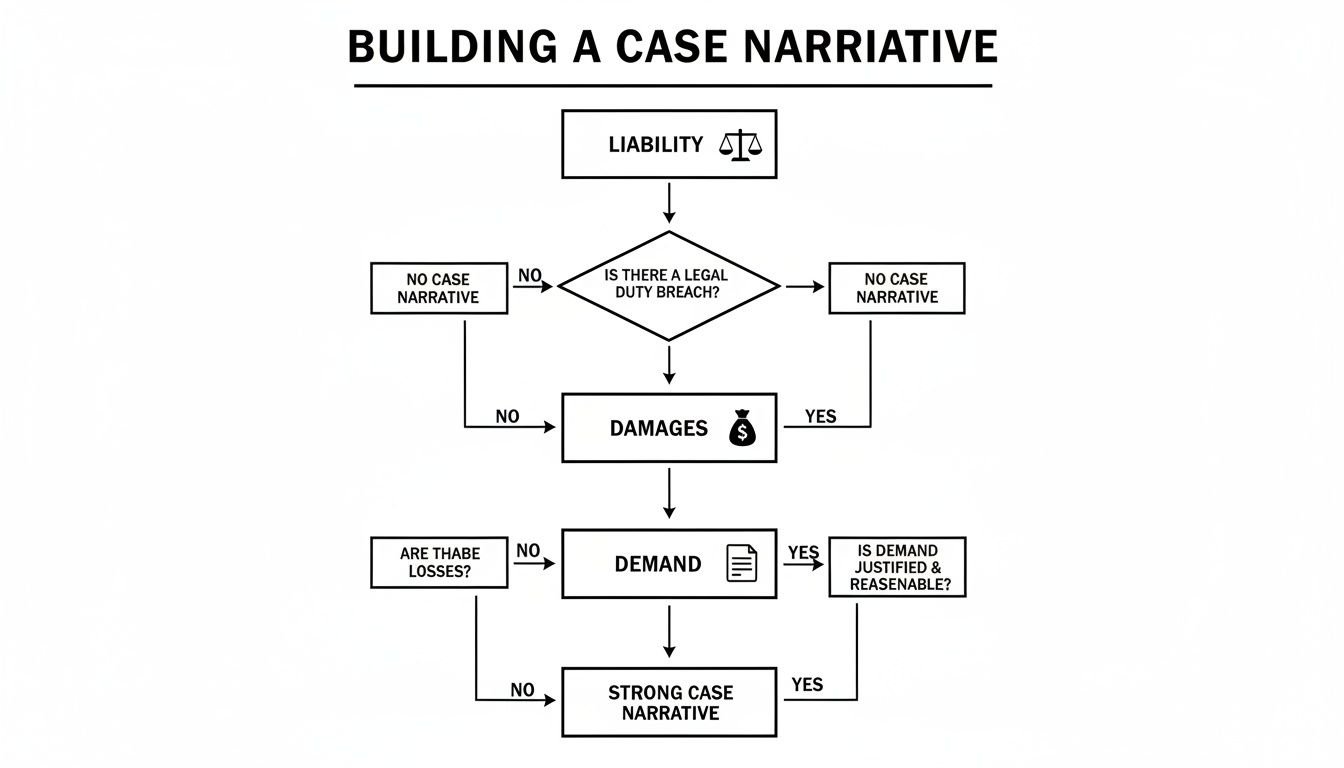
Following this kind of logical flow ensures every part of your argument supports the next, leading to a settlement figure that’s not just a number, but a well-defended conclusion.
Sample for a Minor Injury Case (Whiplash)
For minor injuries—think soft-tissue whiplash from a low-speed rear-ender—the name of the game is efficiency. The goal is a concise, professional letter that’s buttoned up with straightforward documentation. An adjuster handling this kind of file wants a clear reason to close it quickly with a reasonable payment.
Example Snippet: Liability Section
Our Investigation: The facts of this collision are unambiguous. On March 12, 2024, our client, Ms. Emily Carter, was stopped at the traffic light at the intersection of Main Street and Oak Avenue. The police report (No. 24-1589, attached as Exhibit A) confirms her vehicle was stationary when your insured, Mr. David Chen, collided with the rear of her vehicle. Mr. Chen admitted to the responding officer that he was looking down at his phone and failed to notice traffic had stopped.
Expert Analysis: This language is direct and leaves no room for debate. It immediately cites the primary evidence (the police report) and zeroes in on the insured's admission of distracted driving. This establishes clear negligence from the very first paragraph.
Example Snippet: Damages Section
Medical Treatment: As a direct result of the impact, Ms. Carter sustained a cervical strain and sprain, commonly known as whiplash. She sought immediate treatment at City Urgent Care and subsequently completed a course of 12 physical therapy sessions at ProHealth Physical Therapy to restore her range of motion (see medical records and bills, attached as Exhibits B and C).
Total Medical Specials: $4,150.25
Expert Analysis: In a minor case, itemizing the treatment with a specific number of sessions provides concrete detail without getting bogged down. The focus is on showing a clear, finite, and reasonable course of treatment that is directly linked to the accident.
Template for a Moderate Injury Case (Fracture)
When you’re dealing with a more moderate injury like a fracture, the narrative needs to go deeper. You have to paint a vivid picture of how the injury upended the client's daily life, from their ability to work to just getting through the day. The adjuster needs to understand this was far more than a simple inconvenience.
Example Snippet: Pain and Suffering Narrative
Impact on Daily Life: Mr. Allen’s fractured tibia required surgery and left him non-weight-bearing for eight weeks. This wasn't just a medical event; it was a complete disruption of his life. As a self-employed carpenter, he was completely unable to work, resulting in a significant loss of income (see wage loss verification, Exhibit D). Simple tasks like carrying groceries or navigating stairs became impossible without assistance, forcing him to rely heavily on his family.
Expert Analysis: This section moves beyond clinical terms to create a picture of helplessness and financial distress. Using phrases like "complete disruption" and "impossible without assistance" helps justify a much higher value for non-economic damages.
A strong demand for a moderate injury must bridge the gap between what's on the medical chart and what your client actually lived through. It’s not just about the broken bone; it's about the lost income, the frustrating recovery, and the loss of independence.
Framework for a Severe or Catastrophic Injury
For catastrophic cases—those involving permanent impairment or lifelong medical needs—the demand letter transforms into a comprehensive settlement proposal. It’s no longer just a letter; it’s a detailed brief, often supported by a life care plan and multiple expert reports. The tone becomes more formal, and the evidence must be exhaustive because the financial stakes are so high.
Strategic Considerations for Severe Cases:
- Future Medical Costs: You absolutely must anchor your demand in concrete future needs. This requires a life care plan from a certified expert who can project costs for everything from future surgeries and medications to home modifications and in-home care.
- Lost Earning Capacity: This goes far beyond simple lost wages. You’ll need a report from a vocational expert to calculate the total income your client will lose over their entire working life because of their injuries.
- Loss of Consortium: In these cases, it's critical to include a detailed section on how the injury has impacted the client's relationship with their spouse, effectively turning a partner into a full-time caregiver.
Example Snippet: Future Damages
Projected Future Needs: Enclosed is the comprehensive Life Care Plan prepared by Dr. Susan Reed, Ph.D. (attached as Exhibit G), which outlines Ms. Davis’s anticipated medical and non-medical needs for the remainder of her life. The plan projects a total future cost of $3,250,000, accounting for ongoing physical therapy, necessary surgical revisions, prescription medications, and 24-hour attendant care.
Expert Analysis: In a high-value case, you lead with the expert-backed figures. Referencing the life care planner by name and citing the exact projected cost gives the number immediate authority. It makes it credible and very difficult for an adjuster to simply dismiss or lowball.
By tailoring each sample attorney demand letter to the specific gravity of the case, you provide the insurance company with a clear and compelling justification for your settlement figure. This kind of strategic adaptation is the hallmark of effective pre-litigation advocacy.
Calculating Damages and Avoiding Common Pitfalls
Getting the settlement figure right is where methodical analysis meets strategic advocacy. Your demand number isn't just pulled from thin air; it’s the logical conclusion of a well-told story, backed by cold, hard evidence. Calculating this figure, especially the non-economic portion, requires a clear, defensible methodology.
The most common starting point for valuing pain and suffering is the multiplier method. This involves adding up all the special (economic) damages—your medical bills, lost wages, and other out-of-pocket costs—and multiplying that total by a number, typically between 1.5 and 5.
The multiplier you choose is everything. It’s dictated entirely by the severity of the case. A minor soft-tissue injury with a quick recovery might only justify a 1.5x multiplier. But a case involving surgery, permanent impairment, and a life turned upside down? That’s where you start pushing for a 4x or 5x multiplier.
Justifying Your Demand Figure
An adjuster will immediately dismiss a high number unless you’ve already built the foundation for it. Simply stating a figure isn’t enough; you have to anchor it to the specific, human facts of your client's experience.
Here’s how you justify your calculation:
- Connect the Multiplier to the Facts: Don't just pick a number. Explicitly state why the facts of this case warrant your chosen multiplier. Point to the length of treatment, the invasive nature of a surgery, the visibility of permanent scarring, or the client’s inability to do simple things they once took for granted.
- Lean on the Prognosis: Use the treating physician's prognosis to your advantage. If the doctor anticipates future pain, ongoing limitations, or the need for more medical care down the road, that’s your justification for a higher general damages claim right there.
- Humanize the Impact: Circle back to the story you told earlier. Remind the adjuster of the real-world suffering, like your client missing their daughter's graduation because they were in physical therapy, or the chronic pain that now ruins their sleep every single night.
For a deeper dive into this crucial part of the process, our guide on how to calculate pain and suffering damages breaks down the formulas and provides more detailed examples.
Fatal Flaws That Can Weaken Your Demand
Even a perfectly calculated demand can be sunk by simple, avoidable mistakes. These errors don't just weaken your argument; they shred your credibility and signal to the adjuster that you might be disorganized or unprepared. A single oversight can invite a lowball offer or an outright denial.
An error-filled demand letter is a gift to the insurance company. It gives them the justification they need to delay, dispute, and devalue your client's claim. Precision is your greatest asset here.
Avoiding these common pitfalls is just as important as building a powerful narrative. Before any demand letter leaves your office, it needs a final, rigorous quality check.
A Practical Checklist for Quality Control
Think of this as your final pre-flight check. Running through these points can save you from costly mistakes that undermine all your hard work and, more importantly, your client's case.
1. Mathematical Inaccuracies Check your math. Then check it again. An incorrect total for medical specials is an immediate red flag for an adjuster. It screams carelessness and makes them question every other number in your letter.
2. Missing Documentation Never, ever mention a bill, record, or report that isn't attached. If you reference a police report, an MRI result, or a lost wage statement, make sure it’s included as a clearly labeled exhibit. A missing document is the perfect excuse for an adjuster to put your file at the bottom of the pile.
3. Overly Aggressive or Emotional Language Your tone should be firm and professional, not angry. Threats and hyperbole make you seem less objective and actually weaken your position. Let the facts of the case do the heavy lifting and convey the severity of the situation.
4. Vague or Undefined Injuries Don’t just write that your client was "badly injured." Be specific. Use the exact diagnoses from the medical records, such as "cervical herniation at C5-C6 with radiculopathy." Precision adds authority.
5. Failing to Set a Clear Deadline A demand letter without a response deadline has no teeth. It creates no urgency. Always include a specific date by which you expect a response (e.g., 30 days). This sets a professional boundary and keeps the claim moving forward.
Using AI to Draft Demand Letters Faster
If you're in a high-volume personal injury practice, you know that efficiency is the engine that drives profitability. You also know that the traditional way of drafting a demand letter is a massive bottleneck. Sifting through hundreds, sometimes thousands, of pages of medical records is a mind-numbing grind that eats up precious attorney and paralegal time.
This administrative slog doesn't just delay settlements; it puts a hard cap on the number of cases your firm can effectively manage.
Thankfully, modern AI platforms are completely changing this equation. These systems can take an entire case file and, in a matter of minutes, accomplish what used to take days of manual labor. They automatically pull out the critical data points, essentially building the structured foundation for a powerful demand letter before you even start writing.
This means you can go from a mountain of raw documents to a compelling first draft with incredible speed.
How It Automates the Core Workflow
The real magic of AI here is its ability to create order out of chaos. Instead of a paralegal spending hours with a highlighter, manually flagging every diagnosis and treatment date, the software does it all instantly.
Platforms like Ares are built specifically to find and organize the most crucial information for a personal injury claim:
- Medical Chronology: It builds a clean, timeline-based summary of every treatment, from the first ER visit to the last physical therapy session.
- Key Medical Data: It automatically identifies and categorizes diagnoses, provider details, specific symptom complaints, and all associated billing amounts.
- Narrative Generation: The system then uses this neatly structured data to generate a coherent first draft of the medical summary and damages sections.
This kind of interface translates dense, disorganized medical records into an at-a-glance dashboard, letting your team grasp the full case narrative in seconds.
This process does more than just save time—it also drives accuracy. Human error is an unavoidable risk during manual review. An AI doesn't get tired, and it won't miss a crucial detail buried on page 347 of a hospital record. It ensures every single diagnosis and bill is accounted for, which strengthens the very foundation of your settlement demand.
The Tangible Benefits for Your Firm
The impact of this technology is immediate and easy to measure. Firms that use AI to help draft demand letters consistently report saving over 10 hours of manual work on every single case. That time savings directly addresses the market pressures on PI firms, where client demand continues to rise.
Better yet, well-organized medical chronologies have been shown to increase settlement values by 15-25%. It’s not just about speed; it’s about results.
By automating the administrative legwork, you free up your most valuable assets—your legal professionals—to focus on what truly matters: strategy, client communication, and negotiation. This is how smart firms scale their capacity without ever sacrificing the quality of their work.
Of course, the key is to ensure the final letter still has a persuasive, human touch. Learning how to use AI to write a letter that sounds authentic is a critical skill. Think of the technology as a powerful assistant, not a replacement for your legal expertise. It provides the data-driven framework, but you provide the final strategic polish.
For a deeper dive, check out our article on AI for personal injury lawyers.
Common Questions We Get About Demand Letters
Even the most seasoned paralegal or attorney can hit a snag when drafting a demand. The nuances matter, and getting them right can be the difference between a quick, fair settlement and a protracted fight. Here are a few of the most common questions that cross our desks.
When Should We Send the Demand?
Timing is everything. You absolutely want to wait until your client has either finished all their medical treatment or reached what’s known as Maximum Medical Improvement (MMI).
Jumping the gun is one of the biggest mistakes you can make. If you send the demand too early, you won’t have a full picture of the medical specials, let alone any potential future care needs. This will torpedo your client's valuation right out of the gate.
The only real exception to this rule is a clear-cut policy limits case. If the medical bills and lost wages already swamp the at-fault party's insurance coverage, there’s no reason to wait.
What Paperwork Should We Always Attach?
Think of your demand package as a self-contained argument. You need to give the adjuster everything they need to justify the settlement you're asking for. No excuses.
Your package should always include:
- Complete medical records and all itemized bills.
- Documentation for lost wages (think pay stubs or a letter from HR).
- The full, official police or incident report.
- Good, clear photos of your client’s injuries and any property damage.
Missing a single document gives the adjuster an easy out to delay, question, or lowball your claim. A complete, well-organized package shows you're serious and forces them to engage on the merits.
A quick word of advice: Aim high, but stay anchored to your evidence. Throwing out an astronomical number without the facts to back it up just kills your credibility. It tells the adjuster you’re not a serious negotiator, and it can sour the whole process before it even starts.
How Is Technology Changing How We Draft Demands?
The impact has been massive. We're seeing a huge shift in how personal injury firms operate, with a surprising 54% of legal professionals now using AI tools to help draft correspondence like demand letters.
Think about it: where a sample attorney demand letter used to mean hours of tedious, manual work, it's now a much faster process. This is a game-changer for practices in the U.S., where a strong demand letter closes the deal in about 75% of cases without ever seeing a courtroom. You can dig into more of this data in the latest global legal services market analysis.
This kind of automation doesn't just save time. It frees up your team to focus on high-level strategy and client communication instead of getting bogged down in administrative grunt work.
Stop wasting hours on manual work and get your cases settled faster. With Ares, you can transform a mountain of medical records into a solid, accurate demand letter draft in just a few minutes. See how it works at https://areslegal.ai.