Medical records review is the bedrock of any personal injury claim. It's the painstaking process of combing through a client's medical history to pull out the essential facts that will build your case. This means organizing stacks of files, creating a clear timeline, and pinpointing the specific details that link the injury to the damages you're claiming.
Turning Medical Records Reviews Into a Strategic Advantage
Let's be honest. For most personal injury firms, reviewing medical records is a grind. It's a mountain of disorganized paper and PDFs from dozens of providers that has to be conquered, usually by a paralegal who would rather be doing almost anything else. It's seen as a necessary evil, a time-suck that delays settlements and drains resources.
But what if you reframed that thinking? This administrative burden holds the key to unlocking a powerful strategic advantage for your firm.
The trick is to stop treating it as a simple data-entry task and start seeing it as a critical phase of case analysis. By adopting a modern, tech-assisted workflow, you can turn your firm's biggest bottleneck into a genuine competitive edge.
This flowchart maps out the journey from a chaotic mess of files to a clear-cut winning strategy.
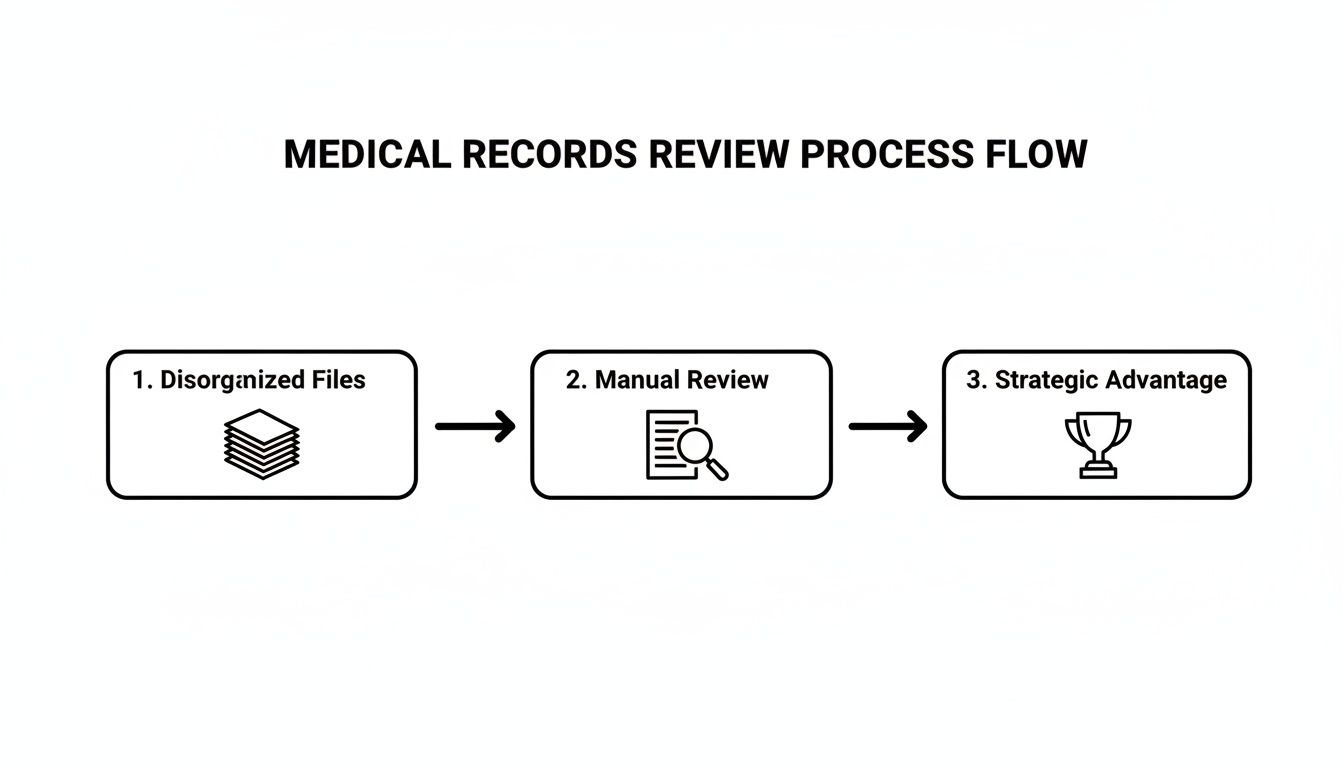
As you can see, a structured review process is what transforms that pile of documentation into the strategic clarity your firm needs to win.
The Challenge of Modern Record Volumes
The problem is only getting bigger. The global market for electronic health records (EHR) was valued at USD 35.89 billion in 2025 and is on track to hit USD 53.11 billion by 2033. For litigators, this digital explosion means cases come with sprawling, often redundant, files that demand hours upon hours of manual review. It's a recipe for burnout and, worse, for missing a crucial detail that could make or break a case.
The real issue isn't just the sheer volume of data; it's the complete lack of structure. A single client's file can contain thousands of pages from hospitals, specialists, imaging centers, and physical therapists—all in different formats. Finding the narrative thread in that chaos is where cases are won or lost.
Embracing a Better Workflow
This is where specialized AI tools change the game. They can slash review time, boost accuracy, and free up your team to do what they do best. By automating the grunt work of extracting key facts, your staff can pivot from tedious data entry to high-value work like developing legal strategy and preparing for negotiations. To truly get ahead, it's worth exploring tools for AI Legal Document Review to supercharge your analysis.
Adopting this new approach pays dividends in several ways:
- Speed and Efficiency: You can cut the hours spent on manual document sorting and data transcription by more than half.
- Improved Accuracy: AI doesn't get tired or miss things. It minimizes human error, ensuring no critical date, diagnosis, or treatment detail is overlooked.
- Strategic Focus: Your team's valuable time is redirected to building stronger arguments and negotiating better settlements.
Manual vs AI-Powered Medical Records Review a Snapshot
The difference between the old way and the new way is stark. While one is a manual, linear slog, the other is an integrated, intelligent process that gives you an immediate advantage.
| Aspect | Manual Review Process | AI-Powered Review (with Ares) |
|---|---|---|
| Initial Sorting | Hours or days spent manually organizing and Bates stamping thousands of pages from multiple sources. | Files are uploaded and automatically organized, sorted by date, and de-duplicated in minutes. |
| Fact Extraction | Paralegals read every page, manually highlighting and copying key dates, diagnoses, and treatments into a separate document. | AI instantly scans all documents and extracts key medical facts, creating an interactive, filterable chronology. |
| Summary Drafting | A time-consuming task of synthesizing notes into a coherent narrative summary or demand letter section. | A draft medical summary and demand letter narrative are generated automatically, ready for attorney review and refinement. |
| Error Potential | High risk of missed details, data entry errors, or overlooked connections due to human fatigue. | Near-zero data extraction error rate. The system flags inconsistencies and missing records for you. |
| Time to Completion | 20-40 hours for a moderately complex case. | 1-2 hours for the same case, freeing up significant staff time. |
| Strategic Insight | Insight is limited to what the reviewer can remember and connect manually. | Provides a high-level, interactive dashboard of the entire case, making it easy to spot trends and build a compelling story. |
This side-by-side comparison makes it clear: the ROI on adopting an AI-powered workflow isn't just about saving time; it's about producing a higher-quality work product that leads to better outcomes.
Platforms like Ares are designed to fit right into this workflow, automating the creation of medical chronologies and even drafting initial demand summaries directly from the raw medical records. If you're curious about the mechanics, you can take a deeper look at how AI transforms medical record review. This approach doesn't just make your firm more efficient—it makes it more profitable and ultimately delivers better results for your clients.
Creating Order From Chaos in the Case File
Every strong medical record review starts with a solid organizational foundation. Before you can even begin to piece together the client's story, you have to wrangle the mountain of documents that lands on your desk. This isn't just busywork; it's the first critical, strategic step in building a winning personal injury case.
Let's be honest, that initial document dump can be a nightmare. You get records in every format you can think of—scrawled notes from a family doctor, blurry faxes from a radiology clinic, and massive electronic health records from a hospital. Each one is a piece of the puzzle, and your first job is to make sure none of them get lost in the shuffle.
Laying the Groundwork: Your Organizational System
The whole point is to create a single, easy-to-navigate case file that anyone on your team can pick up and immediately understand. From my experience, the most reliable manual method is to start sorting every single document first by provider, then chronologically. This simple two-step process stops the file from becoming an information black hole and sets the stage for building your case timeline later on.
Think about a typical multi-car pile-up case. The client was probably seen by paramedics at the scene, went to the ER, followed up with an orthopedic specialist, and then started physical therapy. If you don't have a system, that crucial ER report from day one could easily get buried under six months of physical therapy notes, hiding the initial diagnosis and the direct link to the accident.
A simple intake checklist can be a lifesaver here. Make sure you have:
- Initial Incident Reports: This includes the ambulance run sheet and ER admission records.
- Specialist Consultations: Every report from orthopedic surgeons, neurologists, and other specialists.
- Diagnostic Imaging: All reports for MRIs, X-rays, and CT scans.
- Therapy and Rehabilitation Notes: Records from physical therapists, chiropractors, etc.
- Billing Statements: These are absolutely essential for proving damages.
Getting this phase right is about more than just having a tidy file. For a closer look at the tactics involved, you might find our guide on how to organize medical records helpful for getting maximum clarity and impact.
The Art of a Smart Triage
Once everything is sorted, it's time to triage. Not all records are created equal. The skill here is to quickly pull out the high-impact documents that will form the backbone of your demand. For example, a surgeon's report that explicitly connects a herniated disc to the accident is infinitely more powerful than a routine follow-up note that just says "patient is improving."
A sharp triage process gives you an immediate feel for the case's strengths and weaknesses. You can spot the slam-dunk evidence right away and also identify potential problems, like a pre-existing condition buried in a primary care note from five years ago.
You're actively hunting for the "anchor points" in the client's medical journey. These are the records that definitively lock down key events, diagnoses, and treatment plans. Focusing on these documents first ensures your review time is spent on what will actually move the needle on the settlement value.
How Automation Brings Instant Order
Let's face it, manually sorting hundreds, sometimes thousands, of pages is where firms hemorrhage time and money. This is exactly the kind of task technology was made for. A platform like Ares completely sidesteps the need for manual sorting and triage.
Instead of your team burning hours organizing stacks of paper, you can upload everything at once—it doesn't matter what format it's in. The AI engine gets to work immediately and automatically:
- Sorts and Organizes: Files are instantly arranged by provider and date.
- De-Duplicates: It finds and flags redundant records, instantly cleaning up the file.
- Identifies Key Records: The system highlights the most important documents so you know where to start.
This turns what used to be a multi-day administrative headache into a job that takes minutes. Your team can skip the chaos and jump straight into the high-value work: analyzing the facts and building a winning strategy from a perfectly organized file.
Weaving Raw Data into a Compelling Case Chronology
Once you've managed to wrangle the initial chaos of a new case file, the real analytical work begins. This is where you start to transform that disjointed stack of documents into a powerful, coherent story of your client's journey. Building a compelling case chronology isn't just data entry; it's storytelling. You're using cold, hard medical facts to illustrate the undeniable, day-by-day impact of an injury.
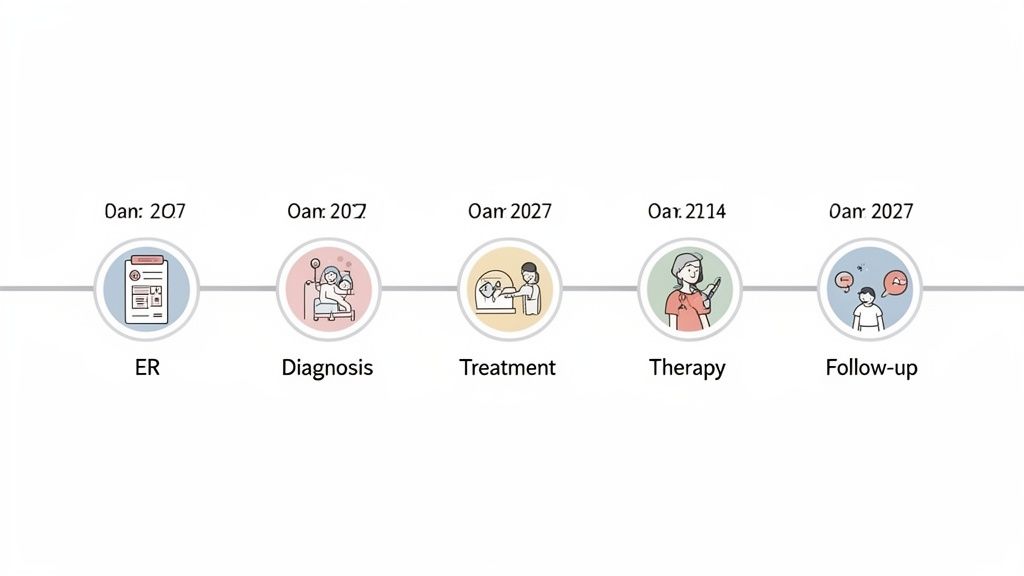
The process involves methodically pulling critical information from every single record to construct a timeline. This timeline will become the very backbone of your demand letter. A strong chronology doesn't just list events—it connects them, painting a clear picture for an insurance adjuster or, eventually, a jury. It has to show the cause-and-effect relationship between the incident and every doctor's visit, every prescription, and every painful procedure that followed.
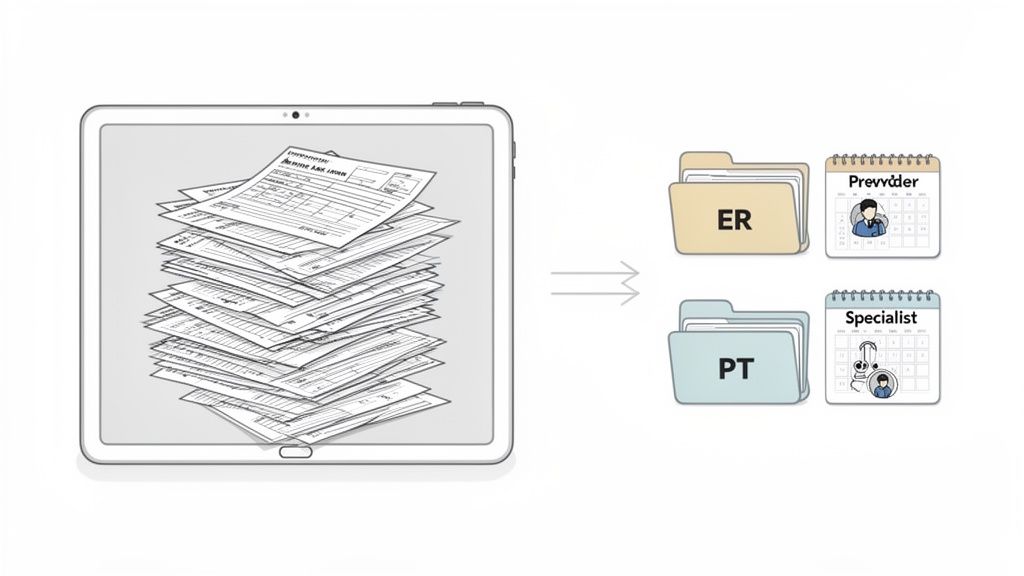
The Core Facts to Extract
To build a truly robust chronology, you have to be meticulous. The goal is simple: capture the "who, what, when, where, and why" of your client's entire medical treatment. Every single entry in your timeline needs to be backed up by a specific document, creating an unshakeable foundation of evidence.
Your extraction checklist should always include these key data points:
- Dates of Service: The exact date for every appointment, procedure, and prescription fill.
- Providers and Facilities: Keep a running list of every doctor, physical therapist, and hospital involved.
- Diagnoses: Capture every official diagnosis. When you can, grab the specific ICD codes—they add a layer of authority.
- Treatment Plans: Document all prescribed medications, therapies, surgeries, and any recommended follow-ups.
- Symptom Evolution: This is crucial. Track the client's reported pain levels, physical limitations, and even their emotional state over time.
Think of yourself as a detective. A note from an orthopedic surgeon on March 15th stating "patient reports persistent 8/10 lumbar pain" is a solid piece of evidence. But it becomes far more powerful when you can connect it directly back to the symptoms documented in the initial ER report from the day of the accident. That’s how you build a narrative.
Reading Between the Lines
A truly effective medical records review goes beyond just transcribing the obvious. It requires a bit of critical reading to spot the subtle details that can either strengthen—or seriously weaken—your case. You're hunting for the story behind the data.
This means paying close attention to inconsistencies. For example, did the client tell their primary care physician their back pain was a "dull ache" but later described it to the orthopedic specialist as "sharp and radiating"? You can bet the defense will pounce on that. Finding it first gives you time to prepare a response.
The most powerful chronologies are the ones that anticipate the defense's arguments. When you proactively identify and contextualize potential weaknesses, like a passing mention of a pre-existing condition, you neutralize their impact before they can be used against your client.
Here's another pro tip: track what wasn't done just as closely as what was. If a doctor recommends an MRI but the client doesn't get one for six weeks, you need to know why. Was it an insurance delay? Was it patient non-compliance? The context here is everything.
The Challenge of Digital Data Overload
Building these detailed chronologies has become exponentially more complex. The shift to electronic health records has been massive, with 96% of U.S. non-federal acute care hospitals and 78% of office-based physicians using them by 2021. For personal injury firms, this means a medical records review is no longer a paper-bound slog—it's a data-overloaded marathon through fragmented digital files. You can dig into the national trends on the official HealthIT.gov data portal.
This is precisely where automation becomes a non-negotiable part of a modern practice. An AI-powered tool like Ares completely automates this extraction grind. It can scan thousands of pages in minutes, pulling out every key date, diagnosis, and treatment with incredible precision.
How AI Automates Chronology Building
Instead of a paralegal dedicating days to manually combing through records, you can upload the entire file and let the system do the heavy lifting. The AI doesn't just pull data; it understands context.
Here’s how it changes the game:
- Automated Data Extraction: The platform instantly identifies and pulls all the relevant data points, from dates of service to specific medical billing codes.
- Instantaneous Organization: It arranges everything into a clean, filterable timeline, linking each fact directly back to its source document for easy verification.
- High-Level Summaries: Ares even generates a high-level summary, giving your team an immediate grasp of the case-defining facts before they've read a single page.
This kind of technology transforms a 10+ hour task into something that takes just a few minutes. The result is a perfectly accurate, evidence-backed chronology that’s ready almost instantly. This frees up your team to jump straight to strategic analysis, focusing their expertise on building the strongest possible case narrative from a flawless factual foundation.
Uncovering Gaps and Strengthening Your Case Narrative
A truly expert medical records review goes way beyond just collecting data. This is where you shift from simply building a timeline to constructing a powerful, persuasive argument. It's about a forensic-level examination of the records, spotting the subtle details that can make or break your case.
This analytical phase is all about looking for what’s missing, what doesn’t quite add up, and what you know the defense counsel will try to use against you. When you find these weak points first, you can build a more resilient case strategy and have your counterarguments ready before they ever become a threat.
Identifying Gaps in Treatment
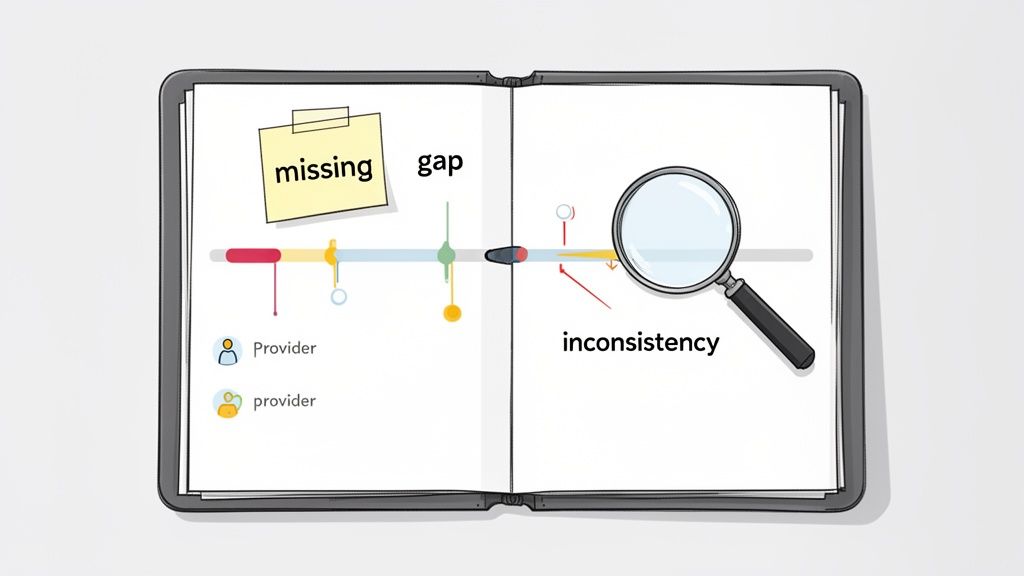
One of the very first things an insurance adjuster or defense attorney looks for is a significant gap in treatment. If your client waited six weeks after the accident to see a doctor, or if there's a two-month pause in their physical therapy, the defense will immediately argue the injury wasn't that serious or was caused by something else entirely.
Your job is to find these gaps before they do and understand the real story behind them. A successful review means actively hunting for these breaks in the timeline.
You’ll often find perfectly reasonable explanations for these gaps:
- Initial Stoicism: Many clients try to "tough it out" at first, only seeking medical help when the pain becomes undeniable and persistent.
- Logistical Hurdles: They might have faced delays with insurance pre-authorization or simply couldn't afford the co-pays right away.
- Conflicting Medical Advice: It’s not uncommon for a doctor to recommend waiting a few weeks to see if symptoms improve on their own.
By finding the gap and its reason, you can frame it as a logical part of your client's experience, not a red flag that weakens the claim. That context is everything.
Spotting Inconsistencies Across Providers
Our clients see multiple specialists—ER doctors, orthopedists, physical therapists—and their records don't always tell a perfectly aligned story. A skilled reviewer knows to focus on finding and reconciling these inconsistencies before the opposition can exploit them.
For instance, a client might tell an orthopedic surgeon their pain is an 8/10, but a week later describe it as a "dull ache" to their family doctor. That kind of discrepancy is exactly what a defense attorney will use to question your client's credibility. Similarly, one doctor’s notes might clearly attribute symptoms to the accident, while another's might hint at a pre-existing degenerative condition.
A truly thorough review means comparing notes from every single provider, side-by-side. You're looking for conflicting diagnoses, varying pain level reports, and different accounts of the accident's impact on your client's life. Finding these issues early gives you time to address them head-on.
This proactive approach is more critical than ever. In 2023, the healthcare sector was hit with a massive wave of data breaches, exposing over 133 million medical records. This reality adds another layer of complexity, as firms now have to scrutinize not just treatment histories but potential data integrity issues. This makes manual reviews even more daunting. You can learn more about the latest healthcare data breach statistics and what they mean for legal practices.
Addressing Pre-Existing Conditions
Let's be realistic: no client comes with a perfectly clean medical slate. Pre-existing conditions are a fact of life, but they're also a favorite target for defense attorneys trying to devalue your claim. Your review has to meticulously identify every mention of prior injuries or similar conditions.
The goal isn't to hide these conditions—it's to contextualize them. You need to dig for the medical evidence that clearly differentiates the old, stable injury from the new, acute one. This often comes down to finding specific language in the records.
For example, a physician might note that the client's current lumbar pain is "a significant exacerbation of a previously stable chronic condition." That single phrase is gold. It acknowledges the prior issue while directly linking the new, more severe symptoms to the accident.
How Technology Fortifies Your Narrative
Manually cross-referencing thousands of pages to spot these subtle gaps and inconsistencies is a monumental task, and frankly, it's ripe for human error. This is where a platform like Ares becomes an incredibly powerful ally in your analysis.
When a case file is organized by AI, it’s so much easier to visually identify timeline gaps or conflicting notes. By structuring all the data chronologically and by provider, the system lets your team scan for these issues with remarkable speed and accuracy.
Here’s how automation strengthens this critical analysis:
- Visual Timeline Gaps: An automated chronology instantly highlights periods with no medical activity, flagging them for your team to investigate further.
- Keyword and Concept Searching: You can search the entire file for terms like "pre-existing" or "degenerative disc disease" in seconds, pulling up every relevant mention instantly.
- Inconsistency Flagging: The right AI can even flag conflicting information, like different pain scores reported to different doctors within the same week.
By letting technology handle the heavy lifting of this deep analysis, your legal team can focus on what they do best: building a stronger, more resilient case narrative and anticipating every move the defense might make.
Drafting Demand Letter Summaries That Get Results
You’ve organized the records, built the chronology, and analyzed every gap. Now comes the moment that can make or break a case: drafting the demand letter summary. This isn't just a clinical list of facts; it's where you craft the narrative that will convince an insurance adjuster of your client's story.
A truly effective summary weaves all your hard work into a compelling story of injury, pain, and recovery. It must draw an undeniable line connecting the incident to the damages you're claiming. The goal is simple: present the case with such clarity and logic that the adjuster has no room to downplay its value.
Every date, diagnosis, and detail must be perfect. Credibility is everything in a negotiation, and a single mistake can give the other side an opening.
Structuring Your Summary for Maximum Impact
A strong demand summary needs a solid narrative blueprint. It guides the adjuster through your client’s medical ordeal in a way that’s logical and easy to follow, even when the records themselves are complex.
Think of it as building a case brick by brick. You start at the scene of the incident and walk them through every single step of the journey that followed.
Here’s a structure that has proven effective time and again:
- Initial Injury and Emergency Care: Kick things off with the incident itself. Detail the ER visit, what the initial diagnoses were, and the client's immediate complaints of pain.
- Diagnostic Journey: Next, lay out the path to a full diagnosis. This is where you cover the specialist consultations, MRIs, X-rays, and other tests that revealed the true extent of the injuries—like a herniated disc that wasn't caught in the ER.
- Treatment and Rehabilitation: This section is the core of the summary. Detail every treatment, from surgeries and physical therapy to pain management injections and prescription medications. Emphasize how long and intensive the care was.
- Prognosis and Future Care: Finally, bring it home with the doctor’s long-term outlook. What permanent impairments is the client facing? Will they need future medical treatment? This is crucial for justifying future damages.
This chronological flow makes the cause-and-effect relationship between the accident and the damages impossible to ignore. For more strategies on telling these stories, check out our in-depth guide to crafting a winning medical record summary.
The Final Quality Check
Before a single demand letter leaves the office, it needs a final, meticulous quality check. This isn't optional. One wrong date or a misstated diagnosis can poison the well and undermine your entire position.
Your quality check is the last line of defense against costly errors. It’s what ensures every claim in that summary is backed by cold, hard evidence from the medical records, creating a demand that’s tough to argue with.
During this final pass, your team should be cross-referencing every single fact in the summary against the source document. That means verifying dates of service, provider names, specific diagnostic codes, and treatment plans. It’s tedious, but this is what transforms a good summary into a powerful negotiation tool.
The Game-Changing Role of AI Drafting Tools
Let's be honest: manually drafting these summaries from a mountain of records is a grind. A skilled paralegal can spend hours pulling everything together. This is exactly where integrated AI drafting tools are changing the game for modern PI firms.
Platforms like Ares take the structured data you’ve already organized and instantly generate a comprehensive first draft of the summary. The AI pulls from your chronology, provider lists, and treatment histories, slotting it all into a clean, well-structured narrative.
The difference this makes is immediate and profound:
- Speed: You get a detailed draft in minutes, not hours.
- Accuracy: Since the draft is built directly from the extracted data, the risk of human transcription errors plummets.
- Efficiency: Your team's job shifts from writing to refining. Instead of facing a blank page, they can dedicate their expertise to sharpening legal arguments and strengthening the narrative for negotiation.
By handing off the initial draft to AI, you can reclaim dozens of hours every month. This frees up your team, boosts your firm's capacity, and ensures a consistently high-quality work product on every single case.
Common Questions About Modernizing Medical Records Reviews
Bringing any new technology into your firm, especially for something as critical as medical records, is going to raise some questions. It's only natural. Concerns about security, accuracy, and what this means for your team are completely valid. Let's walk through some of the most common questions we hear from personal injury pros who are looking to update their process.
The biggest hesitation for most firms? Trust. It all boils down to whether a piece of software can really grasp the subtleties of a complex medical file the way a seasoned paralegal can.
Can AI Truly Understand Nuance in Doctors' Notes?
It's a fair question. Legal work isn't just about data points; it's about context. Modern AI platforms aren't just simple keyword finders. They are built using Natural Language Processing (NLP) and trained on millions of real-world medical documents—from pristine hospital discharge summaries to nearly illegible handwritten notes from a physical therapist.
This training gives the system an incredible ability to recognize different formats, understand complex medical jargon, and connect the dots. It knows that a diagnosis mentioned on page 3 is linked to a specific treatment prescribed on page 47. It then pieces this all together into a clean, chronological timeline.
Of course, the final legal strategy and the story you tell will always need a human touch. But the AI does the heavy lifting—the organizing, the sorting, the data extraction—so your team can jump straight to analyzing the important details and building the case.
Is Using a Third-Party AI Platform HIPAA Compliant?
Compliance isn't just a feature; it's a foundational requirement. Any reputable AI platform built for the legal industry is designed from the ground up to meet and exceed strict security standards for Protected Health Information (PHI). A platform like Ares, for instance, operates in a secure, encrypted environment built specifically to safeguard sensitive client data.
Before you partner with any vendor, your due diligence is key. You absolutely must confirm that they will sign a Business Associate Agreement (BAA). In many ways, using a purpose-built, compliant platform is significantly more secure than old-school methods like emailing records or storing them on vulnerable local servers.
The responsibility for protecting client data doesn't disappear with new technology; it just changes form. A robust AI partner should act as a fortress for your data, with enterprise-grade security controls and transparent compliance documentation.
These responsibilities are outlined in various legal frameworks. Understanding your obligations, like those detailed in a Privacy Impact Assessment in Alberta Under PIPA, FOIP, and HIA, reinforces why choosing a security-first partner is non-negotiable.
Will an AI Tool Make Our Paralegals Obsolete?
This is probably the most common fear we encounter, and the answer is a resounding no. The goal here is to augment, not replace, your team. Think of it as giving your best people a superpower.
By automating the most time-consuming and frankly, mind-numbing, parts of a medical review—like sorting records, Bates stamping, and transcribing dates—you free your paralegals to focus on work that actually requires their expertise.
Instead of being stuck in data-entry mode, their role evolves into one of strategic analysis. They can now invest their time in high-value tasks that directly impact the case:
- Spotting the Smoking Gun: With all the facts neatly organized, it's much easier for them to identify critical inconsistencies or that one key piece of evidence that changes everything.
- Driving Case Strategy: Freed from the administrative slog, they can actively contribute to strategy sessions and help prepare for depositions with a deeper understanding of the medical history.
- Improving the Client Experience: With more bandwidth, they can provide the kind of thoughtful, frequent updates that keep clients happy and informed.
Ultimately, this technology elevates your paralegals from reviewers to analysts, making them even more essential to your firm's success. It lets them use their skills where they count most.
Ready to eliminate the administrative grind of medical record reviews and focus on winning your cases? Discover how Ares can transform your firm's workflow, saving you 10+ hours per case while building stronger, more persuasive demand letters. See the platform in action and claim your strategic advantage today. Learn more at https://areslegal.ai.