

Picking the right law firm partner compensation model is one of the most consequential decisions a leadership team will ever make. It's a strategic move that can either bind individual ambitions to the firm's collective success or, if poorly designed, ignite internal competition and stop growth in its tracks. This single choice fundamentally shapes your firm's culture, directs partner behavior, and ultimately, charts the course for your future.
Why Your Partner Compensation Model Defines Your Firm's Future

A partner compensation plan is much more than a spreadsheet formula; it’s the living embodiment of your firm's values. It provides a clear answer to the most important question: what do we reward here? Is it individual rainmaking? Is it collaborative teamwork and mentorship? Or is it simply seniority and operational discipline? The structure you put in place sends an unmistakable signal to every partner about what truly matters.
This choice creates a powerful feedback loop. A model that only rewards origination might attract aggressive, entrepreneurial lawyers, but it can also kill mentorship and knowledge sharing. On the other hand, a system based purely on seniority can foster loyalty but often fails to light a fire under younger partners to go out and build their own books of business.
The Strategic Importance of Compensation Structure
At the heart of this discussion is the classic tension between rewarding individual performance and nurturing a "firm-first" culture. Smart firms, particularly in high-stakes practice areas like personal injury, are realizing that rigid, one-size-fits-all systems no longer work. They're shifting toward more flexible models that incentivize the specific behaviors needed for long-term, sustainable growth.
Of course, a firm’s capacity to implement any of these models effectively hinges on its financial stability. For managing partners, a key priority is to reduce operational costs to ensure the profit pool available for distribution is as healthy as possible.
A compensation plan should be a strategic tool, not just a mechanism for slicing up the pie. It must be intentionally designed to steer the firm toward its long-term goals, whether that's market expansion, retaining top talent, or boosting profitability.
Key Factors Influenced by Your Model
The ripple effects of your compensation plan are felt in every corner of the firm, which is why a deliberate, thoughtful approach is non-negotiable. Here’s a breakdown of how different models can shape the core operations and culture of a law practice.
| Aspect | Individual-Focused Model (e.g., Eat-What-You-Kill) | Collective-Focused Model (e.g., Lockstep) |
|---|---|---|
| Culture | Breeds a competitive, entrepreneurial "me-first" environment. | Nurtures collaboration, stability, and long-term loyalty. |
| Talent | A magnet for rainmakers and intensely driven individuals. | Attracts team players and is better at retaining institutional knowledge. |
| Client Service | Can lead to "client hoarding" and fractured service delivery. | Encourages seamless client hand-offs and a unified team approach. |
| Growth | Fuels rapid, often aggressive, growth through individual business development. | Delivers steady, more predictable growth and institutional stability. |
The Three Core Philosophies of Partner Compensation
Before we dive into specific formulas and models, it's important to understand the thinking behind them. Nearly every compensation system out there is built on one of three core philosophies, each one telling a different story about what a firm values most.
Getting a handle on this spectrum—from pure collectivism to stark individualism—is the first real step in figuring out which structure fits your firm's culture. Are you rewarding loyalty and seniority above all else? Is it all about individual business generation? Or are you trying to find a balance that recognizes a wider range of contributions?
The Collectivist Philosophy: Lockstep Models
The most traditional approach is Lockstep. It’s a seniority-driven system where a partner’s pay is tied directly to their tenure at the firm. In its purest form, partners who joined in the same year earn the same amount, and their compensation rises predictably as they move up the ladder. The belief here is simple: the firm is a single entity, and its success is a collective effort built over decades.
This model is designed to foster loyalty, stability, and teamwork. Since individual client origination doesn't directly boost your paycheck, partners are encouraged to collaborate on cases, mentor younger attorneys, and make decisions for the firm's long-term health. The big risk, of course, is that it can frustrate high-performing junior partners while protecting senior partners who may be coasting.
The Individualist Philosophy: Eat-What-You-Kill
At the complete opposite end is the Eat-What-You-Kill (EWYK) philosophy. This is a purely entrepreneurial and individualistic model where compensation is a direct result of the revenue a partner personally generates—either from their own billable work or, more often, from the clients they bring in. It's a transparent system where what you produce is what you get.
EWYK creates a competitive, high-stakes culture that’s a magnet for rainmakers. But that intense focus on individual numbers can kill collaboration, mentorship, and time spent on non-billable firm-building activities. At its worst, it leads to things like "client hoarding" and deep internal silos.
The Hybrid Philosophy: Merit-Based Systems
Most firms today live somewhere in the middle with Merit-Based systems. This philosophy tries to blend the best of both worlds, rewarding a more balanced mix of behaviors. These models typically use a formula that assigns weight to multiple factors, like billable hours, origination credit, management responsibilities, and mentorship.
The whole point is to create a more holistic and objective system that connects individual rewards with what the firm actually wants to achieve. Law firm compensation models have evolved dramatically, and today, these formula-based systems are the norm, with pure lockstep becoming a rarity. To get a better sense of this shift, you can learn more about the evolution of partner compensation structures and see how performance-based formulas have taken hold at over 53% of midsize firms.
Comparing Compensation Models for Modern Law Firms
Picking the right compensation model means getting honest about the trade-offs between teamwork and rewarding individual hustle. Each framework sets up a different game with different rules, shaping partner behavior, firm culture, and ultimately, the bottom line. When you put them side-by-side, you start to see how each one stacks up against what a modern firm needs to do: bring in new business, work together effectively, and build something that lasts.
This visual gives you a quick snapshot of the core philosophies behind the most common models, from the seniority-driven Lockstep to performance-based Formula systems and the Hybrid approaches that try to find a middle ground.
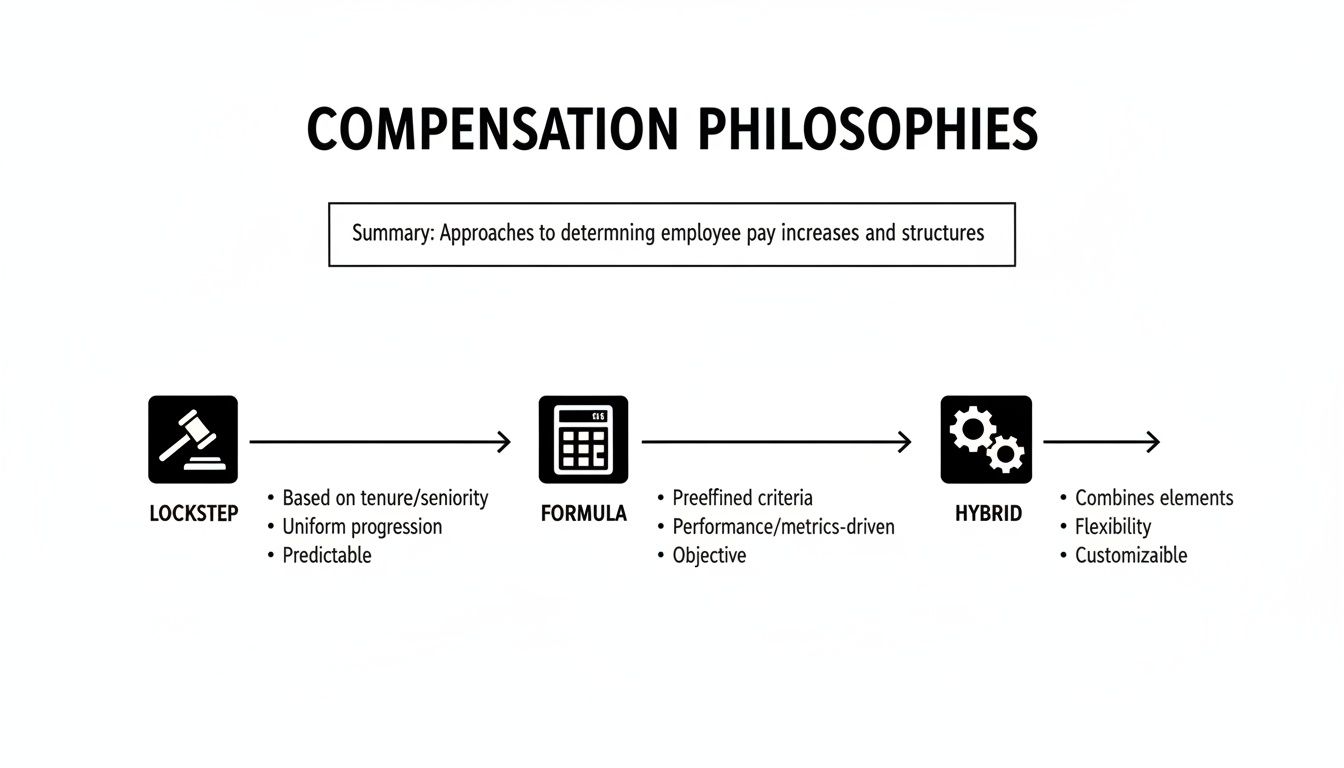
As the diagram shows, there’s a real philosophical divide here. Each path represents a different set of values—whether it’s stability, pure metrics, or a calculated blend of strategic goals.
H3: Lockstep and Modified Lockstep
The traditional Lockstep model is as straightforward as it gets: your pay is based on your seniority. More years at the firm equals a bigger piece of the pie. The whole point is to foster a "one-firm" culture where partners collaborate, mentor junior lawyers, and invest in non-billable work without fighting over credit.
But its biggest flaw is a dealbreaker for many. It fails to reward exceptional performance. A young partner who lands a massive, firm-changing client gets the same pay as their classmates, which can breed resentment and push top talent out the door. That's why pure lockstep is a rare sight these days.
Key Differentiator: Lockstep is fantastic for building institutional loyalty and stability, but it can stifle the entrepreneurial fire needed for aggressive growth. The collective always comes before the individual.
That’s where Modified Lockstep comes in. It keeps the seniority tiers but carves out a portion of the profits for performance-based bonuses or adjustments. This allows the firm to reward home runs—like landing a huge book of business or winning a landmark case—without tearing down the collaborative structure. A firm might, for example, set aside 10-20% of the profit pool for a compensation committee to award as discretionary bonuses.
H3: Eat-What-You-Kill and Originations-Based
On the complete opposite end of the spectrum is the Eat-What-You-Kill (EWYK) model. This is a pure "you get what you earn" system. A partner’s compensation is tied directly to the revenue they personally generate, whether from their own work or the clients they bring in. It's a powerful motivator for business development, essentially turning every partner into an entrepreneur.
The downside is just as powerful. EWYK can create a cutthroat culture of "client hoarding," where partners refuse to share work or collaborate. It completely devalues critical non-billable work like management, mentoring, and firm marketing, which can eat away at the firm’s long-term health. The intense focus on individual numbers often leads to burnout and a disjointed client experience.
An Originations-Based model is a popular spin on EWYK. Here, the "rainmaker" who brings in the client gets a cut of that client’s revenue for life, no matter who actually does the work. While this provides a massive incentive for business development, it can create real friction between the originating partners and the "service" partners grinding out the work.
The money involved in these individual models is staggering. In BigLaw, average total partner compensation has shot up to $1.4 million, a 26% jump since 2022, fueled by a parallel 26% increase in partner originations. As you can read more about the drivers of partner compensation, it’s obvious just how much value the market places on the ability to make it rain.
H3: Merit-Based and Formulaic Systems
A Merit-Based or Formulaic system is an attempt to build a more objective and balanced framework by assigning different weights to different contributions. This is, by far, the most common approach for midsize and boutique firms today. A typical formula could be structured like this:
- 30% Personal Collections
- 40% Origination Credit
- 15% Working Attorney Receipts (revenue from work on other partners' cases)
- 10% Firm Management & Mentorship
- 5% Discretionary Bonus Pool
The beauty of this model is its flexibility. A firm can tweak the formula to push for specific strategic goals. A firm in growth mode might bump up the weight for originations. One trying to improve cash flow might add metrics for realization rates. These systems become even more powerful when supported by the right technology; our guide on law firm automation software explores how modern tools can track these metrics without the administrative headache.
The biggest hurdle is the complexity. Designing a formula that everyone agrees is fair is tough, and tracking the data can become a full-time job without good systems. A poorly designed formula can also backfire, encouraging partners to game the system and focus only on the most heavily weighted tasks.
H3: Comparative Analysis of Partner Compensation Models
To help you decide what’s right for your firm, this table provides a side-by-side comparison of how these models perform against key metrics for a personal injury practice.
| Model | Primary Driver | Incentivizes | Best For | Key Risk |
|---|---|---|---|---|
| Lockstep | Seniority | Loyalty, collaboration, mentorship | Established firms with institutional clients | Demotivates high-performing junior partners |
| Modified Lockstep | Seniority & Performance | Collaboration with some performance recognition | Firms transitioning from pure lockstep | Bonus criteria can become subjective and political |
| Eat-What-You-Kill | Individual Revenue | Aggressive business development, high billables | Entrepreneurial firms focused on rapid growth | Creates silos, discourages teamwork, can cause burnout |
| Merit-Based/Formulaic | Weighted Metrics | A balanced mix of firm-defined behaviors | Firms wanting to align compensation with strategy | Complexity in design and administration |
In the end, there's no magic bullet. A hungry, fast-growing PI firm might thrive with a formulaic system that heavily rewards bringing in great cases and achieving huge outcomes. On the other hand, an established firm with a deep bench of legacy clients might prefer a modified lockstep model to keep things stable and manage succession. The best compensation plans are the ones designed with intention, directly linking pay to the behaviors that reflect the firm's unique culture and strategic goals.
Structuring Equity and Non-Equity Partnership Tiers
Many growing law firms have realized the old single-tier partnership model just doesn't cut it anymore. Bringing in a two-tier system—with both equity partners and non-equity partners—creates a much more flexible and powerful structure for keeping and motivating top lawyers. But it only works if you're deliberate about how each tier is compensated. These aren't just labels; they represent completely different stakes in the firm.
It's critical to understand the divide. An equity partner is an owner in the truest sense. They put in capital, share in the profits (and the losses), and have a vote on the big decisions. A non-equity partner, sometimes called an income partner, is essentially a senior employee on a high-performance track. They typically get a solid base salary plus a bonus tied to performance, but they don't have the risk or capital requirements of ownership.
Defining the Compensation Gap
There's often a massive, and intentional, financial gap between these two tiers. This chasm is a powerful motivator. It shows ambitious non-equity partners exactly what’s on the table when they achieve full ownership. For context, equity partners can average $1.9-$2.21 million annually, while their non-equity counterparts might earn $451,679-$558,000. If you explore the economics of modern law firms, you'll see these compensation ratios can even reach 4.2:1 at elite firms.
This difference isn't arbitrary; it reflects the fundamental split between risk and reward.
- Equity Partners: Their income is a direct reflection of the firm's overall performance. When the firm has a banner year, their take-home skyrockets. In a tough year, they feel the pain. Their reward is tied to the success of the entire enterprise.
- Non-Equity Partners: Their compensation is far more stable and predictable, shielding them from the firm's financial swings. The model rewards them for their individual and team contributions without asking them to shoulder the burden of ownership.
A well-designed two-tier system builds a clear, aspirational career ladder. The pay gap shouldn't feel like a punishment; it should be the ultimate incentive for non-equity partners to become the leaders who will drive the firm's value for years to come.
Establishing a Clear Path to Equity
For a two-tier system to succeed, you absolutely must have a transparent and objective path to equity partnership. If that path is murky or feels like a moving target, the non-equity tier becomes a glorified holding pen, breeding resentment and pushing your best people out the door. For a personal injury firm, this means defining the criteria for making that leap in clear, measurable terms.
What does that look like in practice? Here are some key metrics for advancement:
- Consistent Case Origination: Proving you can bring in a steady pipeline of high-value cases over a 2-3 year period. This shows you're a rainmaker who can generate new business, not just manage existing files.
- Profitability and Financial Management: Demonstrating a history of handling cases efficiently, hitting high realization rates, and directly boosting the firm's bottom line. It’s about being a good steward of the firm's resources.
- Mentorship and Team Leadership: Actively developing junior associates, running a practice group, or making other tangible contributions to building up the firm’s next generation of talent.
- Firm Citizenship: Stepping up to handle significant non-billable work. This could mean serving on important committees, spearheading a marketing campaign, or taking on a role in day-to-day firm management.
By setting these kinds of objective goalposts, the non-equity partner role transforms from a simple job title into a genuine proving ground. It creates a structure that rewards your highest performers with an attainable path to ownership, ensuring you’re developing future leaders who are truly all-in on the firm's long-term success.
How to Implement a New Compensation Plan
Switching compensation models is one of the most sensitive initiatives a firm can undertake. It's far more than a financial exercise; it's a major change management project that can either reinforce your firm's culture or shatter partner morale. If you don't map out the transition with care and communicate transparently, even the best-designed plan can backfire, creating deep-seated distrust. The goal is to make the change feel like a natural, strategic evolution, not a top-down decree.
The first step is always to create a dedicated compensation committee. Don’t just stack it with the managing partners. This group needs credibility across the firm, so include a mix of senior rainmakers, operational leaders, and even respected up-and-comers. Their job is to own the process, gather honest feedback, and make sure the new model truly reflects the firm's strategy and values.
Establishing Objective Performance Metrics
A modern compensation plan is built on data, not just gut feelings. Subjectivity is the enemy of a fair system, and if you want partners to trust the outcome, you have to ground it in objective metrics. For personal injury firms, this means looking beyond simple origination credits and capturing the full picture of a partner's contribution.
The most effective law firm partner compensation models are built on a foundation of unbiased data. When performance is measured with objective metrics, compensation decisions become transparent and justifiable, removing the politics and favoritism that can poison a firm's culture.
What should a PI firm track? Here are some key metrics to consider:
- Origination Value and Quality: Move beyond just the number of new files. What’s their potential value? Do they fit the firm's ideal case profile?
- Case Lifecycle Efficiency: Measure the average time from intake to settlement. This rewards partners who run an efficient and proactive docket.
- Realization Rates: What percentage of expected fees is actually collected? This is a crucial measure of financial discipline.
- Client Satisfaction Scores: Use simple tools like Net Promoter Score (NPS) to put a number on the client experience.
- Mentorship and Team Development: Track the growth and success rates of junior associates and paralegals under a partner's supervision.
Using a balanced scorecard of metrics like these creates a holistic view that rewards the behaviors you want to encourage, not just rainmaking.
The Phased Rollout and Communication Plan
Nobody likes abrupt changes, especially when it comes to their paycheck. A phased implementation gives everyone time to adjust, lets you work out any unexpected kinks, and builds consensus along the way. Your roadmap should be deliberate and paired with a constant stream of communication to manage expectations.
A smart implementation timeline looks something like this:
- Announce the Review (6-9 Months Out): The managing partner and the new committee announce the firm is reviewing its compensation model. Crucially, they must explain why this is happening now.
- Gather Partner Feedback (Months 6-8): This is where you build trust. The committee needs to conduct one-on-one interviews and small group meetings to hear what partners value, what worries them, and what they think is broken.
- Model and Test (Months 3-5): Once you have a few potential models, run them in the background. Use the past year's data to create "shadow reports" that show partners exactly how their compensation would have changed under the new system. This demystifies the process completely.
- Finalize and Announce the New Plan (3 Months Out): Present the final, board-approved model. Provide crystal-clear documentation on the metrics, their weightings, and the official start date. Hold a town hall to answer every last question.
- Launch and Review (Year 1): Go live with the new system, but build in formal check-ins—quarterly is a good cadence—to review the data, discuss how things are going, and address any unintended consequences before they become major problems.
Leveraging Technology for Fair Implementation
Trying to track these kinds of detailed KPIs manually is a recipe for disaster. It’s not just a logistical headache; it's a breeding ground for errors and accusations of bias. Modern legal tech is what makes a truly objective, merit-based system possible.
Automating performance tracking ensures the data is clean and the process is transparent. For a deeper look at how firms are doing this, our guide on time tracking software for law firms provides some great examples. When the data drives the decisions, compensation conversations shift from being about politics to being about performance.
Using Technology to Fuel a Performance-Based Model

Shifting to a data-driven compensation model is one thing, but actually capturing the right performance metrics is a completely different challenge. Technology is the bridge that connects compensation theory to your firm's operational reality. It provides the objective data you need to reward performance fairly, moving your firm away from subjective feelings and toward a system built on real, quantifiable results.
By automating the routine administrative work that bogs down every case, technology directly boosts the key performance indicators that merit-based models are designed to reward. This creates a clear, undeniable link between tech adoption, individual performance, and what a partner takes home.
Quantifying a Partner's Increased Capacity
Think about the real-world impact of automating tasks like sifting through medical records or drafting demand letters. A platform like Ares can wipe out 10+ hours of manual work on a single case. This gives partners and their teams back their most valuable asset: time to focus on what truly matters.
This isn't just about being more efficient; it's a measurable expansion of a partner's capacity. All those recovered hours can be reinvested directly into activities that drive the metrics you care about:
- Client Acquisition: More time becomes available for networking, marketing, and business development.
- Strategic Case Management: Partners can dedicate deeper focus to high-stakes negotiations or complex legal arguments.
- Team Mentorship: Senior attorneys have more bandwidth to train and develop associates, lifting the entire team's productivity.
Of course, to make this work, you need the right tools. Specialized time tracking software for lawyers is essential for accurately capturing both billable and non-billable contributions, ensuring every effort is accounted for.
Technology turns vague goals like "improving efficiency" into hard numbers. It lets you show exactly how a partner who embraces automation can handle a bigger caseload or bring in more revenue in the same number of hours, clearly justifying their compensation under a formulaic system.
A Practical Scenario: Tech-Driven Compensation in Action
Let’s walk through a quick, practical example. Imagine a partner who typically manages 20 complex cases per year. By using automation to save just 10 hours per case, they've suddenly reclaimed 200 hours of their time annually.
If you value their strategic work at an effective rate of $500 per hour, that’s $100,000 in recovered value. That value can be channeled directly into more billable work, originating new clients, or taking on additional cases without burning out.
This is how a partner’s compensation grows not just from working harder, but from working smarter. Technology provides the tools, and a well-designed compensation model provides the incentive. Together, they create a powerful cycle for growth. You can learn more about how modern firms are doing this by reading our insights on the intersection of law firms and technology.
Tackling the Tough Questions on Partner Compensation
When it comes to partner compensation, every firm leader has questions. It’s a complex, often sensitive topic, but getting it right is fundamental to building a healthy, growing practice. Over the years, I've seen the same concerns pop up time and time again as firms try to design, implement, or just tweak their systems.
Let's cut through the noise and get straight to the answers.
One of the first questions is always about timing: "How often should we be looking at this?" A full, top-to-bottom review of your compensation plan should be on the calendar every 3-5 years. But don't just set it and forget it. A lighter annual check-in is just as important to make sure the model is still driving the right behaviors and hasn't backfired by, for example, accidentally discouraging teamwork.
Answering the Hardest Compensation Questions
Another major sticking point is how to value the work that doesn't come with a billable hour attached. The solution is to assign concrete, objective value to contributions like firm management, mentoring associates, or spearheading a new marketing campaign. This can be done through a dedicated "citizenship" bonus pool or by formally weighting these activities within your compensation formula.
The single biggest mistake I see is a lack of transparency when changing models. A sudden switch, rolled out without partner input or a clear explanation, is a recipe for disaster. It breeds immediate distrust and can send your top performers walking. How you manage the change is just as critical as the new plan itself.
And what about when the economy turns south? The firms that weather downturns best have flexibility baked right into their compensation models. A common approach is to make a significant portion of total pay—often 20-30%—variable and tied directly to the firm's overall performance. This structure allows the firm to scale back payouts during lean years without a painful, morale-crushing overhaul of the entire system. Of course, this only works with crystal-clear communication about what triggers these adjustments.
Ready to fuel your performance-based model with objective data? Ares automates medical record reviews and demand letter drafting, saving your team over 10 hours per case. See how our AI-powered platform helps top PI firms boost efficiency and strengthen outcomes at https://areslegal.ai.